Tag: Howey test

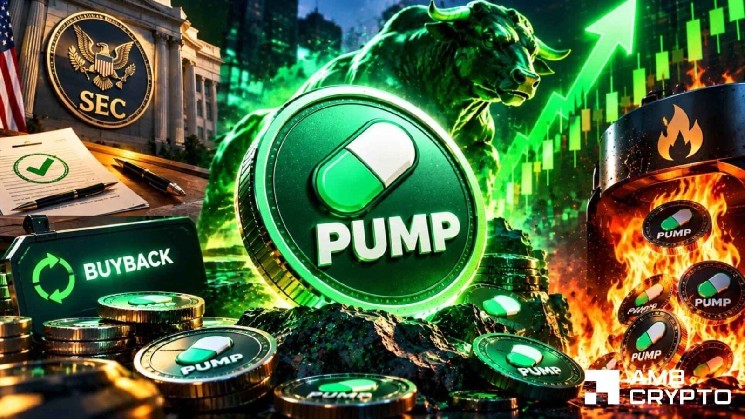
  • PUMP Surges 18% After SEC Clarification, 398M Token Buybacks

    PUMP Surges 18% After SEC Clarification, 398M Token Buybacks

    Key Highlights

    • SEC staff clarified that tokens with protocol revenue and buybacks are not automatically securities, applying the Howey test focused on economic reality over terminology.
    • $PUMP surged 18% to $0.0045 with a 57% volume spike, while protocol inflows reversed to $24 million and buybacks continued removing 16.79% of supply.
    • Technical indicators signal bullish momentum, but persistent profit-taking and positive exchange netflows suggest selling pressure could challenge the uptrend.

    SEC Clarification Triggers Market Reassessment of Token Economics

    The U.S. Securities and Exchange Commission staff has issued guidance that could reshape how protocol-native tokens with revenue-sharing mechanisms are classified under federal securities law. According to the clarification, the agency applies the classic Howey test—assessing whether an investment of money in a common enterprise expects profits derived from the managerial efforts of others—while emphasizing economic substance over labeling. The guidance explicitly states that token buyback programs and liquid staking receipts, by themselves, do not convert an otherwise non-security commodity into a security. This distinction provides a regulatory foothold for protocols like $PUMP that generate genuine revenue and return value to holders through on-chain buybacks and burns.

    $PUMP Price Action and Capital Flows Reflect Renewed Optimism

    Reacting to the SEC’s stance, $PUMP rebounded sharply from a $0.0038 low, reclaiming the $0.004 psychological level and rallying to a daily high of $0.0046. At press time, the token traded near $0.0045, marking an 18% intraday gain accompanied by a 57% surge in spot trading volume. On-chain data from DefiLlama shows protocol USD inflows swung to $24 million, reversing four consecutive days of outflows that had briefly pushed net flows negative. The project’s treasury continues to execute its buyback strategy: after generating $3.2 million in revenue, $PUMP allocated $1.6 million to purchase 398 million tokens, per Lbexplorer. Cumulatively, the team has bought and burned $463.79 million worth of supply, removing 16.79% of tokens from circulation.

    Profit-Taking and Exchange Flows Signal Near-Term Resistance

    Despite the bullish catalyst, selling pressure remains elevated. On September 26, spot sell volume reached 2.68 billion tokens against 2.54 billion in buy volume, producing a negative buy-sell delta of -144.5 million—a clear indication of aggressive distribution, according to Coinalyze. Exchange netflows corroborate this trend: Coinglass data shows spot netflows have stayed positive for three straight days, climbing to $1.49 million following the rebound. Sustained positive netflows typically suggest holders are moving tokens to exchanges to sell, which could cap upside if demand does not absorb the supply.

    Technical Outlook: Bullish Structure Faces Supply Overhang

    Momentum indicators paint a constructive picture. The Trend Strength Index (TSI) on the $PUMP/USDT pair formed a bullish crossover and rose to 6.8, while the Aroon Oscillator has held near 42 for two consecutive sessions, reflecting stabilizing upside momentum, per TradingView. If current conditions persist, the next resistance zones are $0.0048 and the $0.005 psychological level. However, the confluence of active profit-taking and exchange inflows means a failure to hold above $0.004 could see price revisit the $0.0038 support.

    Why This Matters

    The SEC’s clarification arrives at a pivotal moment for revenue-generating DeFi protocols. By confirming that buybacks and liquid staking do not automatically trigger securities classification—provided the Howey test’s “managerial effort” prong is not met—the guidance reduces regulatory uncertainty for tokens that function more like commodity-like assets with cash-flow rights. For $PUMP specifically, the combination of regulatory tailwinds, accelerating buybacks, and improving capital flows creates a fundamental backdrop that could sustain re-rating if the protocol continues to demonstrate real revenue growth. Market participants will now watch whether inflows can outpace exchange deposits and whether the token can convert technical momentum into a higher-low structure above $0.004.

    Frequently Asked Questions

    Does the SEC guidance mean all tokens with buybacks are now non-securities?

    No. The SEC stated it applies the Howey test to each asset based on economic reality. A token is a security if investors expect profits primarily from the managerial efforts of founders or promoters. Buybacks and liquid staking alone do not make a commodity a security, but the overall structure and marketing of the token still matter.

    How much of $PUMP supply has been burned so far?

    According to Lbexplorer data cited in the report, the team has bought and burned $463.79 million worth of $PUMP, removing 16.79% of the total supply from circulation.

    What are the key price levels to watch for $PUMP next?

    Immediate resistance sits at $0.0048, followed by the $0.005 psychological level. On the downside, a break below $0.004 could trigger a retest of the recent $0.0038 low, especially if exchange netflows remain positive and sell volume continues to exceed buy volume.
  • SEC Staff Says Certain Crypto Buybacks, Staking Tokens Fall Outside Securities Laws

    SEC Staff Says Certain Crypto Buybacks, Staking Tokens Fall Outside Securities Laws

    Key Highlights

    • The SEC’s Division of Corporation Finance issued new FAQs Thursday clarifying how token buybacks, liquid staking receipts, and ongoing blockchain development are analyzed under the Howey test and federal securities laws.
    • Staff stated that for a functional crypto network, announcing a buyback of a non-security token does not by itself constitute a promise of essential managerial efforts, though the analysis changes for non-functional networks where buybacks are pitched as yield generation.
    • Liquid staking receipt tokens representing digital commodities may be treated as “digital tools,” while protocol-based liquid staking tokens can qualify as digital commodities when their value derives from a functional system’s operation and market forces.

    SEC Staff Issues New Crypto Guidance on Buybacks, Staking, and Developer Activity

    The U.S. Securities and Exchange Commission’s Division of Corporation Finance published a set of frequently asked questions (FAQs) on Thursday that provide further interpretive guidance on the application of federal securities laws to crypto asset activities. The release builds on the Commission’s March 2025 framework interpretation and addresses several high-stakes areas for industry participants, including token repurchase programs, liquid staking mechanisms, and the role of software developers in maintaining blockchain networks.

    The Division emphasized that the FAQs represent the views of the staff and do not carry the force of law. They have not been approved or disapproved by the Commission itself. Nevertheless, the guidance offers the most granular look to date at how the agency’s enforcement and corporation finance teams are applying the Howey investment contract test to specific crypto-native behaviors.

    Token Buybacks and the Functional Network Distinction

    A central clarification concerns token buyback programs. According to the staff, when a crypto network is already functional, a project’s announcement that it will buy back a non-security crypto asset would not, by itself, amount to a promise to perform essential managerial efforts under the Howey test. This distinction hinges on network maturity: the analysis can differ materially when a network is not yet functional. In that scenario, a buyback could contribute to the formation of an investment contract if it is presented as a mechanism to generate yield or returns for token holders.

    Liquid Staking Receipt Tokens Classified as ‘Digital Tools’ or Commodities

    The FAQs also tackle the regulatory status of liquid staking receipt tokens. Staff indicated that a staking receipt token representing a digital commodity that is not subject to an investment contract can be treated as a “digital tool” because it functions as a receipt for the underlying asset. Separately, a staking receipt token issued by a protocol-based liquid staking provider may instead be classified as a digital commodity when its value is tied to the operation of a functional crypto system and market supply and demand, rather than to the managerial efforts of a promoter.

    Developer Activity and Promoter Status Clarified

    On the question of ongoing development, the guidance states that promoting a network’s current utility or capabilities would generally not, on its own, amount to a promise of essential managerial efforts. Aspirational statements about future features may also fall outside the Howey analysis when they do not promote potential profits. Furthermore, developers can continue maintaining, securing, and improving a functional network without those activities necessarily constituting essential managerial efforts under Howey.

    Finally, staff clarified that operating a secondary market for a crypto asset does not automatically render a trading platform a “promoter” under the Securities Act. To be deemed a promoter, the platform would still have to meet the definition established in Securities Act Rule 405.

    Why This Matters

    The release signals a continued effort by the SEC’s Corporation Finance division to draw finer lines between crypto assets that function as investment contracts and those that operate as commodities or utilities. By explicitly linking the Howey analysis to network functionality—distinguishing between live, operational blockchains and pre-launch or non-functional projects—the staff is providing a framework that could influence how token issuers structure buybacks, staking products, and development roadmaps. The guidance on liquid staking is particularly significant for DeFi protocols like Lido and Rocket Pool, as it suggests a path for stETH and rETH to be viewed as digital commodities or tools rather than securities, provided the underlying networks are functional and the tokens’ value derives from market dynamics. The clarification that developer maintenance of a live network does not equate to essential managerial efforts also reduces regulatory uncertainty for open-source contributors and core protocol teams. However, because the FAQs lack the force of law and have not been ratified by the Commission, they remain interpretive and subject to change through future rulemaking or enforcement actions.

    Frequently Asked Questions

    Does this guidance mean token buybacks are now legal for all crypto projects?

    No. The FAQs clarify that for a functional network, a buyback of a non-security token does not by itself create an investment contract under Howey. For non-functional networks, or where the buyback is marketed as a yield-generating mechanism, the analysis differs and could support an investment contract finding. The guidance does not legalize buybacks; it only articulates staff’s current analytical framework.

    Are liquid staking tokens like stETH now officially classified as commodities?

    Not officially. The staff indicated that a staking receipt token may be treated as a “digital tool” or a digital commodity under specific factual conditions—namely, when it represents a digital commodity not subject to an investment contract, or when its value is tied to a functional system’s operation and market supply and demand. This is a facts-and-circumstances test, not a blanket classification.

    If I am a developer working on a live blockchain, does this guidance protect me from being deemed a promoter?

    The guidance states that maintaining, securing, and improving a functional network does not necessarily constitute essential managerial efforts under Howey. However, it is not a safe harbor. The determination remains fact-specific, and developers who also engage in promotional activities tied to profit expectations could still be scrutinized.

  • SEC Issues Important Cryptocurrency Document

    SEC Issues Important Cryptocurrency Document

    Key Highlights

    • U.S. SEC staff publishes new Q&A guide clarifying application of federal securities laws to crypto assets
    • Guidance specifically addresses regulatory treatment of liquid staking tokens and token classifications
    • Release represents latest effort by securities regulator to provide compliance framework for digital asset market participants

    SEC Staff Issues Targeted Guidance on Crypto Asset Securities Classification

    The U.S. Securities and Exchange Commission (SEC) staff has released a new question-and-answer guide detailing how federal securities laws apply to crypto assets, marking the agency’s latest attempt to bring regulatory clarity to the rapidly evolving digital asset sector. The statement, published today, specifically addresses the conditions under which liquid staking tokens and other token arrangements may constitute investment contracts subject to SEC jurisdiction.

    Scope of New Compliance Guidance

    The Q&A document focuses on practical compliance questions that have emerged as market participants seek to structure crypto products within existing securities frameworks. According to the release, the guidance examines specific token mechanics—particularly those involving liquid staking protocols where users receive derivative tokens representing staked assets—to determine whether these instruments meet the definition of securities under the Howey test and subsequent case law.

    Regulatory Approach to Token Classifications

    Rather than issuing blanket categorizations, the SEC staff guidance applies a facts-and-circumstances analysis to different token models. The document reportedly addresses how varying degrees of decentralization, promoter involvement, and investor expectations of profit from managerial efforts influence whether a particular token offering triggers registration requirements or qualifies for exemptions under the Securities Act of 1933 and the Securities Exchange Act of 1934.

    Why This Matters

    The SEC’s targeted guidance arrives amid ongoing industry debate over regulatory boundaries for decentralized finance (DeFi) protocols and staking services. Major platforms including Coinbase, Kraken, and Lido Finance have faced enforcement actions or inquiries related to staking products, while legislative efforts such as the FIT21 Act and various stablecoin bills remain pending in Congress. Today’s Q&A does not carry the force of law but signals the Division of Corporation Finance’s current enforcement priorities and may influence how market participants structure tokenomics, disclosure practices, and compliance programs pending formal rulemaking or judicial precedent.

    Frequently Asked Questions

    What specific crypto products does the new SEC guidance address?

    The Q&A guide specifically examines liquid staking tokens and the conditions under which they may be classified as securities under federal law, applying a facts-and-circumstances analysis rather than categorical rules.

    Does this guidance create new legal requirements for crypto companies?

    No. Staff guidance represents the SEC staff’s interpretive views and does not have the force of law or create binding obligations. However, it indicates how the Division of Corporation Finance intends to apply existing securities laws to these products.

    How should market participants respond to this guidance?

    Issuers, platforms, and intermediaries operating in the liquid staking space should review their token structures against the analytical framework provided, assess registration or exemption availability, and consider enhanced disclosure practices while monitoring for formal rulemaking or legislative developments.