Tag: Honda

  • Revisiting One of F1’s Most Intriguing ‘What If?’ Moments

    Revisiting One of F1’s Most Intriguing ‘What If?’ Moments

    Key Highlights

    • McLaren dominated Formula 1 from 1988 to 1991, winning four consecutive Constructors’ and Drivers’ Championships with engine partner Honda.
    • The partnership ended abruptly when Honda withdrew from F1 at the close of the 1992 season due to financial pressures.
    • Honda’s departure triggered a period of instability and performance struggles for McLaren throughout the mid-1990s.

    The Golden Era: McLaren-Honda Dominance (1988–1991)

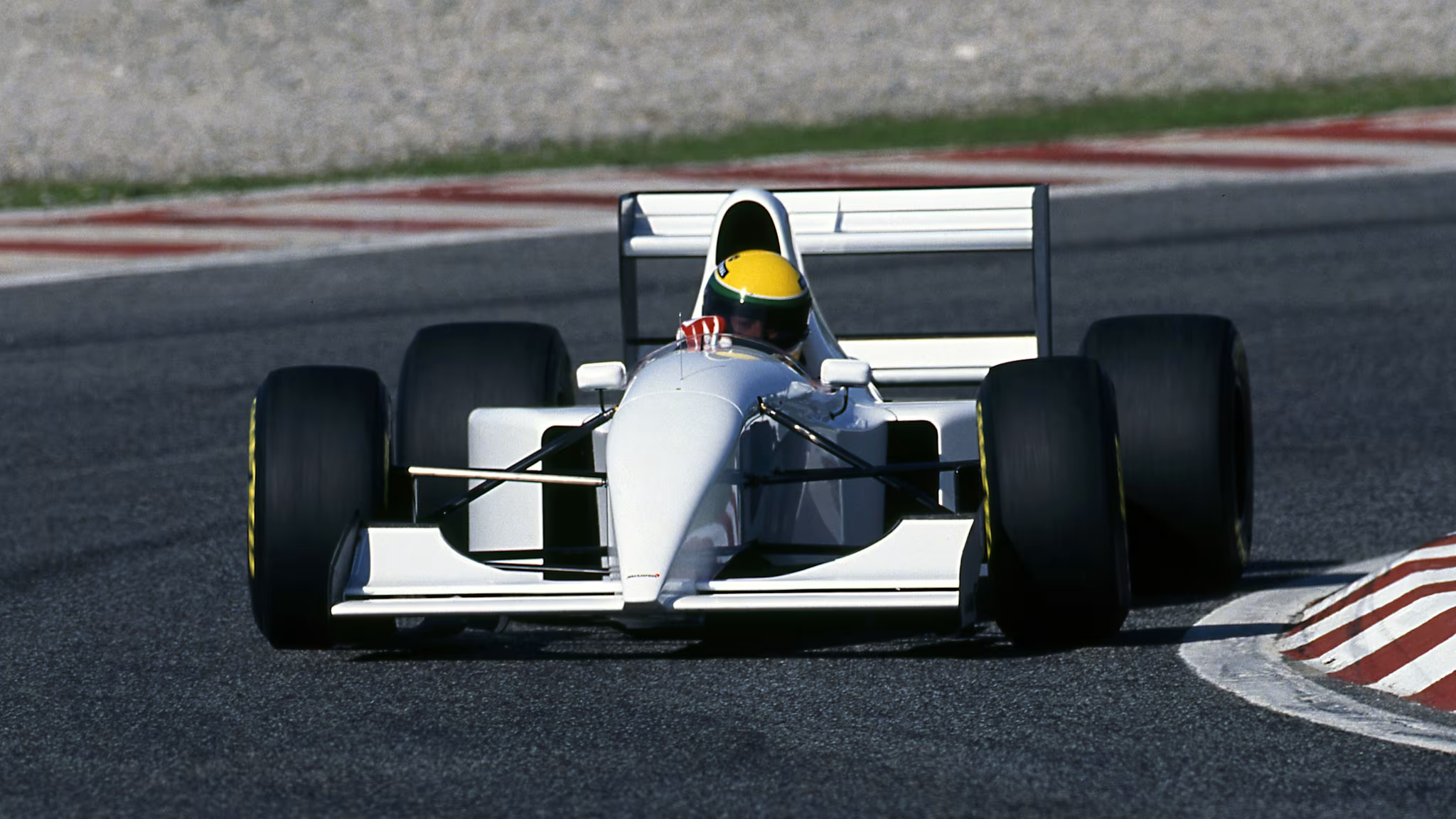
    During the late 1980s and early 1990s, McLaren authored one of the most dominant chapters in Formula 1 history. Between 1988 and 1991, the Woking-based squad secured four successive Constructors’ Championships and four straight Drivers’ Championships, a feat of consistency and excellence rarely matched in the sport. Central to this supremacy was the technical alliance with Japanese engine manufacturer Honda, whose power units—paired with McLaren chassis designed by the likes of Gordon Murray and later Neil Oatley—proved virtually unbeatable. Legendary drivers Ayrton Senna and Alain Prost, and later Gerhard Berger, piloted the MP4/4, MP4/5, MP4/5B, and MP4/6 to a combined 44 race victories over those four seasons, establishing a benchmark for engine-chassis integration.

    Sudden Shift: Honda’s Withdrawal at the End of 1992

    That period of stability and success turned into a spell of change and misfiring performance over the next few years. Amid growing financial pressures and a shifting corporate strategy, Honda made the decision to pull the plug on their Formula 1 operations at the end of the 1992 season. The announcement caught the paddock off guard; Honda had powered McLaren to the previous four titles and was still competitive, with Senna securing three wins in the 1992 campaign driving the MP4/7A. The Japanese manufacturer cited the need to redirect resources toward core automotive operations during a prolonged economic downturn in Japan, leaving McLaren without a works engine supply for the first time in nearly a decade.

    The Aftermath: Scrambling for Power and Competitiveness

    Honda’s exit forced McLaren into a frantic search for a new engine partner ahead of the 1993 season. The team eventually secured a customer supply of Ford HB V8 units, badged as Cosworth, which lacked the development support and raw power of the works Honda V10s and V12s. While Senna extracted remarkable results—including five victories—in the 1993 MP4/8, the writing was on the wall: McLaren had lost its factory backing and the deep integration that had defined its golden era. Subsequent partnerships with Peugeot (1994) and a return to Mercedes (1995 onward) would eventually restore winning ways, but the immediate aftermath of 1992 marked the end of McLaren’s most statistically dominant epoch and the beginning of a transitional wilderness.

    Why This Matters

    The dissolution of the McLaren-Honda alliance in 1992 serves as a pivotal case study in Formula 1’s reliance on manufacturer commitment. It illustrates how quickly a championship-winning structure can unravel when economic externalities—such as Japan’s “Lost Decade”—force OEMs to reprioritize spending. For McLaren, the loss triggered a multi-year rebuild that only concluded with the Mercedes works partnership, which delivered two more Drivers’ titles for Mika Häkkinen in 1998 and 1999. The episode also foreshadowed the volatile nature of engine supplier relationships that continues to shape the grid today, from Red Bull’s Renault and Honda cycles to Aston Martin’s forthcoming Honda return in 2026.

    Frequently Asked Questions

    How many championships did McLaren win with Honda between 1988 and 1991?

    McLaren won four consecutive Constructors’ Championships and four consecutive Drivers’ Championships during the 1988–1991 period with Honda power.

    Why did Honda leave Formula 1 at the end of 1992?

    Honda withdrew due to financial pressures and a need to redirect resources toward core automotive operations during a prolonged economic downturn in Japan.

    What engine did McLaren use after Honda left in 1992?

    For the 1993 season, McLaren used customer Ford HB V8 engines badged as Cosworth, before switching to Peugeot in 1994 and then beginning a long-term works partnership with Mercedes in 1995.
  • Ranked: The 10 Power Unit Manufacturers with the Most F1 Wins in History

    Ranked: The 10 Power Unit Manufacturers with the Most F1 Wins in History

    Top 10 Most Successful Formula 1 Engine Manufacturers of All Time

    Ferrari stands as the most iconic team in Formula 1 history, defined by its scarlet liveries and a roster of legendary drivers. However, Mercedes has now drawn level at the summit of the most successful power unit manufacturers, matching Ferrari’s tally of 251 Grand Prix victories following Kimi Antonelli’s win at the 2026 Spanish Grand Prix.

    From these two motorsport powerhouses to defunct giants like Coventry Climax and BRM, here are the top 10 engine producers with the most Formula 1 wins across 76 years of championship racing.

    1. Ferrari – 251 Wins

    Ferrari has contested every Formula 1 season since the inaugural championship in 1950, amassing vast success over the decades with drivers such as Alberto Ascari, Niki Lauda, and Michael Schumacher. The Scuderia has secured a colossal 251 victories with its own power units. Charles Leclerc celebrated the team’s 250th win at the 2026 British Grand Prix, while the additional victory came courtesy of Sebastian Vettel’s maiden triumph for Toro Rosso in 2008, when the team operated as a Ferrari customer.

    Ferrari’s very first Grand Prix victory belonged to José Froilán González, known as the “Pampas Bull.” He joined the squad for five rounds in 1951, finishing on the podium at every appearance, including a win at Silverstone.

    1. Mercedes – 251 Wins

    Mercedes competed in only two Formula 1 campaigns (1954 and 1955) before a lengthy sabbatical. The manufacturer returned in the mid-1990s as an engine supplier for Sauber and McLaren, later adding Brawn GP and Racing Point to its customer roster. The original stint yielded two Drivers’ Championships for Juan Manuel Fangio, but the modern era of dominance stems from McLaren’s Mika Häkkinen (1998, 1999 World Champion), Brawn GP’s Jenson Button (2009 World Champion), and the full works re-entry in 2010.

    After returning as a constructor with Michael Schumacher and Nico Rosberg, Mercedes required two years to win a race and another two to claim a first title. By then, Lewis Hamilton had joined the team, going on to claim 85 of Mercedes’ total victories. Rosberg, Kimi Antonelli, Valtteri Bottas, and George Russell have also contributed to the record tally.

    3. Ford Cosworth – 176 Wins

    The Cosworth DFV ranks among the most dominant engines in F1 history, delivering 155 wins across outfits including Team Lotus, Brabham, Tyrrell, and Williams. Between the 1960s and 1980s, it was the default choice for any team not building its own power unit. Jim Clark secured its maiden victory at the 1967 Dutch Grand Prix, driving from eighth to first in the Lotus 49. A testament to its supremacy: every single race in the 1969 and 1973 seasons was won by a DFV-powered car.

    The turbo era forced an evolution, with later Ford Cosworth variants adding 21 further wins. These came predominantly via Benetton and McLaren, though Giancarlo Fisichella claimed the final victory for Jordan at the 2003 Brazilian Grand Prix.

    4. Renault – 169 Wins

    Renault pioneered the regular use of turbocharged engines in Formula 1. After two seasons of severe reliability issues—it took 14 races to record a first finish—the breakthrough arrived in 1979. Jean-Pierre Jabouille, who had endured every prior retirement, won the French Grand Prix that year. Alain Prost’s arrival in 1981 unlocked the program’s potential, yielding nine wins before the works team declined and withdrew in 1986.

    Ironically, greater success followed the 1989 ban on turbos when Renault began supplying Williams. Subsequent partnerships with Benetton and Red Bull lifted the total to 169 victories, with Esteban Ocon scoring the final win at the 2021 Hungarian Grand Prix. Renault departed F1 again at the end of the 2025 season, prompting Alpine to switch to Mercedes power for the 2026 regulations.

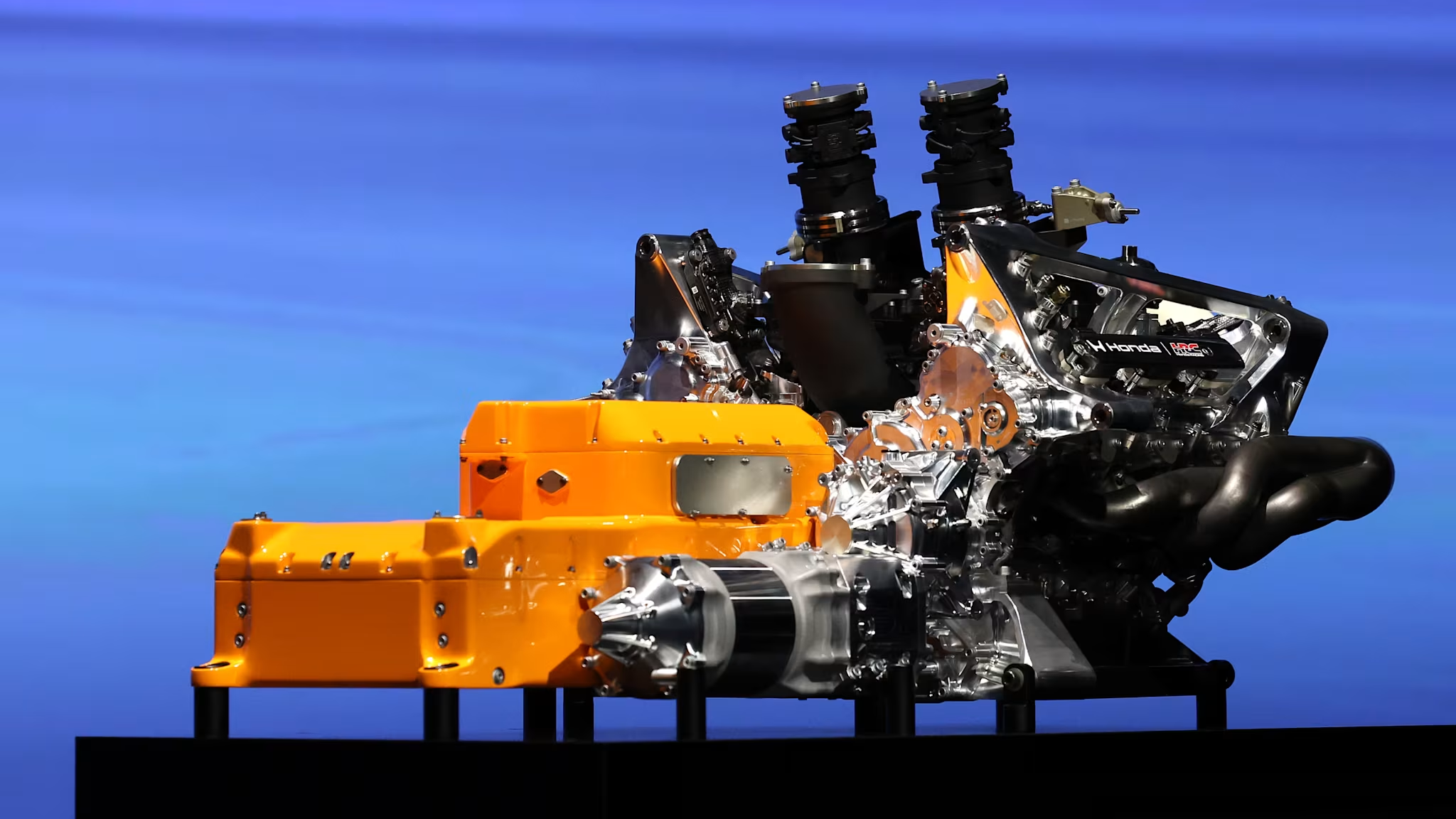
    5. Honda – 89 Wins

    Honda’s F1 history is fractured across four separate stints, beginning in 1964. Early success came quickly as Richie Ginther won the 1965 Mexican Grand Prix in a Honda-built chassis and engine. The manufacturer returned as a supplier for Spirit, Williams, Lotus, McLaren, and Tyrrell between 1983 and 1992. While factory support varied, Nigel Mansell, Nelson Piquet, Ayrton Senna, and Alain Prost all proved Honda could provide an unbeatable power unit.

    Financial reasons triggered a withdrawal before Honda purchased BAR, which became Brawn GP when Honda exited again amid the 2008 economic crisis. A fruitful partnership with Red Bull began in 2019, with Max Verstappen delivering the first win of the V6 turbo-hybrid era. The tally reached 89 victories, the last coming at the 2021 Abu Dhabi Grand Prix, though this was far from the end of Honda’s involvement in the sport.

    6. Coventry Climax – 40 Wins

    Coventry Climax had manufactured engines since the early 20th century but entered racing in the 1950s. Stirling Moss scored their first win at the 1958 Argentine Grand Prix, though the standard 2-litre unit lacked the power to challenge rivals consistently. A 2.5-litre version arrived in 1959, propelling Jack Brabham to the World Championship. The engine proved versatile across Lotus, Cooper, Brabham, and Lola chassis, securing 40 Grand Prix wins between 1958 and 1965.

    The program bowed out in style when Jim Clark secured his third career Grand Slam at the 1965 German Grand Prix en route to the title. Coventry Climax left motorsport when the 3-litre formula was introduced.

    7. Honda RBPT – 38 Wins

    Max Verstappen’s hard-fought 2021 Drivers’ Championship coincided with Honda’s official departure, but the manufacturer agreed to support Red Bull’s transition to in-house production under the Red Bull Powertrains (RBPT) banner. A new agreement transferred the Honda engine IP to Red Bull through the end of the 2025 season, with Honda providing technical support as required.

    This arrangement yielded one of the most dominant seasons in recent memory, as Red Bull won all but one race in 2023, amassing 860 points. While 2024 and 2025 were less productive, the partnership concluded with 38 victories overall, placing seventh on the all-time list.

    8. TAG Porsche – 25 Wins

    Short-lived but immensely successful, the TAG-funded Porsche engine powered McLaren from 1983 to 1987. Originally slated for a 1984 debut, Niki Lauda insisted on early testing, forcing a modified chassis for the 1983 Dutch Grand Prix. The unit was effective immediately: Alain Prost won the season-opening 1984 Brazilian Grand Prix, though Lauda claimed that year’s title. The duo combined for 25 victories before McLaren switched to Honda in 1988, inspired by the Japanese manufacturer’s strong showings with Williams.

    9. BMW – 20 Wins

    BMW’s early F1 involvement consisted of sporadic private entries, but the 1980s saw a full commitment to challenge Renault’s turbo dominance. After an initial exclusive deal with Brabham faltered—Bernie Ecclestone’s team initially preferred Cosworth—Nelson Piquet delivered BMW’s first win at the 1982 Canadian Grand Prix.

    The 1989 ban on turbos paused BMW’s involvement. The manufacturer later replaced Renault at Williams, delivering a competitive engine for 2000 and a more aggressive evolution that won the 2001 San Marino Grand Prix. By 2003, Williams consistently fought for wins but could not match Ferrari’s dominance, ending the partnership in 2005. BMW’s subsequent purchase of Sauber yielded only one victory—Robert Kubica at the 2008 Canadian Grand Prix—before the team was sold back to Peter Sauber.

    10. BRM – 18 Wins

    British Racing Motors (BRM) endured a shaky start as overly ambitious engines failed to deliver results. Delayed development eventually yielded a first win for Jo Bonnier at the 1959 Dutch Grand Prix. Partner Alfred Owen threatened to cancel the project without improvement, promoting former Rolls-Royce employee Tony Rudd to Chief Development Engineer—a masterstroke. Rudd resolved fundamental issues, culminating in Graham Hill’s 1962 Drivers’ Championship.

    BRM also sold engines to privateers, but performance faded, and the marque exited F1 in 1977 with 18 Grand Prix victories: 17 as a works team and one via Team Lotus.

  • ‘One of the best moments we’ve had’ – Pedro de la Rosa on how Aston Martin’s risky upgrade strategy paid off

    ‘One of the best moments we’ve had’ – Pedro de la Rosa on how Aston Martin’s risky upgrade strategy paid off

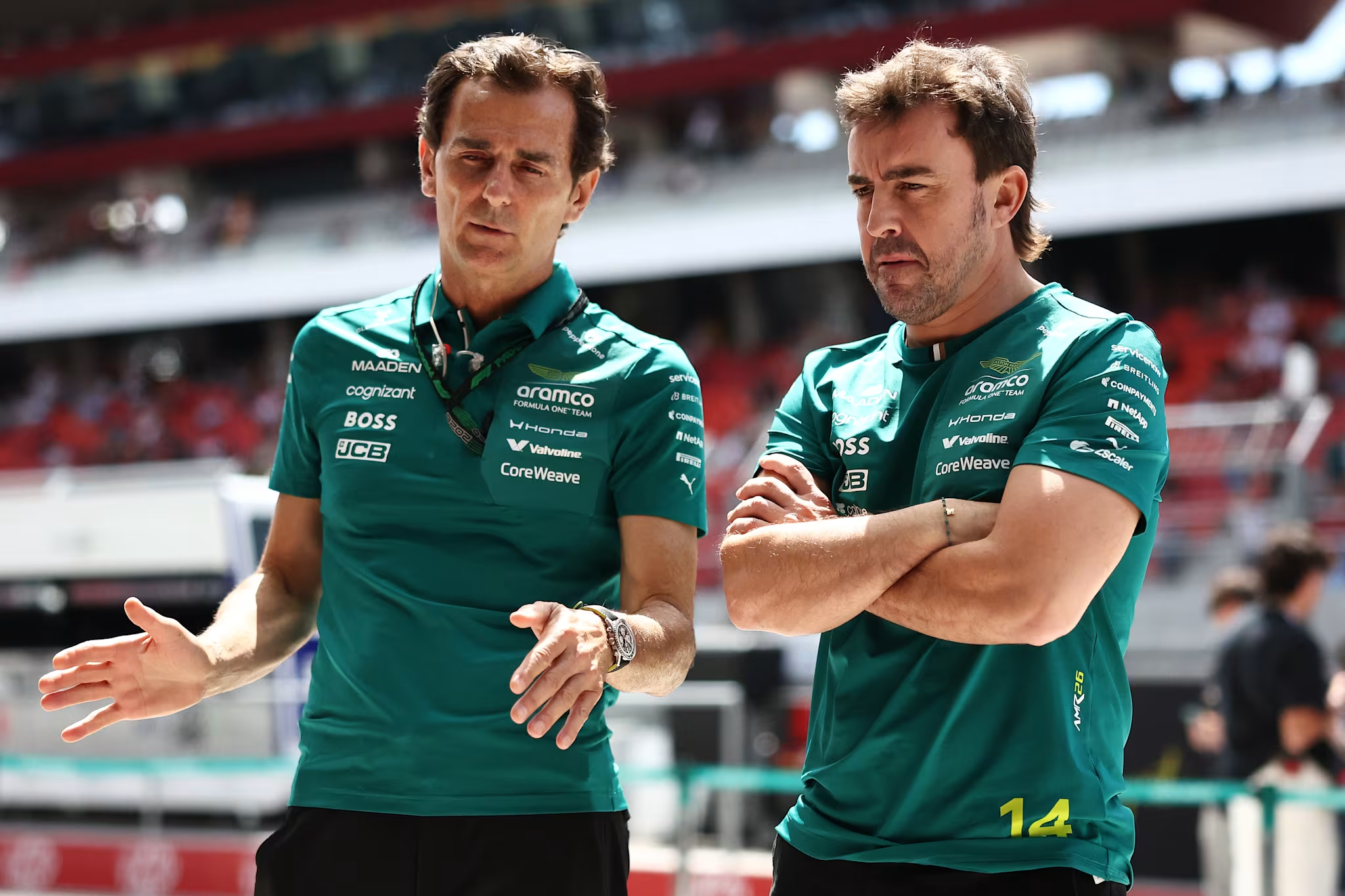
    Pedro de la Rosa has reflected on “one of the best moments we’ve had so far” during the latest episode of the official F1 podcast Beyond The Grid. The Aston Martin Team Representative detailed the tension surrounding the squad’s concentrated upgrade schedule, revealing he was “very nervous” as the heavily revised AMR26 hit the track in Hungary.

    ‘Everything worked as planned’

    The Silverstone-based outfit endured a difficult start to the 2026 campaign, grappling with reliability gremlins and a performance deficit. Instead of drip-feeding updates across multiple weekends like their rivals, Aston Martin opted for a bold B-spec launch at Round 11. The gamble paid immediate dividends: the revised machinery vaulted ahead of Cadillac and Williams in qualifying, with further momentum arriving via a new Honda power unit in the Netherlands.

    De la Rosa conceded the performance gain was never guaranteed, but Fernando Alonso delivered an instant verdict after the installation lap.

    “I would lie if I said I was not very nervous because you are expecting, you are hoping, you’ve been waiting a long time, and then the car just starts,” he said. “I looked at the car and the side pods were so small, the radiators look the smallest I’ve ever seen in my life.

    “And I thought ‘OK, the aero numbers are promising, but maybe the cooling is not enough.’ Or you start thinking about many other scenarios where I’ve been, because I’ve been in most of the most unwanted scenarios in F1. But everything worked as planned.

    “Then after the installation lap, you looked around and the people were relieved because everything was working as expected. With Fernando, I know him so much that we look at the eyes. I always try to be at the front of the car when he comes in after a run. He looks at me, I look at him, and I know exactly what he’s thinking.

    “I don’t even need to listen to the radio. And his eyes look like, ‘yes, it’s working.’ Sometimes we’ve had upgrades in the past and I look at him and he immediately doesn’t want to look at my eyes. When he tries to refuse the eye contact, I know we are in trouble. But that time he looked and he was just like, ‘yeah, it’s there, it’s there.’”

    “It was a very exciting moment. You always have to focus on things you can change, you can do, you can improve. That was, OK, not where we wanted to be, I repeat again, but it was one of the best moments we’ve had so far this season.”

    Upgrades not a factor in Alonso’s future

    With persistent speculation surrounding Alonso’s future in the sport, his visible satisfaction provided a timely morale boost. However, De la Rosa insisted the upgrade timeline was never designed to influence the Spaniard’s contract decision.

    “I think that decision was never based [on] if we lost anyone or anything. I think that Fernando, whatever his decision will be, you have to believe in a project, you know, not if the car is quick on the next race.

    “I think Fernando is so wise, he’s learned so much, that it’s either you believe in the project or you don’t. It’s not whether we managed to improve the car for the summer break as we were expecting.”

    ‘in good hands’ with Adrian Newey

    The team’s early struggles surprised many observers given the high-profile arrival of Adrian Newey last season. Widely regarded as one of the most successful designers in Formula 1 history, Newey’s move from Red Bull was expected to deliver immediate front-running pace. While that transformation remains a work in progress, De la Rosa praised how seamlessly the Briton has integrated into the operation, offering a modern interpretation of the Team Principal role.

    “I must say that Team Principal is a title,” he explained. “It’s not a job description. Adrian has said it many times. We are fortunate in the team having Mike Krack as well, an experienced Team Principal, now chief track operations.

    “But when Adrian is not at the racetrack, Mike acts like a Team Principal. I think we have a very luxurious situation where we have people working in different areas covering for when Adrian is not here. Other teams have different structures.

    “It’s quite ambiguous now what a Team Principal job description really is. In my time, you had a Team Principal that was taking all the decisions. But now you have a Team Principal and normally you also have a CEO on top of them. I think that we have a very good structure. As long as Adrian feels comfortable and competitive, we’re in good hands.”

    Taking steps towards where they want to be

    Aston Martin has been clear that scraping points—achieved twice in 2026 with Alonso—falls well short of their ultimate ambition. The gap to the frontrunners remains significant, but De la Rosa expressed confidence in the current trajectory.

    “I think that we are in the upward trend,” he concluded. “I’ve said it in Australia this year, when we started this, we were nowhere. But all we need to do is improve and never stop improving.

    “Obviously, our strategy was different. We didn’t improve until the summer, but we’ve made a big step. We are now in a position we cannot stop. It’s just a race of time. The people have done a better job than us. That’s why they’re winning. We just have to slowly chip away all this difference. That’s where we are.

    “Everyone has to feel accountable for the results. Everyone has to feel super motivated. We have an amazing partner in Honda that we’ve managed to survive very difficult times together. We can’t stop and we won’t stop.

    “We can do it. It’s just a matter of never stop the development path that we are in right now. The only teams that do win are the ones that make the right investments. I believe I’m in the right team that is definitely making the right investments.”

    To listen to this week’s episode of Beyond The Grid, simply hit go on the audio player above or click here to listen via your preferred podcasting platform.

    You can also check out a huge selection of previous episodes—spanning every decade of F1—in our dedicated Beyond The Grid library.

    You can also watch the podcast on the F1 YouTube channel.