
Tag: Historic preservation

  • Woman Finds Disturbing VHS Tape Hidden in Cupboard After Moving Into ‘Haunted’ 1792 House

    Woman Finds Disturbing VHS Tape Hidden in Cupboard After Moving Into ‘Haunted’ 1792 House

    Key Highlights

    • TikTok creator @saraheposts discovered a labeled VHS tape in the butler’s pantry of her newly purchased 240-year-old Maine home, which was reportedly the childhood residence of a “relatively famous politician.”
    • The tape, marked “1953 to 1957, scenes from home,” remains unwatched due to the creator’s horror-movie-inspired superstition and a notable historical anachronism: the VHS format did not launch until 1976.
    • Social media users flooded the comments urging her to play the footage, with some volunteering to watch it themselves or suggesting AI analysis, while skeptics pointed out the format discrepancy.

    Mystery VHS Tape Surfaces in Historic Maine Home

    TikTok creator Sarah, known as @saraheposts, has documented an unsettling discovery inside her recently acquired 18th-century Maine residence. In a video posted to her account, which focuses on historic preservation and “old house TikTok,” she revealed that a family member found a single VHS cassette inside a cabinet in the butler’s pantry shortly after the purchase closed but before the move-in date.

    The property, which Sarah describes as “haunted” in a tongue-in-cheek manner, dates back roughly 240 years. She notes the attic contains a small room with signatures on the walls and a coat hanger, calling it “a whole separate video” she is not yet ready to film. However, the VHS tape proved an immediate curiosity. “I promised that I would show the creepiest thing in this house and I’ll clarify that that does not include the attic,” Sarah told her followers. “The attic is a whole separate video when I feel like going up there — it’s in great condition for being 240 years old but there is a tiny room in the attic; there’s signatures on the walls, there’s a coat hanger up there, don’t even get me started. I’m not going up there today.”

    Horror Tropes and a Historical Anachronism

    Sarah’s reluctance to view the tape stems directly from the 2012 supernatural horror film Sinister, directed by Scott Derrickson and starring Ethan Hawke. In the film, a true-crime writer discovers a box of home movies in his new attic that turn out to be snuff films, unleashing a malevolent entity. “Right before we moved in (but we’d bought the house,) my little brother was walking the house for us; opened the cabinet and found a VHS tape,” Sarah recounted. “If you’ve ever seen the movie Sinister: if you find a VHS tape in your new home, you don’t watch it! You don’t watch it. So I’m not going to, but I will read the label on this for you. It says: ‘1953 to 1957, scenes from home’. This house was the childhood home of a relatively famous politician and so it would probably be an interesting tape to watch, but it’s never gonna happen. It’s neeeever gonna happen! I’ll probably burn it some day.”

    The label’s date range—1953 to 1957—immediately raised eyebrows among viewers. The VHS (Video Home System) format was developed by JVC and released commercially in 1976, two decades after the latest date on the label. This discrepancy suggests the tape is either a later recording of older film reels, a mislabeled item, or part of a staged narrative.

    Internet Reacts: Curiosity vs. Skepticism

    The comment section quickly filled with a mix of horror-movie jokes, genuine curiosity, and forensic skepticism. “Nothing would stop me from watching that tape,” one user wrote. Another offered: “Mail it to me. I’ll watch it and send u the cliff notes.” A third suggested a modern workaround: uploading the footage to an AI tool for summarization. Despite the engagement, Sarah has maintained her position that the tape will not be played.

    Why This Matters

    The incident highlights the intersection of social media storytelling, historic home ownership, and urban folklore. For owners of historic properties, discovering artifacts from previous occupants is common, though usually in the form of letters, newspapers, or photographs—not magnetic media formats that post-date the labeled content. The Sinister reference underscores how deeply horror cinema has shaped cultural reactions to found media. Additionally, the VHS anachronism serves as a real-time case study in digital media literacy: audiences quickly identified the technological impossibility, demonstrating how collective knowledge on platforms like TikTok can fact-check narrative details within hours. The identity of the “relatively famous politician” remains undisclosed, leaving a gap in the historical provenance that could authenticate or debunk the artifact’s origin.

    Frequently Asked Questions

    Who is the politician connected to the house?

    Sarah (@saraheposts) has not publicly identified the “relatively famous politician” whose childhood home she now owns. She only stated the property was their childhood residence.

    Why is the VHS tape considered anachronistic?

    The tape is labeled “1953 to 1957,” but the VHS format was not commercially available until 1976. This means the tape could not have been originally recorded in that format during those years; it would have to be a later transfer from film reels or a different medium.

    Has Sarah watched the tape or planned to?

    No. Sarah explicitly stated she will not watch it, citing the plot of the horror movie Sinister as a deterrent, and joked she would “probably burn it some day.”
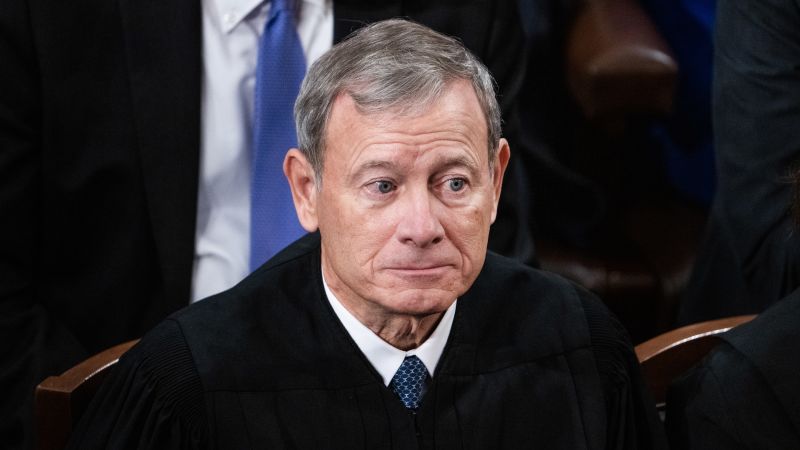
  • John Roberts Often Defers to Trump—but Not on the White House Ballroom Project

    John Roberts Often Defers to Trump—but Not on the White House Ballroom Project

    Chief Justice John Roberts broke with Donald Trump and the Supreme Court’s other conservative justices on Monday, objecting to the president’s plan to build a massive ballroom at the White House.

    “The White House is not just any building.”

    Roberts has often deferred to Trump’s executive authority, but his dissent marked a rare break from a president whose policies have dominated the court’s docket. Roberts has authored major opinions supporting Trump, including the 2024 ruling granting him immunity from criminal prosecution and last June’s decision allowing him to fire the heads of independent agencies.

    Even in dissent, Roberts used the historically minded rhetoric for which he is known. His six-page statement invoked the history and architecture of Washington, quoting Theodore Roosevelt and Winston Churchill on the importance of iconic public buildings.

    “‘We shape our buildings, and afterwards our buildings shape us,’” Roberts wrote, lifting a line from a 1943 Churchill war speech.

    He added, “All the more reason to ensure that those responsible follow the rules in deciding what to tear down and what to build up at the People’s House.”

    Roberts invokes the White House’s historic role

    Roberts, who often tells audiences that he once planned to pursue a history Ph.D. rather than a law degree at Harvard, highlighted the symbolism of Washington’s historic architecture.

    He noted that when Roosevelt thanked Congress in 1902 for funding additions to the East and West wings, the president referred to “the stately simplicity” of the original architecture and the importance of preserving “such buildings as historic monuments which keep alive our sense of continuing with the Nation’s past.”

    Throughout his opinion, Roberts showed his own appreciation for the White House’s architecture, much as he has expressed pride in the Supreme Court’s columned building. The Supreme Court did not have its own building until 1935, more than a century after the White House and US Capitol were constructed.

    Roberts’ position did not affect the outcome and came at no apparent cost to Trump. His five conservative colleagues formed a majority that allowed construction of the ballroom to continue. The project has been underway for nearly a year and is nearing completion.

    Still, Monday’s statement adds another dimension to Roberts’ record as chief justice during Trump’s aggressive second-term agenda. The president’s cases have shaped the court’s work and will form a significant part of Roberts’ legacy.

    Roberts has approved many Trump policies, but last session he voted against two of the president’s most far-reaching initiatives: sweeping tariffs on foreign goods imposed without congressional approval and an effort to restrict birthright citizenship, the long-standing practice granting US citizenship to children born in the country.

    Trump’s plans to reshape Washington

    The case’s focus on American history also underscored Roberts’ role as chancellor of the Smithsonian Institution. The position is largely ceremonial because he serves as chief justice, but Roberts has presided over Smithsonian board meetings and observed the Trump administration’s continuing effort to reshape the nation’s leading public museums.

    Trump’s campaign to transform Washington in his own image has included adding his name to the John F. Kennedy Center for the Performing Arts and proposing a 250-foot triumphal arch. The arch is planned for the traffic circle between the entrance to Arlington National Cemetery and the Lincoln Memorial.

    The lawsuit was brought by the National Trust for Historic Preservation. The organization argued that demolishing the East Wing and constructing a 90,000 square-foot ballroom and security structure required congressional approval.

    Lower federal courts initially sided with the Trust and allowed the case to proceed. The judges found that the organization had “standing” to sue because it had shown a significant injury. The Trust cited Alison Hoagland, a longtime Trust leader and member and an architectural historian, who said the project had harmed her enjoyment of the White House.

    The Supreme Court’s majority rejected that reasoning, writing that “mere offense, disagreement, or distaste does not qualify as a concrete and particularized injury” for purposes of bringing a lawsuit. The majority issued its ruling per curiam, Latin for “by the court,” as is common in appeals arriving through the court’s emergency docket. Justices Clarence Thomas, Samuel Alito, Neil Gorsuch, Brett Kavanaugh and Amy Coney Barrett did not sign separate opinions.

    Roberts disagreed that Hoagland’s claim was minor. Liberal Justices Sonia Sotomayor, Elena Kagan and Ketanji Brown Jackson joined his opinion.

    “The White House is not just any building, and – when it comes to historic preservation – Hoagland is not just any person.”

    Roberts said earlier court decisions had recognized injury based on “esthetic interests.” He cited a 1992 precedent in which, as Roberts described it, “a desire to … observe an animal species like a particular crocodile, even for purely esthetic purposes was undeniably a cognizable interest for purposes of standing.”

    Roberts says ballroom project is likely unlawful

    In the case before the court, Roberts declared, “A historic preservationist such as Hoagland can be aesthetically injured in a concrete, particularized way by the transformation of a historic building that she frequently enjoys, just as an environmentalist can sustain a concrete, particularized aesthetic injury from the extinction of a particular animal or the transformation of a particular forest or river that he regularly enjoys.”

    Monday’s ruling addressed only the question of standing. The majority said it was not deciding whether the ballroom project itself was lawful. Roberts, however, made clear that he viewed the broader construction effort skeptically.

    He wrote that Congress had expressly prohibited construction on such federal property “without express authority of Congress.”

    “That construction is likely unlawful,” he said, adding that the usual appropriation for White House maintenance “likely does not authorize the President to use hundreds of millions of dollars in private donations to tear down the East Wing and construct a ballroom in its stead.”