Tag: Gold

  • US Debt Tops $40 Trillion as Investors Flock to Gold, Swiss Franc, Bitcoin

    US Debt Tops $40 Trillion as Investors Flock to Gold, Swiss Franc, Bitcoin

    Key Highlights

    • US national debt has surpassed $40 trillion, prompting investors to seek hedges against potential dollar depreciation including gold, the Swiss franc, and Bitcoin.
    • Bitcoin-backed lending products are expanding in the US, allowing BTC holders to access liquidity without selling, though these carry liquidation risks if collateral values decline.
    • Neoclassic Capital co-founder Michael Bucella emphasizes Bitcoin retains its risk-asset status and remains sensitive to macroeconomic conditions, unlike traditional safe havens such as gold.

    Mounting US Debt Drives Search for Dollar Alternatives

    The United States national debt crossing the $40 trillion threshold has intensified market scrutiny of public finances and the long-term trajectory of the dollar, pushing a segment of investors toward alternative store-of-value assets. In a recent interview, Michael Bucella, co-founder of Neoclassic Capital, outlined how the rapid accumulation of sovereign debt is reshaping portfolio allocation strategies. According to Bucella, the accelerating pace of borrowing is causing some investors to diversify away from dollar-denominated holdings, with gold, the Swiss franc, and Bitcoin emerging as preferred hedges against currency depreciation risk.

    Bitcoin-Backed Lending Creates New Liquidity Pathways

    Beyond direct allocation, Bucella highlighted the growing adoption of Bitcoin-backed loan products in the United States as a structural development for the asset class. These mechanisms allow Bitcoin holders to pledge their BTC as collateral to obtain cash loans, preserving their long-term positions while meeting immediate liquidity needs. The co-founder noted this innovation is creating new financing opportunities for investors who would otherwise face taxable events or opportunity costs from selling. However, he cautioned that such products carry inherent risks, including the potential for margin calls or forced liquidation if the collateral value declines sharply during market downturns.

    Bitcoin’s Risk Profile Distinguishes It From Traditional Havens

    Despite its increasing institutional adoption, Bucella was explicit about Bitcoin’s fundamental nature. According to him, unlike traditional safe-haven assets such as gold, BTC remains sensitive to global economic developments and broader macroeconomic conditions. He stated that Bitcoin still retains its risky asset status, meaning its price behavior correlates more closely with risk-on sentiment and liquidity cycles than with the defensive characteristics typically associated with sovereign debt crises or currency debasement scenarios. This distinction is critical for investors evaluating Bitcoin’s role in a diversified hedge strategy.

    Why This Matters

    The $40 trillion debt milestone represents more than a psychological threshold; it reflects a structural fiscal trajectory that has reignited debate about dollar dominance, inflation expectations, and the architecture of global reserves. As sovereign debt service costs rise, the search for non-sovereign, non-correlated assets accelerates. Bitcoin’s dual narrative—as both a speculative risk asset and a potential monetary hedge—places it at the center of this transition. The proliferation of Bitcoin-backed credit markets further integrates the asset into traditional financial plumbing, potentially deepening liquidity while introducing new systemic linkages. Institutional demand, regulatory clarity, and macroeconomic volatility will collectively shape whether Bitcoin evolves into a reliable diversifier or remains a high-beta proxy for liquidity conditions.

    Frequently Asked Questions

    What assets are investors considering as hedges against dollar depreciation amid rising US debt?
    According to Michael Bucella, investors are diversifying into gold, the Swiss franc, and Bitcoin as preferred alternatives to dollar-denominated holdings.
    How do Bitcoin-backed loans work and what are the risks?
    Bitcoin-backed lending allows BTC holders to use their holdings as collateral for cash loans without selling. Risks include margin calls or forced liquidation if Bitcoin’s price falls significantly, requiring additional collateral or resulting in asset loss.
    Is Bitcoin considered a safe-haven asset like gold?
    No. Bucella emphasized that Bitcoin retains its risky asset status and remains sensitive to macroeconomic conditions and global economic developments, unlike traditional safe havens such as gold.
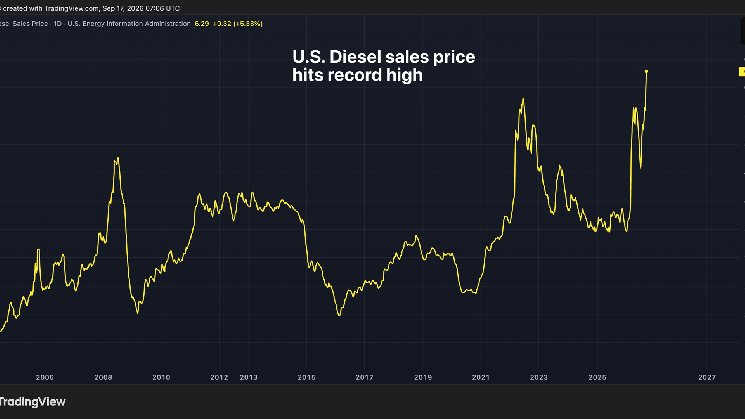
  • U.S. Diesel Prices Hit Record High as Bitcoin and Gold Struggle

    U.S. Diesel Prices Hit Record High as Bitcoin and Gold Struggle

    Diesel prices are surging globally, driven primarily by escalating geopolitical tensions in the Middle East. The ongoing conflict involving the U.S., Israel, and Iran has disrupted crude oil flows and injected significant risk premiums into refined product markets. Compounding the supply-side pressure, tight refinery capacity and robust demand from both freight and industrial sectors have amplified the price move, transforming a regional supply shock into a worldwide spike at the pump.

    Federal Reserve Policy Under Scrutiny Amid Supply-Driven Inflation

    The Federal Reserve’s decision on Wednesday to raise its benchmark borrowing cost by 25 basis points to the 3.75%–4% range has drawn criticism from market observers. Critics argue the hike demonstrates a policy bias toward using interest rate increases to combat inflation rooted in oil-supply shocks—a strategy some view as a fundamental mistake. Higher borrowing costs historically act as a headwind for non-yielding assets, and the current environment is no exception.

    Record Diesel Prices Create Headwinds for Gold, Bitcoin, and Tech Stocks

    Record-high diesel prices are pressuring traditional safe-haven assets and growth equities alike. Both gold and bitcoin are widely viewed as stores of value and hedges against sovereign risk. However, historical precedent shows that rising interest rates weigh heavily on cryptocurrency valuations, a dynamic clearly illustrated during the Fed’s aggressive tightening cycle in 2022. Technology stocks, sensitive to discount rates and economic growth forecasts, face similar downward pressure.

    Global Central Banks Extend Tightening Cycle

    The shift toward restrictive monetary policy is not isolated to the United States. The European Central Bank has recently implemented its own rate increase, and the Bank of Japan (BOJ) is widely expected to follow suit with a hike on Friday. Major Wall Street institutions, including Goldman Sachs and Morgan Stanley, anticipate the Fed will deliver an additional 25 basis point increase at its October meeting, signaling that the global tightening cycle remains firmly in place.

  • U.S. Diesel Prices Hit Record High as Bitcoin, Gold Struggle

    U.S. Diesel Prices Hit Record High as Bitcoin, Gold Struggle

    Diesel Prices Surge Amid Middle East Tensions and Tight Refining Capacity

    Diesel prices are climbing sharply, driven primarily by escalating geopolitical tensions in the Middle East. The ongoing conflict involving the U.S., Israel, and Iran has disrupted crude oil flows and inflated risk premiums on refined products. Constrained refinery capacity worldwide, combined with robust demand from freight and industrial sectors, has amplified the price move, transforming a regional supply shock into a global price spike.

    Federal Reserve Policy Adds Pressure

    The Federal Reserve’s Wednesday rate hike underscores how policymakers remain biased toward using interest rate increases to combat inflation stemming from oil-supply shocks—a strategy some observers characterize as a mistake. Record diesel prices now present a significant headwind for gold, bitcoin, and technology stocks.

    Like gold, bitcoin is widely viewed as a store of value and a sovereign hedge. However, historically, higher borrowing costs have weighed on the cryptocurrency’s market value, as evidenced during the 2022 Fed tightening cycle.

    Rate Hike Details and Forward Guidance

    On Thursday, the Fed raised rates by 25 basis points, lifting the benchmark borrowing cost to the 3.75%-4% range. Goldman Sachs and Morgan Stanley both anticipate an additional 25 basis point hike in October.

    Global Central Banks Follow Suit

    Other major central banks are also tightening monetary policy. The European Central Bank recently increased rates, and the Bank of Japan (BOJ) is expected to do the same on Friday.

  • Gold Draws $500B Amid Rising Yields, Threatening Bitcoin’s Dominance

    Gold Draws $500B Amid Rising Yields, Threatening Bitcoin’s Dominance

    Gold Defies Rising Yields as Central Bank Demand Reshapes Market Dynamics

    While precious metals show bearish technical signals on the charts, fundamental data reveals a striking divergence: gold has risen nearly 15% since late June even as the 10-year U.S. Treasury yield jumped almost 20% over the same period. This breakdown of the traditional inverse relationship between gold and yields suggests structural demand shifts are overriding rate sensitivity.

    Central Banks Drive Gold’s Yield Insensitivity

    According to TradingEconomics data, the 10-year Treasury yield surged approximately 20% from late June through the current quarter. Historically, such a move would pressure gold lower. Instead, gold advanced nearly 15% during the same window.

    The primary catalyst appears to be sustained central bank purchasing, which has weakened gold’s typical correlation with monetary policy expectations. Analysts observe that this institutional demand floor is “shifting the precious metal’s yield-sensitive dynamics and providing support to the metal despite high yields.”

    Record ETF Inflows Signal Persistent Appetite

    Chinese gold ETFs added 11 tonnes in August, marking the second consecutive monthly increase and bringing total holdings to 293 tonnes—the highest level since April and the third-highest on record. Year-to-date, these funds have accumulated 45 tonnes, with early September data indicating continued buying as domestic yields decline and equities weaken.

    Broader positioning data suggests over $500 billion has flowed into gold and silver combined, raising questions about whether metals are attracting fresh capital or diverting it from risk assets such as equities and cryptocurrencies.

    FOMC Positioning and Crypto Implications

    With the Federal Open Market Committee meeting approaching, investors appear to be using gold as a strategic hedge against potential Fed-driven yield volatility rather than a tactical trade. The metal’s resilience contrasts with Bitcoin’s 30% quarterly return, which has captured much of the safe-haven narrative in recent months.

    If yields remain elevated while the dollar weakens, analysts suggest gold could continue drawing capital, potentially creating additional headwinds for risk assets including crypto.

    Key Takeaways

    • Gold has decoupled from rising Treasury yields, gaining ~15% while the 10-year yield rose ~20% since late June.
    • Central bank demand is the primary structural driver, reducing gold’s rate sensitivity.
    • Chinese gold ETFs hold 293 tonnes, a near-record high, with 45 tonnes added year-to-date.
    • Over $500 billion has reportedly entered gold and silver markets.
    • Sustained gold strength could pressure risk assets, including cryptocurrencies, ahead of the FOMC decision.
  • Fidelity Executive Comments on U.S. Treasury’s Latest Bitcoin Move

    Fidelity Executive Comments on U.S. Treasury’s Latest Bitcoin Move

    Fidelity Investments’ Global Macro Director Jurrien Timmer argues that recent U.S. Treasury operations—specifically increased long-term bond buybacks paired with heightened short-term bill issuance—are pressuring the dollar while providing tailwinds for Bitcoin and gold.

    Treasury Buybacks Weaken Dollar, Lift Bitcoin and Gold

    Timmer observed that the dollar declined last week following the Treasury’s repurchase of additional long-term bonds funded by issuing more short-term securities. He contends the concurrent sharp rally in both gold and Bitcoin prices signals market anticipation of shifts in fiscal and monetary policy frameworks.

    According to the analyst, investors may have started pricing in a potential transition toward what is increasingly termed “fiscal dominance” in the United States, alongside a perceived erosion of Federal Reserve independence.

    “It is noteworthy that the U.S. Treasury Department’s issuance of more short-term Treasury bills last week while simultaneously buying back more long-term bonds dragged the dollar down and caused both gold and Bitcoin to rise sharply. The market senses a slippery slope towards fiscal dominance and a possible loss of the Federal Reserve’s independence.”

    Larger Buybacks May Require Fed Involvement

    Timmer suggests that for the Treasury’s strategy to effectively suppress long-term yields, the repurchase program may need to expand significantly beyond current levels. Such an expansion, he notes, could compel Federal Reserve participation in what amounts to an “Operation Maturity Restructuring” aimed at altering the maturity profile of the bond market.

    He warns this trajectory carries heightened currency depreciation risks.

    “For the U.S. Treasury Department to successfully keep interest rates low, it may need to significantly increase the size of repurchases. This could require the Federal Reserve to become involved in this Operation Maturity Restructuring policy, and could lead us down a path of currency depreciation.”

    Expansionary Policy Mix Favors Bitcoin

    The Fidelity executive emphasizes that the simultaneous pursuit of expansionary fiscal policy and accommodative monetary policy creates a distinctly negative outlook for the dollar. With the greenback testing a significant long-term trend line, Timmer views this macroeconomic backdrop as structurally positive for gold, adding that Bitcoin stands to benefit from the same dynamics.

    This is not investment advice.