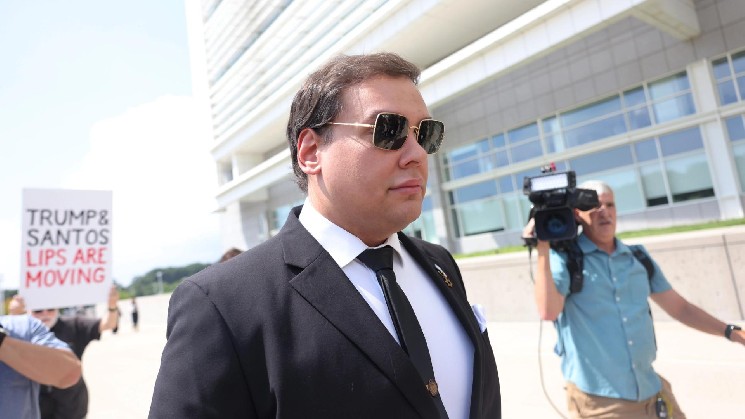
Kalshi has permanently banned former U.S. Representative George Santos and imposed a $71,356 penalty after determining that he manipulated an event market tied to his attendance at President Donald Trump’s 2026 State of the Union address. The exchange said Santos earned $17,839.57 from the trades.
Kalshi says Santos traded on an outcome he could control
In an Aug. 28 disciplinary notice, Kalshi said Santos placed large trades between Feb. 2 and Feb. 25 in contracts that paid out depending on whether he attended the address.
Because Santos’s attendance determined the contracts’ result, he could directly influence the underlying event. Kalshi Rule 5.17(z) prohibits members from trading contracts when they can affect the outcome.
Despite the restriction, Kalshi’s compliance department found that Santos bought and sold contracts tied solely to his own attendance. His positions included both “Yes” contracts, which paid if he appeared at the event, and “No” contracts, which paid if he did not.
During the trading period, Santos published several statements about his travel and attendance plans. Kalshi said some of the posts were false or misleading and were intended to move prices before he bought or sold the related contracts.
The exchange determined that the statements affected the market as intended. By shifting between “Yes” and “No” positions while controlling information about his plans, Santos generated $17,839.57 in profit, according to the notice.
Kalshi cited violations involving market manipulation, trading with material nonpublic information, trading on an outcome a member can influence, and using a deceptive scheme connected to exchange activity. The exchange’s compliance department also found that Santos did not cooperate promptly and fully with its internal investigation.
Under the settlement, Santos cannot access Kalshi directly or through another person or account. The exchange also imposed a $71,356 penalty, exactly four times the profit amount listed in its notice. The disciplinary document took effect on Aug. 28.
Social media posts moved Santos attendance contracts
A separate Commodity Futures Trading Commission order issued on July 31 provided a more detailed timeline of Santos’s trades. According to the regulator, Santos opened his Kalshi account on Feb. 11 and deposited about $7,000, using the funds exclusively to trade on his own attendance.
From Feb. 12 through Feb. 22, Santos accumulated 30,874 “Yes” contracts at a total cost of $6,695.94. While holding the position, he asked his X followers whether he should wear a serious suit or a bedazzled one to the address.
After the post, the “Yes” contract rose from about $0.15 to $0.70. Santos then sold the entire position for a $3,448.43 profit and withdrew $10,146.07 through a Venmo account created four days earlier, the CFTC said.
Later on Feb. 22, an airline notified Santos that his flight to Washington, D.C., had been canceled. He booked a train that night, then posted the following morning that bad weather had made his trip difficult and suggested that the address might not take place. The “Yes” price fell from $0.63 to $0.28 after the post.
On the evening of Feb. 23, Santos posted that he would attend from the House gallery. According to the federal order, a video repeating his attendance plans pushed the contract price from $0.40 to $0.70.
About 40 minutes after publishing the video, Santos began buying “No” contracts. He eventually acquired 23,855 contracts for $8,650.66. His train was canceled about an hour after he began building the position, but he later responded, “I am” when another user asked whether he was still going.
With both his flight and train canceled, Santos had not bought another ticket when he posted on Feb. 24 that he was watching the address on an airport television. The “Yes” contract fell from $0.73 to $0.02, increasing the value of his opposing position.
The CFTC found that Santos closed the “No” trade early on Feb. 25 for a $14,390.57 profit. Combined with his earlier gain, the two positions generated the amount later addressed in Kalshi’s disciplinary action.
Federal penalties are separate from Kalshi’s lifetime ban
Kalshi’s sanction is separate from the CFTC settlement, which imposed different payment amounts and a shorter restriction covering all federally registered trading venues.
As crypto.news previously reported, the CFTC ordered Santos to disgorge $17,569.98, pay a $17,500 civil penalty, and stop trading on any CFTC-registered entity for three years. Santos consented to the July order without admitting or denying its findings or legal conclusions.
The regulator applied Section 6(c)(1) of the Commodity Exchange Act and Regulation 180.1, which prohibit manipulative or deceptive conduct involving swaps. The order classified the State of the Union event contracts as swaps because their payouts depended on a future event with possible financial, economic or commercial consequences.
Although Kalshi cited Santos for failing to cooperate with its inquiry, the CFTC recognized his cooperation in the federal investigation. The findings relate to two separate reviews conducted by the exchange and its regulator.
Earlier in June, federal investigators were examining the trades after Kalshi froze Santos’s account and referred the activity to authorities. The CFTC later resolved its part of the matter through the July settlement, while the reported Justice Department inquiry has not received a publicly announced resolution.
Prediction markets expand controls after insider-trading cases
Kalshi operates as a designated contract market under CFTC oversight, making its event contracts subject to federal derivatives rules and exchange-level restrictions. Users trade contracts priced according to the perceived likelihood of outcomes involving politics, sports, economic data and other public events.
Concerns about privileged information have increased as contracts tied to speeches, political decisions and unpublished content attract more trading. In February, Kalshi imposed a $20,397.58 penalty and a two-year suspension on a MrBeast-affiliated editor over trades involving unreleased YouTube videos.
A separate federal case involves U.S. Army Special Forces member Gannon Ken Van Dyke, whom prosecutors accused of using classified information to earn about $409,881 from Polymarket contracts linked to the capture of Nicolás Maduro. A federal judge paused the CFTC case in August while the related criminal proceeding continues. Van Dyke has pleaded not guilty and disputes whether the contracts qualify as swaps.
Kalshi has also introduced employer-disclosure rules, a whistleblower channel and risk reviews for proposed markets. In June, it partnered with StarCompliance so participating financial firms could connect employee accounts to internal monitoring systems.
The exchange said it conducted more than 150 investigations during the first quarter of 2026, blocked more than 100 suspected insider-trading attempts and referred 20 cases to law enforcement.