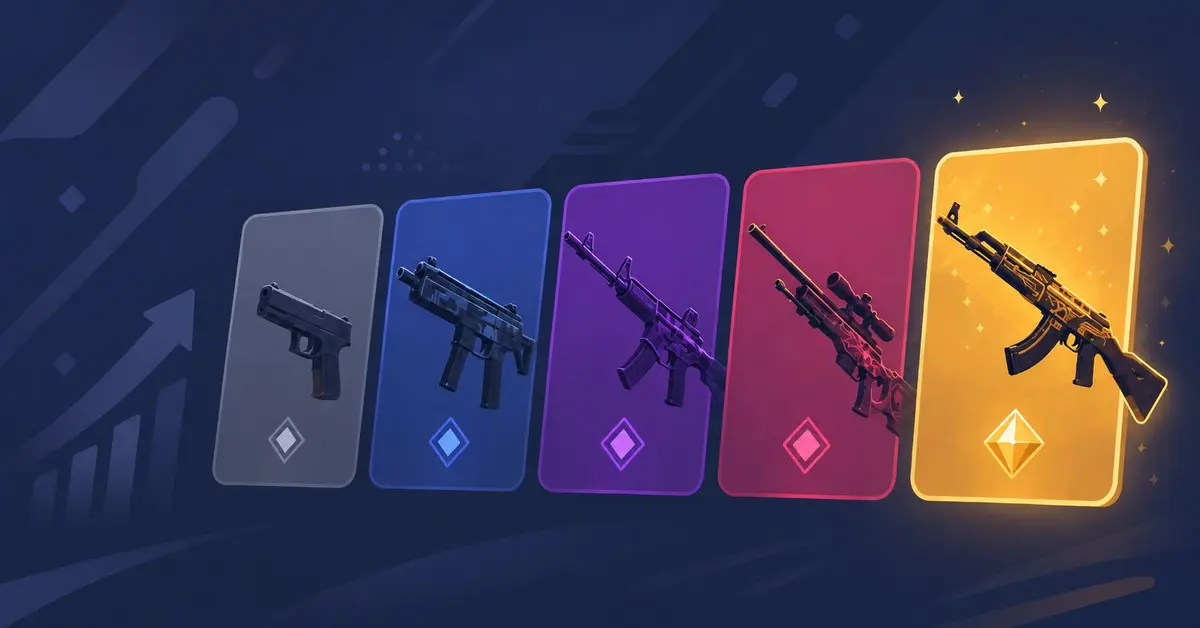
Key Highlights
- The Counter-Strike 2 cosmetic item market carries an estimated valuation of $7.1 billion.
- Every item in this marketplace is a purely digital asset with zero impact on gameplay mechanics such as damage, accuracy, or movement.
- Despite being intangible and functionally cosmetic, these virtual goods sustain a multi-billion-dollar economy driven by rarity, aesthetics, and community demand.
The $7.1 Billion Valuation
The cosmetic item ecosystem surrounding Counter-Strike 2 (CS2) has been valued at roughly $7.1 billion, according to current market analyses. This figure reflects the aggregate worth of weapon skins, gloves, agents, stickers, and containers traded across the Steam Community Market and third-party platforms. Unlike traditional in-game purchases that unlock gameplay advantages, every asset in this economy is strictly visual—offering no competitive edge whatsoever.
How the CS2 Skin Economy Functions
The marketplace operates on a foundation of scarcity, visual appeal, and community-driven status signaling. Items are obtained primarily through random case openings, mission rewards, or direct purchases, with supply constrained by Valve’s drop rates and collection retirements. Once in circulation, skins trade freely between users, with prices determined by exterior wear condition (Factory New through Battle-Scarred), pattern index, float value, and the presence of rare stickers or StatTrak counters. High-tier items such as the AK-47 | Case Hardened with a “Blue Gem” pattern or the Karambit | Doppler in Sapphire/Ruby/Black Pearl phases routinely command five-figure sums.
Purely Cosmetic, Purely Digital
Critically, the source underscores that these assets “can’t be touched and don’t improve damage, accuracy, movement, or any other part of gameplay.” This distinction separates the CS2 economy from pay-to-win models prevalent in other titles. A Dragon Lore AWP skin performs identically to the default variant; its value derives entirely from cultural cachet, historical significance, and the social signaling it enables within the player base. The intangibility of these goods—existing solely as database entries on Valve’s servers—has not prevented them from behaving like speculative commodities, complete with price volatility, investor speculation, and liquidity considerations.
Market Mechanics and Player Psychology
Valve Corporation retains a 15% transaction fee (5% Steam fee + 10% CS2-specific fee) on every Steam Community Market sale, creating a direct revenue stream from the secondary market. Third-party marketplaces and peer-to-peer trading networks exist alongside the official platform, often offering lower fees or cash-out options prohibited by Steam’s wallet-only policy. The ecosystem is further fueled by content creators, professional players, and major tournaments—where souvenir packages dropped during Majors become instant collectibles. Psychological drivers such as the endowment effect, fear of missing out (FOMO) during limited-time operations, and the gambler’s fallacy associated with case openings sustain demand despite the absence of utility.
Why This Matters
The $7.1 billion valuation positions the CS2 skin economy as one of the largest virtual goods markets in the world, rivaling the GDP of small nations and exceeding the annual revenue of many AAA game studios. It represents a mature case study in digital property rights, platform-controlled economies, and the monetization of cosmetic customization. For regulators, the market raises questions about gambling-adjacent mechanics (case openings), money laundering risks via high-value item transfers, and consumer protections for digital assets that can be revoked or devalued by platform policy changes. For the gaming industry, it validates the “games-as-a-service” model where ongoing revenue derives not from gameplay-altering purchases but from self-expression and social status within a persistent community. Upcoming developments—including potential Source 2 engine optimizations affecting skin rendering, new case collections, and evolving third-party marketplace regulations—will shape whether this valuation expands or contracts.
Frequently Asked Questions
Do CS2 skins provide any gameplay advantage?
No. Skins are purely cosmetic and do not affect damage, accuracy, movement speed, recoil, or any other gameplay mechanic. A weapon with a $10,000 skin performs identically to the same weapon with the default skin.
How is the $7.1 billion market valuation calculated?
The figure represents the estimated aggregate value of all tradable CS2 cosmetic items based on current listing prices across the Steam Community Market and major third-party exchanges, multiplied by available supply. It reflects theoretical market capitalization rather than realized liquidity.
Can CS2 skins be converted into real money?
On the official Steam Community Market, proceeds remain as Steam Wallet funds and cannot be withdrawn as cash. However, numerous third-party platforms facilitate peer-to-peer sales for real-world currency, operating in a regulatory gray area with varying degrees of legitimacy and user protection.