
Tag: Futures open interest

  • Coinbase Issues Warning Following XRP Rally

    Coinbase Issues Warning Following XRP Rally

    Key Highlights

    • Coinbase Markets data shows XRP one-week call/put implied volatility skew hit 9.3 volatility points, placing it in the top 5% of readings over the past year, signaling heightened bullish derivative demand.
    • XRP futures open interest surged to $4.1 billion, with CME Group overtaking Binance as the leading venue, indicating growing institutional participation in the token’s derivatives market.
    • Analysts warn the concentration of long call positions after XRP’s 15–18% weekly rally creates “crowded positioning” risk, which could amplify downside volatility if sentiment reverses.

    XRP Derivatives Signal Aggressive Bullish Positioning Amid Market Pullback

    Bitcoin’s recent ascent above $87,000 and broad altcoin strength were abruptly halted this week as surging global bond yields—reaching levels last seen in 2007—triggered a sharp risk-off move across digital assets. While major cryptocurrencies retreated from local highs, on-chain and derivatives data for XRP tell a contrasting story of intensifying speculative conviction. Coinbase Markets, the institutional-facing arm of the Nasdaq-listed exchange, published a detailed analysis highlighting an extraordinary shift in XRP options pricing that suggests professional traders are betting heavily on continued upside.

    Options Skew Reaches Extreme Bullish Territory

    According to Coinbase Markets, the one-week implied volatility spread between XRP call and put options widened to 9.3 volatility points. This metric, known as the risk reversal or skew, sits in the 95th percentile of observations recorded over the trailing twelve months. In practical terms, the premium investors are willing to pay for upside protection (calls) versus downside protection (puts) has ballooned, reflecting a consensus expectation that XRP’s recent 15% to 18% weekly gain is a precursor to further appreciation rather than exhaustion. Coinbase cautions, however, that a 9.3-point volatility differential does not mathematically translate to a 9.3% price move; it merely quantifies the intensity of directional demand in the options market.

    Futures Open Interest Hits $4.1 Billion as CME Leads Institutional Flow

    Complementing the options signal, aggregate open interest across XRP futures contracts climbed to $4.1 billion. Notably, CME Group—the primary regulated venue for institutional crypto derivatives in the United States—surpassed Binance in XRP futures volume and open interest. This shift is widely interpreted by market structure analysts as evidence that regulated, compliance-first capital is allocating to XRP with greater conviction than retail-heavy offshore platforms. The CME’s leadership position in a specific altcoin’s futures complex is relatively rare and underscores the token’s evolving status among professional allocators.

    Why This Matters: Crowded Trade Dynamics and Macro Crosscurrents

    The confluence of extreme options skew and record futures open interest introduces a classic “crowded positioning” vulnerability. When a disproportionate share of market participants holds similar directional bets—here, long calls and long futures—any catalyst that challenges the thesis can trigger a violent unwind. Forced liquidation of leveraged futures and delta-hedging by options market makers can accelerate price declines, creating a feedback loop detached from spot fundamentals. This risk is amplified by the macro backdrop: the U.S. 10-year Treasury yield piercing 4.5% has already pressured risk assets broadly. Should yields continue climbing, the high-beta nature of altcoins like XRP could see disproportionate selling, testing the resolve of the very derivatives positions that currently appear so bullish. Traders and risk managers will monitor CME positioning reports and options expiry calendars closely for signs of de-risking.

    Frequently Asked Questions

    What does a 9.3-point call/put implied volatility skew mean for XRP?
    It indicates that options market participants are paying a significantly higher premium for one-week call options versus put options, placing current demand for upside exposure in the top 5% of the past year. It reflects sentiment, not a guaranteed price target.
    Why is CME surpassing Binance in XRP futures significant?
    CME is the primary regulated derivatives marketplace for U.S. institutions. Its leadership in XRP futures suggests professional, compliance-driven capital is actively building positions, which often correlates with longer holding periods and deeper liquidity than retail-dominated offshore venues.
    What is the primary risk highlighted by Coinbase Markets?
    Coinbase warns of “crowded positioning” risk: if a large number of investors hold similar long positions simultaneously, a sudden sentiment reversal can cause exaggerated price swings as participants rush to exit, amplified by futures liquidations and options dealer hedging.

    *This article summarizes third-party market analysis and does not constitute investment advice.
  • Bitcoin Could Test $90,000 After Short Squeeze, but Traders Warn Leverage Is Building

    Bitcoin Could Test $90,000 After Short Squeeze, but Traders Warn Leverage Is Building

    Key Highlights

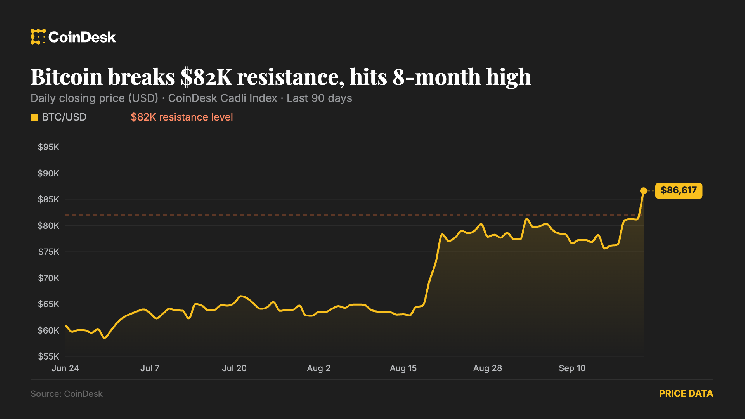
    • Bitcoin surged to an eight-month high of $86,000 on Monday, clearing the $82,000 resistance level that had capped prices since August and triggering roughly $750 million in bearish derivative liquidations.
    • Futures open interest rose faster than price, with approximately $2 billion in new leveraged exposure added since the breakout, signaling aggressive fresh positioning even as short sellers were wiped out.
    • While renewed spot ETF demand and short covering drove the rally, crypto-native investor positioning has been slower to flip from bearish to bullish, according to Nansen analytics.

    Bitcoin Breaks Key Resistance at $82,000

    Bitcoin pushed to a fresh eight-month high of $86,000 on Monday, extending a rally that forced bearish traders out of their short positions and drew fresh leverage bets back into the market. The move cleared the $82,000 level that had acted as a ceiling for prices since August, unleashing a cascade of liquidations across crypto derivative markets.

    Short Liquidations Fuel Momentum

    Roughly $750 million in bearish crypto derivative positions were liquidated as bitcoin cleared $82,000, according to CoinGlass data. When short positions are liquidated, exchanges execute buy orders to close them, adding fuel to an already upward market. “Bitcoin up 5% this morning due to short perpetual futures contracts being liquidated,” Schwab’s head of crypto research Jim Ferraioli told CoinDesk.

    Leveraged Bets Return Aggressively

    Meanwhile, futures open interest — the value of outstanding derivatives bets — rose even faster than bitcoin’s price. Since the breakout, about $2 billion in new leveraged exposure has been added, according to Coinalyze data, suggesting traders are placing fresh bets even as shorts got wiped out. The rapid rebuild in open interest indicates strong conviction among market participants that the breakout has legs.

    ETF Demand vs. Crypto-Native Caution

    While the rally has been fueled by a mix of renewed ETF demand and short covering, crypto-native positioning has been slower to shift from bearish to bullish, according to crypto analytics firm Nansen’s senior research analyst, Nicolai Sondergaard. This divergence suggests that while institutional flows via exchange-traded products are driving near-term price action, the core crypto trading community remains cautious about the sustainability of the move.

    Why This Matters

    The $82,000 level had served as a critical technical barrier since August, and its decisive breach marks the first time bitcoin has traded above this threshold in eight months. The combination of massive short liquidations and a rapid $2 billion rebuild in open interest creates a feedback loop that can sustain upward momentum in the near term. However, the reluctance of crypto-native traders to fully embrace the rally introduces a potential vulnerability: if ETF flows slow or macro conditions shift, the market may lack the deep conviction needed to hold gains. Market participants will be watching whether open interest continues to expand alongside price — a sign of healthy trend development — or if the current leverage buildup sets the stage for a volatile unwind.

    Frequently Asked Questions

    What triggered Bitcoin’s surge to $86,000?

    The rally was driven by a combination of renewed spot Bitcoin ETF demand and a massive short squeeze. As Bitcoin cleared the $82,000 resistance level — a ceiling since August — roughly $750 million in bearish derivative positions were liquidated, forcing exchanges to execute buy orders that accelerated the move higher.

    How much new leverage has entered the market since the breakout?

    According to Coinalyze data, approximately $2 billion in new leveraged exposure has been added to futures open interest since Bitcoin broke above $82,000, with open interest rising faster than price itself.

    Are crypto-native traders bullish on this move?

    Not yet. Nansen senior research analyst Nicolai Sondergaard notes that crypto-native positioning has been slower to shift from bearish to bullish, suggesting the core trading community remains cautious despite the price breakout and ETF-driven inflows.

  • Jupiter Token Falls 10% as $0.24 Support Breaks, Protocol Inflows Turn Negative

    Jupiter Token Falls 10% as $0.24 Support Breaks, Protocol Inflows Turn Negative

    Jupiter (JUP) suffered a sharp decline during the latest cryptocurrency sell-off as traders broadly reduced exposure to risk assets. The entire digital asset market came under heavy selling pressure, with most established coins recording significant losses.

    Jupiter Price Breaks Key Support

    Amid the bearish shift, JUP lost the $0.24 support level and fell to an intraday low of $0.20, dropping below its short-term 9-day and 21-day moving averages. At the time of writing, the token was trading near $0.21, down 10.2% on the daily chart. Trading volume rose 20% to $50 million over the same period, indicating heightened sell-side activity.

    Protocol Inflows Turn Negative

    Data from DefiLlama shows Jupiter’s USD inflows swung sharply negative, plummeting from $33 million to -$55 million. This reversal suggests a substantial outflow of capital from the network, confirming intense selling pressure.

    Derivatives Data Shows Reduced Exposure

    Futures market metrics from CoinGlass reinforce the risk-off narrative. Jupiter’s Open Interest declined 15% to $55.7 million, while derivatives volume fell 6% to $69 million. The drop in Open Interest signals that investors are actively closing positions and reducing leverage.

    Futures Netflows Signal Aggressive Panic

    According to CoinGlass, Jupiter futures recorded $16.8 million in outflows against $13.97 million in inflows. Netflows consequently collapsed 172% to -$2.8 million, a clear indicator of aggressive market panic and dominant bearish sentiment.

    Technical Outlook: Risk of Further Decline

    The TradingView Bulls vs. Bears indicator dropped to -49, reaching levels last seen in mid-August. A negative reading confirms that sellers have significantly outweighed buyers. If selling pressure persists and sentiment remains risk-averse, JUP could breach the $0.20 support and target $0.19. To invalidate this bearish structure, the price must close back above the short-term moving averages near $0.23.

    Summary

    • JUP declined 10%, breaking $0.24 support to hit a low of $0.20.
    • The drop was driven by strong selling pressure after sentiment turned risk-off, prompting investors to reduce exposure.
    • On-chain and derivatives data confirm capital outflows, falling Open Interest, and negative futures netflows.
    • Technical indicators remain bearish; a close above $0.23 is needed to shift the short-term outlook.