Tag: ETF inflows

  • $1.5T and Counting: 2026 ETF Inflows Surpass 2025’s Record

    $1.5T and Counting: 2026 ETF Inflows Surpass 2025’s Record

    Key Highlights

    • Bitcoin ETFs dominated 24-hour inflows with $433.03 million, leading a broad-based rally that saw Ethereum attract $143.80 million and Solana draw $47.62 million, per SoSo Value data.
    • Grayscale’s newly launched Spot Zcash ($ZEC) ETF recorded $37.67 million in inflows within its first month, outperforming many established altcoin ETF products.
    • Bloomberg’s Eric Balchunas noted global ETFs have already surpassed 2025’s full-year record of $1.5 trillion in flows with 3.5 months remaining, while Coinbase Derivatives filed with the CFTC to launch cash-settled perpetual futures on U.S. stocks and ETFs.

    Broad-Based Crypto ETF Inflows Signal Renewed Investor Appetite

    The cryptocurrency exchange-traded fund landscape experienced a decisive shift in momentum over the past 24 hours, with net inflows turning positive across nearly every major digital asset category. According to data compiled by SoSo Value, Bitcoin [BTC] products commanded the lion’s share of fresh capital, absorbing $433.03 million in net subscriptions. Ethereum [ETH] followed at a considerable distance with $143.80 million, while Solana [SOL] continued its institutional adoption trajectory with $47.62 million in new allocations.

    Grayscale’s Zcash ETF Defies Altcoin Skepticism

    Perhaps the most striking data point emerged from Grayscale Investments’ recently launched Spot Zcash ($ZEC) ETF. Despite being on the market for less than a month, the fund has already accumulated $37.67 million in net inflows—a figure that exceeds the early traction of numerous longer-standing altcoin ETFs. Smaller but notable inflows were also recorded for Hyperliquid [HYPE] at $1.03 million and Chainlink [LINK] at $2.19 million. XRP [$XRP] stood alone on the negative side of the ledger, registering modest outflows of approximately $43,700, suggesting lingering hesitation among investors toward the token’s ETF prospects.

    Balchunas: ETF Industry Rewriting Flow Records at Historic Pace

    The surge in crypto fund flows mirrors a broader structural expansion across the entire ETF ecosystem. Bloomberg Senior ETF Analyst Eric Balchunas highlighted the milestone on X, stating:

    ETFs have now surpassed last year’s record flows of $1.5T with 3.5mo to spare.

    Balchunas provided critical historical context, noting that roughly two decades ago—when he began covering the industry—$100 billion in annual flows was considered a banner year. Today, the global ETF complex is attracting more than $100 billion every month, translating to roughly $8.5 billion per trading day. This acceleration has occurred despite what Balchunas characterized as a challenging 2026 for cryptocurrency markets, which have contended with Middle Eastern geopolitical tensions, rising oil prices, Federal Reserve rate hikes, and the legislative setback of the CLARITY Act. The analyst emphasized that even after a strong August rally gave way to September selling pressure, the downturn proved temporary, with flows rapidly reasserting their upward trajectory.

    Coinbase Derivatives Pushes Into Equity-Linked Perpetual Futures

    Balchunas’s commentary arrived alongside a significant regulatory filing from Coinbase Derivatives. The exchange has petitioned the U.S. Commodity Futures Trading Commission (CFTC) for approval to launch cash-settled perpetual futures contracts tied to individual U.S.-listed stocks and ETFs. If cleared, the product would enable eligible U.S. traders to obtain leveraged long or short exposure to single-name equities and exchange-traded funds without purchasing the underlying securities. These instruments would be structured as security futures products, placing them under the joint regulatory purview of the CFTC and the Securities and Exchange Commission (SEC). The move represents Coinbase’s most ambitious push yet to diversify its derivatives franchise beyond digital assets and establish a regulated U.S. venue for equity-linked perpetual contracts.

    Global Expansion Narrative Gains Momentum

    Optimism extends beyond U.S. borders. Japan-based DeFi asset manager xWin Finance projects that the country’s forthcoming Spot Bitcoin ETFs could attract up to $18.4 billion in assets, underscoring the global dimension of institutional crypto adoption. Combined with the Coinbase filing and record-breaking flow data, the developments suggest a maturing market infrastructure that is increasingly bridging traditional finance and digital asset ecosystems.

    Why This Matters

    The convergence of record-breaking global ETF flows, successful launches of niche crypto products like Grayscale’s Zcash ETF, and major exchanges like Coinbase seeking to replicate crypto’s perpetual futures model in equity markets signals a profound structural shift. For investors, the data confirms that institutional capital allocation to digital assets is deepening beyond Bitcoin and Ethereum into a wider spectrum of protocols. For regulators, the Coinbase filing tests the boundaries of security futures frameworks and could establish a precedent for crypto-native firms entering traditional derivatives markets. The resilience of flows amid macroeconomic headwinds—geopolitical instability, monetary tightening, and legislative uncertainty—suggests that crypto ETFs are evolving from speculative vehicles into permanent portfolio building blocks. Market participants should monitor the CFTC’s review of Coinbase’s application and the trajectory of Japan’s Spot Bitcoin ETF launch as key indicators of the next phase of institutional integration.

    Frequently Asked Questions

    Which crypto assets saw the largest ETF inflows in the latest 24-hour period?

    Bitcoin led with $433.03 million in net inflows, followed by Ethereum at $143.80 million and Solana at $47.62 million, according to SoSo Value data. Grayscale’s new Spot Zcash ETF also attracted a notable $37.67 million in its first month.

    What is the significance of Eric Balchunas’s comment about $1.5 trillion in ETF flows?

    Balchunas, a senior ETF analyst at Bloomberg, noted that global ETFs have already exceeded the full-year 2025 flow record of $1.5 trillion with 3.5 months remaining in 2026. He contrasted this with the industry standard of two decades ago, when $100 billion in annual flows was considered exceptional, versus the current pace of over $100 billion monthly.

    What would Coinbase Derivatives’ proposed perpetual futures on stocks and ETFs enable?

    If approved by the CFTC, the cash-settled perpetual futures would allow eligible U.S. traders to take leveraged long or short positions on individual U.S.-listed stocks and ETFs without owning the underlying shares. The contracts would be regulated as security futures products under joint CFTC and SEC oversight, expanding Coinbase’s derivatives offerings beyond cryptocurrency.


  • ETH/BTC Ratio Surges 25% in Q3 as Ethereum Targets Strongest Quarter on Record

    ETH/BTC Ratio Surges 25% in Q3 as Ethereum Targets Strongest Quarter on Record

    Ethereum has significantly outperformed Bitcoin during the third quarter, with data suggesting a pronounced capital rotation into $ETH and higher-beta assets as $BTC stalled near the $80,000 resistance level.

    Dominance Metrics Signal Major Rotation

    According to a quarterly framework analysis, Bitcoin’s dominance grew by a modest 1.5% quarter-over-quarter. In contrast, Ethereum’s dominance surged over 25% during the same period. The $ETH/$BTC trading pair mirrored this strength, rising more than 25% in Q3—its highest quarterly increase since Q3 2025.

    However, the ratio remains capped near the 0.03 resistance area. A decisive break above this level would be required to confirm a sustained, bullish rotation into Ethereum.

    Source: TradingView ($ETH/$BTC)

    On-Chain Dynamics Favor Ethereum

    Bitcoin’s on-chain metrics provide further context for the shift. The asset’s True Market Mean Price is gradually approaching $76,921.27. Analysts suggest that if $BTC reaches this level, a fresh wave of selling pressure could trigger new exchange deposits, creating the liquidity conditions necessary for capital to rotate into Ethereum.

    One analyst predicts Ethereum will outperform Bitcoin once the broader market flips to a “risk-on” stance, driven by a confluence of on-chain and technical factors. With $ETH already delivering a 58%+ return in Q3, the question arises: is this growing fear of missing out (FOMO) setting the stage for Ethereum’s strongest third quarter on record?

    Ethereum Dominance and ROI Near Historic Highs

    On the technical front, Ethereum dominance ($ETH.D) has risen over 25% this quarter, aligning with the gain in the $ETH/$BTC ratio. Ethereum’s Q3 return on investment (ROI) is nearing 60%, closing in on the Q3 2025 record of over 66%. Should $ETH surpass that threshold, it would mark the asset’s best third-quarter performance in history.

    The concurrent rise in both dominance and absolute returns indicates that Ethereum’s ascent is not solely a byproduct of Bitcoin’s weakness. Instead, it reflects a genuine increase in investor appetite for the altcoin itself.

    Source: Coinglass

    ETF Inflows Validate Underlying Demand

    Recent exchange-traded fund (ETF) inflows corroborate the thesis of strong fundamental demand for Ethereum. While rotational flows from Bitcoin account for a portion of the quarter’s gains, the sustained institutional interest suggests a structural shift. Bitcoin’s relative stagnation may continue to provide Ethereum with room to attract fresh capital as investors chase higher beta returns.

    Key Takeaways

    • $ETH.D and $ETH/$BTC are both up over 25% in Q3.
    • Strong ETF demand shows growing interest in Ethereum.
  • Solana Tests $100 Support as Whale Traders Bet on Price Rebound

    Solana Tests $100 Support as Whale Traders Bet on Price Rebound

    Solana (SOL) slipped 2% on Tuesday, trading near $102, yet a cluster of large derivatives traders is positioning for a continuation of the asset’s recent recovery. Five whale addresses on Hyperliquid collectively opened $9.11 million in SOL long positions between September 7 and September 8, according to CoinGlass data.

    Whale Long Positions Signal Confidence Ahead of Network Upgrade

    The concentrated bullish exposure suggests these traders expect Solana to extend the rebound that began on August 17. Their combined $9.11 million commitment reflects confidence that the upcoming network improvement could spark renewed buying demand. Long positions profit when the underlying asset rises, though they carry liquidation risk if SOL resumes its decline. While the activity of a few large traders does not guarantee a rally, sizable whale moves often influence sentiment, especially ahead of a major protocol change.

    Solana’s September 9 Upgrade Expands Transaction Capacity

    The scheduled upgrade will raise the maximum transaction size from 1,232 bytes to 4,096 bytes. This increase allows developers to pack more instructions into a single operation, bundling processes that previously required multiple separate transactions. By more than tripling the size limit, Solana aims to support more complex applications and reduce the need to split related instructions across several transactions.

    Additional context on the upgrade can be found in this post by Scott Melker.

    Broader Derivatives Metrics Remain Bearish

    Despite the whale long positions, Solana’s wider futures market continues to show caution. SOL’s funding rate sits at a positive 0.0025%, meaning long holders are paying shorts to maintain their trades — a sign of stronger demand for bullish positions. However, the long-to-short ratio stands at 0.94, indicating short accounts outnumber long accounts. This reading reinforces the view that the five Hyperliquid whales are taking a contrarian stance against prevailing futures sentiment.

    Demand for SOL derivatives has also weakened. Trading volume fell 10% to $6.58 billion, while open interest declined 1.21% to $6.47 billion. Lower volume signals reduced trading activity, and declining open interest shows leveraged positions are being closed. Together, these metrics suggest futures traders are reducing exposure as SOL approaches its upgrade.

    Institutional Demand Paints a More Constructive Picture

    On the institutional side, Solana exchange-traded funds have recorded inflows for ten consecutive weeks. This streak indicates that demand through regulated investment products remains resilient despite weaker futures activity. The result is a divided market outlook: whale positioning and ETF inflows favor an eventual recovery, while negative funding, falling open interest, and a sub‑one long‑to‑short ratio point to short‑term caution. SOL’s reaction to the September 9 upgrade could determine which side gains control.

    Technical Analysis: Symmetrical Triangle Points to $124 Resistance or $84 Support

    On the four‑hour chart, SOL is trading within a symmetrical triangle — a pattern that reflects tightening price action and can break out in either direction. The formation’s projected height is approximately 16%. A decisive break below the lower trendline could send SOL down a similar percentage toward $84. Before that target comes into view, sellers would need to push price below the psychological support at $100.

    Conversely, a clear move above the triangle resistance at $107 could trigger a 16% rally toward $124. Momentum currently leans toward sellers: the Relative Strength Index sits at 44, below the neutral 50 level, and its lower lows indicate growing selling pressure. Solana’s immediate outlook therefore hinges on the triangle’s boundaries. Holding $100 and breaking above $107 would strengthen the whale‑backed bullish scenario, while losing triangle support could expose SOL to a decline toward $84.

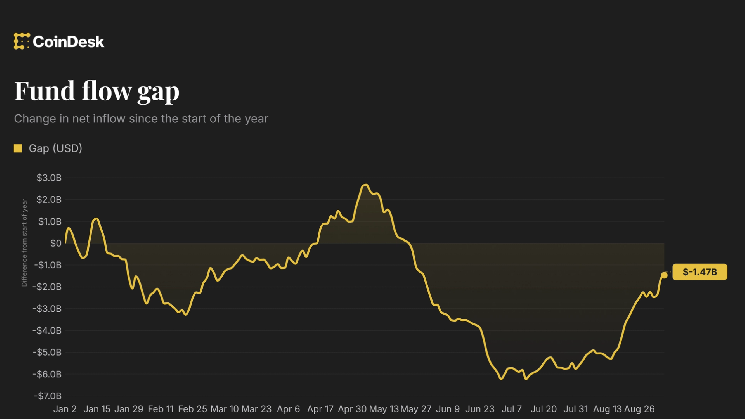
  • Bitcoin ETFs Still $1 Billion Short of Breaking Even in 2026

    Bitcoin ETFs Still $1 Billion Short of Breaking Even in 2026

    Investor appetite for U.S.-listed spot bitcoin exchange-traded funds (ETFs) has surged in recent weeks, yet cumulative flows for 2024 remain deeply negative.

    Strong Summer Inflows Fail to Offset Spring Selloff

    Data from SoSoValue shows a dramatic turnaround in August, which attracted a massive $3.52 billion in fresh capital. Momentum carried into September, adding another $770.15 million through the early part of the month. While the winning streak signals that the worst of the mid-year market doldrums may be over, the broader arithmetic reveals a persistent deficit.

    Despite the recent rally, the funds are still down roughly $1 billion on a year-to-date basis. The primary driver of this lingering shortfall is the brutal two-month stretch in May and June, when institutional capital exited the funds at an alarming pace. June alone wiped out a staggering $4.51 billion, completely erasing the gains accumulated during March and April. Consequently, bulls still have significant ground to cover before ETF flows break even for the year.

    Macro Catalysts Loom as Critical Test

    Market participants are now focused on whether the positive momentum can withstand upcoming macroeconomic events. “The key test now is whether those inflows survive this week’s CPI and Treasury buyback,” analysts at crypto exchange Bitfinex said in a note to CoinDesk.