Tag: Dogecoin

  • DOGE Rally Accelerates as Price Hits Multi-Month High

    DOGE Rally Accelerates as Price Hits Multi-Month High

    Key Highlights

    • Dogecoin surged to an intraday high of $0.1059 before settling near $0.09986, a 1.04% gain over 24 hours, putting the psychological $0.10 resistance level in focus.
    • X (formerly Twitter) launched its Cashtag trading integration with Coinbase, Kraken, Gemini, Moomoo, and Interactive Brokers, creating a direct pipeline from social discussion to trade execution for U.S. users.
    • Despite bullish momentum signals from derivatives activity and a rising RSI, the 50-day EMA remains below the 200-day EMA, preserving a longer-term bearish moving-average structure that requires sustained buying to reverse.

    Dogecoin Extends Recovery as X Cashtag Trading Links Go Live

    Dogecoin ($DOGE) pushed to its highest intraday level in months on Tuesday, briefly touching $0.1059 before consolidating around $0.09986—a 1.04% advance over the prior 24 hours. The rally brought the psychologically significant $0.10 threshold back into immediate range, fueling renewed speculative interest across spot and derivatives markets. Volume data from major exchanges showed elevated participation, with the token’s market capitalization climbing back toward the $14.5 billion mark as buyers stepped in ahead of the weekly options expiry.

    X Cashtag Integration Creates New Distribution Channel

    The catalyst coincides with the public rollout of X‘s Cashtag trading program, which now surfaces real-time market data and a “Trade” button next to supported tickers—including $DOGE—for users in the United States. Clicking the button redirects traders to one of five integrated brokerages: Coinbase, Kraken, Gemini, Moomoo, and Interactive Brokers. The feature does not constitute native wallet integration or payment functionality on the social platform, but it dramatically shortens the latency between financial discourse, price discovery, and order placement.

    Given Elon Musk‘s years-long public endorsement of Dogecoin—including past references to it as “the people’s crypto” and his acquisition of X itself—the Cashtag rollout is widely interpreted by market participants as a structural tailwind. Analysts note that while no formal payment integration has been announced, the mere presence of a one-click trade pathway on the platform where Dogecoin narratives originate represents a meaningful distribution advantage over assets lacking similar social-graph exposure.

    Derivatives Activity Amplifies Price Action

    Futures markets added a second layer of momentum. Perpetual swap contracts on Binance, Bybit, and OKX recorded a sharp uptick in open interest, rising over 12% in the last two sessions to exceed $650 million in notional value. Funding rates flipped positive across major venues, signaling that leveraged longs are willing to pay a premium to maintain exposure. This derivatives bid can accelerate upside moves during low-liquidity windows, but it also raises the risk of cascading liquidations if price reverses below key support near $0.095.

    Technical Signals Point to a Key Test of Moving-Average Structure

    Short-Term Momentum Improves, Longer-Term Hurdle Remains

    On the daily chart, the Relative Strength Index (RSI) climbed to 62, placing it at the upper boundary of the neutral-to-bullish zone, while the Average Directional Index (ADX) held above 25—a threshold typically associated with a confirmed trending environment. These readings confirm that buying pressure has intensified and that the current leg higher possesses directional conviction.

    However, the macro structure remains cautious. The 50-day Exponential Moving Average (EMA) continues to trade below the 200-day EMA, maintaining the bearish crossover—commonly referred to as a “Death Cross”—that formed during the prolonged decline from the 2024 highs. A sustainable trend reversal would require $DOGE to reclaim both moving averages and, critically, to flip the 200-day EMA into support. Until that occurs, rallies toward $0.11–$0.12 are vulnerable to distribution by longer-term holders who have been underwater since the prior cycle peak.

    Psychological Resistance at $0.10 Draws Algorithmic Attention

    Order-book analysis shows a cluster of sell-limit orders stacked between $0.100 and $0.102, alongside concentrated stop-loss buy orders just above $0.105. This liquidity magnet explains the sharp rejection from the $0.1059 intraday high and suggests that a clean break above $0.106 could trigger a short-covering squeeze toward the next volume node near $0.112. Conversely, failure to hold the $0.095–$0.097 demand zone would likely invite a retest of the 50-day EMA near $0.092.

    Why This Matters

    The convergence of a major social-media distribution upgrade (X Cashtags), heightened derivatives participation, and improving short-term technicals creates a rare alignment of fundamental, structural, and technical catalysts for Dogecoin. For retail traders, the Cashtag integration lowers the friction of converting social sentiment into positions, potentially accelerating reflexive price-action loops that meme assets are prone to exhibit. For institutional desks, the elevated open interest and positive funding rates signal that professional capital is actively engaging with the long side, not merely providing liquidity.

    However, the persistent 50/200-day EMA bear cross serves as a reminder that Dogecoin has not yet transitioned into a confirmed macro uptrend. The next two to three weeks—encompassing the monthly options expiry, U.S. CPI data, and potential Federal Reserve policy signals—will determine whether the current bounce matures into a trend reversal or fades into another lower-high sequence. Market participants should monitor the $0.095 support and the 200-day EMA (currently ~$0.108) as the critical battlegrounds for that decision.

    Frequently Asked Questions

    What is the X Cashtag trading feature and which brokers are connected?

    X Cashtags now display live market data and a “Trade” button for supported tickers, redirecting U.S. users to Coinbase, Kraken, Gemini, Moomoo, or Interactive Brokers to execute orders. The feature is informational and transactional via partner platforms, not a native X wallet or payment system.

    Why does the 50-day EMA below the 200-day EMA matter for Dogecoin?

    This “Death Cross” formation signals that the medium-term trend remains bearish relative to the long-term trend. Until $DOGE closes sustainably above both moving averages and flips the 200-day EMA into support, rallies are considered counter-trend and carry higher risk of reversal.

    How are derivatives influencing Dogecoin’s current price action?

    Open interest in perpetual futures has surged above $650 million with positive funding rates, indicating aggressive long positioning. This leveraged bid can amplify upside moves but also creates liquidation clusters below $0.095 that could accelerate a correction if triggered.


  • 5 Best Meme Coins for 2026 Compared: DOGE, SHIB, PENGU, BONK & MemeToro’s Fair-Launch Model

    5 Best Meme Coins for 2026 Compared: DOGE, SHIB, PENGU, BONK & MemeToro’s Fair-Launch Model

    Key Highlights

    • MemeToro ($MT) raises over $140,000 in Stage 7 presale at $0.00430 per token, targeting a $0.05186 listing price implying ~12x hypothetical upside.
    • Established meme coins Dogecoin ($DOGE), Shiba Inu ($SHIB), Pudgy Penguins ($PENGU), and Bonk ($BONK) retain dominance through community size, ecosystem integrations, and brand IP.
    • MemeToro differentiates with an AI-powered, open-source fair-launch pad enforcing zero-insider allocation and offering $MT utility across trading, staking (up to 35% APY), and prediction markets.

    Meme Coin Landscape in 2026: Established Giants Versus Emerging Infrastructure

    The conversation around the leading meme coins heading into 2026 centers on five distinct projects, each representing a different value proposition. Dogecoin ($DOGE) and Shiba Inu ($SHIB) continue to benefit from deep liquidity and multi-year community momentum. Pudgy Penguins ($PENGU) leverages a recognizable consumer brand and digital intellectual property portfolio. Bonk ($BONK) remains tightly woven into the Solana ecosystem’s memecoin activity. Meanwhile, MemeToro ($MT) is still in its presale phase, having crossed $140,000 raised in Stage 7 at a price of $0.00430, while building an AI-driven launchpad infrastructure designed to support future token creation and trading.

    Dogecoin and Shiba Inu: Community Depth and Ecosystem Maturity

    Dogecoin retains one of the longest track records among major meme assets. Its broad mainstream recognition and deep market liquidity have allowed it to remain a fixture in cryptocurrency market discussions regardless of cycle. Shiba Inu has expanded beyond a single token, developing a broader ecosystem that includes the Shibarium layer-2 network. This ecosystem development gives $SHIB a structural complexity that distinguishes it from a simple community token. Both projects already operate in open markets with established trading activity, providing a baseline of stability and accessibility that newer entrants have yet to achieve.

    Pudgy Penguins and Bonk: Brand IP and Chain-Native Integration

    Pudgy Penguins provides $PENGU with a direct link to a wider consumer-facing brand and digital IP ecosystem. The token’s meme identity is reinforced by the broader Pudgy Penguins project, which spans physical merchandise, licensing, and community engagement. Bonk, by contrast, has cultivated a dominant presence within the Solana network’s memecoin sector. Its integrations across Solana decentralized applications and trading venues give it a chain-native role that differs from the multi-chain or Ethereum-centric positioning of $DOGE and $SHIB. These ecosystem connections create defensive moats rooted in distribution and utility rather than narrative alone.

    MemeToro’s Fair-Launch Model and AI Launchpad Infrastructure

    MemeToro’s latest update emphasizes open-source AI launchpad smart contracts engineered to enforce fixed fair-launch rules. The system validates allocation totals and funding consistency under a zero-insider-allocation framework, aiming to reduce distribution uncertainty that often plagues new token launches. The $MT token is designed for utility across memecoin trading, platform access, staking, rewards, and prediction markets. The project currently advertises a projected staking return of up to 35% APY. With a Stage 7 price of $0.00430 and a stated listing target of $0.05186, the implied move represents approximately 12.06x or 1,106% hypothetical upside, though the project explicitly notes this is not a prediction or guaranteed return. Buyers are directed to verify the official website, contract address, BNB Chain network, presale stage, and purchase instructions before connecting a wallet.

    Why This Matters

    The 2026 meme coin narrative is bifurcating between incumbent tokens with proven network effects and infrastructure plays betting on the next wave of token creation. Established assets like $DOGE, $SHIB, $PENGU, and $BONK derive value from liquidity, brand recognition, and chain-specific entrenchment. MemeToro represents a shift toward launchpad-as-a-service models, where AI-driven trend detection and programmatic fair-launch mechanics attempt to solve the trust and distribution problems that have historically plagued early-stage memecoins. For market participants, the distinction is critical: investing in incumbents is a bet on sustained cultural relevance and liquidity, while participating in presales like MemeToro is a bet on the execution of unproven infrastructure and the future pipeline of tokens it may spawn. Regulatory scrutiny on fair-launch claims, smart contract audits, and the realized performance of AI-curated launches will be key watch items through late 2025 and into 2026.

    Frequently Asked Questions

    What is MemeToro’s current presale price and fundraising status?
    MemeToro is in Stage 7 at $0.00430 per $MT token, with over $140,000 raised to date.
    How does MemeToro’s fair-launch mechanism work?
    The project uses open-source AI launchpad smart contracts that enforce fixed allocation rules, check funding consistency, and operate under a zero-insider-allocation framework to minimize distribution manipulation.
    What utilities are planned for the $MT token?
    $MT is designed for memecoin trading, platform access, staking (up to 35% projected APY), rewards, and prediction markets within the MemeToro ecosystem.

    More Information on MemeToro ($MT) Presale: Website: https://memetoro.com/ | X: https://x.com/memetoro_mt | Telegram: https://t.me/memetoro_mt | YouTube: https://www.youtube.com/watch?v=gY0jgWy_DtA

  • Top 5 Memecoins to Buy Right Now: DOGE, SHIB, PEPE, BONK, MemeToro Gain Traction as Memecoin Momentum Builds

    Top 5 Memecoins to Buy Right Now: DOGE, SHIB, PEPE, BONK, MemeToro Gain Traction as Memecoin Momentum Builds

    Key Highlights

    • Established memecoins Dogecoin ($DOGE), Shiba Inu ($SHIB), $PEPE, and $BONK maintain market dominance through deep liquidity and exchange access, while MemeToro ($MT) enters as an early-stage BNB Chain project building an AI-guided launchpad currently in Stage 7 presale at $0.00430 with over $137,000 raised.
    • MemeToro differentiates through utility infrastructure: a 1,373-line Solidity fair-launch codebase across 17 files, AI-driven trend analysis for token proposals, manifest transparency showing supply and funding terms, and validator checks against insider allocations—backed by Coinsult, BlockSAFU, and SOLIDProof reviews.
    • Risk profiles diverge sharply: $DOGE, $SHIB, $PEPE, and $BONK face volatility and shifting trader attention in live markets, while MemeToro carries execution risk on platform delivery but presents a theoretical 12.06x upside to its $0.05186 launch target if the AI launchpad achieves adoption.

    Market Landscape: Established Leaders vs. New Utility-Focused Entrants

    The memecoin sector continues to stratify between legacy assets with proven liquidity and emerging projects attempting to capture attention through functional infrastructure rather than community momentum alone. Dogecoin, Shiba Inu, $PEPE, and $BONK remain the primary reference points for traders and investors, each benefiting from broad exchange listings, recognizable branding, and established holder bases. MemeToro, by contrast, positions itself as a platform token for an AI-led launchpad on BNB Chain—a model that shifts the value proposition from social virality to utility-driven token issuance. The project’s Stage 7 presale price of $0.00430 and a stated launch target of $0.05186 imply a theoretical 12.06x multiple, though the source material emphasizes this is a displayed project target rather than a guaranteed return, contingent on development milestones, liquidity formation, and market conditions.

    MemeToro’s AI-Led Launchpad Architecture and Token Utility

    MemeToro’s core proposition centers on an autonomous agent designed to scan public trends, generate evidence-backed token proposals, and publish structured launch manifests before any funding commences. These manifests are intended to disclose supply parameters, funding caps, fixed pricing, and source evidence—creating a transparency layer absent in many presale models. A validator component is programmed to reject proposals containing unsupported links, broken allocation totals, insider allocations, or inconsistent funding terms. The $MT token is slated to underpin platform access, funding participation, staking rewards, future memecoin trading, prediction markets, and a news portal, representing a broader utility stack than tokens relying solely on community narrative. The project has published its initial fair-launch contracts—1,373 lines of Solidity across 17 files—providing a verifiable code artifact for prospective buyers to audit. Remaining milestones include the executor module, liquidity connection, factory deployment, BNB Chain testnet launch, and independent review completion.

    Dogecoin: Market Structure and Technical Outlook

    Dogecoin retains its position as the largest and most widely recognized meme asset, trading in a range between approximately $0.0815 and $0.093 according to the supplied market data. Technical observers are monitoring the $0.087 support level as a prerequisite for a potential advance toward $0.10. Longer-term bullish models cited in the source suggest targets between $0.32 and $0.50, though these are explicitly framed as estimates dependent on a strong market cycle. Dogecoin’s advantages—deep brand recognition, universal exchange availability, and a vast holder base—also mean it requires significantly more capital inflows to generate large percentage moves compared to smaller-cap alternatives. For investors seeking established meme exposure with a mature market structure, $DOGE offers a lower-risk profile relative to presale-stage assets.

    SHIB, PEPE, and BONK: Divergent Ecosystem Narratives

    Each of the three major alt-memecoins carries a distinct fundamental narrative. Shiba Inu continues building utility through its Shibarium layer-2 network and ongoing token burn mechanisms, currently contending with resistance near $0.0000051. Bullish projections referenced in the source place a potential year-end range between $0.000008 and $0.000015 should momentum improve. $PEPE remains predominantly a culture-driven trading vehicle, currently under pressure near $0.00000334 with the $0.00000320 level identified as critical support to avoid a deeper pullback. $BONK’s trajectory is tightly coupled to Solana ecosystem activity; it requires approximately a 7% recovery to reclaim the $0.0000030 psychological threshold, with longer-term strength contingent on Solana’s throughput and $BONK’s own liquidity conditions. All three tokens share the core risk of volatility and the fickle nature of trader attention cycles.

    MemeToro’s Presale Mechanics and Risk Considerations

    MemeToro’s presale structure incorporates several trust-minimization features designed to address common early-stage project concerns. The fair-launch escrow mechanism locks round parameters, prohibits insider allocations, and routes funds exclusively toward contributor refunds or planned liquidity provision—critically, the contract specifies no owner role, admin privileges, or upgrade path. Third-party verification is cited from Coinsult, BlockSAFU, and SOLIDProof, providing a stronger audit narrative than projects relying solely on social proof. However, the source material underscores that $MT should be treated as a speculative early-stage position: the platform’s executor, liquidity integration, factory contracts, testnet deployment, and independent review remain incomplete. Buyers are essentially underwriting the delivery of an AI-guided launchpad that has yet to demonstrate market fit.

    Why This Matters

    The memecoin sector is undergoing a subtle but meaningful bifurcation. Legacy assets like Dogecoin and Shiba Inu are increasingly evaluated on their ability to sustain relevance through ecosystem development—Shibarium for SHIB, payment integration for DOGE—while newer entrants such as MemeToro attempt to bootstrap value by solving a structural problem: the lack of transparency and standardization in memecoin launches. If MemeToro’s AI-curated, manifest-driven model gains traction, it could introduce a replicable framework that reduces rug-pull risk and aligns issuer incentives with community participants. Conversely, failure to ship a functional launchpad would render $MT a speculative artifact with no underlying utility. For market participants, the key distinction lies in time horizon and risk tolerance: established tokens offer liquidity and optionality on sentiment shifts, while presale-stage platform tokens offer asymmetric upside contingent on product execution. The next inflection points to watch include MemeToro’s testnet deployment and independent audit publication, alongside technical breakout or breakdown levels for $DOGE, $SHIB, $PEPE, and $BONK.

    Frequently Asked Questions

    Which of these memecoins is the most established?
    $DOGE is the most established by market history and broad recognition, while $SHIB, $PEPE, and $BONK also have active public markets with significant liquidity and community followings.
    Why is MemeToro different from $DOGE or $PEPE?
    MemeToro is an early-stage platform token designed for an AI-led launchpad on BNB Chain, whereas $DOGE and $PEPE are already-trading memecoins with established communities and market presence. MemeToro’s value proposition centers on launch infrastructure utility rather than pure community momentum.
    Is the $0.05186 launch target for MemeToro guaranteed?
    No. It is a displayed project target. Actual $MT prices will depend on development progress, liquidity formation, market demand, and broader crypto sentiment. The 12.06x multiple from the Stage 7 price of $0.00430 is a theoretical comparison, not a promised return.
  • Dogecoin Whales Accumulate 240M DOGE: Why Is Price Still Falling?

    Dogecoin Whales Accumulate 240M DOGE: Why Is Price Still Falling?

    Dogecoin Whales Accumulate 240M DOGE Amid Correction, But Derivative Selling Pressure Persists

    Dogecoin ($DOGE) has remained in a retracement phase over the past three weeks, with the price correction showing no immediate signs of ending. The decline mirrors broader weakness across the memecoin sector, where the top ten assets by market capitalization all traded in negative territory over the last 24 hours.

    Spot Whale Accumulation Intensifies at Discounted Levels

    On-chain data reveals that large holders are using the pullback to increase positions. The number of $DOGE tokens held by whales rose from 18.72 billion to approximately 19 billion over the past week. According to crypto analyst Ali Martinez, spot holders purchased over 240 million $DOGE tokens worth more than $20 million during this period.

    Source: Ali Martinez/X

    While this accumulation signals growing confidence ahead of a potential rebound, analysts caution that buying activity alone does not guarantee immediate price appreciation. The current price action reflects a market awaiting exhaustion of selling pressure before a directional move.

    Technical Outlook: 0.618 Fibonacci Level Tested as Key Support

    On the 4-hour chart, Dogecoin is trading near the 0.618 Fibonacci retracement level, measured from the prior rally between $0.07 and $0.10. Bulls are encountering resistance at $0.085, which aligns with the 50% retracement level. The lower boundary of the recent sideways range sits at $0.082, identified as the most recent demand zone that previously propelled price to $0.095.

    Source: $DOGE/USDT on TradingView

    Maintaining support above $0.080 and clearing the $0.085 resistance would reopen the path toward $0.10. However, market structure remains mildly bearish. A decisive break below $0.080 would reinforce downside risks. Supporting this view, the Bull Bear Power (BBP) indicator flashed red at press time, while the Relative Strength Index (RSI) at 40 remains 10 points above oversold territory, suggesting selling pressure has not yet fully exhausted.

    Derivative Data Reveals Profit-Taking and Leveraged Unwinding

    Data from CryptoQuant shows that large whales have dominated the Futures Average Order Size since $DOGE reached $0.10 on August 22, indicating profit-taking by major holders following the rally. Further analysis of the Futures Taker Cumulative Volume Delta (CVD) confirms that sellers have been the dominant force in derivatives markets.

    Source: CryptoQuant

    Compounding the bearish signals, Open Interest (OI) has declined across major exchanges including Binance, OKX, Bybit, KuCoin, and Gate. On KuCoin Futures alone, $DOGE open interest fell by 5%, according to CoinGlass data. The combination of leveraged profit-taking, declining OI, and persistent derivative selling explains why prices continue to fall despite notable spot accumulation by whales.

    Summary

    • Whales accumulated over 240 million $DOGE in the past week during the correction.
    • $DOGE is testing the 0.618 Fibonacci retracement level, a historically significant bounce zone.
    • Technical indicators show selling pressure remains unexhausted, with RSI at 40 and BBP negative.
    • Futures data points to large-holder profit-taking and broad-based Open Interest decline as primary drivers of the downtrend.
  • Dogecoin Co-Founder Proposes $1.2 Trillion Giveaway in Bold Move

    Dogecoin Co-Founder Proposes $1.2 Trillion Giveaway in Bold Move

    Dogecoin cofounder Billy Markus, known as Shibetoshi Nakamoto on X, responded to a proposal for a $5,000 stimulus check for every U.S. adult by suggesting the government purchase $1.2 trillion worth of Dogecoin instead. Economists warn that a one-time direct payment of that size would do little to ease affordability pressures and could push consumer prices higher in the coming months.

    instead the government should buy 1.2 trillion dollars of dogecoin and give some to every american 🤣 https://t.co/JkcrCMsQbI

    — Shibetoshi Nakamoto (@BillyM2k)

    Consumer Sentiment Weakens Amid Inflation Concerns

    In August, consumers’ short-term outlook slipped further into negative territory, according to a Conference Board report. The University of Michigan’s latest consumer survey also showed sentiment worsening due to concerns that inflation would remain elevated.

    $1.2 Trillion Dogecoin Giveaway: Feasibility Check

    Markus is known for his characteristic humor, and his recent comment about a $1.2 trillion Dogecoin giveaway may be taken lightly. Ranking as the 11th largest cryptocurrency by market cap, Dogecoin is currently worth $13.24 billion. The coin has a total supply of 155.88 billion DOGE (valued at over $13.09 billion), with all coins in circulation. A $1.2 trillion purchase would far exceed the asset’s total market value.

    Although Dogecoin has an infinite maximum supply, a fixed yearly issuance of 5 billion coins prevents excessive supply from flooding the market. This mechanism supports the narrative of a diminishing inflation rate for Dogecoin, meaning the rate of inflation decreases relative to the total supply each year. Markus’ comment may not directly imply a literal $1.2 trillion buy but rather highlight Dogecoin’s diminishing inflation property.

    Stimulus Checks Viewed as Inflationary

    Direct payments to consumers are often considered inflationary by economists and may cause prices to rise further, reducing the intended impact of a stimulus check. The Dogecoin cofounder supports this viewpoint, stating that the $5,000 stimulus payment may be inflationary when we don’t need more inflation.

    At the time of writing, Dogecoin was trading at $0.0849, up 1.75% in the last 24 hours, according to CoinMarketCap.

  • Crypto Weekly: Solana Leads Altcoin Gains as XRP and DOGE Decline

    Crypto Weekly: Solana Leads Altcoin Gains as XRP and DOGE Decline

    Crypto markets ended the week virtually flat after a volatile stretch that saw bitcoin and major altcoins retreat from multi-week highs before recovering late in the session. The choppy trading followed a sharp rally the previous week, when digital assets added more than $500 billion in combined market value in seven days.

    Crypto market capitalization began the week near $2.74 trillion, fell below $2.7 trillion on Aug. 23, and then recovered to $2.79 trillion by Friday. By Saturday afternoon, however, total market capitalization had slipped to approximately $2.73 trillion, leaving the crypto economy nearly unchanged for the week.

    Bitcoin Recovers After Volatile Trading

    Momentum from the previous week’s U.S. Treasury bond buyback announcement carried into Tuesday, Aug. 25, briefly pushing bitcoin above $81,000 before the rally stalled. Bitcoin then consolidated between $77,000 and $79,000 for two days before surging again Thursday and reclaiming $81,000 for the second time in a week.

    Bitcoin fell below $77,000 in the period surrounding Federal Reserve Chair Kevin Warsh’s Jackson Hole address. The leading cryptocurrency later recovered some of its losses, returning above $78,000 by Saturday afternoon and recording a modest 1% weekly gain. The move kept bitcoin on track to end August more than 20% higher.

    Bitcoin and Gold Fuel Scarce-Asset Debate

    Bitcoin’s parallel movement with gold during the week renewed debate over whether institutional investors are shifting toward a broader debasement trade to hedge against the erosion of fiat currencies. Industry experts, however, described the trend as a structural evolution rather than a straightforward hedging strategy.

    Himanshu Sahay, co-founder and CTO of Arch Lending, said the simultaneous movement in bitcoin and gold was notable but should not automatically be viewed as evidence of an institutional flight from fiat debasement alone.

    “What I do think we’re seeing is a broader reassessment of scarce assets,” Sahay said. “Gold has traditionally played that role, while bitcoin increasingly occupies a similar position for investors who are comfortable with a higher-volatility asset. The fact that they’re moving together is important because it suggests bitcoin is increasingly being traded within a broader macro framework rather than purely on crypto-specific narratives. That’s a meaningful evolution for the asset.”

    Altcoin Performance Diverges

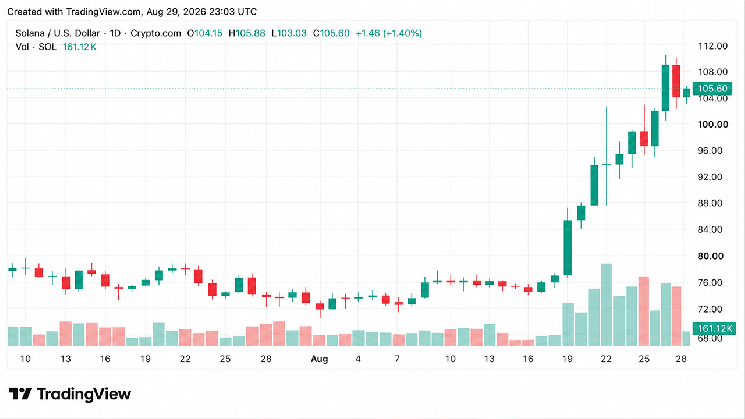
    Altcoin performance varied sharply, with several tokens recording double-digit gains or losses. Solana (SOL) led the advancing assets after Charles Schwab announced plans to add SOL, AVAX and LINK to its accounts in the near future.

    Privacy-focused cryptocurrency Monero (XMR) also posted strong gains, rising from $425 to close the week at $463 on Saturday. Among large-cap digital assets, RAIN recorded the strongest weekly performance, climbing 24%.

    On the losing side, XRP, one of the previous week’s top performers, declined nearly 7%. Dogecoin fell 7.2%, while ADA, XLM and BCH each dropped more than 10%.

    Despite the mixed performance across individual tokens, the combined altcoin market capitalization increased by just over 4%, rising from $1.13 trillion at the start of the week to $1.18 trillion on Aug. 29.