Tag: Digital Asset Market Clarity Act

  • Blockchain Association Announces Leadership Change After Crypto Clarity Act Stalls

    Blockchain Association Announces Leadership Change After Crypto Clarity Act Stalls

    Key Highlights

    • Summer Mersinger is stepping down as CEO of the Blockchain Association effective October 16, just one week after the U.S. Senate failed to advance the Digital Asset Market Clarity Act.
    • Kristin Smith, the association’s founding CEO who led the organization from 2018 until 15 months ago, will return to helm the advocacy group on an interim basis.
    • The leadership change closes a tumultuous period that included significant regulatory wins at the SEC and CFTC but ended with a sweeping legislative defeat for the crypto industry’s top priority bill.

    Blockchain Association Announces Leadership Transition After Senate Setback

    The Blockchain Association, one of the cryptocurrency industry’s most influential lobbying organizations in Washington, announced Friday that Summer Mersinger will depart as chief executive officer on October 16. The transition comes barely a week after the U.S. Senate failed to advance the Digital Asset Market Clarity Act—the sector’s signature legislative priority—in a vote that saw all Democratic senators and several Republicans withhold support.

    Stepping into the role on an interim basis is Kristin Smith, who founded the association in 2018 and served as its first CEO until her departure 15 months ago. The handover marks a return to familiar leadership for an organization that has been at the center of the crypto industry’s engagement with federal regulators and lawmakers during a period of intense scrutiny and policy debate.

    Mersinger Reflects on Regulatory Progress Amid Legislative Defeat

    In a statement accompanying the announcement, Mersinger highlighted the progress achieved during her tenure while acknowledging the recent setback. “I’m proud of how far we’ve come together, from the $GENIUS Act to real regulatory clarity at the SEC and CFTC,” said Mersinger, who joined the association after serving as a commissioner on the Commodity Futures Trading Commission (CFTC). “Kristin built this association from the ground up, and BA is in good hands. I’ll be cheering them on.”

    Mersinger’s reference to the GENIUS Act—the Guiding and Establishing National Innovation for U.S. Stablecoins Act—underscores one of the few legislative victories for the digital asset sector this Congress. Her tenure also coincided with a notable shift in enforcement posture at both the Securities and Exchange Commission (SEC) and the CFTC, though the failure of the broader market structure bill represents a significant blow to the industry’s push for comprehensive regulatory framework.

    Why This Matters

    The leadership change at the Blockchain Association signals a strategic recalibration for the crypto industry’s primary Washington advocacy vehicle at a critical juncture. With the Digital Asset Market Clarity Act effectively stalled for this congressional session, the industry faces a prolonged period of regulatory uncertainty heading into the 2025 legislative calendar. Smith’s return brings institutional memory and established relationships with key Hill offices and regulatory agencies—assets that may prove valuable as the association navigates a likely shift toward administrative and judicial strategies in the absence of legislative progress. The transition also reflects the broader volatility in crypto policy advocacy, where personnel moves often track the ebb and flow of political momentum in Washington.

    Frequently Asked Questions

    When does the leadership transition take effect?

    The handover from Summer Mersinger to Kristin Smith is scheduled for October 16, according to the association’s Friday statement.

    Why is Summer Mersinger leaving the Blockchain Association?

    The announcement did not specify a reason for Mersinger’s departure, but it comes one week after the U.S. Senate failed to advance the Digital Asset Market Clarity Act, a major legislative priority for the crypto industry.

    What is Kristin Smith’s background with the organization?

    Kristin Smith founded the Blockchain Association in 2018 and served as its first CEO until stepping down approximately 15 months ago. She is returning on an interim basis.

  • GOP Senator Spotlights US President’s Crypto Ventures

    GOP Senator Spotlights US President’s Crypto Ventures

    Key Highlights

    • Republican Senator John Curtis of Utah has defected from party lines to demand subpoenas for both Donald Trump Jr. and Hunter Biden, citing cryptocurrency ventures and foreign influence concerns.
    • Curtis specifically alleges Trump Jr. attended a private island wedding after-party funded by a Putin-connected Russian oligarch, while also promoting family crypto projects and prediction markets.
    • Senate Judiciary Committee Ranking Democrat Dick Durbin endorsed the bipartisan investigation, warning that ignoring the matter would make the committee complicit in “a cover up.”

    First-Term Senator Breaks Ranks to Demand Dual Investigation

    In a striking departure from Republican orthodoxy, freshman Senator John Curtis of Utah has formally requested that the Senate Judiciary Committee issue subpoenas for the adult sons of two sitting and former presidents. Addressing Committee Chair Chuck Grassley of Iowa and Ranking Member Dick Durbin of Illinois, Curtis framed his demand around “the use of family relationships for private financial benefit, favoritism, or access by domestic and foreign entities.” The move places the first-term senator, who faces no reelection until 2030, at the center of a bipartisan push to scrutinize the business dealings of Donald Trump Jr. and Hunter Biden simultaneously.

    Cryptocurrency Ventures and Oligarch Connections Draw Scrutiny

    Curtis’s letter singles out several interlocking concerns surrounding Trump Jr., with cryptocurrency promotion taking center stage. The senator highlighted the president’s son’s active involvement in family cryptocurrency projects, work on prediction markets falling under Commodity Futures Trading Commission jurisdiction, foreign real estate transactions, and contracts with defense companies. These activities, Curtis argues, raise questions about whether foreign individuals gain inappropriate access to relatives of the sitting president.

    The catalyst for Curtis’s intervention traces to Trump Jr.’s wedding celebrations. According to the senator, Russian oligarch Aras Kremlev—who recently traveled with Vladimir Putin’s delegation to China—financed an after-party on a private island in the Bahamas. Trump Jr.’s wife, Bettina Anderson, acknowledged the event on Instagram as a “very generous gift from Kremlev.” Last week, ProPublica reported the celebration had been “secretly financed” by an oligarch associated with Putin, though the president subsequently stated his son had reimbursed Kremlev.

    Bipartisan Momentum Builds Around Equal Scrutiny

    Curtis drew a sharp distinction between ordinary wedding gifts and the alleged oligarch-funded festivities. On X, he wrote: “A toaster is a wedding gift. A private-island party paid for by a Putin-connected oligarch is something else altogether. Republicans nearly wore out the subpoena machine investigating Hunter Biden’s foreign relationships. We should not unplug it now. ‘Trust us’ was not enough then, and it…”

    The senator’s demand extends equally to Hunter Biden, whom Curtis argues conducted substantial business dealings abroad—particularly with China and Ukraine—during periods when Joe Biden either held office or sought it. While the former president pardoned his son in December 2024, Curtis noted that Hunter Biden has denied involving his father in business dealings.

    Durbin endorsed the dual approach, declaring that “corruption at the highest levels of our government should never be tolerated.” He emphasized that while Hunter Biden has already testified under oath to Congress, Trump Jr. has not. To ignore the issue, Durbin warned, would render the committee part of “a cover up.”

    Why This Matters: Crypto Regulation and Ethical Boundaries

    The investigation request arrives at a pivotal moment for digital asset policy. Just one week earlier, Republican senators failed to secure sufficient Democratic support to advance the Digital Asset Market Clarity Act (CLARITY), legislation designed to establish market structure regulations for the cryptocurrency industry. Several Democrats opposed the bill explicitly because they believed the president “was using crypto to convert the presidency into a money-making scheme.”

    That allegation carries a specific financial figure: Trump has claimed $1.4 billion in digital asset investment earnings through 2025. Prior to this episode, Democrats had already called for investigations into the president’s memecoin, the family-owned World Liberty Financial venture, and a reported $500 million deal with the Abu Dhabi royal family. Republicans countered that Trump had made concessions on ethics language before the vote. Curtis’s intervention now threatens to reshape the legislative calculus around crypto regulation by tying market structure debates directly to first-family financial entanglements.

    Frequently Asked Questions

    What specific allegations does Senator Curtis make against Donald Trump Jr.?

    Curtis alleges Trump Jr. promoted family cryptocurrency projects and prediction markets, engaged in foreign real estate transactions and defense contracts, and attended a private island wedding after-party funded by Russian oligarch Aras Kremlev, who has ties to Vladimir Putin. The senator argues these activities raise questions about foreign access to the president’s family.

    Why is Senator Curtis also targeting Hunter Biden?

    Curtis argues for equal scrutiny, citing Hunter Biden’s “substantial business dealings abroad, especially with China and Ukraine” during periods when Joe Biden held office or was seeking it. While Hunter Biden has testified under oath and received a presidential pardon in December 2024, Curtis maintains the investigation should proceed to establish facts and identify needed reforms.

    How does this relate to cryptocurrency legislation?

    The demand comes one week after Senate Republicans failed to advance the Digital Asset Market Clarity Act due to Democratic opposition. Democrats explicitly cited concerns that the president was using cryptocurrency to monetize the presidency, pointing to $1.4 billion in reported digital asset earnings, the family’s World Liberty Financial venture, and a $500 million Abu Dhabi deal. Curtis’s investigation could directly impact future crypto regulatory efforts.

  • Clarity Law Fails, Bitcoin and Altcoins Drop; Analysts Say “Don’t Worry About It,” Outline Recovery Needs

    Clarity Law Fails, Bitcoin and Altcoins Drop; Analysts Say “Don’t Worry About It,” Outline Recovery Needs

    The Digital Asset Market Clarity Act failed to advance in the U.S. Senate on Tuesday, falling short of the 60-vote threshold required to proceed. The procedural vote tally stood at 49 in favor and 50 against, effectively stalling the comprehensive regulatory framework for digital assets.

    The outcome triggered immediate sell-offs across Bitcoin and altcoin markets. However, analysts speaking to The Block characterized the legislative setback as a delay rather than a structural shift for the crypto sector, emphasizing that macroeconomic forces—particularly Federal Reserve monetary policy—remain the primary driver of medium-to-long-term market direction.

    “The Failure of the Law to Pass is Not a Structural Problem”

    Arctic Digital Research President Justin d’Anethan told The Block that while the CLARITY Act’s failure was disappointing, it does not signal a fundamental market problem.

    d’Anethan pointed out that current Bitcoin price levels and previous all-time highs were achieved before the Clarity Act was in effect. He noted that institutional investors view the development not as a complete failure of the regulatory framework, but rather as a delay in the regulatory timeline. According to the analyst, interest rates and the overall monetary policy environment may be more decisive than regulatory clarity in determining the direction of the crypto market.

    Regulation Not a Key Determinant in Current Cycle

    BTC Markets crypto analyst Rachael Lucas offered a parallel assessment, stating that regulatory efforts are not a key determinant in the current crypto market cycle and that the market is more sensitive to interest rates.

    Lucas identified three critical areas for investors to monitor in the coming period:

    “1) Whether the Fed’s expected interest rate hikes will mark the beginning of a longer period of tightening, 2) Whether capital inflows into spot Bitcoin ETFs will accelerate again, 3) Whether an alternative regulatory path will emerge that can proceed without requiring 60 Senate votes.”

    Lucas added that capital is not exiting the market but concentrating in specific assets. While Congress is not strictly necessary for a fourth-quarter recovery, the analyst stressed that a prerequisite for such a rebound is for interest rates not to worsen further.

    “All Eyes Are on the FED Today!”

    Market attention has now pivoted squarely to the Federal Reserve. The U.S. central bank is expected to raise its benchmark interest rate for the first time since 2023 at today’s FOMC meeting, with a 25-basis-point increase widely anticipated. Futures markets are pricing in a higher than 90% probability of a hike at this session, with an additional increase projected before year-end.

    This is not investment advice.

  • Senate Cloture Vote on H.R. 3633 Falls 11 Votes Short as Four Republicans Oppose

    Senate Cloture Vote on H.R. 3633 Falls 11 Votes Short as Four Republicans Oppose

    The U.S. Senate failed to advance the Digital Asset Market Clarity Act on Tuesday, rejecting a procedural motion to begin debate on the legislation by a narrow 49-50 vote. The measure, formally known as H.R. 3633, required 60 votes to overcome a filibuster and fell 11 votes short of the threshold needed to proceed.

    Party Lines Fracture on Procedural Vote

    Every senator voting in favor of the motion was a Republican. However, four Republican senators broke with their party to vote against proceeding: Susan Collins of Maine, Josh Hawley of Missouri, Jerry Moran of Kansas, and Thom Tillis of North Carolina. No Democrat or independent supported the motion. Senator Chris Coons of Delaware did not cast a vote.

    The vote occurred at 2:19 p.m. ET and was recorded as Roll Call 234. Because the motion to proceed failed, the Senate never took up the bill for debate, amendment, or a final passage vote.

    Bill Would Define Crypto Oversight and Restrict CBDC

    The Digital Asset Market Clarity Act aimed to establish a regulatory framework dividing oversight of digital commodities between the Securities and Exchange Commission (SEC) and the Commodity Futures Trading Commission (CFTC). The legislation also included provisions prohibiting Federal Reserve banks from offering products directly to individuals and barring the use of a central bank digital currency (CBDC) in monetary policy operations.

    Bitcoin ETFs See $160 Million Inflow as Ether Products Extend Gains

    In market activity on Monday, U.S. spot bitcoin exchange-traded funds (ETFs) recorded a net inflow of $160.04 million, reversing four consecutive sessions of outflows from the prior week. Ether ETFs continued their positive momentum with a second straight day of inflows, adding $121.02 million.

    BlackRock’s IBIT dominated bitcoin fund flows, attracting $134.35 million. Fidelity’s FBTC followed with $53.33 million in inflows. Ark and 21Shares’ ARKB was the notable exception, posting a $41.95 million outflow.

    According to SoSoValue data, total bitcoin ETF trading volume reached $2.69 billion for the session. Combined net assets across the funds rose back above the $100 billion milestone to $100.09 billion after dipping below that level during last week’s selling pressure.

    BlackRock’s ETHA Leads Ether Inflows; XRP and Solana Funds Gain

    BlackRock’s ETHA paced ether ETF inflows with $80.50 million. XRP-focused ETFs added $11.26 million, all directed to Bitwise’s XRP fund. Solana ETFs attracted $11.01 million in new capital.

    Weekly Context Shows Volatility Amid Institutional Accumulation

    The Monday inflows follow a turbulent week for bitcoin ETFs, which posted $462.7 million in net outflows for the week ending Sept. 12 — the first weekly reversal after three straight weeks of inflows. Thursday alone saw $282.7 million exit the funds, marking the largest single-day withdrawal since July.

    Despite the weekly outflows, on-chain data from Arkham Intelligence shows BlackRock’s IBIT accumulated approximately $1.08 billion worth of bitcoin over the preceding 20 days, with inflows recorded on seven of those sessions. By comparison, Grayscale’s GBTC shed a net $254.7 million during the same period.

  • Trump Agrees to Revised Clarity Act Ethics Provision

    Trump Agrees to Revised Clarity Act Ethics Provision

    Legislation addressing digital asset market clarity and government ethics advanced toward a critical procedural vote this week, setting the stage for a complex legislative path that extends into the post-election session.

    Cloture Vote Determines Immediate Future

    The bill’s survival hinges on a cloture vote scheduled for this week. If successful, the measure will proceed through additional procedural steps, including a final passage vote in the Senate. The House of Representatives must also take up the legislation when it reconvenes after the November election recess.

    Ethics Provisions Strengthened in Revised Draft

    The updated legislation introduces significant changes to ethics enforcement for senior government officials. The provision now includes civil penalties for issuers and, marking a departure from the previous draft, grants state attorneys general the authority to file lawsuits to enforce compliance. Additionally, lawmakers removed a sunset clause that would have limited the enforcement timeframe.

    Divestiture and Blind Trust Requirements Detailed

    The revised text establishes strict timelines for covered individuals—defined as senior government officials subject to the ethics rules—who hold significant financial interests in digital assets. According to the bill:

    “Not later than the effective date of division C of the Digital Asset Market Clarity Act under section 30104 of that division, a covered individual who maintains a significant financial interest shall — A$0.08276 divest the significant financial interest; or B$0.2173 place the significant financial interest in a qualified blind trust,” the revised text said.

    Disclosure and Exchange Restrictions

    Following divestiture or placement in a blind trust, the covered individual has three days to notify the relevant ethics office. That office then has an additional three days to publicly announce the action, which will be treated as a sale for regulatory purposes. The legislation also prohibits cryptocurrency exchanges from listing any digital assets issued by a covered individual.

  • What Would It Take to Bring Hyperliquid to the US? Former SEC Counsel Explains

    What Would It Take to Bring Hyperliquid to the US? Former SEC Counsel Explains

    Hyperliquid could face a 10-to-12-month regulatory process to enter the U.S. market, even if federal agencies move quickly, according to former U.S. Securities and Exchange Commission senior counsel Ashley Ebersole. The estimate follows President Donald Trump’s statement that regulators were working on a compliant route for the perpetual futures platform.

    Ebersole, co-founder and chief legal officer at tx, told crypto.news that the main challenge is not simply obtaining approval for Hyperliquid to operate in the United States. Regulators would first need to determine how offshore-style crypto perpetual futures fit within existing securities and derivatives laws.

    Trump highlighted the issue on Aug. 19 during a White House meeting with crypto and financial industry executives. He said Commodity Futures Trading Commission Chair Michael Selig was working to bring Hyperliquid into the United States in a “fully compliant and legal fashion.” Contemporary reports did not identify an approval, regulatory structure, or timetable for the proposed move.

    The comments came as the administration urged Congress to advance the Digital Asset Market Clarity Act. As previously reported by crypto.news, Trump used the same Aug. 19 meeting to call on lawmakers to pass the legislation, which would establish clearer boundaries between SEC and CFTC oversight of digital assets.

    Hyperliquid would need more than CFTC approval

    U.S. law does not currently provide a straightforward route for offering crypto perpetual futures to American retail customers in the same form commonly available on offshore platforms, Ebersole said.

    The CFTC would probably have primary jurisdiction over perpetual contracts tied to commodities, including crypto assets that are not securities. Contracts based on securities, however, could fall under the SEC’s authority as security-based swaps or other securities-linked products.

    “The threshold issue is that U.S. law does not currently provide a straightforward regulatory pathway for offering crypto perpetual futures to U.S. retail customers in the form in which they trade offshore,” Ebersole said.

    A compliant Hyperliquid structure could require registrations covering the trading venue, clearing operations and intermediaries. Ebersole said designated contract market, or DCM, and derivatives clearing organization, or DCO, infrastructure could form part of the process, with separate SEC requirements applying when securities are involved.

    Registration would address only part of the challenge. Federal agencies would first need to determine whether Congress had already granted them sufficient authority over the products and then establish rules allowing perpetual futures to be legally offered.

    “The harder problem is not simply obtaining a registration; it is that the existing U.S. regulatory architecture was not designed around offshore-style perpetuals, so a lot of regulatory ‘building’ would be needed.”

    Regulators could use formal rulemaking, exemptive relief or a combination of both to create such a pathway, Ebersole added.

    Part of that debate is already underway. In July, the Hyperliquid Policy Center and Phantom asked the CFTC to develop rules tailored to onchain markets instead of applying requirements designed for traditional intermediaries. The groups argued that decentralized software developers and non-custodial wallet providers should not automatically face the same registration obligations as conventional financial firms.

    SEC and CFTC jurisdiction would depend on the underlying asset

    Dividing responsibility between the two federal agencies would create another layer of regulatory work.

    Ebersole compared the issue with the framework established after the Dodd-Frank Act, which divided federal oversight between swaps regulated by the CFTC and security-based swaps overseen by the SEC. In his view, crypto perpetuals could follow a similar principle, with jurisdiction determined by each contract’s economic exposure.

    A perpetual based on a security or group of securities would generally involve the SEC, while a contract tied to a commodity would normally fall under the CFTC’s derivatives authority, he said.

    More complex questions could emerge when spot assets and derivatives interact within the same trading ecosystem. According to Ebersole, those arrangements could create edge cases requiring coordination between both regulators, similar to the detailed jurisdictional boundaries the agencies developed after Dodd-Frank.

    The issue is particularly relevant to equity-linked perpetuals. On Aug. 24, the Hyperliquid Policy Center proposed treating qualifying equity perpetuals as security futures under an existing structure jointly overseen by the SEC and CFTC. The organization said HIP-3 markets had processed more than $480 billion in cumulative notional volume during their first 10 months.

    Several days earlier, the Policy Center and trade[XYZ] had submitted five proposed pillars to the SEC for regulating pre-IPO perpetual contracts. The SEC had published the submission but had not endorsed or approved the proposed products.

    A U.S. Hyperliquid pathway could take 10 to 12 months

    Even with political support, Ebersole expects the administrative process to take considerably longer than the technical work required to offer the products.

    His 10-to-12-month estimate assumes that the SEC and CFTC actively decide to establish a route for perpetual futures. Regulators would first need to identify their statutory authority, develop a framework and prepare any required rules or exemptions.

    A formal rulemaking process could then require the agencies to publish proposals, collect public comments, review those submissions, adopt final measures and implement the resulting framework.

    “The 10-to-12-month estimate assumes a lengthy procedure phase that’s principally about administrative process rather than technological implementation,” Ebersole said.

    A faster process could be possible if regulators relied substantially on powers and exemptions already available to them.

    “Could that happen in six months? Potentially, particularly if the agencies rely heavily on existing authorities or exemptive mechanisms.”

    Ebersole cautioned that the longer estimate already assumes regulators want the process to succeed. Litigation, disagreements between the SEC and CFTC, changing political priorities or a conclusion that Congress must first pass legislation could delay any U.S. launch further.

    U.S. traders already have limited exposure to perpetual products under regulated structures. In June, Kalshi filed with the CFTC to list perpetual futures linked to HYPE after launching Bitcoin and Ethereum perpetual contracts for U.S. customers.

    Access to Hyperliquid itself remains more restricted. Coinbase added more than 290 Hyperliquid-powered perpetual markets to its Base App on Aug. 19, with leverage reaching as high as 50x on supported contracts. U.S. users were excluded, along with users in the United Kingdom and Canada.

    Existing law could offer a faster but less certain route

    Rather than waiting for Congress, the SEC and CFTC could conclude that their existing statutory powers are sufficient to establish a regulated framework, according to Ebersole. That approach could shorten the process, particularly if the agencies used exemptions alongside existing derivatives and securities rules.

    A legal constraint remains after the U.S. Supreme Court’s 2024 decision in Loper Bright Enterprises v. Raimondo, which ended the Chevron doctrine that had directed courts to defer to reasonable agency interpretations of ambiguous federal statutes.

    “An agency cannot create statutory jurisdiction simply by interpreting an ambiguity in its favor,” Ebersole said.

    If an SEC or CFTC interpretation were challenged, a court would independently determine whether Congress had actually granted the agency authority over the product, he said. Agency reasoning could still carry persuasive weight, but it would not receive Chevron-style deference simply because the underlying statute was ambiguous.

    Congressional action would therefore provide a cleaner legal route, according to Ebersole. Lawmakers could expressly authorize perpetual products, divide responsibility between the SEC and CFTC and establish the limits of each regulator’s authority.

    That route carries its own timing problem. Ebersole said the congressional process could take considerably longer and might not result in a law at all.

    The question is particularly relevant while the CLARITY Act remains unresolved in Washington. The legislation seeks to establish federal boundaries between digital commodities and securities, giving the CFTC additional authority over qualifying digital commodity markets while allowing the SEC to retain jurisdiction over securities.

    A U.S. perpetual futures framework would extend beyond Hyperliquid

    Any regulatory route created for Hyperliquid would also affect competing U.S. trading platforms, Ebersole said.

    Federal regulators could not realistically establish a lawful framework that applied only to one company. Once the SEC and CFTC set requirements for offering crypto perpetual futures, other firms meeting the same regulatory standards would have grounds to seek permission to offer comparable products.

    “Whatever pathway regulators create for Hyperliquid cannot realistically be Hyperliquid-specific,” Ebersole said.

    Coinbase, Kraken and other appropriately registered platforms would therefore have a strong basis to pursue similar products if regulators establish a workable U.S. framework, according to Ebersole.

    “The larger significance of onshoring Hyperliquid is not simply whether one offshore platform can enter the United States. It is whether regulators are prepared to welcome a major product category that has largely developed outside the U.S. to regulated domestic competition.”

  • Tether CEO Slams BIS Push for Tokenized Bank Deposits

    Tether CEO Slams BIS Push for Tokenized Bank Deposits

    The debate over how to represent fiat money onchain is intensifying, with Tether CEO Paolo Ardoino challenging the Bank for International Settlements’ (BIS) preference for tokenized bank deposits over stablecoins.

    Ardoino criticized recent comments from Pablo Hernandez de Cos, general manager of the BIS, who argued that stablecoins are not an effective substitute for fiat money. De Cos cited concerns including limited redeemability, supply constraints, interoperability challenges and the potential facilitation of crime.

    Instead, De Cos described tokenized bank deposits as a “more direct path to harness ​tokenisation while preserving the monetary system’s foundations.”

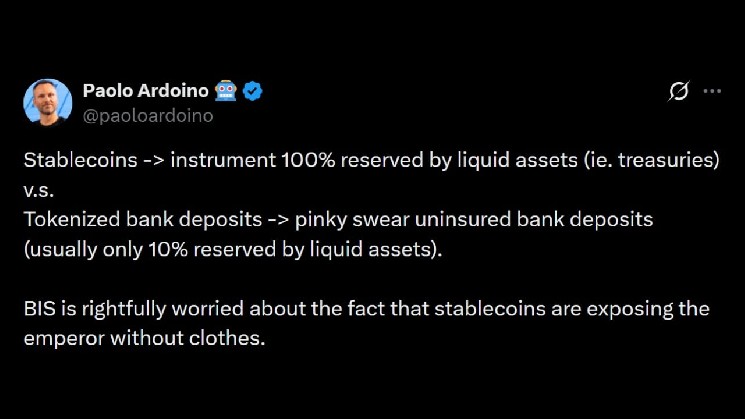
    Ardoino argued that the BIS’s concerns overlook what he views as a key distinction between the two forms of digital money. He said stablecoins are generally backed almost entirely by U.S. Treasury securities, while tokenized bank deposits are typically backed by only around 10% in liquid assets.

    “BIS is rightfully worried about the fact that stablecoins are exposing the emperor without clothes. Why someone should choose to put his savings into a fractional reserve product while stablecoins are fully reserved?” Ardoino declared.

    Stablecoin adoption expands in emerging markets

    Stablecoins have continued to gain popularity and adoption. Tether’s $USDT, with a market capitalization of more than $183 billion at the time of writing, has become an important financial product in emerging markets.

    Ardoino said there were economies “heavily relying on $USDT, for both internal and foreign commerce.”

    Stablecoins become a U.S. policy flashpoint

    The debate over stablecoins has also reached the highest levels of U.S. politics, becoming a contentious issue in discussions over the Digital Asset Market Clarity Act, known as the CLARITY ACT.

    Banks have raised concerns about deposit flight if cryptocurrency exchanges are permitted to offer rewards on stablecoin holdings. Ardoino suggested that broader awareness of stablecoin reserves could accelerate a shift away from traditional bank deposits.

    “What happens to financial system if people start realizing that stablecoins are safer and move their savings into the better asset class? We’re in the Find Out phase.” Ardoino concluded, hinting at large-scale deposits-for-stablecoins substitution.