Tag: diesel prices

  • Bitcoin Faces New Inflation Test as Diesel Hits Nominal $6.53 Record

    Bitcoin Faces New Inflation Test as Diesel Hits Nominal $6.53 Record

    Key Highlights

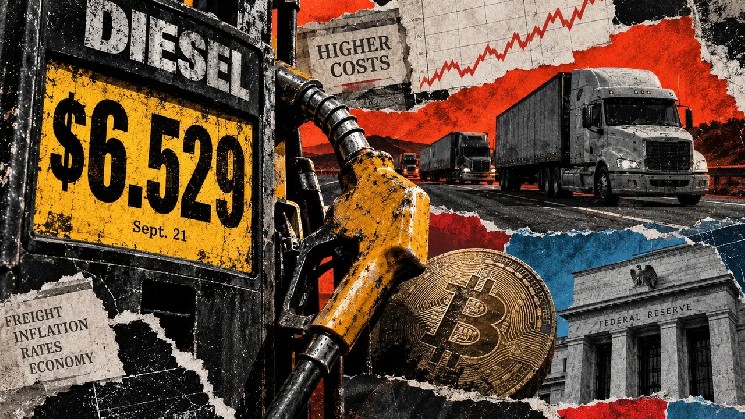
    • US on-highway diesel reached $6.529 per gallon on September 21, marking a new nominal record high and a 24.4-cent weekly increase, according to the Energy Information Administration.
    • Distillate fuel inventories fell to 107.431 million barrels in the week ended September 18, signaling constrained supply amid tight global distillate and crude markets.
    • The price surge raises freight-cost inflation risks that could influence Federal Reserve interest-rate policy, with upcoming CPI and PCE data releases in October serving as critical tests for Bitcoin and risk-asset investors.

    Diesel Hits Fresh Nominal Record as Inventories Tighten

    The Energy Information Administration reported Monday that the US average on-highway diesel price climbed to $6.529 per gallon on September 21, up 24.4 cents from the prior week. Because the EIA had already designated the September 14 reading as a nominal dollar record, the latest figure establishes another all-time high at the pump without inflation adjustment. The increase coincides with a drawdown in distillate fuel stocks, which fell to 107.431 million barrels in the week ended September 18 from 107.859 million barrels a week earlier, according to EIA data published September 23. The inventory decline reinforces evidence of constrained supply in the distillate complex.

    Global Supply Dynamics Drive Price Surge

    The EIA attributes the recent diesel surge to tight global distillate supply and elevated crude oil prices. Diesel fuels the majority of US freight movement by road and rail, and the agency notes that sustained high prices can translate into higher shipping costs across the logistics chain. Whether carriers pass those costs to shippers and ultimately to consumers depends on contract structures, competitive dynamics, and the duration of the fuel-price squeeze. A prolonged rise across multiple freight billing cycles would pose a more significant inflation risk than a single expensive week at the pump.

    Upstream Price Pressure Evident in Producer Data

    Earlier data from the Bureau of Labor Statistics illustrate why the diesel-to-freight channel warrants close monitoring. The producer price index for diesel fuel jumped 24.1% in August from July, while the truck freight transportation price index rose 2.0% over the same period. Both increases occurred before the latest retail diesel record, signaling upstream price pressure building in August. The data leave the precise cause of the freight index increase and any downstream consumer-price effect unsettled, but the sequence suggests a transmission mechanism from fuel costs to transportation services is active.

    Inflation and Rate Expectations Link Diesel to Bitcoin

    The potential Bitcoin effect operates through inflation and interest-rate expectations. If sustained fuel and freight costs keep broader inflation firm, investors may anticipate the Federal Reserve holding rates higher for longer, weighing on assets sensitive to financing conditions. The Federal Open Market Committee raised its target federal funds range to 3.75%–4% on September 16, citing elevated inflation broadly. That decision preceded the September 21 diesel reading. Bitcoin’s specific response to this diesel move remains to be seen, but the macroeconomic pathway is clear: diesel → freight costs → services inflation → Fed policy expectations → risk-asset valuation.

    Why This Matters

    The diesel price spike sits at the intersection of physical commodity markets and monetary policy. Distillate inventories remain near seasonal lows, and global refining constraints—particularly in Europe and Asia—limit quick supply responses. The Federal Reserve’s next policy meetings will incorporate the September CPI release scheduled for October 14, the September producer price index on October 15, and the September Personal Consumption Expenditures price index on October 29. If diesel prices moderate or freight and consumer prices show limited pass-through, the case for a lasting inflation impulse from this episode weakens. For Bitcoin investors, the sequence of data releases over the next month will clarify whether the latest diesel record represents a transient supply shock or a durable cost-push factor that could keep interest rates elevated deeper into 2025.

    Frequently Asked Questions

    What is the current US on-highway diesel price and how does it compare to recent history?

    The national average on-highway diesel price reached $6.529 per gallon on September 21, 2024, up 24.4 cents from the prior week. The EIA had already labeled the September 14 price a nominal record, making this the second consecutive weekly record high in nominal dollar terms.

    How could higher diesel prices affect Federal Reserve interest-rate decisions?

    Diesel powers most US freight transport. Sustained increases can raise shipping costs, which may feed into broader services inflation. If upcoming CPI and PCE data show persistent inflation partly driven by freight costs, the Fed may maintain its current 3.75%–4% target range longer than markets currently expect, creating headwinds for rate-sensitive assets like Bitcoin.

    What upcoming economic releases will clarify the inflation impact?

    Key releases include the September Consumer Price Index on October 14, the September Producer Price Index on October 15, and the September Personal Income and Outlays report (including PCE price data) on October 29. These will reveal whether August’s upstream diesel and freight price pressures have passed through to consumer-level inflation.

  • U.S. Diesel Prices Hit Record High as Bitcoin and Gold Struggle

    U.S. Diesel Prices Hit Record High as Bitcoin and Gold Struggle

    Diesel prices are surging globally, driven primarily by escalating geopolitical tensions in the Middle East. The ongoing conflict involving the U.S., Israel, and Iran has disrupted crude oil flows and injected significant risk premiums into refined product markets. Compounding the supply-side pressure, tight refinery capacity and robust demand from both freight and industrial sectors have amplified the price move, transforming a regional supply shock into a worldwide spike at the pump.

    Federal Reserve Policy Under Scrutiny Amid Supply-Driven Inflation

    The Federal Reserve’s decision on Wednesday to raise its benchmark borrowing cost by 25 basis points to the 3.75%–4% range has drawn criticism from market observers. Critics argue the hike demonstrates a policy bias toward using interest rate increases to combat inflation rooted in oil-supply shocks—a strategy some view as a fundamental mistake. Higher borrowing costs historically act as a headwind for non-yielding assets, and the current environment is no exception.

    Record Diesel Prices Create Headwinds for Gold, Bitcoin, and Tech Stocks

    Record-high diesel prices are pressuring traditional safe-haven assets and growth equities alike. Both gold and bitcoin are widely viewed as stores of value and hedges against sovereign risk. However, historical precedent shows that rising interest rates weigh heavily on cryptocurrency valuations, a dynamic clearly illustrated during the Fed’s aggressive tightening cycle in 2022. Technology stocks, sensitive to discount rates and economic growth forecasts, face similar downward pressure.

    Global Central Banks Extend Tightening Cycle

    The shift toward restrictive monetary policy is not isolated to the United States. The European Central Bank has recently implemented its own rate increase, and the Bank of Japan (BOJ) is widely expected to follow suit with a hike on Friday. Major Wall Street institutions, including Goldman Sachs and Morgan Stanley, anticipate the Fed will deliver an additional 25 basis point increase at its October meeting, signaling that the global tightening cycle remains firmly in place.

  • U.S. Diesel Prices Hit Record High as Bitcoin, Gold Struggle

    U.S. Diesel Prices Hit Record High as Bitcoin, Gold Struggle

    Diesel Prices Surge Amid Middle East Tensions and Tight Refining Capacity

    Diesel prices are climbing sharply, driven primarily by escalating geopolitical tensions in the Middle East. The ongoing conflict involving the U.S., Israel, and Iran has disrupted crude oil flows and inflated risk premiums on refined products. Constrained refinery capacity worldwide, combined with robust demand from freight and industrial sectors, has amplified the price move, transforming a regional supply shock into a global price spike.

    Federal Reserve Policy Adds Pressure

    The Federal Reserve’s Wednesday rate hike underscores how policymakers remain biased toward using interest rate increases to combat inflation stemming from oil-supply shocks—a strategy some observers characterize as a mistake. Record diesel prices now present a significant headwind for gold, bitcoin, and technology stocks.

    Like gold, bitcoin is widely viewed as a store of value and a sovereign hedge. However, historically, higher borrowing costs have weighed on the cryptocurrency’s market value, as evidenced during the 2022 Fed tightening cycle.

    Rate Hike Details and Forward Guidance

    On Thursday, the Fed raised rates by 25 basis points, lifting the benchmark borrowing cost to the 3.75%-4% range. Goldman Sachs and Morgan Stanley both anticipate an additional 25 basis point hike in October.

    Global Central Banks Follow Suit

    Other major central banks are also tightening monetary policy. The European Central Bank recently increased rates, and the Bank of Japan (BOJ) is expected to do the same on Friday.

  • Gas Prices Set for “staggering increases” Across Multiple States

    Gas Prices Set for “staggering increases” Across Multiple States

    Americans are bracing for a sharp jump at the pump this week as escalating geopolitical tensions in Ukraine and the Middle East continue to tighten global oil supplies, according to leading energy analysts.

    Tom Kloza, chief energy advisor at Gulf Oil, issued a stark warning Tuesday that the coming 24 hours would deliver “staggering increases at the pump for both gasoline and diesel.”

    In a post on X, Kloza explained that fuel margins—the spread between wholesale costs and retail prices—“yet to catch up with previous wholesale hikes.” He specifically flagged the “Great Lakes and Rocky Mountain states in particular” for the most dramatic spikes.

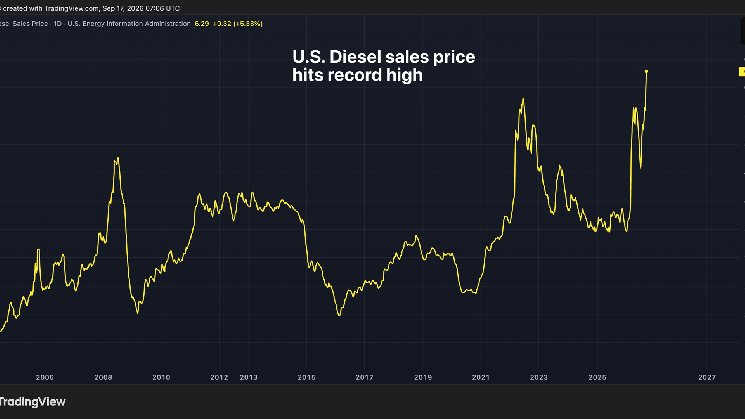
    Patrick De Haan, head of petroleum analysis at GasBuddy, echoed that urgency on social media Tuesday. “we’ve reached a new milestone—the U.S. average diesel price has hit $6.301/gal while gasoline is up to $4.355/gal. I expect both of these to jump noticeably over the next 48 hours. diesel could hit $6.60/gal in a few days, surpassing the inflation-adjusted peak seen in 2022.”

    National Averages Climb Above $4.37

    The latest data from the American Automobile Association (AAA) confirms the upward trajectory. The national average for regular gasoline reached $4.37 per gallon on Wednesday, up from $4.33 on Tuesday and $4.22 a week earlier. Year-over-year, the average has surged more than a dollar from $3.19 per gallon.

    State-by-State Breakdown: Where Prices Are Highest and Lowest

    California continues to lead the nation with the highest average price at $6.04 per gallon. Five other states—Washington, Hawaii, Nevada, Oregon, and Alaska—also recorded averages above the $5 threshold.

    Conversely, Indiana posted the lowest statewide average at $3.75 per gallon, though that figure remains up from $3.12 a year ago. Only ten states reported averages below $4 per gallon:

    • Texas ($3.8788)
    • Mississippi ($3.8955)
    • Louisiana ($3.9278)
    • Alabama ($3.9446)
    • Arkansas ($3.9699)
    • Kansas ($3.9733)
    • Missouri ($3.9745)
    • Kentucky ($3.9903)
    • Tennessee ($3.9970)
    • Indiana ($3.75)

    In 34 states, the average price sits between $4 and $5 per gallon, reflecting the broad geographic reach of the current price surge.