Tag: DeFi tokens

  • Layer-2 and DeFi Tokens Lead Broad Crypto Advance as Post-Fed Hike Nerves Fade

    Layer-2 and DeFi Tokens Lead Broad Crypto Advance as Post-Fed Hike Nerves Fade

    Key Highlights

    • DeFi and Layer-2 tokens led a broad crypto market rally Friday, with the DeFi Select Index surging 16% in 24 hours as risk-on sentiment returned following the Fed rate decision.
    • Bitcoin reclaimed $78,000 while Uniswap (UNI) futures open interest neared a record high, signaling strong institutional conviction in major DeFi protocols.
    • Implied volatility dropped to May lows and options skew turned short-term bullish for BTC and ETH, suggesting traders expect near-term market calm after key macro events cleared.

    DeFi and Layer-2 Tokens Spearhead Post-Fed Risk-On Rotation

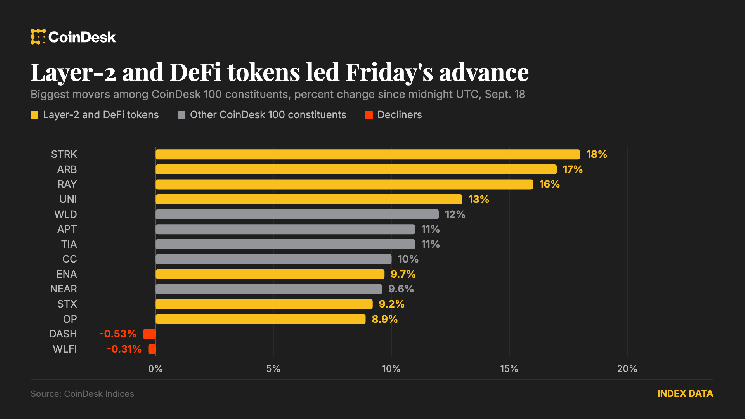
    Cryptocurrency markets extended their post-Federal Reserve rally into Friday, with a pronounced sector rotation shifting leadership from privacy and haven assets toward decentralized finance (DeFi) and Layer-2 scaling tokens. The DeFi Select Index (DFX) accelerated fastest among major benchmarks, surging 8.3% since midnight UTC and 16% over the trailing 24-hour period, reflecting a broad-based return to risk-on positioning across digital asset markets.

    Bitcoin $BTC rose above $78,000 during the European morning session, adding 2.1% since midnight UTC and 1.9% over the past 24 hours to trade at $78,192.86. Despite the advance, the largest cryptocurrency remains approximately 5% below its September 4 monthly high of $82,284 after two weeks of range-bound price action. The CoinDesk 100 index showed near-universal gains, with all but two constituents trading higher on the day.

    Macroeconomic Backdrop Fuels Risk Appetite

    The rally unfolded against a more conducive macroeconomic backdrop. The 10-year U.S. Treasury yield slipped back below the psychologically significant 5% threshold, while Brent crude eased under $103 per barrel after touching $109 earlier in the week. This combination relieved some of the inflation pressure that had followed the latest rate increase. Traditional risk assets mirrored the optimism, with S&P 500 and Nasdaq 100 futures rising 0.3% and 0.6% respectively, while gold and silver added 1.1% and 2.8%.

    Derivatives Data Reveals Structural Capital Inflows

    Futures Open Interest Expands as Volume Dips

    The crypto futures market is signaling a revival in positional trading rather than speculative churn. Cumulative open interest (OI) expanded nearly 5% to $141.2 billion, contrasting with a 3% decline in daily trading volume to $95 billion. The taker buy-sell volume remains balanced, suggesting capital is entering the market structurally rather than through aggressive momentum chasing.

    Bitcoin Positioning Builds Gradually

    Bitcoin futures open interest ticked up to 680,000 BTC from 670,000 BTC since midnight UTC, a modest increase accompanying the price advance. This combination typically represents a build-up of long, or bullish, positions. However, the increase remains slight, and the OI tally sits well below the peak of 800,000 BTC recorded early this year, indicating overall positioning remains light by historical standards.

    Binance Trader Ratios Show Institutional Conviction

    Binance’s top trader long-short accounts ratio pulled back to 1.52 from Wednesday’s high near 2.0, while the long-short positions ratio remains elevated at 2.36. This divergence means fewer individual large holders, or “whales,” are leaning long, but those who are have significantly increased their bet sizes, pointing to strong institutional conviction rather than retail-driven speculation.

    Uniswap Futures Open Interest Nears Record

    Among altcoins, open interest in futures tied to Uniswap’s $UNI surged to 86.61 million tokens, flirting with an all-time high and up from 76.89 million tokens yesterday. This expansion highlights substantial capital inflows moving in tandem with a 30% explosion in the token’s spot price. The renewed appetite for major DeFi altcoins stems from mounting market optimism surrounding friendly, coordinated crypto regulations from the SEC and CFTC.

    Volume Delta and Volatility Metrics Confirm Bullish Tilt

    The bullish mood is reflected in the 24-hour OI-adjusted cumulative volume delta, which is positive for most major tokens excluding GRAM, SHIB, HBAR, and BNB. A positive reading indicates bulls are being more aggressive by executing market orders rather than passive limit orders. With major events including the Clarity Act vote and the Federal Reserve and Bank of Japan interest-rate meetings now past, Bitcoin’s annualized 30-day implied volatility index (BVIV) dropped to 36%, a level that has acted as a floor since May, pointing to expectations for near-term market calm.

    Options Skew Turns Short-Term Bullish

    In options listed on Deribit, Bitcoin’s one-week put-call skew has turned positive, indicating relative richness of calls over puts. However, one- and two-month skews still show a slight put bias. Ethereum’s one-week skew also shows bullishness. The 24-hour volume rankings present a mixed picture, with both BTC calls and puts featuring among the most actively traded contracts.

    Token Spotlight: UNI Leads DeFi Surge, Layer-2 Tokens Match Strength

    The DeFi Select Index’s advance rested largely on Uniswap ($UNI), which gained 13% since midnight UTC and 25% over the past 24 hours. Ethena (ENA) added 9.6% and liquid-staking token Lido DAO ($LDO) rose 6.6%. Layer-2 tokens matched DeFi’s strength, led by Starknet ($STRK) at 18% on the day and 21% over 24 hours, with Arbitrum ($ARB) up 17% and 25%, Stacks ($STX) up 9.2%, and Optimism ($OP) up 8.9%. STRK reached its highest level since June 19, while ARB at 20.9 cents hasn’t traded this high since January.

    Solana ($SOL) added 4.5% to $106.14, though the sharper move occurred within its ecosystem where Solana-based DEX token Raydium ($RAY) rose 16% to $1.71 while liquid-staking token Jito ($JTO) lagged at 1.6%. This split points to DEX volume driving the bid rather than a blanket rally for the chain. Thursday’s leader, Zcash ($ZEC), traded at $1,490.10 for a gain of 1.6% on the day against 7.6% over 24 hours, meaning almost all of its advance occurred Thursday. Rival privacy token Dash ($DASH) was one of only two CoinDesk 100 constituents in the red, losing 0.53%, alongside World Liberty Financial ($WLFI), which fell 0.31%. CoinMarketCap’s “Altcoin Season” index rose to 44/100 from Tuesday’s low of 32/100, confirming speculation as the overarching theme Friday.

    Why This Matters

    The sector rotation from privacy coins to DeFi and Layer-2 tokens signals a meaningful shift in market narrative. For months, regulatory uncertainty had pressured DeFi protocols, but the prospect of coordinated SEC and CFTC frameworks has reignited institutional interest in governance tokens like UNI and scaling solutions like ARB, OP, and STRK. The derivatives data reinforces this: rising open interest alongside declining volume suggests conviction-driven positioning rather than speculative flipping. Meanwhile, implied volatility compressing to multi-month lows and short-term options skew turning bullish indicate the options market is pricing in a period of stability after a dense macro calendar. For traders, the Altcoin Season index climbing from 32 to 44 confirms broadening participation beyond Bitcoin, though it remains well below levels seen during full altcoin rotations. The next test will be whether this derivatives-led bid translates into sustained spot accumulation or fades as macro data dependencies return.

    Frequently Asked Questions

    Why are DeFi and Layer-2 tokens outperforming Bitcoin and privacy coins?

    Market optimism around potential coordinated crypto regulations from the SEC and CFTC has renewed institutional appetite for major DeFi protocols like Uniswap and scaling solutions like Arbitrum, Optimism, and Starknet. The DeFi Select Index surged 16% in 24 hours while privacy leaders like Zcash and Dash stalled or declined.

    What does the rise in futures open interest with falling volume indicate?

    The 5% expansion in cumulative open interest to $141.2 billion alongside a 3% drop in daily volume to $95 billion suggests structural capital inflows and positional trading rather than short-term momentum chasing. Balanced taker buy-sell volume further supports this interpretation.

    How should traders interpret the current options skew and volatility readings?

    Bitcoin’s 30-day implied volatility (BVIV) dropping to 36%—a floor since May—signals expectations for near-term calm after key macro events. One-week put-call skew turning positive for both BTC and ETH shows short-term bullish bias, though longer-dated skews retain a slight put bias, indicating hedging for medium-term downside risk remains.

  • Weekly Crypto Winners and Losers: VVV, LSK, ARB, ENA

    Weekly Crypto Winners and Losers: VVV, LSK, ARB, ENA

    Crypto Market Shifts to Defensive Posture Amid Rising Yields and Rate-Hike Fears

    This week, the cryptocurrency market adopted a more defensive setup. Rising Treasury yields, climbing oil prices, and growing expectations for Federal Reserve rate hikes pressured risk assets, pushing Bitcoin (BTC) below the $77,000 threshold. However, the sell-off was not uniform across the board. Capital continued to rotate into utility-based narratives, specifically DeFi and privacy tokens, signaling where investors are allocating capital during the current uncertainty.

    Weekly Winners: Privacy AI and DeFi Lead Gains

    Venice Token (VVV): Privacy-Focused AI Platform Hits New All-Time High

    Venice Token (VVV) emerged as the best-performing cryptocurrency this week, surging more than 35% to break into a new all-time high. The critical question now is whether this bullish momentum can sustain into next week.

    Two technical signals suggest continuation is likely. First, VVV’s Relative Strength Index (RSI) on the weekly chart remains well below the overbought threshold. This contrasts sharply with the token’s early-May rally, which drove the RSI into overbought territory and appeared to cap price action near the $20 level.

    Source: TradingView (VVV)

    Consequently, VVV is currently in a stronger technical position than it was in May. The price has successfully broken through the crucial $20 resistance during the past week, suggesting the next leg higher may have significantly more room to run. If VVV holds above $20, a continued breakout could open the path toward the $25–$30 range in the coming week.

    Bitway (BTW): Bitcoin Infrastructure Project at a Technical Crossroads

    Bitway (BTW) secured the second-largest weekly gain, rising 22%. Unlike VVV, BTW has yet to enter the price discovery phase. The asset has climbed for six consecutive weeks, making it technically due for a correction.

    Technically, BTW appears extended at current levels. The token is encountering resistance near $0.60, and the RSI has already entered overbought territory. These factors suggest the rally is unlikely to continue unabated. If this setup holds, BTW is expected to correct shortly before attempting to overcome resistance once again. For the bullish trend to remain intact, buyers must withstand near-term selling pressure.

    Injective (INJ): DeFi Blockchain Tests Key Resistance

    Injective (INJ) claimed the third spot among weekly winners, climbing 10% on Thursday. INJ displays a more robust weekly uptrend compared to VVV and BTW, having steadily climbed since a mid-August correction that saw prices drop to $5.30.

    On the technical front, the RSI indicator sits at a neutral level, leaving room for the rally to extend. Furthermore, INJ rebounded nearly 20% following a late-August bearish correction that dropped the price over 6%. This resilience supports the potential for further gains in the upcoming weeks, with a target range of $6–$7 by the end of September.

    Other Notable Gainers

    Outside the major caps, smaller altcoins posted explosive moves:

    • Lisk (LSK): +877%
    • GreenHood (HOOD): +455%
    • Stonk (STONK): +237%

    Weekly Losers: Major L2s and Synthetic Dollars Under Pressure

    Arbitrum (ARB): Ethereum Layer-2 Faces Profit-Taking

    Arbitrum (ARB) was the week’s biggest loser, plummeting 27%. However, context is critical: this decline follows a 124% weekly increase the prior week, framing the move as a cooldown rather than a structural breakdown. Resistance is forming in the $0.20 zone.

    The key question is whether this sell-off evolves into a deeper correction or remains a minor adjustment. Technical analysis offers clues. Despite the massive 124% rally, ARB’s RSI never entered the overbought area, indicating the long weekly increase never became technically overextended. Simultaneously, the rally pushed price into mid-January resistance near $0.20, suggesting the pullback is a reaction to that level rather than a bearish trend shift.

    Source: TradingView (ARB/USDT)

    If buyers defend key support, ARB could stabilize and stage another assault on the $0.20 resistance.

    Ethena (ENA): Synthetic Dollar Protocol Loses Reversal Momentum

    Ethena (ENA) finished the week down 21%, marking the second-worst performance. Unlike ARB, ENA appears intent on holding the $0.15 level, which it has tested for three consecutive weeks—a sign buyers may be accumulating dips.

    That said, ENA’s RSI has turned lower, signaling cooling buyer enthusiasm. The current setup favors either a prolonged accumulation period or a potential bull trap. The first critical level to watch is $0.10. A break below this level would confirm the recent corrective rally was a trap. Conversely, holding $0.15 with a rising RSI would indicate strengthening buying pressure.

    Dash (DASH): Privacy Payment Coin Rejected at Key Resistance

    Dash (DASH) closed as the third-largest weekly loser, recording a 21% drawdown. Its weekly profile closely mirrors ARB, hinting that the action is a short-lived consolidation rather than a bearish trend reversal.

    Technically, the 21% correction followed a 70% rebound the previous week—the strongest rally since early January. The sell-off was triggered by rejection from the $80 area, a level DASH has failed to retest since the early Q1 cycle. With the RSI remaining overextended and resistance intact, bears may capitalize to lock in profits. However, bulls could regain control at current levels, shaking out weak hands and fueling the next move toward $80.

    Other Notable Decliners

    Broader market volatility punished several lower-cap assets:

    • Safebit (SAFE): -67%
    • Basecat (BASECAT): -66%
    • Cluster Protocol (CP): -54%

    Market Summary

    This week delivered a rollercoaster session characterized by explosive pumps, sharp dips, and nonstop action. As the macro backdrop remains heavy, market participants are advised to stay vigilant, conduct independent research, and manage risk carefully.

    Final Weekly Scorecard

    • Top Gainers: Venice Token (VVV), Bitway (BTW), Injective (INJ)
    • Top Losers: Arbitrum (ARB), Ethena (ENA), Dash (DASH)
  • Bitcoin Slips to $78,800 as BNB, DeFi Tokens Buck Selloff

    Bitcoin Slips to $78,800 as BNB, DeFi Tokens Buck Selloff

    Bitcoin Slips Below $79K as Macro Pressures Weigh; BNB Chain Tokens Lead Gainers

    Bitcoin (BTC) traded around $78,800 on Tuesday, down 0.42% since midnight UTC and 0.75% over the past 24 hours, according to CoinDesk data. The decline leaves the largest cryptocurrency 4.1% below the $82,320 resistance level it failed to breach last week. Ether (ETH) held relatively steady at $2,490, shedding just 0.02%, while Solana (SOL) dipped 0.06% to $103.77.

    Market Breadth Mixed as BNB Ecosystem Outperforms

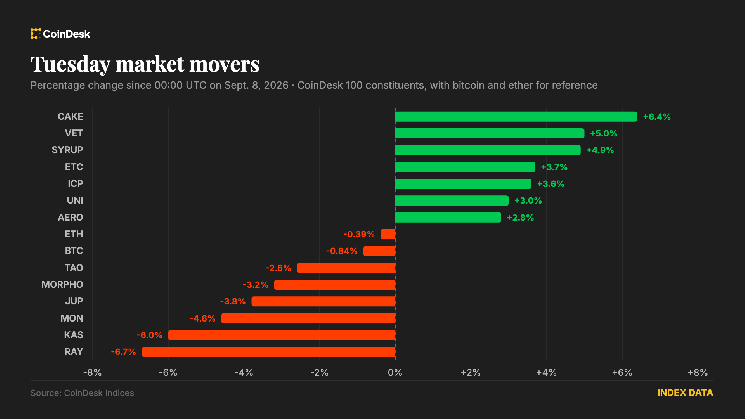
    Among the 100 assets in the CoinDesk 100 Index, 42 traded in negative territory. BNB Chain tokens emerged as notable exceptions, with BNB rising 2% to $754 since midnight. Related assets CAKE (PancakeSwap) and SYRUP also advanced, benefiting from a rotation into the BNB Chain ecosystem.

    The CoinDesk 5 Index slipped 0.47%, while the broader CoinDesk 20 Index edged up 0.2%. The CoinDesk Memecoin Index outperformed with a 0.41% gain.

    Derivatives Signal Caution Amid Macro Headwinds

    Taker Flow Remains Bearish

    The buy-sell ratio of takers—traders who remove liquidity by executing at market prices—in crypto futures stayed bearish. Major tokens came under pressure from rising oil prices, speculation around Federal Reserve rate increases, and elevated bond yields.

    Open Interest Flat, Volume Rises 5%

    Twenty-four-hour open interest (OI) remained largely unchanged at $141 billion, but trading volume climbed 5% to $149.85 billion. The divergence suggests increased churn rather than fresh positional conviction, indicating traders are rotating capital without adding significant new leverage.

    Aerodrome’s AERO Leads Top-100 Gainers with 17% Surge

    Decentralized exchange Aerodrome Finance’s native token AERO surged 17% in 24 hours, topping the leaderboard among top-100 assets by market value. The rally coincided with a sharp rise in futures open interest to a record 129 million tokens, a combination that points to a buildup of long positions supporting the spot-price move.

    Positive CVD Confirms Aggressive Buying

    AERO’s bullish momentum is reinforced by a positive 24-hour open-interest-adjusted cumulative volume delta (CVD), signaling that buyers are executing market orders more aggressively than passive limit orders.

    Injective’s INJ Mirrors Bullish Futures Structure

    INJ, up 10%, displays a similar bullish futures setup, lending credibility to its spot-price breakout above $6—a level that has acted as a supply zone since mid-June, capping previous advances.

    Bitcoin Futures OI Rises Despite Price Drop

    Overall Bitcoin open interest remains below the 700,000 BTC mark, reflecting still-low appetite for leverage. However, open interest in major USDT- and USD-margined futures increased to 265,000 BTC from 257,000 BTC even as spot prices fell to $78,700 from $80,000. The uptick suggests some traders may have initiated short positions anticipating further downside.

    Bears Dominate Most Majors; AVAX, XLM, DOGE Show Strength

    Negative 24-hour cumulative volume deltas across most major tokens indicate bears are leading price action. Exceptions include Avalanche (AVAX), Stellar (XLM), and Dogecoin (DOGE), which posted positive CVDs.

    Volatility Indexes Calm; Deribit Options Lean Bullish Short-Term

    Bitcoin and ether volatility gauges remain near recent lows, signaling no scramble to buy options or hedge positions. On Deribit, weekly-expiry calls dominated 24-hour volume rankings for both BTC and ETH, reflecting short-term bullish expectations despite the broader bearish taker flow.

    Token Movers: CAKE, VET, SYRUP Lead; RAY, KAS, TAO Lag

    • PancakeSwap (CAKE): +4.9% since midnight UTC, +7.5% over 24 hours to $2.29, extending a rally driven by BNB Chain rotation and the exchange’s tokenized-stocks initiative.
    • VeChain (VET): +8% on the day, +9% over 24 hours to $0.00735.
    • SYRUP: +8% to $0.23, placing three DeFi and enterprise-chain names atop the gainers board while major assets sold off.
    • Raydium (RAY): -5.5% since midnight to $1.10, tracking Solana’s decline.
    • Kaspa (KAS): -4.7% to $0.034, unwinding most of a weekend surge that made it a top 24-hour gainer on Monday.
    • Bittensor (TAO): -1.5% on the day, -3.7% over 24 hours to $256, after leading the market on Sunday.
    • Aerodrome (AERO): +18% over 24 hours to $0.64, though momentum cooled to a 2.8% gain since midnight.
    • Jupiter (JUP): -3.8% to $0.24, a second consecutive heavy session following Monday’s 9% drop with no clear catalyst identified.
  • Bitcoin Holds Near $78,000 as Arbitrum Surges 30% on Robinhood Chain Revenue

    Bitcoin Holds Near $78,000 as Arbitrum Surges 30% on Robinhood Chain Revenue

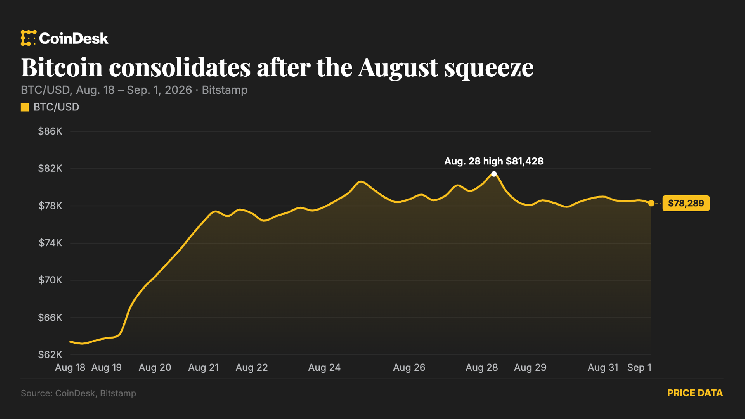
    Bitcoin is trading near $78,000, down 0.4% since midnight UTC and about 0.7% over the past seven days as the market consolidates after a short squeeze lifted the price from below $63,000 to nearly $81,400 last week.

    Bitcoin’s relative strength has remained intact despite the calmer conditions. Nasdaq 100 futures are down 0.5% since midnight, meaning bitcoin is once again outperforming equities.

    Spot bitcoin exchange-traded funds recorded $3.04 billion in net inflows across nine consecutive sessions, their longest streak since April. The run ended Friday with a $202 million outflow before resuming Monday with $217 million in fresh inflows, according to SoSoValue data.

    Altcoins are mixed in the latest session. The Altcoin Season index has fallen to 26 out of 100 from 34 on Friday, its lowest reading in more than 90 days.

    Crypto derivatives positioning remains balanced

    Balanced positioning: The 24-hour taker buy-sell volume ratio in crypto futures markets has remained balanced for a second consecutive day. Open interest has held near $136 billion, while trading volume has declined 7%. The combination suggests traders are adding neither significant long nor short exposure and are waiting for a clearer market signal.

    Arbitrum leads gainers: Arbitrum’s $ARB is the best-performing token among the top 100 cryptocurrencies over the past 24 hours, gaining nearly 30%. The rally is supported by increased futures participation, with open interest rising more than 10%. The data points to a buildup of long positions as $ARB attempts to establish support above chart resistance at 11 cents. Annualized funding rates near 8% suggest the market is not overheated.

    Monero open interest continues to rise: Open interest in privacy-focused Monero futures has climbed to 640,000 tokens, the highest level since February 2024. The signals are mixed. Funding rates have dropped to 15% from more than 50%, suggesting bullish positions are no longer overcrowded. However, the 24-hour open-interest-adjusted cumulative volume delta is negative, indicating bearish leadership. XMR has already pulled back to around $525 from Monday’s high of $548.

    Demand for $TRX shorts: Tron’s $TRX stands out with funding rates at minus 80%, signaling crowded bearish positioning. Short sellers are accepting a high cost to maintain their positions. $TRX is trading near 33 cents after falling for a third consecutive day.

    Light positioning in bitcoin and ether: Open interest in $BTC and $ETH remains subdued, hovering near multi-week lows.

    Volatility cools: Bitcoin’s and ether’s 30-day implied volatility indexes, BVIV and EVIV, have reversed their mid-August spikes, pointing to calmer market conditions.

    Options flow turns bullish: In options listed on Deribit, the $80,000 bitcoin call expiring Sept. 25 was the most-traded position over the past 20 hours. A call represents a bullish bet on the underlying asset. For ether, the $2,500 call attracted the most activity.

    Arbitrum leads the altcoin market

    Arbitrum’s surge is the clearest standout across the altcoin sector. The rally is linked to Robinhood Chain, which operates as a dedicated Arbitrum chain and sends 10% of net protocol revenue to the Arbitrum ecosystem.

    Offchain Labs co-founder Steven Goldfeder said Monday that Robinhood Chain’s 24-hour transaction revenue had exceeded $2 million, up from approximately $1.22 million the previous day. At that pace, Arbitrum’s share would amount to roughly $73 million annually.

    ARK Invest’s Lorenzo Valente calculated that gross revenue on Robinhood Chain rose from $54,676 on Aug. 22 to $1.088 million on Aug. 30, an increase of nearly 20 times. Arbitrum’s share increased from $5,400 to $108,000 over the same period.

    Curve DAO’s CRV$0.3586 rose 14% over 24 hours to approximately 35.13 cents on $119 million in trading volume. The move forms part of the broader decentralized finance rally that has lifted lending and decentralized exchange tokens through the second half of August.

    Uniswap’s $UNI extended its gains, rising 8% since midnight to around $5.80 after advancing 12% over the previous 24 hours. The token is now up 34% over the past seven days on $519 million in volume.

    Among the day’s smaller movers, Aave’s AAVE$126.93 gained 1.9% to $126.54, while Morpho’s MORPHO$2.5549 rose 2%. The moves suggest decentralized finance assets are holding up better than the broader crypto market during Tuesday’s session.

  • DeFi Sector Surges 38% as US Policy Shift Unlocks Token Value Capture

    DeFi Sector Surges 38% as US Policy Shift Unlocks Token Value Capture

    DeFi tokens have risen nearly 38% since August 17 as investors reassess how evolving US crypto policy could affect protocol revenue and token valuations.

    SoSoValue said the rally is bringing decentralized finance closer to a market in which fees, token buybacks and on-chain activity play a larger role in determining value.

    US Crypto Policy Shift Supports DeFi Rally

    In a post on X, SoSoValue said its DeFi sector index, $DEFI.ssi, climbed from 0.3616 on August 17 to approximately 0.498 after reaching 0.511. The move represents a cumulative gain of about 37.7%.

    The rally coincided with recoveries in Bitcoin and Ethereum, as well as broader short covering. However, the research firm said investors are also reconsidering whether mature DeFi protocols can return more of their revenue to tokenholders.

    That question has constrained DeFi valuations for years. Protocols have generated substantial trading fees, lending income and other revenue, while tokenholders often had little direct claim on those economics.

    Fee distributions and token buybacks have also raised potential securities-law concerns in the United States. As a result, many protocols have been reluctant to activate mechanisms that connect revenue directly to their tokens.

    That situation could be changing. Last week, the SEC proposed its “Regulation Crypto Assets” framework, which includes exemptions and a conditional safe harbor for certain crypto-asset offerings.

    Under the proposal, a token may no longer remain part of an investment contract after a project completes or permanently stops the essential managerial work it had promised to perform.

    US Legislation Could Expand DeFi Tokenholder Rewards

    The Senate’s CLARITY Act draft goes further by proposing protections for noncontrolling developers, validators, node operators, oracle providers and self-custody wallet software.

    The draft also leaves room for rewards tied to trading, staking, governance and liquidity provision. It still requires 60 votes in the Senate, while the SEC proposal remains subject to public comment.

    Even so, SoSoValue said markets are already expressing greater confidence in the direction of US crypto policy, despite the lack of complete legal certainty.

    You may also like:

    • Aave Deprecates 50 Low-Adoption Assets and Winds Down Six Chain Deployments
    • Flare Simplifies DeFi for XRP Holders With Smart Accounts Upgrade
    • DEX Aggregator Odos is Shutting Down: What Users Need to Do Before July 30

    Protocol Revenue and Buybacks Strengthen DeFi Valuations

    The valuation case for DeFi tokens becomes more compelling when protocol revenue is considered. Uniswap generated approximately $7.18 million over the past 30 days, followed by PancakeSwap with $5.16 million, Jupiter with $4.69 million, Aave with $4.12 million and Aerodrome with $4.11 million.

    Several of these protocols now have mechanisms that connect their revenue to their tokens. Hyperliquid, for example, uses part of its trading fees to buy HYPE. Uniswap has linked revenue to UNI burns, while Jupiter allocates 50% of protocol fees to JUP purchases. PancakeSwap also directs part of its fees toward CAKE buybacks and burns.

    Ethena has proposed an even larger allocation. Once USDe reaches its stated supply threshold, 95% of the net revenue paid to the foundation across its three core business lines would be used for ENA buybacks.

    According to SoSoValue, the next phase of the DeFi token rally will depend on whether protocol revenue continues to grow and whether tokenholders receive a larger share of those economics.