Tag: Darkfost

  • ‘Bull Market Confirmed’: Analyst Identifies Bitcoin’s Fifth Historic Signal

    ‘Bull Market Confirmed’: Analyst Identifies Bitcoin’s Fifth Historic Signal

    Key Highlights

    • Cryptoquant contributor Darkfost identifies a fifth historical bull market signal for Bitcoin on September 24, marking the first such crossover since 2023 and joining prior signals in 2012, 2015, 2019, and 2023.
    • The signal triggers when the short-term holder cost basis rises above the active long-term holder cost basis, using a seven-year activity filter that excludes over 3.5 million dormant BTC untouched for a decade or more.
    • U.S. spot Bitcoin ETFs recorded $2.06 billion in net inflows over three consecutive days (Sept. 21–23), led by a record $999 million single-day inflow on Sept. 21, coinciding with the signal’s confirmation.

    Fifth Cost-Basis Crossover Confirms Bull Market Structure

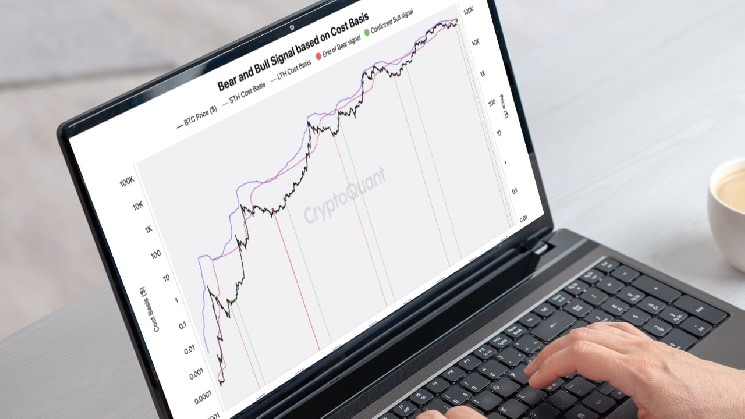
    A new on-chain metric flashed a bullish confirmation for Bitcoin on September 24, marking the fifth time in the asset’s history that the average acquisition cost of short-term holders has surpassed that of active long-term holders. The analysis, published by Cryptoquant contributor Darkfost, identifies the crossover as a recurring structural signal that has preceded sustained upward moves in each of the four prior cycles.

    In a post on X, the analyst stated: “Bull Market Confirmed … This is the 5th occurrence, which gives a bit more credibility to the dynamic bitcoin is putting in place, though there’s always a margin for error, and I prefer to point that out.” The comment underscores both the statistical weight of the pattern and the inherent uncertainty in any single indicator.

    The metric compares two distinct cost bases: the average price paid by short-term holders versus the average price paid by active long-term holders. Crucially, the long-term cohort is filtered to include only coins that have moved at least once in the past seven years. This design excludes deeply dormant supply—estimated at more than 3.5 million BTC older than ten years—which the analyst argues would otherwise distort the measure of genuine holder conviction.

    Defining Active Long-Term Holders: The Seven-Year Filter

    The seven-year activity threshold serves a different analytical purpose than the standard 155-day holding period used by firms such as Glassnode to separate short-term from long-term supply. While Glassnode’s definition classifies any coin held longer than roughly five months as long-term, Darkfost’s additional filter asks whether that long-term coin has shown any on-chain life in the last seven years. Coins that have not are treated as effectively lost or permanently dormant and removed from the active cost-basis calculation.

    The analyst acknowledges the cutoff is arbitrary but notes its practical relevance. The dormant pile grows by an estimated 8,000 to 30,000 BTC each month, and its monthly change has turned negative only once since 2019—when an early miner moved approximately 100,000 BTC. Notably, coins inactive for five to 15 years resumed movement in 2026, demonstrating that even decade-old supply can re-enter circulation and validating the decision to track active versus dormant segments separately.

    ETF Inflows Provide Liquidity Backdrop for the Signal

    The cost-basis crossover arrived alongside a surge of institutional demand via U.S. spot Bitcoin exchange-traded funds. According to daily flow data from Farside, the funds attracted $2.06 billion in net inflows across the three sessions from September 21 through September 23. Every session printed positive flows, though the pace decelerated sharply after the opening day.

    September 21 saw the largest single-day inflow of 2026 at $999 million. The following day added $714.7 million, and September 23 contributed $346.9 million. The three-day sequence coincides with the period in which the on-chain signal confirmed, lending circumstantial support to the argument that fresh ETF liquidity is reinforcing the shift in holder economics. The analyst cautions, however, that the flow data establishes correlation during the signal window, not causation of the crossover itself.

    Spot Bitcoin ETFs allow investors to gain exposure through brokerage-traded shares backed by actual BTC held by the fund, lowering the operational barrier for institutional allocators and wealth managers who cannot or prefer not to custody digital assets directly.

    Cycle Outlook: Tempered Volatility, Multi-Fold Returns

    The bullish signal and ETF momentum are being framed within a broader cycle thesis. In a separate assessment published September 22, Cryptoquant founder and CEO Ki Young Ju argued that the market’s expanding size and deepening institutional ownership could dampen the extreme boom-bust amplitude characteristic of earlier cycles. His base-case forecast projects threefold to fivefold returns for Bitcoin this cycle, followed by a milder bear market drawdown than historical norms.

    Why This Matters

    The fifth cost-basis crossover matters because it represents a rare confluence of on-chain holder behavior and institutional capital flows. Prior occurrences in 2012, 2015, 2019, and 2023 each preceded significant bull-market legs, suggesting the metric captures a fundamental shift in the marginal buyer—from long-term accumulators to newer participants willing to pay higher average prices. The seven-year activity filter refines this insight by focusing on economically active long-term holders, filtering out supply that behaves more like lost coins than invested capital. Meanwhile, the $2.06 billion in ETF inflows over three days—anchored by a record $999 million session—signals that traditional financial infrastructure is now a primary vector for Bitcoin demand. If Ki Young Ju’s cycle thesis holds, the combination of structural on-chain signals and sustained institutional flows could produce a cycle defined by steadier appreciation and shallower corrections, reshaping risk expectations for both retail and institutional participants.

    Frequently Asked Questions

    What exactly is the “fifth bull market signal” identified by Cryptoquant?

    It is the fifth historical occurrence where the short-term holder realized price (average acquisition cost of coins held less than ~155 days) crosses above the active long-term holder realized price (average cost of coins held longer than 155 days that have also moved at least once in the past seven years). Previous crossovers appeared in 2012, 2015, 2019, and 2023.

    Why does the analysis exclude Bitcoin that hasn’t moved in over seven years?

    The analyst treats coins untouched for seven-plus years as dormant or effectively lost supply. Including them in the long-term holder cost basis would dilute the measure of active holder conviction. Over 3.5 million BTC fall into this category, growing by 8,000–30,000 BTC monthly, with only one monthly decline since 2019.

    Did the ETF inflows cause the bullish crossover?

    The data shows the $2.06 billion in net ETF inflows (Sept. 21–23) coincided with the signal’s confirmation, but the analyst explicitly states the flows “do not establish that ETF buying caused the crossover.” The inflows provide liquidity context, not proof of causation.

  • Analysts Say Binance ETH Withdrawals Hit Highest Level Since 2023, Flag Bullish Signal

    Analysts Say Binance ETH Withdrawals Hit Highest Level Since 2023, Flag Bullish Signal

    Key Highlights

    • Binance Ethereum withdrawals hit a three-year high, with monthly averages exceeding 90,000 transactions—roughly double the rate seen at the start of 2024.
    • CryptoQuant analyst Darkfost links the surge to investors moving ETH into self-custody wallets, signaling a shift toward longer-term holding strategies rather than active exchange trading.
    • While exchange outflows suggest growing preference for personal custody, Darkfost cautions that withdrawal data alone does not conclusively prove long-term investment intent.

    Binance Ethereum Withdrawals Surge to Highest Level Since 2021

    On-chain analytics firm CryptoQuant has flagged a notable acceleration in Ethereum withdrawals from Binance, the world’s largest cryptocurrency exchange by volume. According to analyst Darkfost, the platform’s average monthly ETH withdrawal count has climbed above 90,000, marking the most elevated sustained level since 2021. The current pace is approximately twice the monthly average recorded in the opening months of 2024, underscoring a pronounced shift in how market participants are managing their Ethereum holdings.

    Analyst Interprets Outflows as Signal of Accumulation Behavior

    Darkfost’s analysis of on-chain data frames the withdrawal spike as a noteworthy behavioral indicator. The analyst stated that the large volume of ETH leaving exchange wallets could be linked to the transfer of purchased assets to personal wallets or other external addresses, suggesting a tendency towards longer-term holdings. This pattern aligns with a broader market narrative in which investors increasingly favor self-custody solutions—such as hardware wallets or non-custodial software wallets—over leaving assets on centralized platforms for short-term speculative trading.

    Self-Custody Preference Grows Amid Custody Landscape Evolution

    The movement of assets from exchange-controlled addresses to user-controlled addresses may indicate that investors prefer to store those assets in addresses under their own control rather than holding them on exchanges for short-term trading. This trend coincides with heightened regulatory scrutiny of centralized custodians, high-profile exchange failures in recent years, and the maturation of user-friendly self-custody tooling. However, Darkfost emphasized that exchange exits alone do not definitively prove that investors intend to hold assets long-term; funds could be rotated to other venues, deployed in decentralized finance protocols, or staged for over-the-counter transactions.

    Why This Matters

    Sustained high withdrawal volumes from a dominant venue like Binance serve as a real-time barometer of investor sentiment and custody preferences. If the elevated outflow rate persists, it would suggest a structural reduction in the exchange-resident ETH supply, potentially tightening available liquidity for short-term traders and altering market dynamics during periods of volatility. Conversely, a reversion to lower withdrawal levels could signal renewed comfort with exchange-based custody or a shift back toward active trading strategies. Market observers will likely monitor the weekly and monthly withdrawal trends closely as a leading indicator for medium- and long-term Ethereum market behavior.

    Frequently Asked Questions

    What is driving the surge in Ethereum withdrawals from Binance?

    CryptoQuant analyst Darkfost attributes the increase to investors transferring ETH to personal or external wallets, indicating a preference for self-custody and longer-term holding over keeping assets on the exchange for active trading.

    Does a high withdrawal count guarantee bullish long-term price action for ETH?

    Not necessarily. While outflows suggest reduced exchange supply, Darkfost cautions that withdrawals alone do not definitively prove long-term holding intent; funds may move to other exchanges, DeFi protocols, or OTC desks.

    How does the current withdrawal rate compare to historical levels?

    The monthly average of ETH withdrawals on Binance has reached its highest point since 2021 and is roughly double the rate observed at the beginning of 2024.

  • Binance ETH Withdrawals Hit Highest Level Since 2023, Analysts Report

    Binance ETH Withdrawals Hit Highest Level Since 2023, Analysts Report

    Key Highlights

    • Binance’s average monthly Ethereum withdrawal count has exceeded 90,000, reaching a three-year high and roughly doubling the pace seen at the start of the year.
    • CryptoQuant analyst Darkfost links the surge to investors moving $ETH to personal wallets, signaling a shift toward self-custody and potential long-term holding.
    • While exchange outflows suggest accumulation, Darkfost cautions that withdrawals alone do not definitively prove long-term holding intent.

    Binance Ethereum Withdrawals Hit Three-Year Peak Amid Accumulation Signals

    On-chain data from CryptoQuant reveals that Ethereum withdrawals from Binance have surged to their highest monthly average since 2023, with the exchange now processing more than 90,000 $ETH withdrawals per month on average. According to analyst Darkfost, this metric has approximately doubled compared to levels recorded at the beginning of the year, marking the most elevated accumulation activity in the last three years. The spike coincides with a broader trend of assets leaving centralized exchanges, a pattern often interpreted by market observers as a precursor to reduced sell-side pressure.

    Analyst Darkfost Highlights Shift Toward Self-Custody

    Darkfost stated that the large amount of $ETH being moved out of cryptocurrency exchanges is noteworthy in terms of investor behavior. The analyst noted that withdrawals from exchanges could be linked to the transfer of purchased Ethereum assets to personal wallets or other external addresses, suggesting a tendency towards longer-term holdings. The transfer of assets from exchanges to personal or external wallets may indicate that investors prefer to store those assets in addresses under their own control rather than holding them on exchanges for short-term trading.

    Custody Preferences Evolving But Intent Remains Nuanced

    Despite the compelling correlation between exchange outflows and accumulation narratives, Darkfost emphasizes a critical caveat: exchange exits alone do not definitively prove that investors intend to hold assets long-term. Funds withdrawn from Binance could be redirected to decentralized finance protocols, staking services, or over-the-counter desks rather than cold storage. This distinction matters for market structure analysis because the ultimate destination of the withdrawn $ETH determines whether selling pressure is genuinely removed or merely relocated.

    Why This Matters

    The sustained elevation of Ethereum withdrawals from Binance—the world’s largest cryptocurrency exchange by volume—serves as a real-time barometer of investor sentiment and custody preferences. Historically, prolonged periods of net exchange outflows have coincided with bullish market phases, as they reduce the immediately available supply for trading. However, the current macroeconomic backdrop, including evolving regulatory scrutiny of centralized platforms and the upcoming Ethereum network upgrades, adds layers of complexity. Market participants should monitor whether the 90,000-withdrawal monthly threshold holds in subsequent months, as a reversal could signal renewed trading appetite or profit-taking, while persistence would reinforce the accumulation thesis.

    Frequently Asked Questions

    Who is Darkfost and what is CryptoQuant?

    Darkfost is an analyst at CryptoQuant, a blockchain analytics firm that provides on-chain data and market insights for cryptocurrencies including Bitcoin and Ethereum.

    Does a high withdrawal count guarantee Ethereum’s price will rise?

    No. While large exchange outflows often correlate with accumulation and reduced sell-side supply, Darkfost explicitly notes that withdrawals alone do not definitively prove long-term holding intent. Price action depends on multiple factors including demand, macro conditions, and overall market sentiment.

    What does “self-custody” mean in this context?

    Self-custody refers to investors holding their Ethereum in personal wallets where they control the private keys, rather than leaving assets on a centralized exchange like Binance. This gives the holder full control but also full responsibility for security.