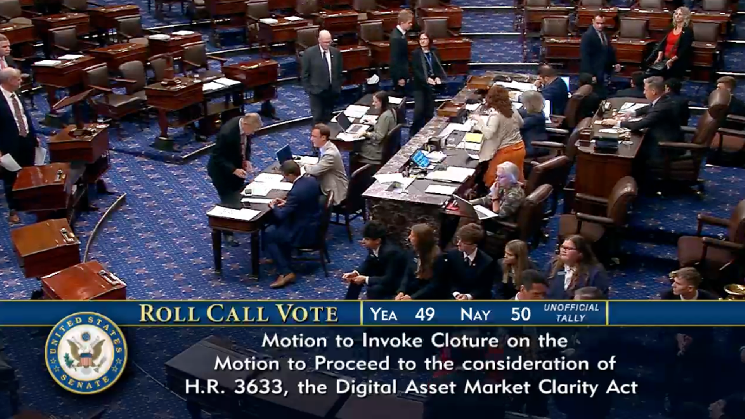
The CLARITY Act aims to resolve a question that has challenged U.S. regulators for more than a decade: when should a crypto token be treated as an investment, and when does it function more like a commodity such as gold?
The answer would determine which regulator oversees a token, what its creators must disclose, and which rules crypto platforms must follow when listing the asset or holding it for customers.
What Problem Is the CLARITY Act Designed to Solve?
When a company or development team creates a token and sells it to finance a project, the transaction can resemble an investment. Early buyers may be betting on the team’s ability to build and promote the network.
Years later, however, the same token could trade broadly across a decentralized network, with its value no longer primarily tied to the original team. At that stage, it may look more like a commodity than a security.
U.S. law currently provides no clear rule for when a token crosses that line, leaving two federal regulators involved. The Securities and Exchange Commission oversees securities, while the Commodity Futures Trading Commission regulates futures markets and has more limited authority over direct commodity trading. Traditional assets generally fit clearly into one category. Crypto assets often do not.
How the CLARITY Act Would Treat Bitcoin
Bitcoin is already generally treated as a commodity, largely because it has no central issuer or company behind it. Under the current system, the CFTC’s authority over spot Bitcoin trading is mostly limited to policing fraud and market manipulation.
The CLARITY Act would expand that authority, giving the CFTC broader power to directly regulate platforms where Bitcoin is bought and sold rather than intervening only after problems occur.
How the Bill Would Treat Ethereum and $XRP
Tokens such as Ethereum and $XRP occupy a more ambiguous position because of their fundraising histories and current decentralized use. The CLARITY Act attempts to draw the regulatory line based on a token’s function rather than solely on its origins.
Fundraising activity would remain under SEC oversight, while later-stage trading in tokens deemed sufficiently decentralized could move to a new CFTC framework. The bill would not automatically classify every token as a commodity. Instead, it would create a path for tokens to move out of securities treatment when they no longer depend primarily on a central team.
New Rules for Crypto Platforms and Projects
Platforms operating under the proposed CFTC framework would have to register, keep customer assets separate from their own funds, and comply with requirements covering disclosures, recordkeeping and conflicts of interest.
Projects raising money through token sales would need to disclose information about the people behind the project and explain how the underlying technology works. Insiders would also face new restrictions on how quickly they could sell their holdings.
Why the CLARITY Act Has Been Difficult to Pass
The central disagreement is not whether the crypto industry needs regulation, but what those rules should require and which agency should enforce them. Three disputes have shaped the bill’s progress.
The first concerns rewards paid to stablecoin holders. Some platforms offer rewards for holding stablecoins, in a way that can resemble bank interest. Banks have argued that these programs could draw deposits away from the traditional banking system. Crypto companies have countered that restricting such rewards would protect banks from competition.
After months of negotiations, lawmakers reached a compromise that would prohibit rewards paid solely for holding a stablecoin while allowing rewards connected to actually using one. Coinbase supported the revised agreement, and the Senate Banking Committee advanced the bill in May.
The second dispute involves state regulatory authority. The CLARITY Act would replace certain state-level requirements with a single federal framework. Supporters say this would create consistency across the country, while critics warn that it could weaken states’ existing tools for investigating scams and holding crypto platforms accountable.
The third issue concerns potential conflicts of interest among lawmakers and other federal officials. The latest draft would prohibit federal officials and their spouses from being paid to issue or sponsor digital assets while in office.
Democrats are seeking stricter limits on lawmakers profiting from cryptocurrency. Republicans supporting the bill argue that the current draft already goes far enough. The legislation requires bipartisan support, and identical versions must pass both the House and Senate before it can reach the president’s desk.
What Would Happen If CLARITY Passes?
Crypto businesses would receive a clearer federal rulebook for registering and operating in the United States. Because the U.S. accounts for a significant share of global crypto capital and users, businesses and exchanges based outside the country could also adjust their practices to align with the new framework.
That could extend the CLARITY Act’s influence beyond U.S. borders, particularly among companies serving American customers or seeking access to the U.S. market.
What Happens If CLARITY Fails?
Cryptocurrency would not become unregulated if the bill fails. Existing laws would continue to apply through regulators, courts and individual states.
The main difference would be timing. Many of today’s legal boundaries are clarified only after a product launches, often after something has gone wrong. The CLARITY Act is designed to establish those boundaries in advance rather than after the fact.
Source: cryptonews.net