
Tag: Crypto winter

  • Tom Lee Identifies Key Signs of Crypto Winter Dynamics

    Tom Lee Identifies Key Signs of Crypto Winter Dynamics

    Key Highlights

    • BitMine Chairman Tom Lee identifies ‘rage quitting’ as a defining investor behavior during crypto winters, alongside sharp price declines and leverage liquidations.
    • Bitcoin is testing the pivotal $64,000–$65,000 resistance zone, with buyers struggling to overcome dominant selling pressure.
    • Lee’s cyclical framework suggests current skepticism and forced exits historically align with potential market bottoms, offering a roadmap for traders navigating volatility.

    Tom Lee Maps the Anatomy of a Crypto Winter

    During a recent interview with Wealthion, Tom Lee, Chairman of BitMine, laid out a framework for understanding the recurring phenomenon known as the crypto winter. Lee emphasized that these downturns are not random collapses but structured cycles characterized by three distinct features: steep price declines, widespread leverage liquidation, and a behavioral pattern he explicitly labels ‘rage quitting’ among investors. According to Lee, this capitulation event—where participants abandon positions in frustration—typically clusters near the bottom of the cycle, making it a critical signal for market observers rather than a reason for panic.

    Bitcoin Tests Critical $64K–$65K Battleground

    The theoretical framework meets real-time market action as Bitcoin contends with the $64,000 to $65,000 range, a level that has repeatedly acted as both support and resistance in recent sessions. Current order-flow data shows aggressive selling defending this ceiling, while buying attempts have so far lacked the volume to sustain a decisive breakout. Lee’s observation that ‘rage quitting’ intensifies as sentiment sours aligns with on-chain metrics showing a spike in realized losses and short-term holder exits. Traders interpreting this confluence of technical resistance and behavioral capitulation are weighing whether the zone represents a distribution top or the final shakeout before a new leg higher.

    Sentiment Signals and Historical Rhymes

    Lee’s analysis draws a direct line between public skepticism—often amplified by high-profile critics—and the psychological trough of the cycle. The current wave of cautious commentary from financial media and institutional voices mirrors patterns observed in prior bear markets, where maximum pessimism preceded sustained recoveries. By framing ‘rage quitting’ as a feature of the bottoming process rather than a bug, Lee reframes the narrative: the absence of retail euphoria and the prevalence of forced selling may, paradoxically, reduce the supply overhang required for the next uptrend.

    Why This Matters

    Understanding the cyclical mechanics of crypto winters is essential for risk management and position sizing in an asset class defined by boom-bust dynamics. Lee’s framework provides a mental model that separates structural market forces—leverage flushes, miner capitulation, holder base rotation—from emotional decision-making. For institutional allocators and active traders alike, recognizing that ‘rage quitting’ signals exhaustion of weak hands rather than fundamental failure can prevent premature exits at the point of maximum financial opportunity. As Bitcoin’s price action hinges on the $64K–$65K pivot, the interplay between technical structure and behavioral extremes will likely dictate the near-term trajectory for the broader digital asset complex.

    Frequently Asked Questions

    What does Tom Lee mean by ‘rage quitting’ in crypto markets?

    ‘Rage quitting’ refers to the phenomenon where investors, frustrated by sustained losses and volatility, abruptly exit their positions near the bottom of a market cycle. Lee identifies this as a behavioral hallmark of crypto winters that historically coincides with maximum pessimism and the exhaustion of selling pressure.

    Why is the $64,000–$65,000 range so critical for Bitcoin right now?

    This price zone has acted as a key pivot point in recent trading, representing a confluence of technical resistance, psychological round numbers, and options market open interest. A decisive break above could signal renewed bullish momentum, while failure may invite a deeper correction toward lower support levels.

    How can traders use Lee’s crypto winter framework practically?

    Traders can monitor on-chain metrics such as realized loss spikes, short-term holder MVRV ratios, and funding rates to quantify ‘rage quitting’ intensity. When these indicators peak alongside extreme negative sentiment and price testing of major support, the framework suggests elevated probability of a cyclical bottom forming.

  • Bitcoin Faces 2022 Parallels as Federal Reserve Resumes Rate Hikes

    Bitcoin Faces 2022 Parallels as Federal Reserve Resumes Rate Hikes

    Bitcoin Bear Market Nears One-Year Mark as Fed Rate Hikes and Energy Shock Cloud Outlook

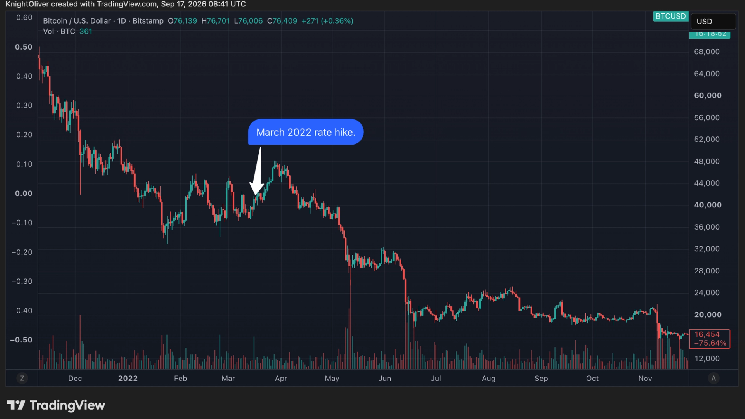
    Bitcoin’s prolonged downturn is approaching the one-year milestone, raising questions about whether a new Federal Reserve rate-hiking cycle could extend the crypto winter. The market’s recent behavior echoes the aftermath of the Fed’s initial March 2022 hike, when bitcoin rallied roughly 18% over 12 days before plummeting around 50%. That pattern suggests any near-term relief rally may give way to further losses, though a single comparable cycle offers limited predictive evidence.

    Inflation Progress Meets Fresh Energy Shock

    The Federal Reserve’s decision to raise rates on Wednesday stemmed from persistent inflation pressures. Annual headline inflation has remained above the 2% target for over five years. However, core inflation — which excludes volatile food and energy components — has eased to 2.4%, its lowest level in five years, signaling meaningful progress.

    That progress now faces a significant headwind. Escalating geopolitical tensions in the Middle East have propelled both West Texas Intermediate and Brent crude oil prices well above $100 per barrel. The surge threatens to reignite inflationary pressures and squeeze economic growth simultaneously.

    Rising Yields Amplify Pressure on Risk Assets

    Global bond yields have climbed in response, with the benchmark U.S. 10-year Treasury yield reaching 5%. The move tightens financial conditions further and adds downward pressure on risk assets, including cryptocurrencies. Bitcoin’s 2022 decline coincided with broad-based losses across equities, bonds, and metals, alongside internal turmoil within the crypto industry — a correlation that underscores its sensitivity to macroeconomic liquidity cycles.

    Key Question for Crypto Markets

    With the bear market nearing its first anniversary, market participants are weighing whether the current tightening cycle — compounded by an energy-driven inflation resurgence — will prolong the downturn or if the asset class has already priced in the worst of the macroeconomic storm.

  • Binance Founder CZ Says Crypto Sector Has Ended Its Harshest “Crypto Winter” in History: Here Are the Details

    Binance Founder CZ Says Crypto Sector Has Ended Its Harshest “Crypto Winter” in History: Here Are the Details

    Binance founder Changpeng Zhao said the cryptocurrency industry has endured the most severe “crypto winter” in its history while maintaining strong underlying fundamentals.

    Speaking at Bitcoin Asia 2026 in Hong Kong, Zhao said the market has matured significantly following previous sharp declines. The Binance founder, widely known as CZ, also offered a broadly positive outlook for the sector’s future.

    Real-world asset tokenization gains momentum

    Zhao said expectations are particularly high for the tokenization of real-world assets (RWA). He noted that putting tokenized assets on-chain could reduce time and cross-border transaction constraints, while also improving liquidity for small and medium-sized assets by connecting them with investors worldwide.

    Global cryptocurrency regulation

    Discussing regulatory approaches around the world, Zhao identified the United Arab Emirates (UAE) as one of the leading countries in cryptocurrency regulation. He added that the United States is making rapid progress in establishing rules for stablecoins and cryptocurrency exchanges.

    Zhao said Japan has adopted a crypto-friendly approach, Hong Kong’s market is expanding rapidly, and Singapore is following a more cautious policy than some other regions.

    Decentralized exchanges continue to mature

    CZ also said decentralized exchanges (DEXs) have made significant advances in both technological infrastructure and user awareness over the past eight years. According to Zhao, DEXs have become a more mature part of the cryptocurrency ecosystem, and the sector could make an even greater leap forward if regulatory conditions were relaxed further worldwide.

    Zhao’s comments highlighted regulatory clarity, broader adoption of RWA tokenization and continued development of decentralized finance infrastructure as potential drivers of the cryptocurrency sector’s next growth phase.

    This is not investment advice.