
Tag: Crypto market structure bill

  • Democrats ‘chose visceral hatred for’ Donald Trump Over crypto Clarity Act, Lummis Says

    Democrats ‘chose visceral hatred for’ Donald Trump Over crypto Clarity Act, Lummis Says

    Key Highlights

    • Senator Cynthia Lummis blamed Senate Democrats for blocking a procedural vote on bipartisan crypto market structure legislation last week, calling the outcome “dismayed, dumbfounded and saddened.”
    • Speaking at CoinDesk’s Policy & Regulation event, Lummis alleged Democrats prioritized opposition to President Donald Trump over passing the bill, which had grown from 300 to over 600 pages after Democratic requests for provisions such as bankruptcy protections.
    • The legislation was the product of cross-party negotiations, but failed to advance before the midterm election cycle, leaving digital asset regulatory clarity in limbo.

    Lummis Points Finger at Democratic Opposition to Trump

    Senator Cynthia Lummis (R-Wyo.) delivered a sharp rebuke of her Democratic colleagues on Tuesday, arguing that partisan animosity toward President Donald Trump derailed a carefully negotiated crypto market structure bill that had achieved rare bipartisan consensus. Addressing attendees at CoinDesk’s Policy & Regulation event in Washington, D.C., Lummis said she was “dismayed, dumbfounded and saddened” that the Senate could not advance a key procedural vote on the measure last week.

    The Wyoming Republican framed the failure as a deliberate choice by Democrats to deny the incoming administration a legislative win ahead of the midterm elections. The problem was, as I see it, Democrats hate President [Donald] Trump more than they like good policy, and the way I see it is they chose their visceral hatred for President Trump and denied the opportunity to pass important policy legislation before a midterm, Lummis said. They chose that … pin it on the Democrats.

    Bill Expanded Significantly After Democratic Input

    Lummis emphasized that the legislation was not a partisan product but the result of extensive negotiations between members of both parties. She noted the bill had ballooned from roughly 300 pages to more than 600 after Democrats requested additional provisions addressing issues such as bankruptcy protections, among other items. Those concessions, she argued, demonstrated Republican willingness to accommodate Democratic priorities, only for the bill to stall at the procedural stage.

    The stalled measure represents the most comprehensive attempt to date to establish a clear regulatory framework for digital asset markets in the United States. Its failure to advance leaves critical questions unresolved regarding the classification of tokens, the roles of the SEC and CFTC, consumer protections, and the treatment of digital assets in bankruptcy proceedings — issues the expanded text had sought to address.

    Why This Matters

    The collapse of the bipartisan crypto market structure bill underscores how broader political dynamics — particularly the polarized response to President Trump — can override substantive policy agreement on emerging technologies. With the legislation now stalled, regulatory uncertainty continues to hamper the digital asset industry, driving activity offshore and complicating compliance for U.S.-based firms. The next opportunity for comprehensive crypto legislation will likely depend on the composition of the next Congress and whether either party chooses to revive the negotiated text or pursue a new approach. For now, the SEC and CFTC will continue to rely on existing enforcement authorities, and market participants will operate without the statutory clarity the bill was designed to provide.

    Frequently Asked Questions

    What specific provisions did Democrats request that expanded the bill?

    According to Senator Lummis, Democrats asked for provisions addressing bankruptcy protections, among other items, which caused the bill to grow from roughly 300 pages to over 600 pages.

    Was the crypto market structure bill a partisan or bipartisan effort?

    Lummis described the bill as a bipartisan product resulting from negotiations between members of both parties, though it ultimately failed to advance due to what she characterized as Democratic opposition to President Trump.

    What happens next for crypto regulation in the Senate?

    With the procedural vote blocked before the midterm elections, the legislation is effectively stalled. Future progress will depend on the next Congress’s composition and priorities, and whether lawmakers choose to revive this negotiated text or start anew.
  • CLARITY Act Passage Odds Drop Below 20% as Senate’s 60-Vote Path Narrows

    CLARITY Act Passage Odds Drop Below 20% as Senate’s 60-Vote Path Narrows

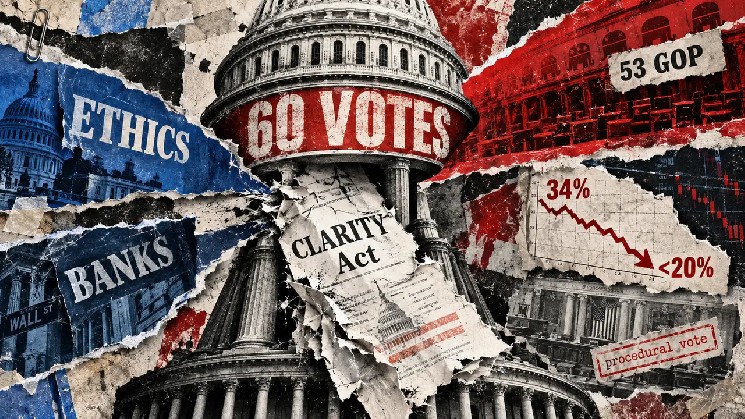
    The CLARITY Act is heading toward a critical Senate vote with no clear coalition capable of delivering the 60 votes needed for enactment. Expectations for the landmark crypto market‑structure bill deteriorated sharply Tuesday, with Polymarket odds of enactment falling below 20% after reaching about 34% during the previous 24 hours.

    CLARITY Act Faces Critical Senate Vote

    The Senate is expected to vote Tuesday afternoon on whether to proceed with the bill. Clearing that procedural hurdle requires 60 votes, meaning Republicans cannot advance the legislation alone even if all 53 GOP senators support the measure. However, that assumption increasingly looks difficult as Sens. Susan Collins and John Cornyn are among Republicans who have yet to commit. According to reports, Collins has raised concerns about whether the bill could accelerate deposit flight from community banks, one of the financial industry’s central objections to allowing crypto firms to compete more aggressively for customer balances. Meanwhile, Sen. John Curtis plans to support opening debate but has drawn a distinction between allowing the process to continue and backing the legislation itself, saying the current text would not win his vote on final passage. The uncertainty has prompted the White House to intensify its outreach to Republican senators, according to Semafor, as administration officials try to prevent banking‑industry opposition from peeling away votes the legislation can scarcely afford to lose.

    Republican Coalition Wavers

    The arithmetic leaves Republican negotiators trying to protect their right flank while finding enough Democrats to cross the 60‑vote line. That second challenge also became harder Monday night. Senate Democrats agreed after a private meeting to send Republicans their own counterproposal. Democrats have since delivered the document to GOP negotiators, though they have not yet publicly disclosed its provisions. Sen. Mark Warner said Democrats who had participated in the negotiations were making another offer after concluding that the latest Republican package still fell short. Ethics restrictions remain a central concern. Republicans had spent the weekend trying to close that gap with what aides described as their final legislative offer, including tougher rules governing financial conflicts involving senior government officials. Those changes were meant in part to address Democratic concerns about President Donald Trump’s crypto interests.

    In response to this, Sen. Cynthia Lummis said:

    “It’s becoming clear that some Democrats simply won’t get to yes, no matter what we put in the text. President Trump has now agreed to two historic ethics provisions — provisions these very members demanded. We’ve given you everything you’ve asked for, yet you keep holding the bill hostage, demanding more and more and more. It’s beyond frustrating. There’s nothing left to give.”

    Crypto Industry’s Closing Arguments

    The crypto industry is now trying to convince wavering senators that Democrats have already secured substantial concessions. Coinbase Chief Policy Officer Faryar Shirzad said the CLARITY Act addresses all seven principles Democratic senators outlined a year ago for acceptable crypto market‑structure legislation, including regulatory jurisdiction, issuer oversight, illicit finance, conflicts of interest and consumer protection. He said negotiators also incorporated 126 additional substantive changes requested by Democrats, portraying the current bill as the result of more than a year of bipartisan bargaining rather than a Republican proposal Democrats are being asked to accept unchanged.

    “Democratic negotiators played a major role in getting it here,” Shirzad said. “They should vote for it.”

    Ripple Chief Executive Brad Garlinghouse made a similar appeal, arguing that lawmakers had already made meaningful compromises on difficult provisions.

    “Perfect can’t be the enemy of good,” he said, urging senators to vote yes.

    Coalition Strains and Broader Political Pressures

    Those interventions reflect what’s at stake in Tuesday’s procedural vote. The crypto industry has spent years pushing Congress to replace the U.S. regulatory patchwork with legislation that divides oversight responsibilities and establishes rules for digital‑asset businesses. But the coalition that brought the bill this far is showing strain from several directions at once. Democrats remain dissatisfied with the ethics package. Banking groups are pressing Republicans over stablecoin competition and deposits. Some GOP senators are still studying a bill that has grown to more than 600 pages after successive rounds of negotiations.

    At the same time, political pressure is spreading beyond the Senate. Semafor reported that some House Democrats who backed crypto legislation earlier in Congress are becoming concerned that major industry‑backed super PACs may not support them in upcoming elections despite their votes. That unease adds another layer to the standoff as crypto political groups decide where to deploy their substantial campaign resources.

    What’s at Stake

    A successful procedural vote would not settle those disputes. Instead, it would move them onto the Senate floor, where lawmakers could spend much of the remainder of September fighting over amendments, ethics provisions and banking issues before reaching final passage. However, a defeat could be more damaging, with Lummis saying such a situation would “drive the digital asset industry overseas, leave consumers vulnerable, and sideline American [crypto] leadership.”