Tag: Consumer Price Index

  • Bitcoin Faces New Inflation Test as Diesel Hits Nominal $6.53 Record

    Bitcoin Faces New Inflation Test as Diesel Hits Nominal $6.53 Record

    Key Highlights

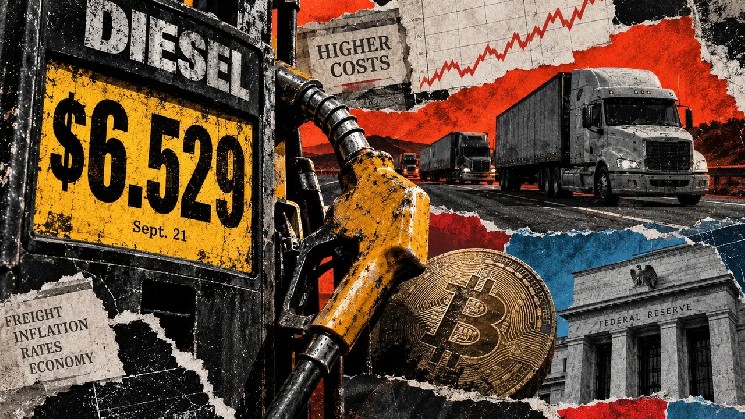
    • US on-highway diesel reached $6.529 per gallon on September 21, marking a new nominal record high and a 24.4-cent weekly increase, according to the Energy Information Administration.
    • Distillate fuel inventories fell to 107.431 million barrels in the week ended September 18, signaling constrained supply amid tight global distillate and crude markets.
    • The price surge raises freight-cost inflation risks that could influence Federal Reserve interest-rate policy, with upcoming CPI and PCE data releases in October serving as critical tests for Bitcoin and risk-asset investors.

    Diesel Hits Fresh Nominal Record as Inventories Tighten

    The Energy Information Administration reported Monday that the US average on-highway diesel price climbed to $6.529 per gallon on September 21, up 24.4 cents from the prior week. Because the EIA had already designated the September 14 reading as a nominal dollar record, the latest figure establishes another all-time high at the pump without inflation adjustment. The increase coincides with a drawdown in distillate fuel stocks, which fell to 107.431 million barrels in the week ended September 18 from 107.859 million barrels a week earlier, according to EIA data published September 23. The inventory decline reinforces evidence of constrained supply in the distillate complex.

    Global Supply Dynamics Drive Price Surge

    The EIA attributes the recent diesel surge to tight global distillate supply and elevated crude oil prices. Diesel fuels the majority of US freight movement by road and rail, and the agency notes that sustained high prices can translate into higher shipping costs across the logistics chain. Whether carriers pass those costs to shippers and ultimately to consumers depends on contract structures, competitive dynamics, and the duration of the fuel-price squeeze. A prolonged rise across multiple freight billing cycles would pose a more significant inflation risk than a single expensive week at the pump.

    Upstream Price Pressure Evident in Producer Data

    Earlier data from the Bureau of Labor Statistics illustrate why the diesel-to-freight channel warrants close monitoring. The producer price index for diesel fuel jumped 24.1% in August from July, while the truck freight transportation price index rose 2.0% over the same period. Both increases occurred before the latest retail diesel record, signaling upstream price pressure building in August. The data leave the precise cause of the freight index increase and any downstream consumer-price effect unsettled, but the sequence suggests a transmission mechanism from fuel costs to transportation services is active.

    Inflation and Rate Expectations Link Diesel to Bitcoin

    The potential Bitcoin effect operates through inflation and interest-rate expectations. If sustained fuel and freight costs keep broader inflation firm, investors may anticipate the Federal Reserve holding rates higher for longer, weighing on assets sensitive to financing conditions. The Federal Open Market Committee raised its target federal funds range to 3.75%–4% on September 16, citing elevated inflation broadly. That decision preceded the September 21 diesel reading. Bitcoin’s specific response to this diesel move remains to be seen, but the macroeconomic pathway is clear: diesel → freight costs → services inflation → Fed policy expectations → risk-asset valuation.

    Why This Matters

    The diesel price spike sits at the intersection of physical commodity markets and monetary policy. Distillate inventories remain near seasonal lows, and global refining constraints—particularly in Europe and Asia—limit quick supply responses. The Federal Reserve’s next policy meetings will incorporate the September CPI release scheduled for October 14, the September producer price index on October 15, and the September Personal Consumption Expenditures price index on October 29. If diesel prices moderate or freight and consumer prices show limited pass-through, the case for a lasting inflation impulse from this episode weakens. For Bitcoin investors, the sequence of data releases over the next month will clarify whether the latest diesel record represents a transient supply shock or a durable cost-push factor that could keep interest rates elevated deeper into 2025.

    Frequently Asked Questions

    What is the current US on-highway diesel price and how does it compare to recent history?

    The national average on-highway diesel price reached $6.529 per gallon on September 21, 2024, up 24.4 cents from the prior week. The EIA had already labeled the September 14 price a nominal record, making this the second consecutive weekly record high in nominal dollar terms.

    How could higher diesel prices affect Federal Reserve interest-rate decisions?

    Diesel powers most US freight transport. Sustained increases can raise shipping costs, which may feed into broader services inflation. If upcoming CPI and PCE data show persistent inflation partly driven by freight costs, the Fed may maintain its current 3.75%–4% target range longer than markets currently expect, creating headwinds for rate-sensitive assets like Bitcoin.

    What upcoming economic releases will clarify the inflation impact?

    Key releases include the September Consumer Price Index on October 14, the September Producer Price Index on October 15, and the September Personal Income and Outlays report (including PCE price data) on October 29. These will reveal whether August’s upstream diesel and freight price pressures have passed through to consumer-level inflation.


  • Bitcoin Recovers From CPI Dip as US Inflation Holds at 3.4%

    Bitcoin Recovers From CPI Dip as US Inflation Holds at 3.4%

    US Inflation Data Triggers Brief Bitcoin Dip Before Recovery Above $77,000

    Bitcoin experienced a sharp but short-lived decline toward $76,000 following the release of the latest US Consumer Price Index (CPI) report, which showed underlying price pressures running slightly hotter than economists anticipated. The cryptocurrency quickly reversed course, reclaiming the $77,000 level, while Ethereum and several major altcoins maintained gains throughout the trading session.

    Core CPI Exceeds Forecasts, Keeping Federal Reserve Policy in Focus

    The US Bureau of Labor Statistics reported that the Consumer Price Index rose 0.4% in August, accelerating from July’s 0.1% increase and matching consensus estimates. On a year-over-year basis, headline inflation held steady at 3.4%, remaining well above the Federal Reserve’s 2% target.

    The core inflation measure, which strips out volatile food and energy components, increased 0.3% month-over-month — above the 0.2% increase most economists had projected. However, the annual core inflation rate edged down from 2.5% to 2.4%.

    Gasoline prices accounted for over one-third of the monthly headline increase, surging 3.9% and lifting the broader energy index 2.1%. Shelter costs rose 0.3%, while food prices edged up 0.1%.

    Bitcoin Volatility Reflects Trader Uncertainty on Rate Outlook

    Bitcoin initially slid to approximately $76,050 immediately after the data release before recovering to trade above $77,100. The token’s intraday range spanned $76,400 to $79,550, highlighting the divided sentiment among market participants interpreting the inflation implications for US interest rates.

    The stronger-than-expected core reading could reinforce a more hawkish stance from the Federal Reserve at its September 15-16 policy meeting. Elevated interest rates typically reduce the appeal of riskier assets as investors find alternative yield opportunities in safer instruments.

    Ethereum Outperforms as Broader Crypto Market Shows Resilience

    Ethereum led the major cryptocurrencies during the session, trading near $2,543 — a gain of nearly 3.2% after reaching intraday highs of $2,648. Solana advanced approximately 1.5% to around $101, while BNB climbed 1.4% to roughly $723. Dogecoin added a modest 0.5%, and XRP was little changed near $1.35.

    Notably, gains across the altcoin complex began before the CPI release, meaning they cannot be attributed to the inflation data. However, the market’s refusal to follow Bitcoin’s initial slide lower suggests the sell pressure was isolated rather than systemic.

    Key Takeaways

    • US headline inflation held at 3.4% year-over-year; monthly core CPI (0.3%) exceeded the 0.2% forecast.
    • Bitcoin briefly dipped toward $76,000 before recovering above $77,000, with an unusually wide $3,000+ intraday range.
    • Ethereum and major altcoins held gains, indicating the initial Bitcoin weakness did not trigger a broader market sell-off.
  • Stock Market Today: Dow, S&P 500, Nasdaq Set for Weekly Decline Ahead of Key Inflation Report

    Stock Market Today: Dow, S&P 500, Nasdaq Set for Weekly Decline Ahead of Key Inflation Report

    Key Economic Data and Earnings Set to Drive Markets as Inflation Concerns Resurface

    Investors face a packed economic calendar this week with critical inflation readings, consumer sentiment data, and notable earnings reports poised to test market resilience amid renewed concerns over energy prices and monetary policy trajectory.

    Inflation and Labor Metrics Take Center Stage

    The August Consumer Price Index (CPI) headlines the data docket. Economists forecast the headline index rose 0.4% month-over-month, accelerating from the previous 0.1% gain, while the year-over-year rate is seen holding steady at 3.4%. Core CPI, which strips out volatile food and energy components, is projected to increase 0.2% for the month — matching July’s pace — with the annual rate expected to tick down to 2.4% from 2.5%.

    Real earnings data will provide insight into household purchasing power. Real average hourly earnings were previously flat year-over-year at -0.1%, while real average weekly earnings edged up 0.1%.

    Consumer Sentiment and Inflation Expectations in Focus

    The University of Michigan’s preliminary September sentiment survey offers a real-time gauge of consumer mood. The headline index is expected to come in at 51, slightly below August’s 51.7 final reading. Current conditions are seen at 51.5 versus 51.9 previously, with expectations at 51 against 51.5.

    Inflation expectations remain elevated. The 1-year outlook previously stood at +4%, while the 5-10 year horizon is expected to hold at +3.3%, matching the prior print.

    Earnings Calendar Highlights

    Corporate reporters include The Kroger Co. (KR) and Rent the Runway (RENT), with results likely to color sector sentiment ahead of the broader reporting season.

    Overnight Headlines: Buyout Speculation, AI Anxiety, and Energy Surge

    PayPal Keeps Strategic Options Open Amid Takeover Chatter

    PayPal’s chief executive addressed persistent buyout rumors, stating the payments giant is “keeping options open” regarding its strategic direction. The comments come as the stock trades well below pandemic-era highs, fueling speculation about potential private-equity interest or a transformative deal.

    Adobe Forecast Miss Reignites AI Monetization Worries

    Shares of Adobe slumped after the software leader issued a revenue forecast that fell short of Wall Street estimates. The miss renewed investor anxiety over the pace at which generative AI features can be monetized across its Creative Cloud franchise, a concern rippling through the broader software sector.

    Trump Proposes Eliminating H-1B Grace Period for Laid-Off Workers

    Former President Donald Trump announced a proposal to end the 60-day grace period that allows H-1B visa holders to remain in the U.S. after job loss. The move would significantly tighten the window for skilled foreign workers to find new sponsorship, escalating the immigration debate ahead of the 2024 election.

    Global Bond Selloff Intensifies as Oil Rally Fans Inflation Fears

    Government bonds worldwide came under pressure as surging crude prices amplified concerns that sticky inflation will keep central banks restrictive for longer. The selloff pushed yields higher across major developed markets, pressuring rate-sensitive equities.

    U.S. Diesel Tops $6 a Gallon for First Time, GasBuddy Reports

    The national average price for diesel fuel breached $6 per gallon, a historic milestone documented by fuel-tracking service GasBuddy. The surge adds to transportation cost pressures and threatens to feed into broader consumer price indices in coming months.