Tag: Commodity Futures Trading Commission

  • Kalshi Loses Another Major Court Fight as States Win Power to Regulate Sports Prediction Markets

    Kalshi Loses Another Major Court Fight as States Win Power to Regulate Sports Prediction Markets

    Key Highlights

    • The 6th U.S. Circuit Court of Appeals ruled unanimously that Ohio and Tennessee can enforce state gambling laws against Kalshi’s sports prediction markets, rejecting the platform’s claim that its contracts fall under exclusive federal CFTC jurisdiction.
    • The decision reverses a Tennessee federal district court ruling that had favored Kalshi while upholding an Ohio district court decision siding with state regulators, creating a split that may push the issue toward the U.S. Supreme Court.
    • Ohio’s Casino Control Commission has issued a cease-and-desist order demanding Kalshi stop offering sports contracts to Ohio residents and warned licensed sportsbooks against partnering with the exchange.

    Sixth Circuit Hands States Major Victory in Prediction Market Jurisdiction Fight

    A unanimous three-judge panel of the 6th U.S. Circuit Court of Appeals dealt a significant blow to Kalshi on Friday, ruling that states retain the authority to apply local gambling statutes to the platform’s sports event contracts. The decision marks the second major legal setback for the prediction-market industry as the regulatory battle over whether event contracts constitute federally regulated financial derivatives or state-governed gambling products inches closer to the U.S. Supreme Court.

    Court Rejects Kalshi’s ‘Swap’ Classification Argument

    Kalshi and other prediction-market operators have long contended that their event contracts qualify as “swaps”—a category of financial derivatives falling under the exclusive regulatory purview of the Commodity Futures Trading Commission (CFTC) under the Commodity Exchange Act (CEA). The states, led by Ohio and Tennessee, countered that sports-event contracts are fundamentally gambling products subject to state sports-betting licensing regimes. The appeals court sided decisively with the states.

    “We hold that Kalshi has not shown that its sports-event contracts satisfy the statutory definition of a ‘swap’ so as to fall within the scope of the CFTC’s ‘exclusive jurisdiction,’” the judges wrote in their opinion. The panel went further, establishing an alternative holding that even if the contracts were deemed swaps, federal commodities law would not displace state gambling regulations. “Even assuming that Kalshi’s sports-event contracts are swaps, we alternatively hold that the CEA neither expressly nor impliedly preempts Ohio’s or Tennessee’s gambling laws,” the opinion stated.

    Tennessee Attorney General Accuses Kalshi of Regulatory End Run

    The ruling reverses a Tennessee federal district court decision that had backed Kalshi while leaving intact an Ohio district court ruling favoring the states. Tennessee Attorney General Jonathan Skrmetti characterized the platform’s strategy as a deliberate attempt to circumvent consumer protections and tax obligations. “Kalshi attempted an end run around Tennessee law to avoid any of the rules or taxes associated with sports gambling. They failed,” Jonathan said. He emphasized the public-policy rationale behind strict gambling oversight: “Sports wagering is heavily regulated because it can do a lot of harm, and I’m glad we thwarted Kalshi’s efforts to remove every safeguard and put Tennessee sports bettors at risk.”

    Ohio Regulator Escalates Enforcement With Cease-and-Desist Order

    Parallel to the appellate proceedings, the Ohio Casino Control Commission (OCCC) has taken direct administrative action. The commission sent Kalshi a cease-and-desist letter asserting that the exchange offered sports event contracts to Ohio residents without obtaining a required sports gaming license. The notice, documented in court filings as Schuler, DE 1-1, includes a demand on Page ID 26 ordering the company to “immediately cease offering these sports wagering products unlawfully in Ohio.”

    Age-Verification Violations and Warnings to Licensed Operators

    The OCCC further accused Kalshi of making unlicensed sports products available to individuals under 21, Ohio’s legal gambling age. On Page ID 27 of the same filing, the regulator cited Ohio Revised Code Section 3775.99(A)(2), calling the practice “a flagrant disregard of Ohio’s statutory gambling age limit.” In a related move, the commission warned licensed Ohio sportsbooks—in Schuler, DE 1-5, Page IDs 57-59—that assisting an unlicensed operator could jeopardize their own licenses. The OCCC stated it would “consider whether a licensed operator chose to work with a company it viewed as operating illegally and could take administrative action against any operator that did.”

    Kalshi responded in court filings (Schuler, DE 1-2, Page IDs 29-30) by citing the now-reversed district court rulings in its favor, describing itself as “a federally licensed exchange . . . authorized to operate its market in all 50 states” and asserting that no state could regulate its activities. The company labeled the OCCC’s warning to sportsbooks a “clear attempt” to limit its business relationships, including those with no nexus to Ohio, and disputed the commission’s characterization of its operations as “online sports gaming.”

    Why This Matters: Federalism, Consumer Protection, and the Future of Event Contracts

    The Sixth Circuit’s decision deepens a circuit split on the central question of whether the CEA grants the CFTC exclusive jurisdiction over event contracts, effectively preempting state gambling laws. Other circuits have reached differing conclusions, and the CFTC itself has sued nine states arguing for federal primacy—a position the Sixth Circuit explicitly rejected. This judicial fragmentation creates a “state-by-state patchwork” that Kalshi spokesperson Dani Lever warned makes market operation untenable. “Courts can’t agree on the basics: Some say federal law covers these contracts, and others say it doesn’t. Some recognize that sports have real economic impact, while others (incorrectly) claim they don’t,” Dani said. “Markets can’t operate when the rules change at every state line, which is why Congress created a single federal regulator with nationwide rules.” The practical consequence is immediate: Kalshi must exit or seek licenses in Ohio and Tennessee, while other states emboldened by the ruling may pursue similar enforcement. The next flashpoint will likely be a petition for certiorari to the U.S. Supreme Court, which could finally resolve the statutory interpretation of “swap” and the scope of CEA preemption.

    Frequently Asked Questions

    What exactly did the Sixth Circuit decide regarding Kalshi’s sports contracts?
    The court held that Kalshi’s sports-event contracts do not meet the statutory definition of a “swap” under the Commodity Exchange Act, so the CFTC does not have exclusive jurisdiction. Even if they were swaps, the CEA does not expressly or impliedly preempt Ohio’s or Tennessee’s gambling laws, allowing those states to enforce their sports-betting regulations against Kalshi.
    Does this ruling apply nationwide or only in Ohio and Tennessee?
    The binding precedent applies within the Sixth Circuit (Kentucky, Michigan, Ohio, and Tennessee). However, the reasoning is persuasive authority elsewhere and encourages other states to pursue similar enforcement. The CFTC’s pending lawsuits against nine states remain active in other circuits.
    What immediate actions must Kalshi take following the cease-and-desist order?
    Kalshi must immediately stop offering sports wagering products to Ohio residents. The OCCC also warned that any licensed Ohio sportsbook partnering with Kalshi risks administrative action against its own license, effectively pressuring the industry to sever ties with the exchange in Ohio.

  • Another Appeals Court Rules Against Kalshi, Finds Sports Contracts Subject to State Regulations

    Another Appeals Court Rules Against Kalshi, Finds Sports Contracts Subject to State Regulations

    Key Highlights

    • A federal appeals court ruled that Kalshi’s sports-event contracts are not federally regulated swaps, rejecting the prediction market’s argument that they fall under Commodity Futures Trading Commission jurisdiction.
    • The three-judge panel agreed Kalshi had standing to sue but determined its contracts do not depend on events “associated with a potential financial, economic, or commercial consequence” as required by statute.
    • The decision intensifies the regulatory clash between states and federally regulated prediction markets over taxation, age restrictions (18 vs. 21), and market competition since the 2024 election.

    Appeals Court Rejects Kalshi’s Swap Classification for Sports Contracts

    A three-judge federal appeals panel delivered a significant setback to prediction market operator Kalshi on Friday, ruling that its sports-event contracts do not qualify as federally regulated swaps under the Commodity Exchange Act. The decision marks a pivotal moment in the escalating regulatory battle between state gambling regulators and federally overseen prediction markets that have surged in prominence following the 2024 presidential election.

    Core Legal Dispute Centers on Statutory Definition

    The court acknowledged that Kalshi had legal standing to bring its case, but parted ways with the platform on the central statutory interpretation. In its written opinion, the panel stated: “While we agree with Kalshi that its sports-event contracts are conditioned on the occurrence of ‘event[s],’ we conclude that Kalshi’s contracts do not depend on events that are ‘associated with a potential financial, economic, or commercial consequence’ within the meaning of the statute.” This distinction effectively removes Kalshi’s sports offerings from the protective umbrella of federal derivatives regulation, leaving them exposed to state-level gambling enforcement.

    New York Giants Example Illustrates Judicial Reasoning

    To clarify its reasoning, the ruling employed a concrete illustration involving the New York Giants. The court explained that the classification hinges on how the “event” is defined. If the event is defined as the Giants winning a Super Bowl, then that outcome would be described as “that event having occurred.” However, the panel determined that such a sporting outcome lacks the requisite financial, economic, or commercial consequence necessary to transform the contract into a regulated swap.

    Why This Matters

    The ruling arrives amid intensifying friction between state gambling authorities and prediction markets like Kalshi, PredictIt, and Polymarket. Since the 2024 election cycle drove unprecedented volume and public attention to these platforms, states have moved aggressively to bring them under local regulatory frameworks. State regulators argue that prediction markets offer functionally identical products to licensed sportsbooks—wagering on game outcomes—yet enjoy structural advantages: they avoid state gaming taxes, operate under lighter compliance burdens, and in many cases accept customers as young as 18, whereas state-licensed operators universally enforce a 21-year-old minimum. Friday’s decision strengthens states’ hand by confirming that, at least for sports-event contracts, federal derivatives law does not preempt their authority. The case is likely to accelerate legislative and enforcement efforts in multiple states seeking to either tax, restrict, or ban these markets outright.

    Frequently Asked Questions

    What specific products did the court rule on?

    The ruling addresses Kalshi’s sports-event contracts—derivative-style instruments that pay out based on the outcomes of sporting events such as the Super Bowl. It does not directly address the platform’s political, economic, or weather-related contracts.

    Does this mean Kalshi must shut down its sports markets immediately?

    The decision removes the federal regulatory shield Kalshi claimed for these products. While not an injunction, it clears the path for state regulators to pursue enforcement actions, cease-and-desist orders, or litigation to halt the offering of sports contracts within their jurisdictions.

    How does the age restriction difference affect the regulatory fight?

    State gambling laws uniformly set the minimum betting age at 21. Kalshi and some other prediction platforms have allowed users as young as 18. States cite this discrepancy as a consumer-protection concern and a competitive inequity, arguing that younger adults are being exposed to gambling-like products without the safeguards required of licensed operators.

  • Blockchain Association Announces Leadership Change After Crypto Clarity Act Stalls

    Blockchain Association Announces Leadership Change After Crypto Clarity Act Stalls

    Key Highlights

    • Summer Mersinger is stepping down as CEO of the Blockchain Association effective October 16, just one week after the U.S. Senate failed to advance the Digital Asset Market Clarity Act.
    • Kristin Smith, the association’s founding CEO who led the organization from 2018 until 15 months ago, will return to helm the advocacy group on an interim basis.
    • The leadership change closes a tumultuous period that included significant regulatory wins at the SEC and CFTC but ended with a sweeping legislative defeat for the crypto industry’s top priority bill.

    Blockchain Association Announces Leadership Transition After Senate Setback

    The Blockchain Association, one of the cryptocurrency industry’s most influential lobbying organizations in Washington, announced Friday that Summer Mersinger will depart as chief executive officer on October 16. The transition comes barely a week after the U.S. Senate failed to advance the Digital Asset Market Clarity Act—the sector’s signature legislative priority—in a vote that saw all Democratic senators and several Republicans withhold support.

    Stepping into the role on an interim basis is Kristin Smith, who founded the association in 2018 and served as its first CEO until her departure 15 months ago. The handover marks a return to familiar leadership for an organization that has been at the center of the crypto industry’s engagement with federal regulators and lawmakers during a period of intense scrutiny and policy debate.

    Mersinger Reflects on Regulatory Progress Amid Legislative Defeat

    In a statement accompanying the announcement, Mersinger highlighted the progress achieved during her tenure while acknowledging the recent setback. “I’m proud of how far we’ve come together, from the $GENIUS Act to real regulatory clarity at the SEC and CFTC,” said Mersinger, who joined the association after serving as a commissioner on the Commodity Futures Trading Commission (CFTC). “Kristin built this association from the ground up, and BA is in good hands. I’ll be cheering them on.”

    Mersinger’s reference to the GENIUS Act—the Guiding and Establishing National Innovation for U.S. Stablecoins Act—underscores one of the few legislative victories for the digital asset sector this Congress. Her tenure also coincided with a notable shift in enforcement posture at both the Securities and Exchange Commission (SEC) and the CFTC, though the failure of the broader market structure bill represents a significant blow to the industry’s push for comprehensive regulatory framework.

    Why This Matters

    The leadership change at the Blockchain Association signals a strategic recalibration for the crypto industry’s primary Washington advocacy vehicle at a critical juncture. With the Digital Asset Market Clarity Act effectively stalled for this congressional session, the industry faces a prolonged period of regulatory uncertainty heading into the 2025 legislative calendar. Smith’s return brings institutional memory and established relationships with key Hill offices and regulatory agencies—assets that may prove valuable as the association navigates a likely shift toward administrative and judicial strategies in the absence of legislative progress. The transition also reflects the broader volatility in crypto policy advocacy, where personnel moves often track the ebb and flow of political momentum in Washington.

    Frequently Asked Questions

    When does the leadership transition take effect?

    The handover from Summer Mersinger to Kristin Smith is scheduled for October 16, according to the association’s Friday statement.

    Why is Summer Mersinger leaving the Blockchain Association?

    The announcement did not specify a reason for Mersinger’s departure, but it comes one week after the U.S. Senate failed to advance the Digital Asset Market Clarity Act, a major legislative priority for the crypto industry.

    What is Kristin Smith’s background with the organization?

    Kristin Smith founded the Blockchain Association in 2018 and served as its first CEO until stepping down approximately 15 months ago. She is returning on an interim basis.

  • Kalshi Seeks En Banc Rehearing in Nevada Sports Prediction Markets Case

    Kalshi Seeks En Banc Rehearing in Nevada Sports Prediction Markets Case

    Prediction market platform Kalshi has escalated its legal challenge against the state of Nevada, filing a petition for an en banc rehearing before the Ninth Circuit Court of Appeals. The move comes after a three-judge panel ruled in favor of Nevada, upholding the state regulator’s authority to classify Kalshi’s sports-related event contracts as gambling.

    Background: Kalshi vs. Nevada Regulatory Action

    The dispute centers on Kalshi’s offerings of event contracts tied to sports outcomes. The Nevada Gaming Control Board (NGCB) previously issued a cease-and-desist order asserting that these contracts constitute unlicensed gambling under state law. Kalshi, a federally regulated exchange overseen by the Commodity Futures Trading Commission (CFTC), argues that its contracts fall under federal derivatives jurisdiction and are therefore preempted from state gambling regulation.

    Ninth Circuit Panel Decision

    In a recent decision, a Ninth Circuit panel sided with Nevada. The court held that the state retains the authority to regulate the sports contracts as gambling, rejecting Kalshi’s argument that the Commodity Exchange Act (CEA) preempts state law in this instance. The panel’s ruling effectively allows the NGCB’s enforcement action to proceed, creating a significant regulatory hurdle for the platform’s operations in the state.

    Petition for En Banc Rehearing

    Kalshi’s petition for a full court rehearing—known as an en banc review—asks the entire complement of active Ninth Circuit judges to reconsider the panel’s decision. Such petitions are granted sparingly, typically reserved for cases involving exceptional importance or conflicts with precedent. Kalshi contends that the panel’s ruling creates a circuit split regarding the scope of CEA preemption and threatens the regulatory framework for federally designated contract markets.

    Implications for Prediction Markets and Federal Preemption

    The outcome of this case carries broad implications for the prediction market industry and the balance of power between federal derivatives regulation and state gambling laws. A final ruling affirming state authority could encourage other states to pursue similar enforcement actions against federally regulated exchanges offering event contracts on sports, elections, or other outcomes. Conversely, a reversal would reinforce the CFTC’s exclusive jurisdiction over designated contract markets.

    Next Steps

    The Ninth Circuit will now decide whether to grant the petition for en banc review. If denied, the panel’s decision stands, and Kalshi may consider petitioning the U.S. Supreme Court. If granted, the case will be re-argued before a larger bench of judges, extending the legal timeline but offering Kalshi a critical opportunity to overturn the adverse precedent.

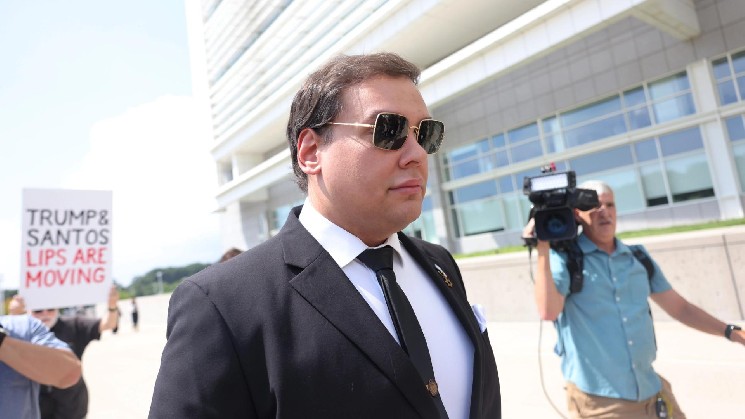
  • Kalshi Issues First Lifetime Ban to Former Congressman George Santos

    Kalshi Issues First Lifetime Ban to Former Congressman George Santos

    George Santos did not attend the event, ultimately betting money on that outcome. In addition to banning him, Kalshi fined Santos more than $70,000 in an enforcement action late last week. Federal authorities have reportedly also been investigating the matter. Santos did not immediately respond to CoinDesk’s request for comment.

    Santos was expelled from Congress in 2023 as criminal investigations pursued the disgraced former lawmaker. He was serving a prison sentence for fraud when President Donald Trump commuted it last year.

    Kalshi said the Santos case was one of five new enforcement actions at the company. Under its regulatory obligations, the prediction-market platform is responsible for serving as a first line of defense against market manipulation. The other individuals received temporary trading bans after cooperating with Kalshi’s investigations.

    “Mr. Santos faces additional financial penalties and will be banned permanently from trading on Kalshi given his lack of cooperation,” a spokesperson said in a statement.

    The U.S. Commodity Futures Trading Commission, which regulates the industry, also fined a former White House aide for illicit trading late Friday. Gabriel Perez was ordered to pay more than $170,000 and received a three-year trading ban. The penalties were reduced after what regulators described as his “exemplary cooperation.”

  • Kalshi Imposes First Lifetime Ban on George Santos for Market Manipulation

    Kalshi Imposes First Lifetime Ban on George Santos for Market Manipulation

    Kalshi, the regulated U.S. prediction-market exchange, has issued its first permanent trading ban, barring former Representative George Santos and fining him more than $70,000 for allegedly manipulating a contract linked to his own attendance at a public event, according to CoinDesk.

    The penalty, detailed in a disciplinary record published on Kalshi’s website and confirmed by a company spokesperson, is the most severe sanction the exchange has imposed. It comes as prediction markets face growing scrutiny over whether they can prevent trading based on public figures’ actions and non-public information.

    What Kalshi Says George Santos Did

    Kalshi’s disciplinary record says Santos made a series of large trades in a market whose contracts depended on whether he attended an appearance by President Donald Trump earlier this year. The record says Santos then made public statements about his attendance in an effort to influence the market’s outcome.

    Santos ultimately bet that he would not attend the event, and he did not appear. Kalshi imposed the fine in the final days of August, in addition to banning him from the platform for life.

    Santos did not respond to CoinDesk’s request for comment. He was expelled from Congress in 2023 amid criminal fraud investigations and was serving a prison sentence when Trump commuted his sentence last year.

    Kalshi Announces Broader Enforcement Action

    Kalshi said the Santos case was one of five new enforcement matters. The other four traders received temporary bans after cooperating with investigators.

    The exchange described the cases as part of its responsibility under its regulations to serve as a first line of defense against market manipulation. A spokesperson said Santos “faces additional financial penalties and will be banned permanently from trading on Kalshi given his lack of cooperation.”

    The action followed a separate Commodity Futures Trading Commission order issued Friday, August 28. Under that order, former White House aide Gabriel Perez was directed to pay more than $170,000 and was barred from trading for three years over bets on “mention” contracts involving Trump.

    The CFTC said Perez’s penalties were reduced because of what it described as exemplary cooperation. Perez had worked as a teleprompter operator. “Mention” contracts pay out when prominent figures speak specific words during public addresses.

    Why Prediction-Market Enforcement Matters

    Prediction markets have spent the past year seeking to reassure regulators and institutional partners that their platforms can resist manipulation. That effort has gained importance as companies such as Cantor Fitzgerald open Kalshi markets to institutional clients and trading volumes increase.

    Self-enforcement is a key part of that argument. Platforms that investigate suspicious activity and impose penalties can cite those actions as evidence that their compliance systems are working.

    Rival platform Polymarket has said it uses machine learning, blockchain analytics, trade surveillance and open-source research to identify unusual activity. The company says it has referred more than 100 cases to authorities, including bets linked to a U.S. soldier accused of using classified information to wager on the capture of Venezuela’s Nicolás Maduro and possible insider trading before U.S. military action in Iran.

    Polymarket has also said its systems block the vast majority of U.S. users from accessing its international platform, as required under a 2022 settlement with the CFTC.

    Kalshi’s disciplinary record illustrates how a lightly monitored market tied to one person’s behavior can become vulnerable to manipulation. BlockchainReporter has examined a similar dynamic in coverage of sophisticated traders’ structural advantage on Kalshi.

    Key unanswered questions include how far federal scrutiny will extend and whether other prediction-market platforms will impose permanent bans of their own. Kalshi has said federal authorities have reportedly examined the Santos trades, while the wider regulatory environment—including state efforts to prohibit prediction markets—suggests that the industry’s enforcement practices will remain under close scrutiny through the U.S. midterm elections.

  • Former White House Teleprompter Operator Fined for Prediction Market Insider Trading

    Former White House Teleprompter Operator Fined for Prediction Market Insider Trading

    A former White House teleprompter operator has agreed to pay $172,000 to settle allegations that he used advance knowledge of presidential speeches to trade prediction-market contracts linked to words President Donald Trump would say.

    The Commodity Futures Trading Commission said Gabriel Perez misappropriated confidential government information to trade “presidential mention market” contracts. These event contracts pay out based on whether a president uses specific words or phrases during a speech.

    Because his role gave him access to presidential speeches before they were delivered, Perez allegedly placed trades on outcomes he already knew, according to the CFTC. Between December 2025 and February 2026, he generated more than $107,500 in profits, the agency said.

    Under the settlement, Perez must disgorge $107,539.02 in gains, pay a $65,000 civil penalty, accept a three-year trading ban and cease further violations of the Commodity Exchange Act.

    The CFTC said the penalty was substantially reduced under a new cooperation policy because of what it described as Perez’s “exemplary assistance” with the investigation. The regulator also credited exchange operator Kalshi with helping advance the case.

    Prediction markets face growing insider-trading scrutiny

    The enforcement action is one of the clearest examples yet of the insider-trading risks facing prediction markets as they grow in popularity. These platforms allow users to wager real money on real-world outcomes, including elections, sports and increasingly specific details of political speeches.

    The risks are not hypothetical. Earlier this year, a U.S. soldier was charged over alleged Polymarket trading that produced more than $400,000 in illicit gains tied to the military operation that ousted Venezuelan leader Nicolas Maduro. Separately, a MrBeast video editor was fired in March amid a Kalshi insider-trading investigation.

    Kalshi has also been working through a backlog of suspicious-activity reviews and has introduced additional safeguards amid increasing scrutiny over whether insiders are manipulating its markets.

    The case comes as prediction markets move further into the mainstream, generating billions of dollars in trading volume and attracting greater regulatory attention. It also signals that the CFTC considers event contracts to fall squarely within its authority as swaps subject to insider-trading rules.

  • Connecticut Sues Kalshi Over Sports Prediction Contracts

    Connecticut Sues Kalshi Over Sports Prediction Contracts

    Connecticut has filed a lawsuit against prediction market operator Kalshi, escalating a nationwide legal battle over whether such platforms can offer sports-related contracts without state gambling licenses. The action, filed Thursday by Attorney General William Tong, alleges that Kalshi’s sports contracts function as traditional sports wagers and violate state consumer protection laws.

    State Alleges Unlicensed Sports Gambling

    The complaint targets contracts covering team wins, game scores, and point spreads. Connecticut officials contend these products cross the line into unlicensed sports gambling, an activity reserved for licensed operators under state law. The lawsuit follows a 2023 enforcement order directing Kalshi and two other platforms to cease offering unlicensed sports wagering to Connecticut residents.

    Kalshi Claims Federal Preemption

    Kalshi has challenged Connecticut’s authority in federal court, arguing its contracts qualify as regulated financial instruments under the Commodity Exchange Act. The company maintains that the Commodity Futures Trading Commission (CFTC) holds exclusive jurisdiction over its markets, preempting state gambling regulations.

    Regulatory Conflict Expands Across States

    Connecticut’s lawsuit opens a new front in Kalshi’s growing regulatory challenges. New York has launched a similar challenge against the company’s sports prediction markets. Meanwhile, a federal court recently blocked Minnesota from enforcing a ban against prediction markets, a ruling that bolstered Kalshi’s argument for federal oversight.

    However, a Connecticut judge recently denied Kalshi’s motion to halt the state’s enforcement efforts. The company has appealed that decision.

    National Implications for Prediction Markets

    The outcomes of these cases could define how regulators classify prediction markets across the United States. The central question remains whether states retain the power to regulate sports-related event contracts independently, or whether federal commodities law provides a complete shield for platforms like Kalshi.

  • HPC Presses CFTC to Prioritize Perpetual Contracts in Continued Policy Push

    HPC Presses CFTC to Prioritize Perpetual Contracts in Continued Policy Push

    Hyperliquid Policy Center Urges CFTC to Prioritize Perpetual Contracts in Innovation Agenda

    The Hyperliquid Policy Center (HPC) formally petitioned the Commodity Futures Trading Commission (CFTC) on Thursday, August 27, 2026, urging the regulator to place perpetual contracts at the center of its innovation roadmap. The filing arrives as U.S. traders remain largely excluded from a global perpetual derivatives market that has surpassed $500 billion in offshore volume.

    Perpetual Contracts Dominate CFTC Innovation Advisory Committee Meeting

    The HPC statement follows the CFTC’s first Innovation Advisory Committee meeting on August 20. While the official agenda covered digital assets, artificial intelligence, and prediction markets, HPC reports that committee members raised perpetual contracts repeatedly across all three sessions.

    Citing timestamps from the meeting webcast, HPC identified several industry leaders who advocated for the product:

    • Tyler Winklevoss of Gemini stated that U.S. firms are falling behind as perpetual contracts constitute the bulk of global digital asset trading volume.
    • Don Wilson of DRW characterized perpetuals as essential risk tools that registered funds would prefer to hold alongside dated futures.
    • Brian Armstrong of Coinbase, Raghu Yarlagadda of FalconX, and Tushar Jain of Multicoin Capital also spoke in favor of perpetual contracts.

    HPC interpreted this unsolicited discussion as clear evidence of market demand. Signed by Chief Executive Jake Chervinsky and Senior Counsel Brad Bourque, the statement was submitted to Commission Secretary Christopher Kirkpatrick and advances four core arguments:

    1. Perpetual contracts are critical to the CFTC’s innovation mandate.
    2. They address genuine, ongoing hedging needs.
    3. A more receptive CFTC is already moving these markets onshore.
    4. Public blockchains can modernize derivative infrastructure, warranting regulatory updates.

    Why Perpetual Contracts Track Price Without Expiration

    A significant portion of the filing explains the mechanics of perpetual contracts. Unlike traditional futures, perpetuals have no settlement date, cannot be rolled over, and involve no physical delivery. Instead, periodic funding payments transfer value between long and short position holders, anchoring the contract price to a reference index.

    HPC argues this structure better serves exposures with no natural end date. The filing cites examples including:

    • An airline hedging continuous aviation fuel consumption
    • A fund managing persistent portfolio risk
    • An AI developer facing rising, ongoing compute costs

    In each case, hedging with dated futures introduces roll-cycle risk, timing uncertainty, and recurring transaction costs that perpetual contracts eliminate.

    Shifting Regulatory Landscape and Legal Challenges

    The filing coincides with a noticeable softening in the CFTC’s posture toward perpetual products:

    • May 2026: The CFTC approved the first U.S.-listed perpetual futures contract, Kalshi’s BTCPERP, and issued a policy statement and staff guidance addressing continuous trading.
    • June 2026: The agency requested public comment on extending perpetual contracts to storable energy commodities.
    • August 26, 2026: HPC and the HIP-3 deployer submitted a joint response to the energy commodity request.
    • August 24, 2026: HPC filed a separate response urging the SEC and CFTC to classify qualifying equity perpetuals as security futures.

    According to figures released by FIA President Walt Lukken, the CFTC now oversees 30 designated contract markets—up from 16 in 2003—with 17 pending applications. The agency also manages 6,700 listed contracts, a sharp increase from 2,100 in 2023.

    Opposition remains, however. CME Group filed suit against the CFTC in June, arguing that perpetual contracts constitute swaps rather than futures. CME’s outgoing chief, Terry Duffy, described the product as “a disaster waiting to happen.”

    About the Hyperliquid Policy Center

    HPC describes itself as an independent research and advocacy organization with ties to the Hyperliquid Foundation, which founded the center in February 2026.