Tag: coinbase

  • Coinbase CEO Brian Armstrong Predicts Bitcoin Will Reach $400,000 Within Four Years

    Coinbase CEO Brian Armstrong Predicts Bitcoin Will Reach $400,000 Within Four Years

    Key Highlights

    • Coinbase CEO Brian Armstrong predicts Bitcoin could reach $400,000 by 2030 based on historical halving cycles, though he emphasizes this is a possible outcome, not a fixed forecast.
    • Coinbase launches fixed-rate USDC loans backed by Bitcoin via the Morpho Midnight protocol on its Base blockchain, coexisting with its existing variable-rate Morpho Blue product.
    • U.S. spot Bitcoin ETFs attracted $2.4 billion in net inflows for the week ending September 25, the largest weekly intake since October 2025, while Defense Secretary Pete Hegseth disclosed personal Bitcoin holdings valued between $16,000 and $65,000.

    Armstrong’s $400,000 Bitcoin Prediction Rooted in Halving Cycles

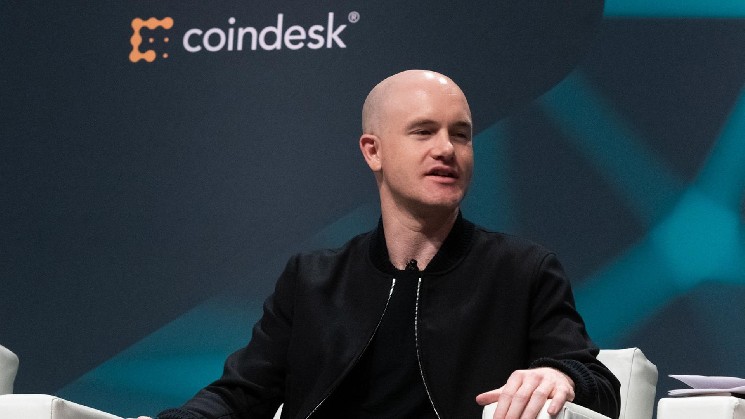
    Coinbase Global (NASDAQ: COIN) Chief Executive Officer Brian Armstrong reiterated his long-term Bitcoin price target during a September 19 interview with MoneyRehabPodcast, stating he still sees a path for Bitcoin to reach $400,000 by 2030. Armstrong’s view is built around Bitcoin’s historical market cycles, specifically the network’s programmed halving events that cut the amount of new BTC entering circulation approximately once every four years.

    According to Armstrong, previous halving periods have often been followed by sharp price runs, then major pullbacks that can drag on for close to a year. He suggested another similar cycle could take Bitcoin to around three times its previous record price before 2030. However, Armstrong made clear that the estimate depends on Bitcoin behaving in a way that resembles earlier cycles, and that earlier price action cannot tell investors exactly what comes next. The target is therefore a possible outcome, not a fixed forecast.

    As of 16:01 WIB on September 25, Coinbase shares were priced at $198.85 on Pluang, down 0.18% over 24 hours. The crypto exchange held a market value of $52.27 billion, while COIN’s 52-week trading range stood between $141.09 and $387.27.

    Coinbase Expands Lending with Fixed-Rate Bitcoin-Backed Loans

    Coinbase has also expanded its lending business with fixed-rate USDC loans backed by Bitcoin. The new product allows borrowers to receive their interest charge and repayment deadline at the start of the loan instead of watching the cost move with market conditions.

    The fixed-rate offering works with Morpho Midnight, a decentralized lending protocol introduced in July. The protocol does not retain any customer funds and allows for lending with predetermined borrowing rates and fixed terms. Transactions on the network will be settled using Base, Coinbase’s second-layer blockchain built upon Ethereum.

    Coinbase currently provides another cryptocurrency lending product called Morpho Blue, which uses variable borrowing rates that depend on available liquidity and demand for loans, making customers pay higher rates during periods of increased borrowing activity. The fixed product will coexist with the current offering rather than replace it. Currently, Coinbase’s variable-rate lending market features more than $1.4 billion in active loans with total collateral of nearly $3 billion.

    Bitcoin ETF Inflows Surge to $2.4 Billion Weekly

    Demand for spot Bitcoin ETFs has picked up sharply. The Block, using SoSoValue figures, reported that U.S. funds received $2.4 billion of net inflows during the week ending September 25, marking their biggest weekly intake since October 2025. Monday accounted for a large chunk of that money, with the 12 Bitcoin ETFs tracked by SoSoValue collecting $999 million in one day. That marked their strongest daily result since October 6, 2025 and ranked as the ninth-biggest daily inflow since U.S. spot Bitcoin ETFs began trading in January 2024.

    The buybacks put the flows back into positive territory for 2026. Year-to-date net flow figures were around $934.1 million. As of July 13, that same group was showing about $5.8 billion in net outflows. The funds have generated about $57.6 billion in net inflows since inception. Net assets for all funds totaled about $108.4 billion as of Friday.

    According to Bloomberg ETF analyst Eric Balchunas, the change in flows is due to the Treasury’s plans to increase purchases of longer-term Treasuries.

    Defense Secretary Pete Hegseth Discloses Personal Bitcoin Holdings

    Defense Secretary Pete Hegseth has also disclosed personal Bitcoin exposure in his newly released 2025 annual ethics filing. The filing lists at least $3.1 million across cash, retirement investments, and BTC. The disclosure includes more than $1 million sitting in one bank account. Hegseth, a former Fox News host who became Defense secretary in January 2025, is also facing impeachment demands from members of his own party over his handling of the war with Iran.

    Hegseth had a total of five retirement accounts that ranged in value between about $2.05 million and $4.35 million. Three of these accounts, which belonged to Hegseth, were worth about $500,000 to $1.25 million. His wife, Jennifer Hegseth, had a total of two Rollover IRAs that were worth about $1.55 million to $3.1 million.

    The couple also disclosed three cash accounts. One was reported only as being “worth more than $1 million.” Their Bitcoin position was valued between approximately $16,000 and $65,000. The wide range in the federal disclosure forms makes it difficult to make a clear year-to-year wealth comparison. In Hegseth’s nomination form from December 2024, the total amount of financial assets falls within $1.4 million and $3.4 million. In the most recent filing, the lower range is $3.1 million with no upper limit since there is no ceiling for the largest cash account.

    The only major change is in the bank balance. Hegseth’s earlier disclosure reveals an account called “U.S. Bank #2” which ranged from $15,001 to $50,000. In the current filing, the account holding the same name ranges above $1 million.

    Why This Matters

    The convergence of institutional price predictions, expanding crypto-native financial infrastructure, and surging ETF demand signals deepening mainstream integration of Bitcoin into traditional finance. Armstrong’s halving-cycle thesis, while speculative, reflects a widely watched analytical framework among market participants. Coinbase’s launch of fixed-rate borrowing via Morpho Midnight on Base demonstrates how centralized exchanges are bridging into decentralized finance primitives, offering users predictable costs previously unavailable in variable-rate DeFi lending. The record-breaking ETF inflows—reversing months of outflows—suggest renewed institutional appetite, potentially influenced by macro shifts in Treasury policy as noted by Balchunas. Meanwhile, a sitting Cabinet secretary’s disclosed Bitcoin holdings, however modest, mark a notable milestone in political normalization of digital asset ownership.

    Frequently Asked Questions

    What is Brian Armstrong’s Bitcoin price prediction and what is it based on?

    Coinbase CEO Brian Armstrong predicts Bitcoin could reach $400,000 by 2030. His forecast is based on historical halving cycles, where the reduction in new BTC supply every four years has previously been followed by significant price appreciation. Armstrong emphasizes this is a possible outcome if Bitcoin behaves similarly to past cycles, not a guaranteed forecast.

    How do Coinbase’s new fixed-rate Bitcoin-backed loans work?

    Coinbase’s fixed-rate USDC loans allow borrowers to lock in their interest charge and repayment deadline upfront, using Bitcoin as collateral. The product operates through the Morpho Midnight protocol, which does not hold customer funds, and settles transactions on Base, Coinbase’s Ethereum layer-2 blockchain. This fixed-rate option coexists with the existing variable-rate Morpho Blue product.

    What drove the recent surge in U.S. spot Bitcoin ETF inflows?

    U.S. spot Bitcoin ETFs saw $2.4 billion in net inflows for the week ending September 25, the largest weekly intake since October 2025. According to Bloomberg ETF analyst Eric Balchunas, the shift is attributed to the Treasury’s plans to increase purchases of longer-term Treasuries, which may be influencing investor risk appetite and portfolio allocation toward Bitcoin exposure.

  • Kraken Parent Payward Bets Billions on Becoming Financial Infrastructure, Not Just a Crypto Exchange

    Kraken Parent Payward Bets Billions on Becoming Financial Infrastructure, Not Just a Crypto Exchange

    Key Highlights

    • Payward, the parent company of Kraken, is pursuing a regulated infrastructure strategy rather than consolidating all products under a single Kraken-branded exchange platform.
    • Architect Partners describes this as an “Everything Financial Infrastructure” model designed to power financial products across multiple brands, customer segments, and partner channels.
    • Kraken averaged approximately $1.1 billion in daily spot trading volume during the first four months of 2026, while Binance held 38.7% of top-10 centralized exchange spot volume in Q2 and Coinbase reported an 8.6% share of overall crypto trading volume in Q1.

    Payward Charts Infrastructure-First Path Distinct From Coinbase Model

    Digital-asset investment bank Architect Partners reports that Payward, the holding company behind the Kraken cryptocurrency exchange, is pursuing a fundamentally different business architecture than its primary U.S. rival, Coinbase. Rather than concentrating all products and services inside a single Kraken-branded platform, Payward is building regulated infrastructure capable of supporting multiple brands and serving outside financial institutions.

    According to Architect Partners, this approach represents a distinct aggregation layer for the digital-asset economy. “Payward appears to be choosing a different aggregation layer: the regulated infrastructure stack that can power financial products across multiple brands, customer segments, and partner channels,” the firm said. “In our view, Payward is helping define the next evolution beyond the ‘Everything Exchange’: an ‘Everything Financial Infrastructure’ model.”

    Market Position and Competitive Landscape

    The infrastructure strategy unfolds against a backdrop of significant market-share disparities among centralized exchanges. CoinGecko data indicates that Kraken averaged about $1.1 billion in daily spot trading volume during the first four months of 2026. By comparison, Binance controlled 38.7% of spot trading volume across the top-10 centralized exchanges in the second quarter of 2026, while Coinbase reported an 8.6% share of overall cryptocurrency trading volume in the first quarter.

    These figures underscore the scale challenge Kraken faces as a standalone exchange venue. Payward’s response, according to the Architect Partners analysis, is to monetize the underlying technology and regulatory licenses across a broader ecosystem of partners and brands rather than relying exclusively on direct retail exchange revenue.

    Legacy Finance Constraints Drive Blockchain Infrastructure Thesis

    Payward’s thesis centers on structural inefficiencies in the traditional financial system. The company argues that decades-old technology and market conventions continue to constrain legacy finance. Securities settlement remains slow, markets close overnight and on weekends, and banks, brokers, custodians, and clearing houses maintain separate records that require costly reconciliation.

    Kraken co-CEO Arjun Sethi articulated the cost of these boundaries. “Each boundary creates another intermediary, delay and fee,” Sethi said. In his view, blockchain-based systems offer an alternative by enabling assets to function simultaneously as investments, collateral, and programmable instruments on shared infrastructure.

    Why This Matters

    The divergence between Payward’s infrastructure-first model and Coinbase’s platform-centric approach highlights a strategic fork in the maturation of the digital-asset industry. As regulatory clarity improves in major jurisdictions, the value proposition may shift from operating a single branded exchange to providing the compliant rails—licensing, custody, settlement, and programmable asset logic—that allow traditional financial institutions, fintechs, and other brands to embed digital-asset functionality natively. If successful, Payward could generate revenue from a wider surface area of the financial system while reducing dependence on volatile retail trading volumes. The model also positions the company to benefit from the anticipated tokenization of real-world assets, which requires precisely the kind of multi-brand, regulated infrastructure Payward is building.

    Frequently Asked Questions

    How does Payward’s strategy differ from Coinbase’s?

    Coinbase concentrates its products and services within a single Coinbase-branded platform for retail and institutional users. Payward is building a regulated infrastructure stack intended to power financial products across multiple brands, customer segments, and third-party partner channels rather than funneling all activity through the Kraken exchange brand.

    What market-share data contextualizes Kraken’s position?

    CoinGecko data shows Kraken averaged roughly $1.1 billion in daily spot trading volume in the first four months of 2026. Binance held 38.7% of top-10 centralized exchange spot volume in Q2 2026, and Coinbase reported an 8.6% share of overall crypto trading volume in Q1 2026.

    What is the “Everything Financial Infrastructure” model described by Architect Partners?

    Architect Partners uses the term to describe Payward’s approach of providing a regulated, programmable infrastructure layer—covering custody, settlement, compliance, and asset issuance—that can be white-labeled or embedded by multiple brands and financial institutions, moving beyond the single-brand “Everything Exchange” paradigm.

  • BlackRock: AI Agents Will Soon Buy Computing Power and Data Using Stablecoins

    BlackRock: AI Agents Will Soon Buy Computing Power and Data Using Stablecoins

    Key Highlights

    • BlackRock identifies artificial intelligence as a primary catalyst for digital asset adoption, citing autonomous agents’ need for native payment and settlement infrastructure.
    • Stablecoins are positioned as the immediate beneficiary due to their price stability for service pricing and blockchain networks’ 24/7 payment capabilities.
    • The asset manager highlights Coinbase’s x402 protocol as an emerging standard for agent-to-service payments, including API calls, while noting traditional payment networks are also adapting to agentic commerce.

    BlackRock Maps Convergence of AI Agents and Digital Asset Infrastructure

    BlackRock, the world’s largest asset manager, has published research arguing that artificial intelligence will serve as one of the most significant drivers for digital asset adoption in the coming years. The paper centers on the rise of autonomous AI agents—software systems capable of independently executing complex tasks—and their fundamental requirement for programmable, always-on financial infrastructure to operate at machine speed.

    Machine-Native Intelligence Requires Machine-Native Payments

    According to BlackRock’s analysis, AI provides “machine-native intelligence” while digital assets supply the corresponding payment and settlement layer these agents need to act on their decisions without human intervention. The paper illustrates a scenario where an autonomous agent carrying out a task could pay for a data request, book a service, or purchase computing capacity instantly, eliminating the latency and friction inherent in traditional financial systems that require human authorization or operate within limited business hours.

    This architectural fit stems from the programmable nature of blockchain networks and tokenized assets, which allow for conditional, automated value transfer based on code execution rather than institutional intermediaries. For AI agents operating across time zones and negotiating micro-transactions for compute resources or data access, the ability to settle instantly and finality is presented as a functional necessity rather than a speculative feature.

    Stablecoins Emerge as Primary Vehicle for Agentic Commerce

    The research identifies stablecoins as the likely first major beneficiary of this paradigm shift. Their relatively stable value makes them practical for pricing services and settling obligations predictably—a critical requirement for autonomous systems budgeting resources or calculating cost-efficiency in real time. Furthermore, public blockchain networks enable these stablecoin payments to occur around the clock, seven days a week, aligning with the non-stop operational tempo of AI agents.

    BlackRock specifically highlights Coinbase’s x402 protocol as one emerging mechanism facilitating this economy. The protocol is designed to allow agents to pay for online resources—including API calls—directly via HTTP payments, embedding settlement into the web request layer itself. This development signals a move toward standardized, interoperable payment rails for machine-to-machine commerce.

    Traditional Finance Adapts to Agentic Payments Landscape

    While emphasizing the structural advantages of crypto-native infrastructure, BlackRock’s paper acknowledges that existing payment networks are not standing still. The research notes that traditional financial rails are actively adapting to accommodate agentic commerce, suggesting a competitive landscape where both blockchain-based and upgraded legacy systems vie for the high-volume, low-value transaction flows generated by autonomous AI agents.

    Why This Matters

    BlackRock’s endorsement of the AI-agent and digital-asset convergence carries significant weight given the firm’s $10 trillion-plus in assets under management and its growing involvement in tokenized funds and blockchain infrastructure. The paper frames digital assets not as speculative vehicles but as essential utility infrastructure for the next computing paradigm. If autonomous agents become a dominant economic force—as many AI researchers predict—the demand for instant, programmable, global settlement could drive institutional adoption of stablecoins and blockchain payment rails far beyond current crypto-native use cases. The mention of Coinbase’s x402 protocol also underscores how major regulated exchanges are building the middleware to bridge traditional web commerce with onchain settlement. Meanwhile, the acknowledgment that legacy payment networks are adapting signals a broader industry recognition that the future of commerce may be increasingly machine-initiated.

    Frequently Asked Questions

    Why does BlackRock believe AI agents need digital assets for payments?
    BlackRock argues that AI agents require “machine-native” payment infrastructure that operates 24/7, settles instantly, and can be triggered programmatically without human authorization—capabilities that blockchain networks and tokenized assets provide natively.
    What role do stablecoins play in this vision?
    Stablecoins are seen as the immediate primary vehicle because their price stability allows agents to price services and budget resources predictably, while blockchain rails enable round-the-clock settlement.
    What is Coinbase’s x402 protocol and why does BlackRock highlight it?
    x402 is an emerging protocol from Coinbase that enables HTTP-based payments for online resources such as API calls, allowing agents to pay for web services directly at the protocol layer. BlackRock cites it as an example of the middleware being built for agent-to-service commerce.
  • Coinbase Launches Fixed-Rate USDC Loans Backed by Bitcoin

    Coinbase Launches Fixed-Rate USDC Loans Backed by Bitcoin

    Key Highlights

    • Coinbase launches fixed-rate USDC loans backed by Bitcoin, offering borrowers certainty on interest costs and repayment dates.
    • The new product runs on Morpho Midnight, a decentralized fixed-rate lending protocol that settles on Coinbase’s Base layer-2 network.
    • Fixed-rate loans sit alongside Coinbase’s existing variable-rate Morpho Blue offering, which currently holds over $1.4 billion in active loans.

    Coinbase Expands Crypto Lending With Fixed-Rate Bitcoin-Backed USDC Loans

    Nasdaq-listed cryptocurrency exchange Coinbase (COIN) has introduced a fixed-rate borrowing option that allows users to mint dollar-pegged stablecoin USDC against their Bitcoin (BTC) holdings. Announced on Tuesday, the new product sets both the interest rate and the repayment date at the moment of borrowing, providing a predictable alternative to the exchange’s existing variable-rate loans. The move signals a significant evolution in how centralized platforms are integrating decentralized finance primitives to offer more sophisticated credit products.

    Morpho Midnight Powers the Fixed-Rate Infrastructure

    The fixed-rate offering operates on Morpho Midnight, a decentralized, non-custodial lending protocol designed specifically for fixed-rate and fixed-term crypto loans. Launched in July of this year, Morpho Midnight enables borrowers to lock in borrowing costs for a defined period, shielding them from the rate volatility inherent in utilization-based models. All transactions settle on Base, Coinbase’s Ethereum layer-2 network, combining the efficiency of a rollup with the composability of onchain lending markets.

    Contrast With the Existing Variable-Rate Model

    Until now, Coinbase’s lending functionality has relied exclusively on the Morpho Blue protocol, where interest rates fluctuate algorithmically based on real-time supply and demand dynamics. During periods of heightened borrowing demand, those variable rates can climb sharply, introducing uncertainty for users managing leveraged positions or liquidity needs. “The move takes onchain borrowing beyond the predominantly variable-rate model, giving users greater certainty over the cost and duration of their borrowing,” according to an announcement on Tuesday. The floating-rate market remains substantial, with more than $1.4 billion in active loans backed by nearly $3 billion of collateral, and will continue to operate alongside the new fixed-term option.

    Why This Matters

    The introduction of fixed-rate, Bitcoin-backed loans on a regulated exchange venue represents a meaningful bridge between traditional finance expectations and decentralized finance architecture. For retail and institutional users alike, the ability to borrow against BTC without selling—and with a known cost of capital—mirrors the term-loan structures common in traditional credit markets. By leveraging Morpho Midnight’s immutable smart contracts and settling on Base, Coinbase reduces counterparty risk while maintaining a compliant, user-friendly interface. This development also underscores the growing role of purpose-built lending protocols like Morpho in powering the next generation of onchain credit, moving the ecosystem beyond the purely variable-rate paradigm that has dominated DeFi lending since its inception.

    Frequently Asked Questions

    What is the difference between Coinbase’s new fixed-rate loans and its existing variable-rate loans?

    Fixed-rate loans lock in the interest rate and repayment date at the time of borrowing, providing cost certainty. Variable-rate loans on Morpho Blue have interest rates that change based on supply and demand and can increase when borrowing demand spikes.

    Which protocol and network power the new fixed-rate USDC loans?

    The fixed-rate loans run on Morpho Midnight, a decentralized fixed-rate lending protocol launched in July, and settle on Base, Coinbase’s Ethereum layer-2 network.

    How large is Coinbase’s existing variable-rate lending market?

    The floating-rate loans on Morpho Blue currently have more than $1.4 billion in active loans backed by nearly $3 billion of collateral.

  • DOGE Rally Accelerates as Price Hits Multi-Month High

    DOGE Rally Accelerates as Price Hits Multi-Month High

    Key Highlights

    • Dogecoin surged to an intraday high of $0.1059 before settling near $0.09986, a 1.04% gain over 24 hours, putting the psychological $0.10 resistance level in focus.
    • X (formerly Twitter) launched its Cashtag trading integration with Coinbase, Kraken, Gemini, Moomoo, and Interactive Brokers, creating a direct pipeline from social discussion to trade execution for U.S. users.
    • Despite bullish momentum signals from derivatives activity and a rising RSI, the 50-day EMA remains below the 200-day EMA, preserving a longer-term bearish moving-average structure that requires sustained buying to reverse.

    Dogecoin Extends Recovery as X Cashtag Trading Links Go Live

    Dogecoin ($DOGE) pushed to its highest intraday level in months on Tuesday, briefly touching $0.1059 before consolidating around $0.09986—a 1.04% advance over the prior 24 hours. The rally brought the psychologically significant $0.10 threshold back into immediate range, fueling renewed speculative interest across spot and derivatives markets. Volume data from major exchanges showed elevated participation, with the token’s market capitalization climbing back toward the $14.5 billion mark as buyers stepped in ahead of the weekly options expiry.

    X Cashtag Integration Creates New Distribution Channel

    The catalyst coincides with the public rollout of X‘s Cashtag trading program, which now surfaces real-time market data and a “Trade” button next to supported tickers—including $DOGE—for users in the United States. Clicking the button redirects traders to one of five integrated brokerages: Coinbase, Kraken, Gemini, Moomoo, and Interactive Brokers. The feature does not constitute native wallet integration or payment functionality on the social platform, but it dramatically shortens the latency between financial discourse, price discovery, and order placement.

    Given Elon Musk‘s years-long public endorsement of Dogecoin—including past references to it as “the people’s crypto” and his acquisition of X itself—the Cashtag rollout is widely interpreted by market participants as a structural tailwind. Analysts note that while no formal payment integration has been announced, the mere presence of a one-click trade pathway on the platform where Dogecoin narratives originate represents a meaningful distribution advantage over assets lacking similar social-graph exposure.

    Derivatives Activity Amplifies Price Action

    Futures markets added a second layer of momentum. Perpetual swap contracts on Binance, Bybit, and OKX recorded a sharp uptick in open interest, rising over 12% in the last two sessions to exceed $650 million in notional value. Funding rates flipped positive across major venues, signaling that leveraged longs are willing to pay a premium to maintain exposure. This derivatives bid can accelerate upside moves during low-liquidity windows, but it also raises the risk of cascading liquidations if price reverses below key support near $0.095.

    Technical Signals Point to a Key Test of Moving-Average Structure

    Short-Term Momentum Improves, Longer-Term Hurdle Remains

    On the daily chart, the Relative Strength Index (RSI) climbed to 62, placing it at the upper boundary of the neutral-to-bullish zone, while the Average Directional Index (ADX) held above 25—a threshold typically associated with a confirmed trending environment. These readings confirm that buying pressure has intensified and that the current leg higher possesses directional conviction.

    However, the macro structure remains cautious. The 50-day Exponential Moving Average (EMA) continues to trade below the 200-day EMA, maintaining the bearish crossover—commonly referred to as a “Death Cross”—that formed during the prolonged decline from the 2024 highs. A sustainable trend reversal would require $DOGE to reclaim both moving averages and, critically, to flip the 200-day EMA into support. Until that occurs, rallies toward $0.11–$0.12 are vulnerable to distribution by longer-term holders who have been underwater since the prior cycle peak.

    Psychological Resistance at $0.10 Draws Algorithmic Attention

    Order-book analysis shows a cluster of sell-limit orders stacked between $0.100 and $0.102, alongside concentrated stop-loss buy orders just above $0.105. This liquidity magnet explains the sharp rejection from the $0.1059 intraday high and suggests that a clean break above $0.106 could trigger a short-covering squeeze toward the next volume node near $0.112. Conversely, failure to hold the $0.095–$0.097 demand zone would likely invite a retest of the 50-day EMA near $0.092.

    Why This Matters

    The convergence of a major social-media distribution upgrade (X Cashtags), heightened derivatives participation, and improving short-term technicals creates a rare alignment of fundamental, structural, and technical catalysts for Dogecoin. For retail traders, the Cashtag integration lowers the friction of converting social sentiment into positions, potentially accelerating reflexive price-action loops that meme assets are prone to exhibit. For institutional desks, the elevated open interest and positive funding rates signal that professional capital is actively engaging with the long side, not merely providing liquidity.

    However, the persistent 50/200-day EMA bear cross serves as a reminder that Dogecoin has not yet transitioned into a confirmed macro uptrend. The next two to three weeks—encompassing the monthly options expiry, U.S. CPI data, and potential Federal Reserve policy signals—will determine whether the current bounce matures into a trend reversal or fades into another lower-high sequence. Market participants should monitor the $0.095 support and the 200-day EMA (currently ~$0.108) as the critical battlegrounds for that decision.

    Frequently Asked Questions

    What is the X Cashtag trading feature and which brokers are connected?

    X Cashtags now display live market data and a “Trade” button for supported tickers, redirecting U.S. users to Coinbase, Kraken, Gemini, Moomoo, or Interactive Brokers to execute orders. The feature is informational and transactional via partner platforms, not a native X wallet or payment system.

    Why does the 50-day EMA below the 200-day EMA matter for Dogecoin?

    This “Death Cross” formation signals that the medium-term trend remains bearish relative to the long-term trend. Until $DOGE closes sustainably above both moving averages and flips the 200-day EMA into support, rallies are considered counter-trend and carry higher risk of reversal.

    How are derivatives influencing Dogecoin’s current price action?

    Open interest in perpetual futures has surged above $650 million with positive funding rates, indicating aggressive long positioning. This leveraged bid can amplify upside moves but also creates liquidation clusters below $0.095 that could accelerate a correction if triggered.

  • Coinbase, Robinhood, Circle Positioned as Early Winners in SEC Tokenized Stock Push, Analysts Say

    Coinbase, Robinhood, Circle Positioned as Early Winners in SEC Tokenized Stock Push, Analysts Say

    Key Highlights

    • The SEC’s five-year innovation exemption establishes a regulatory pathway for tokenized U.S. stocks to trade via automated market makers on public blockchains, requiring preservation of shareholder rights including dividends and voting.
    • Goldman Sachs and Citizens analysts identify Coinbase as a primary beneficiary due to its existing tokenized-equity offering, institutional custody business, Coinbase Tokenize infrastructure, and Base blockchain ecosystem.
    • Coinbase CEO Brian Armstrong confirmed voting rights for token holders are “coming soon,” addressing a key requirement for parity with traditional shareholders.

    SEC Innovation Exemption Creates Onchain Pathway for U.S. Equities

    The U.S. Securities and Exchange Commission has unveiled a five-year innovation exemption that carves out a regulated framework for tokenized U.S. stocks to trade through automated market makers on public blockchains. The exemption mandates that tokens preserve core shareholder rights—specifically dividends and voting—while imposing constraints on trading venues, including limits on trading volume and the number of stocks they may offer. This targeted experiment signals a cautious but concrete step toward integrating traditional securities with decentralized market infrastructure.

    Goldman Sachs and Citizens Pinpoint Coinbase as Multi-Vector Beneficiary

    Analysts at Goldman Sachs project that Coinbase stands to benefit across multiple business lines as the tokenized-equity landscape matures. The firm’s existing tokenized-equity offering already aligns with many SEC requirements, featuring shareholder rights and dividends comparable to the underlying shares. Complementing this, Coinbase operates an institutional custody business and Coinbase Tokenize, a dedicated infrastructure service that enables other firms to bring assets onchain. Citizens analysts echoed this view, emphasizing Coinbase’s sprawling reach across custody, tokenized assets, stablecoins, and its Ethereum Layer 2 network, Base.

    Armstrong Confirms Voting Rights Rollout Imminent

    A critical piece of the compliance puzzle fell into place this week when Coinbase CEO Brian Armstrong stated that voting rights for token holders are “coming soon.” This development would bring tokenized-equity holders to functional parity with investors in the underlying shares, satisfying a core condition of the SEC’s exemption. The announcement underscores Coinbase’s proactive approach to meeting regulatory expectations ahead of broader market adoption.

    Robinhood and Circle Also Positioned for Upside

    While Coinbase commands the most detailed analyst coverage, the exemption’s ripple effects extend to other major players. Robinhood and Circle are cited as potential beneficiaries should the scope of tokenized U.S. securities expand beyond the current narrow pilot. Both firms possess the retail distribution, brokerage infrastructure, and stablecoin capabilities—particularly Circle’s USDC—that could prove pivotal in a scaled onchain equities market.

    Why This Matters

    The SEC’s innovation exemption represents the first formal U.S. regulatory acknowledgment that public blockchains can serve as legitimate venues for securities trading, albeit within strict guardrails. By requiring automated market makers to uphold dividend and voting rights, the regulator is attempting to bridge the investor-protection gap that has historically stalled tokenization efforts. For market participants, the five-year window offers a defined period to build compliant infrastructure, demonstrate demand, and lobby for permanent rulemaking. The involvement of custodians like Coinbase and stablecoin issuers like Circle suggests the emerging stack—custody, settlement, tokenization, and liquidity—is coalescing around a handful of regulated entities. Analysts will be watching trading-volume caps and stock-count limits closely; if these constraints bind quickly, pressure for legislative or rule-based expansion will intensify.

    Frequently Asked Questions

    What specific shareholder rights must tokenized stocks preserve under the SEC exemption?

    The exemption requires that tokenized stocks maintain dividends and voting rights equivalent to those of the underlying traditional shares.

    Which Coinbase business lines do analysts highlight as relevant to the tokenized-equity opportunity?

    Goldman Sachs and Citizens point to Coinbase’s existing tokenized-equity offering, institutional custody business, Coinbase Tokenize infrastructure platform, stablecoin operations, and the Base Layer 2 blockchain as key growth vectors.

    Are Robinhood and Circle expected to benefit immediately from the exemption?

    Analysts describe the current experiment as narrow, but note that Robinhood and Circle are well-positioned to benefit if the program expands to include more U.S. securities onchain.

  • Coinbase Surpasses $1 Billion in DEX Trading Volume for Tokenized

    Coinbase Surpasses $1 Billion in DEX Trading Volume for Tokenized

    Key Highlights

    • Coinbase tokenized stocks surpassed $1 billion in decentralized exchange trading volume within their first month on the Base layer-2 network.
    • The milestone generates transaction fees for Base and creates future revenue pathways through securities lending and a share of DEX trading fees, according to Token Terminal.
    • Regulatory acceptance in the U.S. is enabling traditional equities to intersect with DeFi, offering enhanced liquidity and accessibility for retail and institutional investors.

    Coinbase Tokenized Stocks Hit $1 Billion DEX Volume Milestone on Base

    Coinbase has reached a significant milestone as its tokenized stock offerings surpassed $1 billion in decentralized exchange (DEX) trading volume during their inaugural month on the Base platform. The achievement marks a notable convergence of traditional equity markets with decentralized finance infrastructure, demonstrating tangible demand for on-chain representations of real-world assets. According to blockchain analytics commentator Token Terminal, this activity not only produces immediate transaction fee revenue for the Base network but also establishes a foundation for future income streams, including securities lending programs and a proportional share of ongoing DEX trading fees.

    Market Dynamics Drive Adoption of Tokenized Equities

    The surge in trading volume reflects a broader shift among market participants toward alternative investment vehicles within the cryptocurrency ecosystem. As traders navigate mixed signals across the wider digital asset market, the robust performance of Coinbase’s tokenized stocks has distinguished itself as a focal point for capital allocation. This movement suggests a growing appetite for products that bridge conventional financial instruments with the composability and settlement efficiency of blockchain rails. By offering tokenized versions of established equities, Coinbase is providing investors with enhanced liquidity profiles, fractional ownership capabilities, and 24/7 market access—features that address longstanding limitations of traditional securities infrastructure.

    Regulatory Tailwinds Support Product Expansion

    Coinbase, recognized as a leading United States-based cryptocurrency exchange providing trading, staking, and now tokenized asset services, operates within a regulatory environment that has progressively signaled greater openness to tokenized securities. This evolving framework has created a strategic window for the company to introduce innovative products that cater to a diverse investor base spanning retail participants and institutional allocators. The compliance-forward approach positions Coinbase to capitalize on rising demand for regulated digital asset exposure while mitigating jurisdictional uncertainty that has constrained similar initiatives in prior market cycles.

    Why This Matters: The Convergence of TradFi and DeFi

    The $1 billion volume milestone represents more than a single product success—it signals a structural inflection point in how traditional financial assets are distributed, traded, and settled. Tokenized stocks on Base exemplify the practical application of blockchain technology to solve real-world market structure inefficiencies, including T+2 settlement delays, limited after-hours liquidity, and high barriers to fractional investing. For Base, the fee revenue and potential securities lending yield create a sustainable economic model that incentivizes further asset onboarding. For the broader industry, Coinbase’s execution validates the thesis that regulated entities can successfully deploy DeFi primitives for mainstream financial products, potentially accelerating adoption by asset managers, broker-dealers, and custody providers who have awaited proof of concept at scale.

    Frequently Asked Questions

    What are Coinbase tokenized stocks and how do they work on Base?

    Coinbase tokenized stocks are blockchain-based representations of traditional equity shares, issued and backed 1:1 by the underlying securities held in custody. On Base, Coinbase’s Ethereum layer-2 network, these tokens can be traded on decentralized exchanges with near-instant settlement, fractional denominations, and continuous market hours, while maintaining regulatory compliance through Coinbase’s licensed framework.

    What revenue opportunities does this create for the Base ecosystem?

    Beyond immediate transaction fees generated from DEX trading activity, Token Terminal notes that the protocol can derive ongoing revenue from securities lending programs—where tokenized shares are lent to market makers or short sellers—and from a share of DEX trading fees captured through Base’s sequencer and fee-switch mechanisms.

    What should traders monitor going forward?

    Market participants should track sustained trading volume trends, user engagement metrics on Base, the rollout of securities lending functionality, and any regulatory developments from the SEC or CFTC that could affect the issuance, trading, or custody of tokenized securities in the United States.

  • XRP Sinks 10% as Clarity Act Fails, Bitcoin Slides Toward $76,000

    XRP Sinks 10% as Clarity Act Fails, Bitcoin Slides Toward $76,000

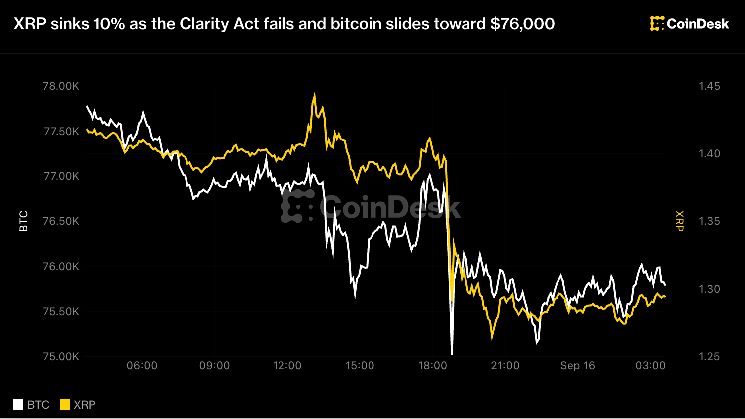
    XRP led a broad cryptocurrency sell-off Wednesday morning, plunging nearly 10% to $1.30 during Asian trading hours after the U.S. Senate failed to advance the Clarity Act, according to CoinDesk data.

    Major Tokens Slide Across the Board

    Ether followed with a decline of nearly 5% to approximately $2,410. Solana dropped 5% to just above $97, while Dogecoin fell nearly 5%. Zcash and Hyperliquid’s HYPE each slipped close to 4%, and Bitcoin retreated nearly 3% to just above $76,000. BNB and Tron proved the most resilient, each down only about 1%.

    Clarity Act Fails on Cloture Vote

    The legislation fell short on a 49-50 cloture vote, the procedural threshold requiring 60 senators to move a bill to debate. Multiple Republicans joined Democrats in voting against the measure. Negotiators had produced more than 600 pages of compromise text, but the provision that ultimately derailed the bill centered on ethics language designed to prevent senior government officials from maintaining crypto business interests.

    Senator Slotkin Cites Ethics Concerns

    Senator Elissa Slotkin, a Michigan Democrat, explained her opposition by stating the “the ethics provisions in this bill are simply too thin,” pointing to President Donald Trump, his children and his Cabinet earning money in crypto.

    She also said the Commodity Futures Trading Commission lacks the staffing to implement the law, and that the bill left gaps on money laundering and terrorist financing.

    Today, I voted no on the Clarity Act, legislation meant to regulate cryptocurrency in America.The ethics provisions in this bill are simply too thin. President Trump, his children, and his Cabinet are making billions of dollars in the crypto space, in part from bilking everyday…

    — Sen. Elissa Slotkin (@SenatorSlotkin) September 15, 2026

    Crypto Equities Hit Harder Than Tokens

    Publicly traded crypto companies suffered steeper losses than the underlying assets. Coinbase shares fell nearly 9% to $174.42, while Circle dropped more than 9% to $88.26. Galaxy Digital declined 8% and Gemini slid 7%. Bullish and Riot Platforms each lost 5%, eToro fell 4%, and Robinhood, MARA Holdings, CleanSpark, IREN and Core Scientific all dropped between 3% and 4%.

    Regulatory Path Forward Shifts to SEC

    Attention now turns to the regulators the bill was intended to constrain. The Securities and Exchange Commission is already advancing its proposed Reg Crypto framework and rules for tokenized securities, which now represents the primary pathway to the regulatory certainty the industry sought from Congress.

    Political and Market Implications

    Industry political action committees, including Fairshake, must now decide how to approach senators who voted against the legislation ahead of the November 3 election. A new Congress will convene in January 2027.

    Meanwhile, the Federal Reserve is scheduled to announce its rate decision later Wednesday, with traders leaning toward a quarter-point hike. The decision lands on a market that has just watched its legislative push collapse and is already selling risk assets.

  • SEC Setback as CLARITY Act Fails to Advance in Senate

    SEC Setback as CLARITY Act Fails to Advance in Senate

    CLARITY Act Stalls in Senate, Putting Spotlight on SEC and CFTC Crypto Authority

    The CLARITY Act failed to advance in the Senate on September 15, 2026, dealing a blow to legislative efforts aimed at establishing a structured regulatory framework for digital assets. The setback was highlighted by Coinbase CEO Brian Armstrong, who expressed disappointment while noting that existing regulatory tools remain available to provide clarity.

    What Happened: Legislative Gridlock Shifts Focus to Agency Action

    The broader cryptocurrency market is showing mixed signals against this backdrop of regulatory uncertainty. The Securities and Exchange Commission (SEC) and the Commodity Futures Trading Commission (CFTC) have previously indicated they possess the authority to implement necessary rules without the CLARITY Act, which was designed to create more structured guidelines for the industry.

    As the regulatory landscape evolves, stakeholders will be closely monitoring how these agencies leverage their existing powers to bring definition to the crypto environment.

    Key Takeaways

    • The CLARITY Act did not advance in the Senate as of September 15, 2026.
    • Brian Armstrong emphasizes the ongoing need for regulatory clarity.
    • The SEC and CFTC are expected to act under existing authorities.
    • Future regulatory frameworks may emerge without congressional approval.
    • The current situation underscores the urgency for clear crypto regulations.

    Market Snapshot: Traders Await Guidance

    Market activity currently shows a standstill, with no reported volume or significant price changes. The lack of movement reflects uncertainty as traders await clearer guidance on regulatory developments. The SEC and CFTC’s ability to act on their own authority may prompt shifts in market sentiment once clarity is established.

    Regulatory Primer: SEC vs. CFTC Jurisdiction

    The SEC is the primary regulatory body overseeing securities markets in the U.S. Its jurisdiction includes enforcing securities laws and ensuring fair practices in financial markets, including cryptocurrencies. The CFTC regulates commodity futures and options markets. Both agencies are pivotal in shaping the future of crypto regulation.

    What to Watch Next

    Traders and industry participants should monitor several key catalysts:

    • Potential announcements from the SEC and CFTC regarding new regulations or enforcement priorities.
    • Any clarification from either agency on their stance toward digital assets under existing authorities.
    • Bipartisan discussions that could revive the CLARITY Act or similar legislation, as political movements may influence regulatory momentum.

    If the SEC and CFTC begin to clarify their positions on crypto under current mandates, it could significantly impact market dynamics and provide the certainty the industry has been seeking.

  • Whale Alert Confirms 688 BTC Transfer from Coinbase to Binance

    Whale Alert Confirms 688 BTC Transfer from Coinbase to Binance

    Whale Alert Reports 688 BTC Transfer From Coinbase to Binance Worth $52.6 Million

    Whale Alert announced a significant transfer of 688 BTC, valued at approximately $52.6 million, from Coinbase to Binance. The transaction was reported on September 15, 2026, highlighting notable activity within the cryptocurrency market as traders analyze liquidity changes. Such movements can have implications on market sentiment and trading strategies, making it crucial for participants to stay informed.

    Key Development: Strategic Liquidity Shift Between Major Exchanges

    The cryptocurrency market is currently exhibiting mixed signals, with varying momentum across major assets. The Whale Alert report of 688 BTC moving from Coinbase to Binance may reflect a strategic liquidity shift by traders or institutional players. A transfer of this magnitude can influence market dynamics, prompting market participants to reassess their positions and strategies in light of potential changes in supply and demand.

    Quick Take: Essential Details at a Glance

    • Transfer confirmed: 688 BTC moved from Coinbase to Binance
    • Date: September 15, 2026
    • Value: Approximately $52.6 million
    • Significance: Highlights active trading between major exchanges
    • Market implication: Increased liquidity could indicate shifts in market sentiment

    By the Numbers: Understanding the Transfer Context

    The cryptocurrency market is experiencing fluctuations, with specific assets showing mixed performance. Whale Alert’s report on the 688 BTC transfer indicates keen interest in shifting liquidity between Coinbase and Binance. Such movements often precede changes in market trends, suggesting that traders should remain vigilant about their implications for future price actions.

    About Whale Alert: Tracking Large-Scale Crypto Movements

    Whale Alert is known for tracking large transactions within the cryptocurrency space, providing vital insights into market flows. The organization serves as an important resource for traders and investors looking to understand significant movements that may affect market conditions. Their role in tracking these transfers provides transparency and aids in market analysis.

    Levels to Watch: Potential Market Follow-Through

    Traders should watch for potential follow-through from this transfer, particularly if similar movements occur in the coming days. The shift between Coinbase and Binance could be a precursor to increased trading activity or price volatility. Monitoring liquidity levels and market sentiment will be essential as participants respond to these developments.