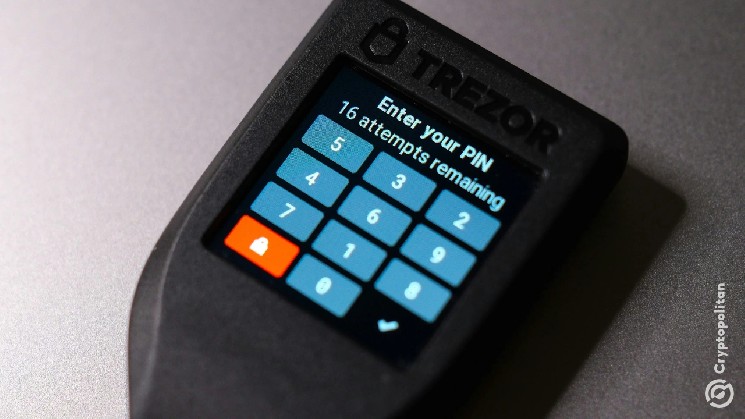
The ERC-7730 standard addresses a long-standing vulnerability in cryptocurrency transactions, and its adoption is accelerating across the hardware wallet ecosystem. The standard enables wallets to decode smart contract transactions, displaying the actual action, tokens, amounts, and destination on the device screen instead of an opaque raw hash.
Trezor activates clear signing via ERC-7730
Trezor has enabled clear signing through the ERC-7730 standard, a development confirmed by both Trezor and the Ethereum Foundation on X on September 8. The rollout extends the security initiative the Foundation first launched in May to an additional set of hardware devices.
Why blind signing created a critical attack vector
Historically, users could not verify that the transaction amount shown on their computer screen matched what the hardware wallet was actually signing. Trezor illustrated the risk with a concrete example: a user intends to “swap 2,000 USDC for ETH.” That description appears on the computer, but the data reaching the wallet arrives as hexadecimal calldata, presented as an unreadable hash.
Approving such a transaction required trusting that a potentially compromised computer displayed accurate information. If the machine was tampered with, the user had no way to detect the discrepancy on the device and could inadvertently sign away their assets. This vulnerability, known as blind signing, has been linked to some of the costliest thefts in crypto history. The Ethereum Foundation specifically cited the $1.5 billion Bybit breach, still the largest crypto hack on record, when launching what is now recognized as a solution to this gap.
What changes on Trezor device screens
With clear signing active, a supported Trezor device parses the transaction and renders it in plain language. This shift makes the hardware wallet the final source of truth rather than the computer it is connected to.
Trezor emphasized that users do not need to install or toggle anything. The feature works automatically through Trezor Suite, WalletConnect, and Trezor Connect, preserving the existing workflow. The decoding stack is open-source, consistent with Trezor’s existing firmware, and the ERC-7730 standard itself is public.
Supported protocols and hardware at launch
At launch, Trezor lists major protocols including 1inch, Aave, Lido, Tether, LiFi, and Hyperliquid, with additional networks in progress. On the hardware side, the feature runs on the Trezor Safe 7, Safe 5, Safe 3, and Model T. The Trezor Model One is not supported.
From Ledger innovation to neutral Ethereum Foundation stewardship
The technical foundation is ERC-7730, an open format that gives wallets a consistent method to translate contract calls into readable actions, amounts, tokens, and destinations. Ledger originally developed the concept as an internal feature before formalizing it as ERC-7730 in 2024. Governance was subsequently transferred to the Ethereum Foundation to maintain neutrality.
Descriptors reside off-chain in a registry at clearsigning.org, allowing existing contracts to adopt the format without redeployment. An attestation layer enables independent auditors to verify that a descriptor accurately reflects a contract’s actual behavior. The Foundation’s Trillion Dollar Security Initiative, the same program behind the One Trillion Dollar Security Dashboard launched in February, acts as steward of this registry.
Security scales with ecosystem adoption
The protective benefit scales directly with adoption because the standard only functions where a decentralized application has supplied a descriptor. Protection grows as more protocols and networks are added to the registry, creating a network effect that strengthens the entire ecosystem.
