Tag: Circle

  • Binance Deal Boosts Circle in Stablecoin Race With Tether, Analysts Say

    Binance Deal Boosts Circle in Stablecoin Race With Tether, Analysts Say

    Key Highlights

    • Binance processed $5 million to $10 billion in daily USDC spot trading volume throughout 2026, capturing 10-20 times more activity than most other exchanges which typically stay below $500 million daily.
    • USDC’s market capitalization reaches approximately $74 billion, remaining the second-largest dollar stablecoin behind Tether’s USDT at roughly $140 billion.
    • Circle is expanding beyond issuance with its Circle Payments Network and a $400 million acquisition of Singapore-based Tazapay to build payment infrastructure across emerging markets.

    Binance Drives USDC Trading Dominance in 2026

    Binance has cemented its position as the primary venue for USDC spot trading throughout 2026, consistently capturing the largest share of daily volume according to data from market research firm Kaiko. The exchange processed between $5 million and $10 billion in USDC spot trading activity each day, a figure that dwarfs the competition. Most other trading venues typically remain below $500 million in daily USDC volume, making Binance’s throughput roughly 10 to 20 times greater than its nearest rivals.

    “Throughout 2026, Binance has consistently captured the largest share of $USDC spot trading activity, processing $5 million-$10 billion in daily volume, roughly 10-20 times more than most other trading venues, which typically stay below $0.5 billion,” said Anastasia Melachrinos, head of research at Kaiko.

    Exchange Landscape Remains Static as Binance Expands

    Kaiko’s analysis indicates that other major exchanges have largely maintained their previous USDC trading ranges, suggesting that Binance itself has been the primary driver of the volume increase. The concentration of activity on a single platform underscores the exchange’s outsized influence on stablecoin liquidity and market structure. As Binance continues to push USDC adoption in emerging markets, researchers expect this dominance to intensify further.

    “As Binance accelerates $USDC’s reach in emerging markets, that dominance is likely to grow even further,” Melachrinos said.

    Circle Counters Tether with Infrastructure Play

    The trading dynamics unfold against a backdrop of intensifying competition between the two leading dollar-pegged stablecoins. USDC currently holds a market capitalization of about $74 billion, positioning it as the second-largest U.S. dollar stablecoin behind Tether’s USDT, which commands roughly $140 billion. Industry observers see a clear mutual incentive for both Binance and Circle, USDC’s issuer, to expand the stablecoin’s footprint through the exchange’s global user base and infrastructure.

    “There is a clear incentive on both sides to grow $USDC through Binance’s user base and infrastructure,” said Martins Benkitis, co-founder and CEO of Gravity Team.

    Circle has been actively building beyond its core issuance business. The company’s Circle Payments Network aims to connect financial institutions for stablecoin-based payments, while its recently announced $400 million acquisition of Singapore-based Tazapay would add local banking relationships and payment rails across emerging markets. This strategy arrives as the stablecoin competitive landscape broadens beyond the traditional Circle-Tether duopoly, with major banks and payment companies including Visa, Mastercard, and Stripe pushing further into stablecoin payments and infrastructure.

    Why This Matters

    The concentration of USDC trading volume on Binance highlights the evolving market structure of stablecoin liquidity, where a single centralized exchange acts as the primary price discovery venue for a major digital asset. For Circle, the partnership with Binance and the Tazapay acquisition represent a strategic pivot toward becoming a payments infrastructure company, not just a stablecoin issuer. This shift coincides with increasing regulatory clarity in major jurisdictions and the entry of traditional financial giants like Visa and Stripe, signaling a maturation of the stablecoin sector from speculative trading instruments to settlement layers for global commerce. The coming months will test whether Circle’s infrastructure investments can translate USDC’s trading dominance into broader adoption for cross-border payments and institutional settlement.

    Frequently Asked Questions

    How much USDC trading volume does Binance handle compared to other exchanges?
    Binance processes $5 million to $10 billion in daily USDC spot trading volume, which is roughly 10-20 times more than most other trading venues that typically stay below $500 million daily, according to Kaiko research.
    What is Circle’s strategy beyond stablecoin issuance?
    Circle is building the Circle Payments Network to connect financial institutions for stablecoin payments and has announced a $400 million acquisition of Singapore-based Tazapay to gain local banking relationships and payment rails across emerging markets.
    How does USDC’s market cap compare to USDT?
    USDC has a market capitalization of about $74 billion, making it the second-largest U.S. dollar stablecoin behind Tether’s USDT at roughly $140 billion.
  • Bitget Hacker Moves $83 Million in Stolen XRP That Ripple Cannot Freeze

    Bitget Hacker Moves $83 Million in Stolen XRP That Ripple Cannot Freeze

    Key Highlights

    • Circle and Tether froze approximately $320,000 in USDC and USDT stablecoins linked to the Bitget exchange hack, leveraging built-in blacklist controls.
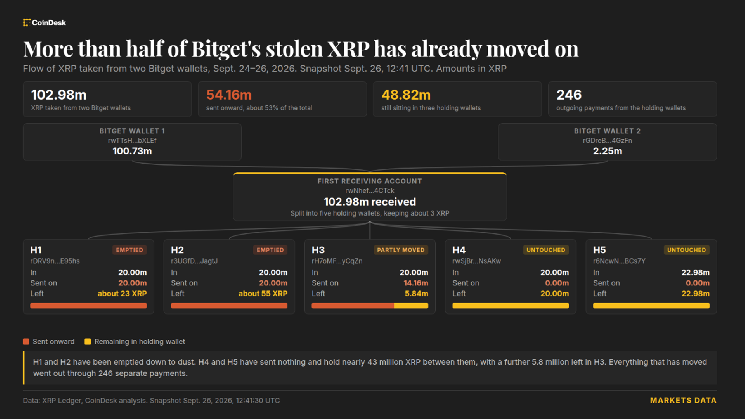
    • The attacker moved roughly 54 million XRP from the original five holding wallets overnight, reducing the balance from 70 million to 49 million tokens in eight hours.
    • XRP traded near $1.54 on Saturday, down 4% in 24 hours but retaining a 9% weekly gain, with the stolen haul valued at approximately $160 million.

    Stablecoin Issuers Intervene to Block Illicit Funds

    Circle and Tether, the operators behind the leading dollar-pegged stablecoins USDC and USDT, have taken swift action to mitigate the fallout from the massive Bitget crypto exchange breach. The companies froze roughly $320,000 worth of stablecoins associated with the hacker’s wallet addresses. Both tokens possess programmable controls that allow the issuers to blacklist specific addresses, effectively preventing the frozen assets from being transferred or redeemed. This intervention highlights the centralized enforcement layer that exists within major fiat-backed stablecoins, a feature often cited by regulators and critics alike.

    Attacker Accelerates XRP Distribution Across Wallets

    On-chain data shows the perpetrator significantly sped up the movement of stolen XRP tokens during the early hours of Saturday. At 04:32 UTC, approximately 70 million XRP remained in the original five accounts identified as the initial holding points for the stolen funds. Roughly eight hours later, that aggregate balance had dropped to 49 million, indicating a rapid dispersal strategy. The transfers reveal the attacker distributing the assets across a growing number of wallets, a common tactic to obfuscate the trail and complicate recovery efforts.

    Transaction Patterns Suggest Automated Scripting

    Analysis of the transfer flows shows certain payments replicating routes previously used by the first wallet. In one notable instance, an attempted transfer of about 521,000 XRP failed because the sending account lacked sufficient funds. Approximately one hour later, a second wallet executed an identical transfer of 521,000 XRP to the same intended recipient. This pattern suggests the use of automated scripts or predetermined routing logic rather than purely manual intervention, with the attacker managing multiple wallets in parallel to drain the holdings.

    Market Absorbs Supply Overhang Amid Price Resilience

    Despite the significant movement of stolen funds, XRP markets displayed relative stability on Saturday. The token traded around $1.54, representing a 4% decline over the preceding 24 hours but maintaining a weekly gain of approximately 9%, according to data from CoinGecko. At the prevailing price, the original XRP haul—estimated at roughly 100 million tokens based on the 54 million moved and 49 million remaining—was worth approximately $160 million. That figure equates to roughly 4% of XRP’s reported $4.4 billion in daily trading volume, suggesting the market possesses sufficient liquidity to absorb potential sell pressure, though actual price impact will depend on the depth of buy orders at the time of execution.

    Why This Matters

    The Bitget hack and subsequent fund movements underscore several critical dynamics in the crypto ecosystem. First, the ability of Circle and Tether to freeze assets demonstrates the “off-switch” capability inherent in centralized stablecoins, providing a rapid response mechanism for illicit flows that does not exist for native blockchain assets like XRP. Second, the speed and sophistication of the XRP laundering—evidenced by automated multi-wallet distribution and retry logic—illustrates the operational maturity of modern cybercriminal groups targeting exchanges. Finally, the market’s muted price reaction reflects XRP’s deep liquidity and the market’s growing desensitization to large-scale exchange breaches, though the ultimate impact hinges on whether the attacker opts for rapid liquidation via decentralized exchanges or slower over-the-counter channels.

    Frequently Asked Questions

    How much XRP was stolen in the Bitget hack?

    Based on on-chain analysis, the original haul held in five primary wallets totaled approximately 119 million XRP (70 million remaining at 04:32 UTC plus 49 million moved subsequently). At Saturday’s price of $1.54, the total value was roughly $160 million.

    Can Circle and Tether freeze XRP tokens?

    No. Circle and Tether can only freeze assets issued on their respective contracts—USDC and USDT. XRP is a native asset on the XRP Ledger and does not have a centralized freeze function. The $320,000 freeze applied only to stablecoin balances held in the hacker’s wallets.

    Will the stolen XRP dump crash the price?

    The stolen amount represents about 4% of XRP’s reported daily trading volume ($4.4 billion). While a sudden market sale could cause short-term slippage, the depth of the order books across major exchanges suggests the market could absorb the supply without a catastrophic price collapse, especially if distributed over time or via OTC desks.

  • Circle Executive Warns Germany’s 50% Crypto Tax Rule Could Hit Retail Investors

    Circle Executive Warns Germany’s 50% Crypto Tax Rule Could Hit Retail Investors

    Key Highlights

    • Germany proposes a 50% default tax base for crypto assets acquired after December 31, 2026, combined with a flat 25% capital gains tax plus solidarity surcharge totaling 26.375%.
    • Circle’s Patrick Hansen warns the framework will disproportionately hit retail investors who cannot provide clean acquisition cost documentation, potentially taxing nonexistent gains.
    • The regime is projected to generate €160 million ($182.2 million) in 2028, rising to €350 million ($398.7 million) annually by 2031, with withholding mechanisms starting in 2028.

    Germany’s Proposed Crypto Tax Framework Sparks Industry Concern

    Germany’s proposed cryptocurrency taxation framework has placed local industry stakeholders on high alert due to its significant implications for retail investors. The draft legislation introduces a default 50% tax base for crypto assets where acquisition costs cannot be verified, alongside a flat 25% levy on capital gains plus a 5.5% solidarity surcharge—bringing the effective rate to 26.375%. This represents a fundamental shift from the current framework, under which retail investors generally owe no tax when cashing out Bitcoin or other cryptocurrencies after holding them for the required period.

    Circle’s Patrick Hansen Warns of Disproportionate Impact on Retail Investors

    Patrick Hansen, who leads policy and strategy at Circle—the largest issuer of stablecoins licensed under the EU’s Markets in Crypto-Assets (MiCA) framework—has emerged as a vocal critic of the proposal. In a post on X, Hansen detailed why the default 50% tax base is problematic for ordinary investors.

    “This will hit normal consumers/investors particularly hard. People who don’t even notice this regulatory change, who can’t technically provide their acquisition costs in a clean way, and who in recent years have sometimes bought with little profit or even at a loss,”

    Hansen wrote.

    Hansen emphasized that he wishes the tax draft would not come into effect. He explained that once the provisions take effect, failure to provide evidence of purchase costs will result in tax authorities treating assets purchased after 2026 as taxable, effectively taxing half of the income earned based on the state’s assumption that the asset’s value has doubled. Hansen argued this assumption appears overly optimistic given Bitcoin’s annual declines and the poor performance of many altcoins, noting the framework could force people to pay taxes on nonexistent gains.

    “In my view, the average Joe will end up paying far too much tax if this isn’t adjusted, especially if – as I fear for many – he can’t provide his acquisition costs in a clean and convincing way,”

    he further asserted.

    Legal Expert Highlights Documentation Requirements and Uncertainty

    Dr. David Hötzel, associate partner at the Poellath law firm, contended that the 50% figure is not yet finalized. However, he echoed Hansen’s concerns about the practical impact on traders.

    “The protection of existing holdings effectively depends on reliable documentation,”

    he said.

    Dr. Hötzel pointed out that a 50% baseline imposes a substantial upfront tax burden on trades that might have generated only minimal real profit, creating a significant compliance challenge for investors with incomplete records.

    Record-Keeping Becomes Critical for Compliance

    The documentation requirement could become one of the most consequential practical changes for German crypto investors. The Finance Ministry has ruled that taxpayers must maintain records of acquisition dates, quantities, purchase costs, transaction fees, and the platforms or wallets involved. Acceptable evidence includes tax returns, exchange transaction records, and structured personal spreadsheets.

    Under the reported draft, the new regime would apply to crypto assets acquired after December 31, 2026, while holdings acquired before January 1, 2027, would generally remain subject to current rules. The withholding mechanism would reportedly begin in 2028. This distinction means investors may need to separate older holdings from new purchases and maintain clearer records of every transaction. Reconstructing acquisition history for those who have traded across multiple exchanges and used self-custody wallets represents a substantial tax compliance undertaking.

    Flat Tax Structure and Exemptions Detailed

    Germany is proposing a flat 25% levy on crypto capital gains, plus the 5.5% solidarity surcharge for a total of 26.375%. Cryptocurrencies such as Bitcoin and Ethereum would be subject to this rate. However, certain digital assets—including NFTs, certain stablecoins, security tokens, and real-world asset (RWA) tokens—would continue to enjoy exemption from the proposed legislation. Day traders are likely to benefit from the change, as they currently pay the maximum personal income tax rate of 45%, which would be replaced by the flat rate.

    For long-term holders, the shift is dramatic. A taxpayer with €100,000 in long-term capital gains would face approximately €26,375 in combined flat tax and solidarity surcharges, eliminating the current tax exemption on capital gains for qualifying holding periods.

    Revenue Projections and Implementation Timeline

    Government estimates project the new tax regime will generate €160 million ($182.2 million) in revenue in 2028, rising to as much as €350 million ($398.7 million) annually by 2031. The withholding mechanism is slated to begin in 2028, giving exchanges and custodial service providers time to implement the necessary reporting infrastructure.

    Why This Matters

    Germany’s proposed framework signals a broader European trend toward harmonizing crypto taxation as the MiCA regulatory regime takes full effect. The 50% default tax base creates a de facto presumption of guilt for investors without perfect records, shifting the burden of proof onto taxpayers—a significant departure from traditional capital gains taxation principles. For the estimated millions of German retail crypto holders, the compliance burden could be substantial, particularly for early adopters who acquired assets across multiple platforms before standardized reporting existed. The exemption of certain stablecoins and tokenized assets suggests regulators are attempting to distinguish between speculative trading instruments and payment or utility tokens, though the boundaries remain contested. As the legislative process advances, industry lobbyists and tax advisors will likely push for higher documentation thresholds or grandfathering provisions to protect long-term holders who acted in good faith under previous rules.

    Frequently Asked Questions

    When would Germany’s new crypto tax rules take effect?

    The proposed framework would apply to crypto assets acquired after December 31, 2026. Existing holdings acquired before January 1, 2027, would generally remain under current tax rules. The withholding mechanism is scheduled to begin in 2028.

    Which crypto assets would be exempt from the proposed flat tax?

    According to the draft, NFTs, certain stablecoins, security tokens, and real-world asset (RWA) tokens would continue to enjoy exemption from the proposed 25% flat capital gains tax plus solidarity surcharge.

    How does the 50% default tax base work if I cannot prove my acquisition costs?

    If you cannot provide documentation of your purchase price for assets acquired after December 31, 2026, tax authorities would assume your asset value doubled and tax 50% of the proceeds at the flat 25% rate plus solidarity surcharge—effectively applying a 26.375% tax on half the sale value regardless of actual profit or loss.

  • Circle Mints $500M USDC on Solana in 6 Hours

    Circle Mints $500M USDC on Solana in 6 Hours

    Key Highlights

    • Circle minted approximately $500 million USDC on the Solana blockchain within a six-hour window, signaling strong stablecoin demand.
    • The minting activity was flagged by on-chain analyst @SolanaFloor and coincides with Solana’s expanding role in tokenized finance and DeFi.
    • Increased USDC supply on Solana is expected to boost network liquiduity, potentially influencing trading volumes and DeFi protocol activity.

    Circle Accelerates USDC Supply on Solana Amid Growing Ecosystem Demand

    Circle Internet Financial has minted roughly $500 million worth of USD Coin (USDC) on the Solana blockchain over a six-hour period, according to on-chain data highlighted by prominent crypto commentator @SolanaFloor. The substantial issuance underscores accelerating demand for dollar-pegged stablecoins within Solana’s rapidly expanding decentralized finance (DeFi) and tokenized asset ecosystem. As one of the two dominant regulated stablecoins globally—alongside Tether’s USDT—USDC’s supply dynamics on high-throughput chains like Solana serve as a real-time barometer for institutional and retail capital flows into on-chain financial applications.

    Strategic Liquidity Expansion in a Mixed Market Environment

    The minting surge arrives while the broader cryptocurrency market exhibits divergent momentum across major assets such as Bitcoin and Ether. Circle’s decision to preemptively expand USDC supply on Solana appears to be a proactive liquidity management strategy, ensuring adequate stablecoin reserves are available for trading, lending, and settlement as Solana continues to attract capital allocated to tokenized real-world assets (RWAs), payment rails, and high-frequency DeFi strategies. The Solana network’s sub-second finality and low transaction fees have positioned it as a preferred execution layer for market makers and quantitative funds rotating stablecoin inventories across venues.

    USDC’s Regulatory Framework and Cross-Chain Utility

    Issued by Circle under a regulated framework that includes regular attestations of reserve assets—primarily short-term U.S. Treasuries and cash held at regulated financial institutions—USDC maintains a 1:1 peg to the U.S. dollar. This regulatory clarity, combined with native issuance on networks including Ethereum, Solana, Arbitrum, Polygon, and Avalanche, allows USDC to function as interoperable settlement infrastructure. The latest Solana minting reinforces Circle’s multi-chain distribution strategy, which aims to meet demand where transaction activity concentrates rather than relying solely on cross-chain bridges that introduce latency and smart-contract risk.

    Why This Matters

    Stablecoin minting volumes on high-performance blockchains like Solana are increasingly viewed as leading indicators of on-chain economic activity. A $500 million injection in six hours suggests market participants are positioning for elevated trading volumes, new DeFi protocol launches, or expanded tokenized treasury and money-market fund offerings on Solana. For traders and liquidity providers, deeper USDC pools reduce slippage on decentralized exchanges such as Orca and Raydium and improve capital efficiency for basis trades and funding-rate arbitrage. For the broader industry, the move signals confidence in Solana’s infrastructure maturity following network upgrades that have improved reliability and throughput consistency.

    Frequently Asked Questions

    Who reported the $500 million USDC minting on Solana?

    The on-chain activity was identified and publicized by @SolanaFloor, a widely followed CryptoTwitter commentator and analytics account that tracks Solana ecosystem metrics in real time.

    What does a large USDC mint typically indicate?

    Large minting events generally reflect anticipation of increased demand for the stablecoin—whether for trading, DeFi lending, payments, or as collateral for tokenized asset issuance—rather than immediate circulation. Circle mints USDC in response to authorized institutional redemption requests.

    How might this affect Solana’s DeFi ecosystem?

    Additional native USDC supply deepens liquidity on Solana-based decentralized exchanges and lending protocols, potentially lowering borrowing costs, tightening spreads, and enabling larger position sizes for market makers and yield strategies operating on the network.

  • Binance Acquires $100M Circle Stake in Five-Year USDC Promotion Deal

    Binance Acquires $100M Circle Stake in Five-Year USDC Promotion Deal

    Key Highlights

    • Binance acquired $100 million worth of Circle Class A shares at $80.84 per share in a private placement that closed September 17, per an SEC filing.
    • The equity purchase accompanies a five-year expanded partnership where Circle will pay Binance monthly incentive fees tied to USDC holdings via Circle’s Modular Smart Contract Wallet.
    • Binance faces a two-year lockup on selling, transferring, or hedging the shares but retains full voting rights throughout the restriction period.

    Binance Deepens Ties with Circle Through $100 Million Equity Investment

    Binance has acquired 1.24 million Class A shares of Circle Internet Financial at $80.84 per share, committing $100 million in a private placement that closed on September 17, according to a U.S. Securities and Exchange Commission filing published Tuesday. The transaction price represented a discount to Circle’s market valuation prior to the sale, the stablecoin issuer confirmed. The equity stake comes with a contractual lockup preventing Binance from selling, transferring, or hedging the shares for up to two years, subject to certain exceptions, though the exchange retains the right to vote its shares during the restriction period.

    Strategic Partnership Expansion Anchors USDC Growth on Binance

    The equity purchase coincides with a significant expansion of the companies’ existing partnership around USD Coin (USDC), Circle’s dollar-pegged stablecoin. Under the new five-year agreement, Circle will pay Binance a monthly incentive fee calculated as a percentage of the USDC held through Circle’s Modular Smart Contract Wallet service. In exchange, Binance will execute promotional activities designed to drive adoption and usage of USDC across its global trading platform. The arrangement effectively aligns Binance’s financial interests with the growth of USDC reserves custodied through Circle’s infrastructure.

    Lockup Terms Preserve Voting Rights While Limiting Liquidity

    The share restrictions impose a notable constraint on Binance’s ability to manage its investment position. For a period extending up to two years from closing, the exchange is prohibited from selling, transferring, or entering into hedging transactions involving the Circle shares. However, the agreement explicitly preserves Binance’s voting rights attached to the Class A shares, allowing the exchange to participate in corporate governance matters throughout the lockup. Certain exceptions to the transfer restrictions apply, though the filing does not specify their precise nature.

    Why This Matters

    This deal signals a deepening institutional alignment between the world’s largest cryptocurrency exchange by volume and the second-largest stablecoin issuer. By taking an equity stake, Binance gains a direct financial interest in Circle’s trajectory—potentially including a future public listing—while securing favorable economics on USDC distribution. For Circle, the partnership guarantees prime placement and promotional support on Binance’s platform, which remains a critical liquidity venue for stablecoins despite regulatory headwinds in multiple jurisdictions. The structure also reflects a broader trend: stablecoin issuers competing aggressively for distribution through incentive programs, with Tether’s USDT still commanding the dominant market share. Regulators will likely scrutinize the incentive fee mechanism, which ties payments to custodial volumes, for potential conflicts of interest or market manipulation concerns.

    Frequently Asked Questions

    How much did Binance pay per share for its Circle stake?

    Binance purchased 1.24 million Class A shares at $80.84 per share, totaling $100 million. The price reflected a discount to Circle’s pre-sale market valuation.

    What restrictions apply to Binance’s Circle shares?

    Binance cannot sell, transfer, or hedge the shares for up to two years, subject to certain unspecified exceptions. The exchange retains full voting rights during the lockup period.

    How does the incentive fee structure work in the USDC partnership?

    Circle will pay Binance a monthly fee calculated as a percentage of USDC held through Circle’s Modular Smart Contract Wallet service. Binance will conduct promotional activities for USDC in return.

  • Circle Launches Bitcoin-Backed USDC Borrowing Service

    Circle Launches Bitcoin-Backed USDC Borrowing Service

    Key Highlights

    • Circle has launched Digital Asset-Backed Borrowing for eligible Circle Mint institutions, enabling them to deposit Bitcoin, mint cirBTC, and borrow USDC through third-party DeFi lending markets on Arc and Ethereum.
    • Morpho is the first supported protocol, with an 86% liquidation loan-to-value threshold on Arc; Circle indicates Aave and other platforms will follow, though no timetable has been announced.
    • The service keeps native Bitcoin in regulated custody via Circle National Trust while cirBTC circulates as collateral through user-controlled Smart Wallets, separating DeFi credit risk from Circle Mint balances.

    Circle Unveils Institutional Bitcoin-Backed USDC Borrowing via DeFi Protocols

    Circle announced on September 21, 2026, the launch of Digital Asset-Backed Borrowing for eligible Circle Mint LLC customers, introducing a streamlined workflow that allows institutions to deposit native Bitcoin ($BTC), mint Circle Wrapped Bitcoin (cirBTC), and borrow $USDC through third-party lending markets on the Arc and Ethereum networks. The product combines what were previously separate steps—custody, wrapping, and DeFi borrowing—into a single coordinated interface, with Morpho serving as the inaugural supported lending protocol.

    Digital Asset-Backed Borrowing is now available in Circle Mint for eligible Circle Mint LLC customers.Deposit $BTC. Mint cirBTC. Borrow $USDC.Through one coordinated workflow, customers can use $BTC-backed cirBTC as collateral through supported third-party lending markets on Arc… the company posted on its official X account on September 21.

    How the Borrowing Workflow Operates

    Under the new workflow, an eligible institution deposits Bitcoin into Circle Mint and mints cirBTC, a 1:1 Bitcoin-backed token. The customer then transfers cirBTC into a user-controlled Smart Wallet, posts the token as collateral with a supported protocol such as Morpho, and borrows USDC. Borrowed funds move automatically from the Smart Wallet into the customer’s Circle Mint balance. Repayment follows the same path: USDC sent from Circle Mint into the Smart Wallet repays part or all of the outstanding debt, freeing collateral subject to the lending protocol’s rules.

    Circle emphasizes that it does not provide the underlying credit. Its legal terms state that Circle Technology Services supplies the interface and Smart Wallet technology, while lending, collateral management, and liquidations occur entirely through third-party DeFi protocols and their smart contracts. Assets moved into the Smart Wallet are no longer held within the regulated Circle Mint environment. Circle Mint remains an institutional service; individual retail users cannot open standard Mint accounts, and Digital Asset-Backed Borrowing carries additional jurisdiction and eligibility requirements. Circle confirmed that New York customers are excluded from the borrowing product.

    Morpho Leads on Arc with Live cirBTC-USDC Markets

    Morpho provides the first lending infrastructure integrated with the Circle Mint borrowing workflow. On Arc, the protocol operates a USDC market using cirBTC as collateral with an 86% liquidation loan-to-value threshold. Live Morpho data viewed on September 22 showed $18.86 million in outstanding borrowing against $157.85 million of available liquidity. The market held $176.71 million in total size with utilization at 10.67%, and no realized or unrealized bad debt was displayed at the time of verification. These figures fluctuate as users supply liquidity, borrow, repay, or withdraw funds.

    Circle’s terms make clear that displayed rates and protocol parameters come from third parties and can change without Circle’s control. Automatic liquidation can occur if collateral values, oracle readings, interest charges, or protocol settings push a position beyond the applicable limit. Morpho had moved onto Arc when Circle’s Layer 1 went public on September 16. As previously reported, the Arc mainnet launched with USDC as its native gas asset, while Morpho and Aave supplied lending infrastructure alongside applications for trading and tokenized assets. Morpho had indicated before the Digital Asset-Backed Borrowing release that institutional Circle Mint customers would gain access to its Arc credit markets directly through Circle’s interface, and the protocol has separately proposed a $50,000 monthly incentive budget for Arc borrowing activity under its governance process.

    cirBTC Reserves Verified Above Outstanding Supply

    cirBTC serves as the collateral bridge connecting native Bitcoin with the Ethereum and Arc smart-contract environments. Circle first introduced the asset on Ethereum in June before bringing it to Arc on September 21. The launch on Ethereum introduced 1:1 Bitcoin backing alongside Chainlink Proof of Reserve, allowing market participants to inspect reserve information while native Bitcoin remains held separately from circulating wrapped tokens.

    Current Circle data showed 948.7508 cirBTC outstanding against 951.2586 BTC in reserves at the time of verification. Arc accounted for 396.9919 cirBTC, while Ethereum carried 551.7590 cirBTC. The displayed reserve value stood at roughly $77.19 million. Circle states the underlying Bitcoin is held through its Bermuda affiliate and safeguarded by Circle National Trust in segregated accounts for cirBTC holders. Circle National Trust received final approval from the Office of the Comptroller of the Currency (OCC) in July to operate as a federally chartered national trust bank. The OCC charter permits the trust bank to provide regulated digital asset custody services; it does not accept deposits or make loans, and digital assets held there are not FDIC insured.

    Circle affirms that cirBTC reserves are not lent, pledged, or rehypothecated. Chainlink Proof of Reserve publishes reserve information onchain, while Circle lists Bitcoin reserve addresses so counterparties can compare native BTC holdings with circulating cirBTC supply.

    Regulatory Perimeter and Risk Disclosures

    Circle’s legal documentation draws a clear line between the Circle Mint account and the DeFi borrowing position. Once collateral leaves Circle Mint for the Smart Wallet, Circle Internet Financial no longer holds those assets under the controls applying to balances kept inside Mint. Customers control the Smart Wallet through a two-of-two multiparty computation key-management system. Circle says it cannot independently initiate, reverse, or cancel blockchain transactions from the wallet. Borrowers remain responsible for monitoring their positions, maintaining collateral, and reviewing protocol risks.

    Liquidations are controlled entirely by the selected lending protocol. Circle warns that falling collateral values, changing rates, oracle movements, or revised market parameters can trigger an automatic liquidation without prior notice, potentially resulting in penalties or collateral losses.

    Why This Matters

    The launch represents a significant step in bridging regulated institutional custody with decentralized finance credit markets. By enabling institutions to unlock dollar liquidity from Bitcoin holdings without selling the underlying asset, Circle addresses a core treasury management need for crypto-native firms and traditional financial institutions entering digital assets. The architecture—keeping native Bitcoin in an OCC-chartered trust while cirBTC circulates through audited smart contracts—offers a compliance-forward model that separates custodial risk from DeFi protocol risk.

    Morpho’s immediate integration on Arc, just five days after the network’s public mainnet launch, demonstrates the velocity at which lending infrastructure can deploy on new chains when native gas assets (USDC) and wrapped collateral (cirBTC) are natively available. The forthcoming addition of Aave and other protocols would deepen liquidity and provide institutions with protocol choice, a key requirement for treasury diversification. Meanwhile, Circle’s expanding institutional USDC network—evidenced by BNY’s June launch of USDC minting, redemption, and custody and Standard Chartered’s July introduction of bank-led USDC access—signals a broader strategy to embed USDC into regulated financial plumbing while using DeFi as a complementary, opt-in yield and credit layer.

    Frequently Asked Questions

    Who is eligible to use Circle’s Digital Asset-Backed Borrowing?

    Only eligible Circle Mint LLC customers—institutional entities that meet jurisdiction and compliance requirements—can access the product. Individual retail users cannot open standard Circle Mint accounts, and New York customers are explicitly excluded from the borrowing service.

    What happens to the Bitcoin deposited as collateral?

    Native Bitcoin is held through Circle’s Bermuda affiliate and safeguarded by Circle National Trust, an OCC-chartered national trust bank, in segregated accounts. The Bitcoin is not lent, pledged, or rehypothecated. cirBTC is minted 1:1 against these reserves, and Chainlink Proof of Reserve provides onchain verification of the backing.

    Does Circle control the lending terms or liquidation process?

    No. Circle provides the interface and Smart Wallet technology through Circle Technology Services. Lending, collateral management, interest rates, liquidation thresholds, and liquidation execution are controlled entirely by the third-party DeFi protocol (currently Morpho) and its smart contracts. Circle cannot initiate, reverse, or cancel transactions from the user-controlled Smart Wallet.

  • Coinbase, Robinhood, Circle Positioned as Early Winners in SEC Tokenized Stock Push, Analysts Say

    Coinbase, Robinhood, Circle Positioned as Early Winners in SEC Tokenized Stock Push, Analysts Say

    Key Highlights

    • The SEC’s five-year innovation exemption establishes a regulatory pathway for tokenized U.S. stocks to trade via automated market makers on public blockchains, requiring preservation of shareholder rights including dividends and voting.
    • Goldman Sachs and Citizens analysts identify Coinbase as a primary beneficiary due to its existing tokenized-equity offering, institutional custody business, Coinbase Tokenize infrastructure, and Base blockchain ecosystem.
    • Coinbase CEO Brian Armstrong confirmed voting rights for token holders are “coming soon,” addressing a key requirement for parity with traditional shareholders.

    SEC Innovation Exemption Creates Onchain Pathway for U.S. Equities

    The U.S. Securities and Exchange Commission has unveiled a five-year innovation exemption that carves out a regulated framework for tokenized U.S. stocks to trade through automated market makers on public blockchains. The exemption mandates that tokens preserve core shareholder rights—specifically dividends and voting—while imposing constraints on trading venues, including limits on trading volume and the number of stocks they may offer. This targeted experiment signals a cautious but concrete step toward integrating traditional securities with decentralized market infrastructure.

    Goldman Sachs and Citizens Pinpoint Coinbase as Multi-Vector Beneficiary

    Analysts at Goldman Sachs project that Coinbase stands to benefit across multiple business lines as the tokenized-equity landscape matures. The firm’s existing tokenized-equity offering already aligns with many SEC requirements, featuring shareholder rights and dividends comparable to the underlying shares. Complementing this, Coinbase operates an institutional custody business and Coinbase Tokenize, a dedicated infrastructure service that enables other firms to bring assets onchain. Citizens analysts echoed this view, emphasizing Coinbase’s sprawling reach across custody, tokenized assets, stablecoins, and its Ethereum Layer 2 network, Base.

    Armstrong Confirms Voting Rights Rollout Imminent

    A critical piece of the compliance puzzle fell into place this week when Coinbase CEO Brian Armstrong stated that voting rights for token holders are “coming soon.” This development would bring tokenized-equity holders to functional parity with investors in the underlying shares, satisfying a core condition of the SEC’s exemption. The announcement underscores Coinbase’s proactive approach to meeting regulatory expectations ahead of broader market adoption.

    Robinhood and Circle Also Positioned for Upside

    While Coinbase commands the most detailed analyst coverage, the exemption’s ripple effects extend to other major players. Robinhood and Circle are cited as potential beneficiaries should the scope of tokenized U.S. securities expand beyond the current narrow pilot. Both firms possess the retail distribution, brokerage infrastructure, and stablecoin capabilities—particularly Circle’s USDC—that could prove pivotal in a scaled onchain equities market.

    Why This Matters

    The SEC’s innovation exemption represents the first formal U.S. regulatory acknowledgment that public blockchains can serve as legitimate venues for securities trading, albeit within strict guardrails. By requiring automated market makers to uphold dividend and voting rights, the regulator is attempting to bridge the investor-protection gap that has historically stalled tokenization efforts. For market participants, the five-year window offers a defined period to build compliant infrastructure, demonstrate demand, and lobby for permanent rulemaking. The involvement of custodians like Coinbase and stablecoin issuers like Circle suggests the emerging stack—custody, settlement, tokenization, and liquidity—is coalescing around a handful of regulated entities. Analysts will be watching trading-volume caps and stock-count limits closely; if these constraints bind quickly, pressure for legislative or rule-based expansion will intensify.

    Frequently Asked Questions

    What specific shareholder rights must tokenized stocks preserve under the SEC exemption?

    The exemption requires that tokenized stocks maintain dividends and voting rights equivalent to those of the underlying traditional shares.

    Which Coinbase business lines do analysts highlight as relevant to the tokenized-equity opportunity?

    Goldman Sachs and Citizens point to Coinbase’s existing tokenized-equity offering, institutional custody business, Coinbase Tokenize infrastructure platform, stablecoin operations, and the Base Layer 2 blockchain as key growth vectors.

    Are Robinhood and Circle expected to benefit immediately from the exemption?

    Analysts describe the current experiment as narrow, but note that Robinhood and Circle are well-positioned to benefit if the program expands to include more U.S. securities onchain.

  • Anthropic’s Potential $2 Trillion IPO Drives $80 Million Crypto Trade

    Anthropic’s Potential $2 Trillion IPO Drives $80 Million Crypto Trade

    Key Highlights

    • Crypto derivatives tied to Anthropic’s anticipated IPO have reached nearly $80 million in open interest, with Binance accounting for roughly 40% of trading volume.
    • Circle CEO Jeremy Allaire publicly urged Anthropic to go public, arguing that public-market scrutiny would strengthen governance and transparency for frontier AI companies.
    • Anthropic confidentially filed for an IPO in June and is reportedly targeting a November listing at a potential $2 trillion valuation, which would rank among the largest offerings ever.

    Crypto Markets Price Anthropic’s IPO Before Wall Street

    Speculative fervor around Anthropic’s prospective initial public offering has migrated into cryptocurrency derivatives markets, where traders have accumulated nearly $80 million in open interest on pre-stock futures contracts despite the company having disclosed no offering price, share count, or final valuation. According to CoinGlass data, the ANTHROPIC pre-stock contract traded around $2,147 with more than $20 million changing hands in futures volume over 24 hours. Binance has emerged as the dominant venue, capturing approximately 40% of the activity. The instrument does not represent actual equity in the Claude developer; CoinGlass shows no circulating supply or spot trading, and Anthropic remains privately held. Instead, the price reflects derivatives markets attempting to value exposure to a company whose shares are not yet publicly available.

    Pre-IPO Perpetuals Surge as New Asset Class

    Anthropic’s derivatives activity is part of a broader shift in which crypto exchanges are building tradable instruments around Silicon Valley’s most valuable private companies. Binance Research reported that open interest across Anthropic and OpenAI pre-IPO perpetuals surpassed $160 million in September, up from roughly $1 million in April and a 179% increase from the prior month. The two companies accounted for about 95% of pre-IPO perpetual volume during the first half of September. These cash-settled derivatives reference an anticipated public company valuation or share price and require no underlying shares to support the contracts, meaning traders are effectively taking opposing positions on what the company could eventually be worth. The structure allows crypto markets to react to corporate developments almost immediately—OpenAI-linked instruments rose after the release of its Astra model and fell after Chief Executive Sam Altman signaled a potential IPO delay.

    Allaire Urges Anthropic to Embrace Public Scrutiny

    Circle Chief Executive Jeremy Allaire has added his voice to the debate, publicly urging Anthropic to complete its transition to public markets. “Take the leap, Anthropic,” Allaire said, arguing that concerns about volatile markets, valuation and AI safety strengthen rather than weaken the case for exposing the company to greater scrutiny. Drawing on Circle’s experience after taking the USDC issuer public in June 2025—pricing its IPO at $31 per share with a total offering of about $1.2 billion including the full exercise of the underwriters’ overallotment option—Allaire said going public imposed audited financial reporting, quarterly disclosures, independent board governance, and Sarbanes-Oxley controls that made Circle easier for banks, governments, and enterprise customers to evaluate. He argued that frontier AI companies are approaching a similar inflection point as their technology becomes embedded across businesses and economic infrastructure, and that model capabilities, safety procedures, computing commitments, revenue concentration, and corporate governance are increasingly matters of public interest.

    Dual Track: Traditional Investors Wait, Crypto Traders Act

    Anthropic now approaches the public markets from two directions. Traditional investors are waiting for its prospectus and the financial disclosures needed to judge whether a valuation approaching $2 trillion is justified—Reuters reported earlier this month that some investors were discussing that figure, while The Wall Street Journal reported the company plans to stage the IPO in November, later than the October timetable previously expected. Anthropic is also considering releasing another AI model ahead of the listing as competition with OpenAI intensifies. Meanwhile, crypto traders have already built nearly $80 million in outstanding futures positions behind a market trying to answer the valuation question in real time. Rising open interest signals increased participation and leverage, though it does not by itself demonstrate overwhelmingly bullish sentiment, as every futures position has both a long and short side. The gap between these two markets should narrow once Anthropic makes its registration documents public, allowing traders to compare the assumptions embedded in pre-IPO contracts with the revenue, costs, risks, and share structure the company actually presents to prospective shareholders.

    Why This Matters

    The emergence of liquid pre-IPO derivatives for Anthropic and OpenAI marks a structural shift in how private-market valuations are discovered and traded. Historically, price discovery for venture-backed unicorns occurred in infrequent funding rounds or secondary markets with limited access. Now, crypto perpetuals provide continuous, leveraged, and globally accessible pricing signals—albeit detached from underlying equity. For Anthropic, this creates a parallel reference price that could influence institutional sentiment ahead of its formal roadshow. For regulators, it raises questions about market integrity, investor protection, and the boundary between derivative speculation and securities offerings. Allaire’s intervention underscores a growing view among public-market veterans that AI labs wielding infrastructure-scale influence should accept the disclosure and governance obligations of listed companies. The November IPO timeline, if confirmed, will test whether traditional underwriters and crypto-native traders converge on a shared valuation—or whether the pre-market derivatives have already priced in expectations that the public filing cannot support.

    Frequently Asked Questions

    What are Anthropic pre-stock futures and do they represent real shares?
    No. The ANTHROPIC pre-stock contracts traded on platforms like Binance are cash-settled derivatives referencing an anticipated public valuation. They are not backed by actual Anthropic shares, carry no ownership rights, and CoinGlass shows no circulating supply or spot market for the instrument.
    When is Anthropic expected to go public and at what valuation?
    The Wall Street Journal reported Anthropic plans to stage its IPO in November, later than an earlier October target. Investors have discussed a potential valuation of up to $2 trillion, though the company has not disclosed an offering price, share count, or final valuation. Anthropic confidentially filed a draft registration statement with the SEC in June.
    Why is Circle CEO Jeremy Allaire urging Anthropic to go public?
    Allaire argues that public-market discipline—audited financials, quarterly reporting, independent governance, and Sarbanes-Oxley compliance—would strengthen Anthropic’s credibility with banks, governments, and enterprise customers. He draws a parallel to Circle’s 2025 IPO and contends that frontier AI companies now operate at a scale where transparency is a matter of public interest, though he also notes an IPO cannot substitute for AI-specific regulation.
  • Velocity Raises $48M Series A from Visa, Circle, and Ripple

    Velocity Raises $48M Series A from Visa, Circle, and Ripple

    Velocity Raises $10M Series A Extension, Valuation Reaches $200M

    London-based stablecoin infrastructure provider Velocity has secured an additional $10 million in Series A funding, bringing the total round to $48 million and valuing the company at $200 million post-money. The extension, announced on September 15, includes participation from Visa Ventures, Circle Ventures, Ripple, Haun Ventures, Translink Capital, and Mirana Ventures.

    Series A Growth From $38M to $48M

    The original $38 million Series A, disclosed on July 14, was led by Dragonfly and FirstMark with participation from Activant Capital, Capital One Ventures, QED Investors, Coinbase Ventures, Wintermute Ventures, and Ripple. At that stage, Velocity reported total capital raised since May 2025 of nearly $50 million.

    CEO Eric Queathem confirmed the additional financing values the company at $200 million after the investment. He noted the original Series A had been oversubscribed, according to comments accompanying the funding disclosure.

    Ripple participated in both financing announcements, while Visa Ventures, Circle Ventures, Haun Ventures, Translink Capital, and Mirana Ventures joined the extension disclosed this week.

    Capital Deployment: Stablecoin Infrastructure for Existing Financial Systems

    Velocity plans to use the capital to develop infrastructure for issuers, acquirers, payment companies, banks, and merchants. Its system connects stablecoins with banking rails, custody, liquidity, compliance, and settlement tools while allowing customers to continue using their existing finance operations.

    Queathem said the company has focused on how money moves behind consumer payments. Velocity’s stated strategy is to place stablecoin settlement underneath existing payment and treasury systems instead of requiring companies to operate a separate crypto stack.

    Visa Investment Follows Operational Stablecoin Settlement Work

    Visa’s investment comes as the card network builds more stablecoin capabilities into its payment infrastructure. In Velocity’s funding announcement, Rubail Birwadker, Visa’s global head of growth products and strategic partnerships, said stablecoins were playing an increasingly important role in the Visa ecosystem and described Velocity as infrastructure for “stablecoin-powered money movement to every business.”

    The investment follows operational work between the two companies. On September 9, MVB Financial and Velocity announced participation in a Visa Direct pilot that lets eligible participants use stablecoins for certain push-to-card funding and settlement obligations. Digital-asset conversion, wallet connectivity, and on-chain controls are handled through licensed partners.

    Velocity said the MVB arrangement uses a single API and regulated wallet infrastructure. Stablecoins can be brought into payment flows without customers maintaining separate blockchain systems, while availability depends on eligibility and geography.

    Visa itself reported this month that more than 160 stablecoin-linked card programs were live globally during its fiscal second quarter. Payment volume across those programs had risen nearly 200% year over year, while stablecoin settlement volume had passed a $20 billion annualized rate.

    Velocity Targets Settlement, Liquidity, and Treasury Operations

    Founded in 2025, Velocity works with merchants, payment providers, fintech companies, and financial institutions that want to use stablecoins for money movement without rebuilding their existing treasury systems. Its platform combines stablecoin rails with local banks, custody providers, liquidity management, and compliance services.

    The company says the infrastructure can reduce reliance on prefunded accounts and extend settlement beyond standard banking hours. Its website lists payments, settlement, treasury automation, regulated wallets, FX connectivity, and liquidity services among its current products.

    Queathem previously worked at Worldpay, where his experience centered on large payment networks and settlement systems. His thesis for Velocity is that stablecoins will increasingly operate behind existing payment products instead of requiring businesses or consumers to change the interface they use.

    His forecast remains a company view rather than a confirmed market outcome. Queathem said he believes “in five years every global business is going to hold value onchain,” with treasury reconciliation and liquidity infrastructure becoming more important as corporate use develops.

    Competitive Landscape: Stablecoin Infrastructure Funding Surge

    Stablecoin payment infrastructure has drawn several large financings during 2026. In March, Tazapay took its Series B funding to $36 million with backing from Circle Ventures, Coinbase Ventures, and Ripple.

    A separate Checker funding round brought $8 million to an infrastructure provider building a single API for banks and fintech firms. Checker said it had processed more than $3 billion in transactions during the previous 12 months.

    Visa had invested in another stablecoin infrastructure provider before joining Velocity. Visa Ventures took a strategic stake in BVNK in 2025 after the company’s $50 million Series B. Mastercard later completed its acquisition of BVNK in August 2026 in a deal worth up to $1.8 billion. BVNK provides fiat-to-blockchain infrastructure for payments, payouts, settlement, and treasury activity.

    UK Regulatory Environment: Developing Stablecoin Regime

    Velocity is headquartered in London, where regulators finalized new rules for qualifying stablecoins and crypto custody on June 30. The framework will apply to firms authorized under the new regime from October 25, 2027, while the application gateway opens September 30, 2026.

    Velocity says its platform connects customers with licensed banks, FX providers, and digital-asset partners. Its public materials do not claim that every regulated function is carried out directly by Velocity itself, and its MVB announcement states that digital-asset conversion and related controls are performed by licensed partners.

    Circle Ventures’ participation comes as Circle expands payment infrastructure tied to $USDC. Circle reported $74.1 billion of $USDC in circulation as of September 10, while the company said the asset was available through more than 1,000 banks, blockchains, distributors, and other partners.

    Velocity said the $48 million Series A will support continued platform expansion and work with issuers, acquirers, merchants, payment providers, and financial institutions. No separate timetable for deploying the new $10 million extension was disclosed in the September 15 announcement.

  • Circle Puts USDC on Chelsea Jersey, FCA Does Not Intervene

    Circle Puts USDC on Chelsea Jersey, FCA Does Not Intervene

    Circle’s Chelsea Shirt Deal Exposes a 14-Month Regulatory Gap in UK Stablecoin Oversight

    On August 31, 2026, roughly 40,000 spectators inside Stamford Bridge watched Chelsea players take the pitch wearing shirts emblazoned with “$USDC by CIRCLE.” Millions more viewed the broadcast across 189 countries. The moment marked the first regulated cryptocurrency company to secure a Premier League front-of-shirt sponsorship, arriving just three months after the Financial Conduct Authority warned clubs against signing “dodgy” crypto sponsors.

    Circle is not dodgy. The company trades publicly on the New York Stock Exchange, holds licenses across four continents, and posts quarterly earnings that rival established fintechs. Yet the product advertised on the shirt—$USDC, a dollar-pegged stablecoin with a circulating supply of 73.7 billion dollars—exists in a regulatory gap that UK law will not close until October 2027.

    Why Chelsea Was Available

    Chelsea has entered each of the last four seasons without a principal shirt sponsor, an anomaly for a club of its stature. The vacancy traces to the sanctions imposed on former owner Roman Abramovich, the subsequent 4.25 billion pound sale to a consortium led by Clearlake Capital and Todd Boehly in May 2022, and the departure of long-time partner Three.

    The sponsorship carousel that followed—Infinite Athlete, DAMAC Properties, IFS—featured short terms and modest figures, nothing matching the 40 million pounds per year Yokohama Tyres paid or the equivalent sum from Three. Clearlake owns 61.5 percent of the club; Boehly holds 18.5 percent. Aggressive player spending had pushed the wage bill past 350 million pounds, creating urgent need for shirt revenue.

    A crypto sponsor willing to pay north of 33 million pounds for a single season solved an immediate problem. Circle solved it while possessing the credentials to survive due diligence. Chelsea’s commercial team had searched since mid-2025, approaching traditional sponsors in automotive, airlines, and financial services. Several balked at the price; others hesitated at the reputational volatility surrounding the club’s ownership transition. Circle was not the default option—it was the option that could write the check, pass compliance review, and move fast enough to brand kits before the season opener.

    In a market where top-six Premier League shirt deals routinely exceed 40 million pounds per season, the estimated 33.6 million to 50 million pound range is competitive but not premium. Both sides were slightly desperate in complementary ways.

    What the FCA Actually Said

    In late May 2026, FCA Director of Consumer Investments Lucy Castledine sent a pointed letter to every Premier League club. The language was unusually direct for a regulator that tends toward bureaucratic circumlocution. Clubs, she wrote, “should not let unauthorised financial firms exploit that loyalty.”

    The word “unauthorised” did the heavy lifting. It was a line drawn in sand, not in statute, but clubs heard it. The letter landed on desks already burned by history: FTX’s collapse in November 2022 turned its 135 million dollar Miami Heat naming rights deal into a global cautionary tale. Binance explored Premier League sponsorships but never signed, partly because it lacked FCA authorization. Crypto.com had advanced talks with Manchester City for a reported 100 million pound-plus deal that died after FCA pressure. The regulator did not formally block it—it did not need to. The letter was enough.

    The pattern was clear: without FCA authorization, a crypto firm would not reach a Premier League shirt. Compliance teams flagged crypto proposals. Legal departments added new checklists. The path appeared closed. Then Circle walked through it.

    How Circle Passed the Test

    Circle did not sneak past the regulator. It entered through the front door carrying a stack of licenses substantial enough to stop a bullet. The company received the UK’s first virtual currency license in 2016, two years before most traditional finance professionals could define “stablecoin.” It obtained FCA Electronic Money Institution authorization in 2018 (license number 900480), placing it in the same regulatory category as Revolut and Wise.

    By the time the Chelsea deal was signed, Circle also held a French EMI license, CASP registration under MiCA, a Singapore Major Payment Institution license, a US OCC bank charter granted in July 2026, and more than 46 US state-level licenses. This is a company that has spent the better part of a decade collecting regulatory credentials the way some people collect stamps.

    The FCA’s letter targeted “unauthorised firms.” Circle is authorized. That distinction is the entire reason the deal exists. eToro had already demonstrated the model, sponsoring several UK football clubs without FCA pushback because it holds FCA authorization. The principle is simple: if the regulator knows who you are and has approved your operations, you can put your name on a shirt. Circle applied the same logic at a larger scale.

    The 14-Month Window Nobody Is Talking About

    Here is the part that deserves more attention than it has received. Circle is FCA-authorized as an Electronic Money Institution. That is a fact. $USDC, the product advertised on the Chelsea shirt, is a different matter.

    Circle’s own legal disclosures contain a sentence that should be projected onto the side of the FCA’s headquarters on Endeavour Square: “$USDC is not issued or regulated under the laws of the United Kingdom.”

    Read that again. The company is regulated. The product on the shirt is not.

    This is not a contradiction in the way a lawyer would define one. Circle operates legally in the UK under its EMI license, which covers electronic money services. But $USDC itself—the dollar-pegged stablecoin backed one-to-one by US Treasuries held in the BlackRock-managed Circle Reserve Fund—is issued under US law. The FCA’s current framework lacks a specific regime for regulating stablecoins used as means of payment.

    That regime is coming. The FCA announced in 2025 that a comprehensive crypto asset regulatory framework would take effect in October 2027. When it does, stablecoins used as payment in the UK will fall under direct FCA oversight. But between now and then lies a 14-month window where a regulated company can promote an unregulated product to millions of football fans, and no rule on the books explicitly prevents it.

    Circle is threading a needle. The company’s FCA authorization gives it institutional credibility. The absence of stablecoin-specific regulation gives it commercial freedom. The Chelsea deal sits at the intersection of those two realities, and it is a perfectly legal place to stand. Whether it is the place the FCA intended sponsors to stand is a different question, and one the regulator has not yet answered.

    Consider the practical implications. A fan watching Chelsea on a Saturday afternoon sees “$USDC by CIRCLE” on the shirt. If that fan downloads the Circle app and buys $USDC, that transaction falls outside the FCA’s current crypto promotional rules because $USDC is not classified as a restricted mass market investment in the way a volatile token would be. The Financial Promotions Order, amended in 2023 to cover crypto assets, applies to communications that invite or induce investment activity. Circle would argue that $USDC is a payment instrument, not an investment. The FCA has not publicly disagreed. That ambiguity is the oxygen the deal breathes.

    The October 2027 deadline is not arbitrary. The Treasury and the FCA spent 2025 and early 2026 consulting on a framework that would bring stablecoins used for payment under the same regulatory umbrella as other forms of electronic money. Once that framework is live, $USDC would need specific FCA authorization to be marketed to UK consumers. Circle would almost certainly obtain that authorization, given its existing EMI license. But the point is that today, in September 2026, it does not need to. The 14-month window is not a loophole in the pejorative sense. It is simply the gap between where regulation is and where regulation is going. Circle planted its flag in that gap, and 4.7 billion pairs of eyes will see it before the gap closes.

    The Numbers Behind the Deal

    Circle can afford this bet because the company prints money in a way most crypto firms do not. In the second quarter of 2026, Circle reported 791 million dollars in revenue and 267 million dollars in net income. Those are not speculative projections—those are audited results from a public company trading on the NYSE under ticker CRCL, priced at 31 dollars per share at its April 2024 IPO and trading between 42 and 48 dollars through August 2026.

    The economics of $USDC are elegant in their simplicity. Every $USDC token in circulation represents one US dollar held in reserve, primarily in short-dated US Treasuries. When interest rates sit above four percent, a 33 billion dollar reserve fund generates substantial yield. Circle keeps the yield. $USDC holders get stability and liquidity. The spread between those two things is Circle’s margin, and at current rates, it is enormous.

    Compare that revenue engine to the cost of a Chelsea shirt deal. Even at the high end of estimates, 50 million pounds represents roughly 63 million dollars, or less than one quarter’s net income. For that price, Circle gets its product name on the chest of one of the five most globally recognized football clubs, broadcast into 189 countries, viewed by a cumulative audience the Premier League pegs at 4.7 billion per season. The cost per impression is trivially small.

    This is not a speculative startup burning venture capital on brand awareness. This is a profitable public company making a calculated media buy. The distinction matters because it explains why the deal survived scrutiny that killed its predecessors.

    What the Graveyard Teaches

    The history of crypto sports sponsorships is a field of tombstones, and reading the inscriptions is instructive.

    • FTX paid 135 million dollars over 19 years for Miami Heat arena naming rights. The company collapsed 18 months into the deal. The arena reverted to its previous name. Sam Bankman-Fried went to prison.
    • Crypto.com’s 700 million dollar Staples Center deal survived because Crypto.com survived, but the company laid off hundreds and retreated from multiple markets—a lesson in overpaying for brand awareness during a bull market.
    • In the Premier League specifically, the regulatory environment proved even more hostile than the financial one. Crypto.com’s reported 100 million pound Manchester City deal collapsed under FCA scrutiny. Binance never got close. Clubs that signed smaller deals with lesser-known crypto firms found themselves fielding uncomfortable questions from the FCA’s enforcement team.

    Circle’s deal is different in kind, not just in degree. The company is profitable, publicly traded with quarterly audited financials, holds the specific regulatory authorization the FCA demanded, and survived the crypto winter, FTX fallout, and regulatory crackdown without a single enforcement action. If the graveyard teaches anything, it is that survival requires a business model that does not depend on token prices going up. Circle’s business model depends on interest rates staying positive. That is a meaningfully different bet.

    The Crypto.com UFC deal (reported 175 million dollars) and Coinbase NBA deal persisted because those companies, like Circle, hold regulatory credentials and remained operational through the bear market. The pattern across all surviving crypto sports deals is identical: regulated entity, profitable operations, product that does not depend on speculative mania. Circle fits every criterion. Most of its Premier League predecessors fit none.

    Stablecoins as the Quiet Winner

    The Chelsea deal is a symptom of a larger shift the crypto industry has been slow to acknowledge publicly. Stablecoins won.

    Not Bitcoin. Not Ethereum. Not the thousands of tokens promising to revolutionize supply chains and social media. The product that achieved genuine mass-market utility is the boring one: a digital dollar that holds its peg and moves fast.

    $USDC’s market capitalization hovers between 33 and 35 billion dollars. Its circulating supply reached 73.7 billion dollars by late August 2026. Tether’s USDT remains larger, but $USDC has carved out a distinct niche as the compliance-first alternative preferred by institutional users and regulated platforms. Circle’s decision to obtain an OCC bank charter in July 2026—making it the first crypto-native company to achieve that status—reinforced the positioning.

    The Premier League shirt deal is Circle telling the world that stablecoins have graduated from crypto infrastructure to consumer brand. $USDC is not competing with Bitcoin for speculative attention. It is competing with PayPal, Wise, and Western Union for payment flows. Putting the name on a football shirt is a consumer marketing play, and consumer marketing plays only make sense when you have a consumer product.

    That framing explains why the FCA did not blink. A stablecoin backed by US Treasuries and managed by a publicly traded, FCA-authorized company is categorically different from a volatile token promoted by an offshore exchange. The regulator may not have explicitly blessed the deal, but its silence is a form of communication. The FCA knows Circle. The FCA authorized Circle. The FCA chose not to intervene.

    What Competitors Cannot Replicate

    No other crypto company on Earth could have signed this deal. That is not hyperbole—it is a consequence of a specific combination of factors no competitor possesses simultaneously.

    • Tether is larger but has never held an FCA license and faces persistent questions about reserve attestations.
    • Binance has brand recognition but lacks FCA authorization and withdrew its UK registration application in 2023.
    • Coinbase holds some UK permissions but is primarily a US exchange, not a stablecoin issuer.
    • Crypto.com tried the Premier League route and failed.

    Circle occupies a unique position: the only company simultaneously a publicly traded US corporation, an FCA-authorized EMI, a MiCA-compliant EU operator, an OCC-chartered bank, and the issuer of a top-three stablecoin by market cap. That combination is the product of eight years of regulatory accumulation and cannot be replicated quickly by a competitor deciding to pivot toward compliance.

    The Chelsea deal is a moat made visible. Every match broadcast, every kit photo, every social media post from the club reinforces that Circle got there first. For a company whose product is trust, being first on a Premier League shirt is not just marketing—it is a competitive barrier built from polyester and broadcast rights.

    The timing amplifies the advantage. Any competitor beginning the FCA licensing process today faces a timeline measured in years, not months. The FCA’s EMI application process averages 12 to 18 months, assuming a clean submission with no remediation requests. A crypto firm without existing UK authorization would need to build compliance infrastructure, appoint a UK-based Money Laundering Reporting Officer, set up local safeguarding arrangements for customer funds, and submit to an FCA assessment that has grown more rigorous since the 2022 crypto collapses. By the time a hypothetical competitor clears those hurdles, the October 2027 regulatory framework will be live, and the rules for stablecoin promotion will have changed entirely. Circle did not just beat its competitors to the shirt—it arrived during the only window in which the shirt deal was possible under the current regulatory architecture. That window will not reopen.

    What to Watch

    • FCA public statements before October 2027: Any guidance specifically addressing stablecoin advertising through sports sponsorships would signal whether the regulator views Circle’s approach as a template or a loophole.
    • Circle’s Q3 and Q4 earnings calls: Management commentary on the Chelsea deal’s ROI and whether a multi-year extension is under discussion will reveal if this is a one-season experiment or a long-term brand strategy.
    • Competing crypto firms applying for FCA EMI licenses: A wave of applications would confirm that the market reads the Circle deal as a playbook, not an anomaly.
    • Premier League policy on crypto sponsors for 2027/28: Whether the league adopts formal criteria beyond the FCA’s informal letter will determine how many more crypto shirts appear next season.
    • The FCA’s stablecoin regulatory framework details: Specific rules around stablecoin promotion and advertising, expected in draft form by mid-2027, will define whether Circle’s current approach remains viable or requires modification.

    Key Deal Facts

    What is the Circle Chelsea deal worth?

    The deal is estimated at between 33.6 million and 50 million pounds for one season. Circle becomes Chelsea’s Principal Partner, with “$USDC by CIRCLE” branding on men’s, women’s, and academy shirts for the 2026/27 campaign.

    Why did the FCA warn clubs about crypto sponsors?

    The FCA wrote to Premier League clubs in late May 2026, cautioning that “unauthorised financial firms” were “using sponsorship to target unwitting fans.” Director Lucy Castledine stated that clubs should not let unauthorised firms exploit fan loyalty. The warning followed years of failed crypto deals and the FTX collapse.

    Is Circle authorized by the FCA?

    Yes. Circle holds FCA Electronic Money Institution license number 900480, granted in 2018. It also received the UK’s first virtual currency license in 2016. This authorization is the primary reason the Chelsea deal proceeded where others failed.

    Is $USDC regulated in the UK?

    No. Circle’s own disclosures state that “$USDC is not issued or regulated under the laws of the United Kingdom.” The FCA’s comprehensive crypto asset regime, which would cover stablecoins, does not take effect until October 2027.

    How does Circle make money from $USDC?

    Circle holds $USDC reserves, primarily in short-dated US Treasuries through the BlackRock-managed Circle Reserve Fund. The company earns yield on those reserves while $USDC holders receive stability. In Q2 2026, Circle reported 791 million dollars in revenue and 267 million dollars in net income.

    What happened to other crypto Premier League deals?

    Crypto.com’s reported 100 million pound deal with Manchester City collapsed under FCA pressure. Binance explored Premier League sponsorships but never signed one, partly due to lacking FCA authorization. The FTX collapse in 2022 made crypto sponsorships broadly toxic across all sports.

    When did the Chelsea shirt debut with $USDC branding?

    The kit debuted on August 31, 2026, during Chelsea’s home match against Brighton. It was Xabi Alonso’s first Premier League home game as Chelsea manager.

    Should I buy $USDC or Circle stock based on this deal?

    This is educational analysis, not investment advice.


    Disclaimer: This article was published on September 9, 2026 and is intended for informational purposes only. It does not constitute financial, investment, or legal advice. Cryptocurrency investments carry significant risk. Always conduct your own research before making any financial decisions.