Tag: Charles Schwab

  • Crypto Weekly: Solana Leads Altcoin Gains as XRP and DOGE Decline

    Crypto Weekly: Solana Leads Altcoin Gains as XRP and DOGE Decline

    Crypto markets ended the week virtually flat after a volatile stretch that saw bitcoin and major altcoins retreat from multi-week highs before recovering late in the session. The choppy trading followed a sharp rally the previous week, when digital assets added more than $500 billion in combined market value in seven days.

    Crypto market capitalization began the week near $2.74 trillion, fell below $2.7 trillion on Aug. 23, and then recovered to $2.79 trillion by Friday. By Saturday afternoon, however, total market capitalization had slipped to approximately $2.73 trillion, leaving the crypto economy nearly unchanged for the week.

    Bitcoin Recovers After Volatile Trading

    Momentum from the previous week’s U.S. Treasury bond buyback announcement carried into Tuesday, Aug. 25, briefly pushing bitcoin above $81,000 before the rally stalled. Bitcoin then consolidated between $77,000 and $79,000 for two days before surging again Thursday and reclaiming $81,000 for the second time in a week.

    Bitcoin fell below $77,000 in the period surrounding Federal Reserve Chair Kevin Warsh’s Jackson Hole address. The leading cryptocurrency later recovered some of its losses, returning above $78,000 by Saturday afternoon and recording a modest 1% weekly gain. The move kept bitcoin on track to end August more than 20% higher.

    Bitcoin and Gold Fuel Scarce-Asset Debate

    Bitcoin’s parallel movement with gold during the week renewed debate over whether institutional investors are shifting toward a broader debasement trade to hedge against the erosion of fiat currencies. Industry experts, however, described the trend as a structural evolution rather than a straightforward hedging strategy.

    Himanshu Sahay, co-founder and CTO of Arch Lending, said the simultaneous movement in bitcoin and gold was notable but should not automatically be viewed as evidence of an institutional flight from fiat debasement alone.

    “What I do think we’re seeing is a broader reassessment of scarce assets,” Sahay said. “Gold has traditionally played that role, while bitcoin increasingly occupies a similar position for investors who are comfortable with a higher-volatility asset. The fact that they’re moving together is important because it suggests bitcoin is increasingly being traded within a broader macro framework rather than purely on crypto-specific narratives. That’s a meaningful evolution for the asset.”

    Altcoin Performance Diverges

    Altcoin performance varied sharply, with several tokens recording double-digit gains or losses. Solana (SOL) led the advancing assets after Charles Schwab announced plans to add SOL, AVAX and LINK to its accounts in the near future.

    Privacy-focused cryptocurrency Monero (XMR) also posted strong gains, rising from $425 to close the week at $463 on Saturday. Among large-cap digital assets, RAIN recorded the strongest weekly performance, climbing 24%.

    On the losing side, XRP, one of the previous week’s top performers, declined nearly 7%. Dogecoin fell 7.2%, while ADA, XLM and BCH each dropped more than 10%.

    Despite the mixed performance across individual tokens, the combined altcoin market capitalization increased by just over 4%, rising from $1.13 trillion at the start of the week to $1.18 trillion on Aug. 29.


  • Ditching ‘digital gold’: BPI Study Finds Everyday Americans Prefer Control and Micro-Investing

    Ditching ‘digital gold’: BPI Study Finds Everyday Americans Prefer Control and Micro-Investing

    Research into Bitcoin messaging suggests that the cryptocurrency’s adoption challenge may be increasingly about presentation rather than awareness. Focus group participants were confused by the “Digital gold,” theme, which ranked near the bottom in national testing. The strongest-performing messages centered on control, proven performance, security and ease of access.

    Bitcoin messaging focused on control and accessibility

    One message stressed that buyers do not need to go “all-in,” emphasizing that they decide how much to invest, “even if that’s just $10 to start.” Another highlighted Bitcoin’s historical four-year returns. Messages featuring familiar financial companies, including Fidelity and Charles Schwab, aimed to ease concerns about security and complexity.

    The research found that these messages could shift consumer interest. After respondents viewed 19 messages, the share who said they were “not interested at all” in owning Bitcoin fell from 39% to 32%. Meanwhile, the proportion who were very or extremely interested rose from 19% to 24%—a roughly 12-point net shift toward interest, according to the researchers.

    Financial advisors rank as the most trusted Bitcoin advocates

    The study also examined who consumers want to hear from about the potential benefits of Bitcoin ownership. Contrary to assumptions that crypto interest is primarily driven by celebrities or influencers, those groups ranked among the least trusted advocates.

    Respondents instead favored personal financial advisors, selected by 33%; retirement planning experts, chosen by 25%; and trusted friends or family members who already own Bitcoin, cited by 23%.

  • Solana Breaks $100: Why the Real Rally Is Just Beginning

    Solana Breaks $100: Why the Real Rally Is Just Beginning

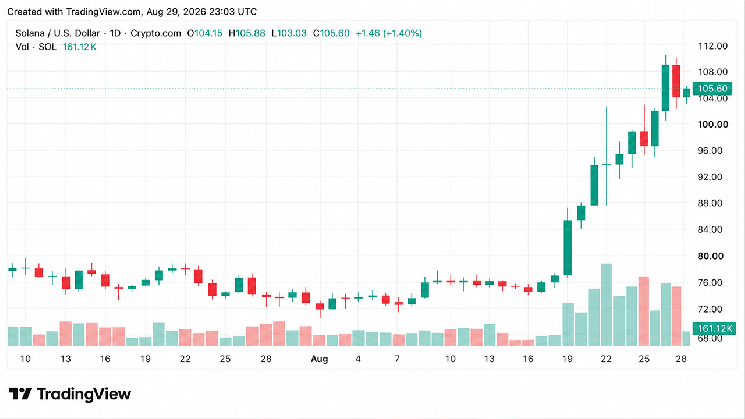
    Solana has decisively broken above the $100 psychological barrier, extending its strongest monthly advance in years as institutional access, exchange-traded fund activity, and evolving tokenomics converge around $SOL. The breakout follows months of resistance below the key level, putting the $110–$120 region firmly back on traders’ radar. With Charles Schwab preparing to expand Solana access and the network moving toward a tighter issuance framework, the latest rally is developing into more than a technical rebound.

    Schwab’s $SOL Expansion Broadens Institutional Access

    The move coincides with Charles Schwab’s decision to add Solana, Avalanche, and Chainlink to Schwab Crypto in the coming months. The brokerage began rolling out direct Bitcoin and Ethereum trading in May, and the planned $SOL addition expands its digital-asset offering to three of the largest cryptocurrencies outside BTC and ETH. Schwab oversees more than $12 trillion in client assets and serves about 39 million active brokerage accounts.

    The significance lies in the distribution channel: Solana is moving closer to investors who already operate within a traditional brokerage environment rather than requiring them to use a crypto-native exchange. ETF activity is providing a separate indication of institutional demand. U.S. Solana-linked products have recorded sustained inflows, while Bitwise’s BSOL staking ETF posted a record $126 million in daily trading volume on August 27, taking seven-day turnover to about $500 million.

    🔥BULLISH: Solana is EXPLODING, surging 13% today and about 50% in August for its strongest month since 2024.The rally comes as Solana votes on cutting issuance and burning more $SOL, potentially triggering a supply squeeze.Notably, Nasdaq-listed DeFi Development Corp. bought… https://t.co/fRjAD9l3CP pic.twitter.com/b4EggMjEMl
    — Coin Bureau (@coinbureau) August 27, 2026

    Solana’s Supply Curve Becomes Part of the Investment Case

    Demand-side developments are being matched by a potentially important change to $SOL’s future supply. Solana validators have been voting on SGP-0002 and SGP-0003, proposals that would accelerate disinflation and increase the amount of transaction-related fees permanently removed from circulation.

    SGP-0002 would increase the annual disinflation rate from 15% to 30%, bringing Solana toward its 1.5% terminal inflation rate considerably faster and reducing projected issuance by about 18.9 million $SOL over six years. SGP-0003 would introduce a resource-based fee that is burned, with estimates suggesting daily $SOL burns could rise from roughly 600–800 to around 7,500–9,000 $SOL under current activity levels.

    $SOL Price Analysis: Can Buyers Defend $100?

    Solana’s chart structure has improved substantially after $SOL cleared the $100 psychological barrier. The token had previously broken above the $78–$79 resistance zone and subsequently established a higher base around $92–$97 before making the latest move through $100. That sequence matters because it shows buyers defending higher levels rather than relying on a single vertical move.

    Immediate resistance now sits around $105–$110. A sustained daily close above this area would strengthen the breakout and expose the $115–$120 region, with the broader $125–$130 supply zone becoming relevant if momentum continues. At the same time, $SOL’s rapid rally has pushed momentum indicators into elevated territory. The daily RSI is around the overbought zone, while the recent run of positive sessions leaves the market vulnerable to profit-taking. A pullback toward $100–$105 would not necessarily damage the bullish setup if buyers defend the former resistance as support. A sustained move back below $100, however, would weaken the breakout and bring the mid-$90s back into focus.

    Final Outlook

    $SOL’s move above $100 has changed the immediate technical structure, but the more important development is the convergence of institutional access, ETF demand, and a potential reduction in future supply growth. Schwab’s planned listing expands the potential buyer base, while the governance proposals could make the token’s issuance profile more conservative if implemented.

    The $100–$105 zone is the key support level and $110–$120 is the next upside test. Holding the breakout would keep the broader recovery intact, while a failure to defend $100 would suggest that the market needs to consolidate after the recent acceleration. Solana has cleared the level that held back the recovery for months; the next phase will depend on whether $100 becomes a durable floor rather than another temporary breakout.