Tag: Charles Hoskinson

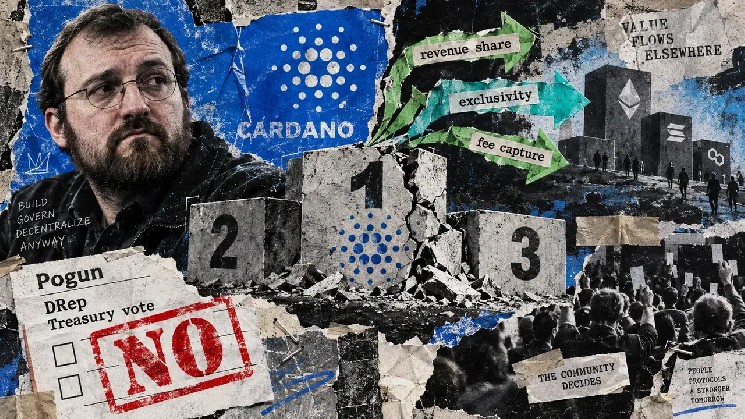
  • Charles Hoskinson Says Cardano No Longer Comes First — Treasury Vote Explains Why

    Charles Hoskinson Says Cardano No Longer Comes First — Treasury Vote Explains Why

    Key Highlights

    • Cardano’s delegated representatives (DReps) rejected a 12.29 million ADA treasury request from Input Output-backed Pogun, with 64.33% voting against ratification.
    • The Constitutional Committee separately approved the proposal 7-0 (100%), but DRep ratification is required for treasury withdrawals under Cardano’s governance framework.
    • Charles Hoskinson confirmed Pogun will still deploy on Cardano by mid-December 2026, but Input Output will pursue a multichain strategy based on technical and commercial fit rather than a Cardano-first policy.

    Cardano DReps Block Treasury Funding for Affiliated Bitcoin DeFi Project Pogun

    Cardano’s on-chain governance system delivered a decisive test of institutional independence this week when delegated representatives (DReps) allowed a 12.29 million ADA funding request for the Pogun protocol to expire without ratification. The proposal, backed by Input Output Global (IOG)—the blockchain engineering firm founded by Charles Hoskinson that built Cardano—sought development capital in exchange for a revenue-sharing arrangement. The final Koios voting summary recorded 35.67% of delegated voting power in favor and 64.33% against, falling short of the threshold needed to advance the withdrawal.

    Dual Governance Bodies Deliver Divergent Verdicts

    The outcome highlights the separation of powers embedded in Cardano’s Voltaire-era constitution. While DReps—elected representatives who vote with authority assigned by ADA holders—rejected the spending request, the Constitutional Committee (CC) conducted a parallel review and recorded seven yes votes, amounting to 100% approval from that body. The two results are procedurally compatible: the CC’s role is to assess constitutional compliance, while DReps hold the ratification authority for treasury withdrawals. Input Output helped build Cardano and remains a major ecosystem participant, but the network’s distinct governance institutions independently controlled the funding outcome.

    Revenue-Share Terms and the Commercial Calculation

    The Pogun proposal presented voters with a specific financial structure. According to Input Output’s April 2026 overview, Pogun would have returned 20% of earnings to the Cardano treasury until the initial 12.29 million ADA outlay was repaid, followed by a perpetual 5% return on Cardano-related products. The formal proposal framed this as a share of quarterly earnings before interest, taxes, depreciation, and amortization (EBITDA), with repayment tied to a $2.95 million valuation benchmark. Cardano would have funded product development and gained a proposal-based path to recover that outlay and participate in later earnings.

    DReps ultimately avoided exposing the treasury to a venture whose revenue, adoption, and network distribution remain unproven. They also declined the defined upside. Because Pogun has not yet established the future earnings or usage metrics needed to value that trade-off, claims about the precise amount Cardano forfeited remain speculative.

    Hoskinson Confirms Pogun Deployment but Signals Multichain Pivot

    Product Launches and Timeline Commitments

    In a September 18, 2026 broadcast, Charles Hoskinson stated that Input Output will choose the best network for each product rather than following a “Cardano-first-and-forever policy.” He nonetheless described Cardano as the strongest technical choice for Bitcoin DeFi systems that use Bitcoin-like transaction outputs (UTXOs). Hoskinson also provided forward-looking launch targets: RealFi is slated to debut on Cardano in October 2026, with Pogun arriving within 90 days of the broadcast—roughly mid-December 2026. These dates remain targets, not guarantees.

    Economic Relationship Shifts After Rejection

    Hoskinson noted that Pogun could still generate transaction fees, total value locked (TVL), and volume for Cardano if its planned deployment proceeds. However, the economic relationship would differ from the rejected proposal: Cardano could benefit from on-chain activity without receiving the revenue share that voters declined. Input Output’s product-by-product approach also predates the Pogun vote. Midnight City V2, an agent-based application tied to the Midnight ecosystem, was already documented on Midnight in July 2026, indicating a broader multichain strategy not attributable to a single treasury decision.

    Exclusivity Claims Require Careful Attribution

    The vote also reshapes Pogun’s commercial incentives. Hoskinson stated the unfunded product will not be exclusive to Cardano, that traffic may be routed to other networks, and that another ecosystem could receive exclusivity in exchange for support. This claim requires precise attribution. The on-chain Pogun proposal reviewed for the vote contains the funding request, repayment structure, perpetual return, and intended Cardano deployment—but it omits an explicit exclusivity covenant. The written record establishes that Cardano declined revenue participation. Hoskinson’s statements describe Input Output’s possible next steps; the proposal itself contains no equivalent term.

    Why This Matters

    The Pogun vote represents the first high-profile test of whether Cardano’s founding entity can access community treasury funds on the strength of its historical role alone. The answer, delivered by DReps, is no. Cardano’s institutions now control treasury spending through a bifurcated process: the Constitutional Committee reviews constitutional compliance, while DReps hold the purse strings. Input Output retains full commercial autonomy—it can finance products elsewhere, negotiate with competing networks, and direct incentives toward partners willing to provide capital or distribution.

    Pogun will now test how these two forms of independence interact. A Cardano deployment could bring fees, liquidity, and volume while activity simultaneously flows to other chains. If Cardano remains Pogun’s primary venue, the rejected revenue agreement may matter more than Hoskinson’s warning about exclusivity. If activity migrates elsewhere, the network’s budget discipline will carry a larger opportunity cost. Either outcome is consistent with decentralized governance: saying no protected the treasury from a speculative investment, but it also required Cardano to compete for Input Output’s future products. History alone no longer puts the network first.

    Frequently Asked Questions

    Why did the Constitutional Committee approve the Pogun proposal while DReps rejected it?

    The two bodies have distinct mandates. The Constitutional Committee assesses whether a governance action complies with the constitution—procedural correctness, format, and legality. DReps, elected by ADA holders, hold the political authority to ratify or reject treasury spending. The CC’s 7-0 approval confirmed the proposal was constitutionally valid; the DRep vote (35.67% yes, 64.33% no) reflected a policy judgment on the merits of the investment.

    Will Pogun still launch on Cardano after the funding rejection?

    Yes. Charles Hoskinson stated in his September 18, 2026 broadcast that Pogun will arrive on Cardano within 90 days (approximately mid-December 2026), and RealFi is targeting an October 2026 launch on Cardano. However, Pogun will not be exclusive to Cardano, and Input Output has signaled it may route traffic to other networks or grant exclusivity to another ecosystem in exchange for support.

    What was the exact financial offer Pogun made to the Cardano treasury?

    The proposal offered 20% of quarterly EBITDA until the 12.29 million ADA principal (valued at $2.95 million) was repaid, followed by a perpetual 5% return on Cardano-related Pogun products. The treasury would have funded development and received a revenue participation right, but DReps judged the venture’s future earnings and adoption too uncertain to justify the outlay.

  • Cardano’s IOG warns users after YouTube channel hijack

    Cardano’s IOG warns users after YouTube channel hijack

    Key Highlights

    • Input Output Global (IOG) warned users on Sept. 18 to avoid its YouTube channel after an apparent takeover featured a suspected AI-manipulated Charles Hoskinson livestream promoting a cryptocurrency giveaway scam.
    • The fraudulent broadcast, presented as a Project Catalyst town hall, used footage resembling Hoskinson and promoted a “double your wealth” scheme via QR code links, with no evidence that Hoskinson or Project Catalyst authorized the promotion.
    • IOG has not confirmed how the channel was compromised, whether administrative control has been fully restored, or if any users lost funds, while the incident follows a documented pattern of Cardano-related impersonation scams dating back years.

    IOG Issues Urgent Warning After YouTube Channel Takeover

    Input Output Global (IOG), the development firm behind the Cardano blockchain, issued an urgent security advisory on Sept. 18 directing users to avoid its official YouTube channel following an apparent account compromise. The organization posted through its verified X account that users should avoid interacting with the channel “until further notice,” explicitly warning people not to click links, transfer funds, or provide personal information through any material appearing on the platform.

    The warning came while the compromised channel was broadcasting a livestream presented as a Project Catalyst town hall. The suspicious broadcast utilized footage resembling Cardano founder Charles Hoskinson and promoted an offer claiming viewers could “double your wealth” by following instructions linked through a QR code. No evidence reviewed indicates that Hoskinson or Project Catalyst authorized the promotion. At the time of IOG’s public warning, the fraudulent livestream had remained online for close to two hours, according to reporting on the incident.

    Details of the Compromise and Official Response

    IOG’s security message focused exclusively on preventing further user interaction with the compromised channel. The organization did not state publicly how access to its YouTube account had been obtained, nor did it identify the party behind the apparent takeover. Its official instruction told users not to follow links, send cryptocurrency, or submit personal details until IOG confirmed that its YouTube presence was safe again.

    As of the latest review, no subsequent official post has confirmed that the channel has been fully recovered. Current search results still surface IOG’s ordinary historical videos, but their availability does not by itself establish that administrative control has been restored. IOG has not published a wallet address associated with the fraudulent broadcast, nor has it disclosed whether anyone sent ADA or another asset after viewing the stream, leaving any claimed losses unverified. No credible blockchain-forensics firm or security researcher reviewed for this report had published a verified attribution, scam-wallet balance, or transaction trail tied specifically to the Sept. 18 incident.

    Fraudulent Stream Follows Established Cardano Scam Pattern

    The format of the Sept. 18 broadcast closely resembles a type of fraud that the Cardano ecosystem has warned users about for years. Cardano’s official scam-awareness guide specifically describes ADA giveaway schemes in which scammers promise to double a user’s holdings after receiving an initial transfer. The guidance states that fraudulent streams frequently use fake videos of Charles Hoskinson or other well-known figures to make the offer appear authentic.

    Cardano’s guidance emphasizes that legitimate giveaways never require users to send cryptocurrency first. Once ADA is transferred to a scam address, blockchain transactions cannot simply be reversed by Cardano’s developers or ecosystem organizations. The Cardano Foundation documented the same technique as early as 2020. In a community notice, it reported that scammers had been hijacking YouTube accounts with established audiences, impersonating Cardano organizations, and promoting offers claiming users would receive more crypto after making a deposit. The Foundation stated explicitly that neither it, EMURGO, nor Input Output would promote giveaways requiring users to send ADA or another asset.

    Community reports have since documented multiple fake Hoskinson streams. A 2024 report described an impersonation channel using what the user characterized as AI-generated Hoskinson footage to promote a giveaway, though that report did not establish who created the video. The recurring pattern involves taking control of established YouTube channels, replacing their content with crypto giveaway livestreams, and directing viewers toward payment addresses or external sites.

    Project Catalyst Branding Provided False Legitimacy

    The Sept. 18 broadcast was presented as a Project Catalyst event, leveraging branding associated with Cardano’s community-funding program to create a veneer of authenticity. Project Catalyst is a genuine Cardano initiative. Its official site describes the program as a community funding system through which Cardano users submit, review, and vote on proposals, with 2,221 proposals having received funding across completed rounds.

    Input Output has historically played a direct role in Catalyst. A February 2026 Catalyst update identified IOG as the program’s operator at that time while responsibilities were being reorganized with the Cardano Foundation and Intersect. By June, Intersect said administration had transferred from IOG to the Cardano Foundation, with remaining milestones from one IOG Catalyst project canceled and 2.06 million ADA returned to the treasury. Using Catalyst branding therefore gave the fraudulent livestream a recognizable Cardano context even though no official Catalyst source reviewed for this report announced a legitimate town hall matching the giveaway broadcast. The combination of a familiar project name with apparent Hoskinson footage follows the social-engineering pattern described in Cardano’s scam guidance: genuine-looking ecosystem material is combined with a malicious payment request.

    Previous Compromises of Cardano-Linked Accounts

    This incident is not the first time a prominent Cardano-linked social account has been compromised. In December 2024, the Cardano Foundation’s X account was compromised and used to publish a false claim that the U.S. Securities and Exchange Commission had sued the organization, with attackers falsely telling users that support for ADA would cease. Hoskinson responded at the time by identifying the posts as unauthorized. That fake announcement was unrelated to the current YouTube incident, but both cases involved trusted Cardano-branded communication channels carrying content that did not originate from the organization controlling the account.

    Scam reports involving YouTube stretch back even further. Cardano’s community forum contains reports from users who said they lost ADA after encountering fake livestreams offering to return twice the amount sent. One 2022 user reported transferring 10,000 ADA after seeing a fraudulent Hoskinson-themed broadcast, though that loss was self-reported and not independently verified.

    AI Manipulation Suspected But Not Independently Verified

    The latest video has been described as AI-manipulated, but no technical forensic report reviewed for this update has confirmed how the Hoskinson footage was produced. The distinction remains relevant because scam operators can use several methods, including edited historical footage, altered audio, synthetic voice generation, or fully generated video. Cardano’s current security guidance explicitly warns that improvements in artificial intelligence are making impersonation scams more sophisticated, and its giveaway section names fake livestreams featuring Hoskinson as a recurring risk.

    Notably, IOG itself has been experimenting publicly with AI-generated content. In June, Hoskinson defended an AI-generated influencer post published through an Input Output account, saying it formed part of experiments around AI agents and Midnight City. Earlier coverage of IOG’s AI content tests reported that some community members objected to the synthetic content. That legitimate experimentation is unrelated to the Sept. 18 suspicious livestream. IOG’s warning expressly told users not to interact with the compromised YouTube channel, while the giveaway itself has not been endorsed by the company.

    Why This Matters

    The compromise of IOG’s official YouTube channel represents a significant escalation in the sophistication and reach of cryptocurrency impersonation scams. By hijacking a verified organizational channel with an established subscriber base, attackers gained immediate credibility that standalone impersonation channels cannot achieve. The use of Project Catalyst branding—a legitimate Cardano governance initiative—demonstrates attackers’ deep familiarity with the ecosystem’s structure and terminology.

    The incident also highlights the growing challenge of AI-generated deepfakes in social engineering attacks. While forensic verification is pending, the mere plausibility of AI-manipulated footage of a recognizable industry figure like Hoskinson lowers the barrier for convincing fraud. For Cardano users and the broader crypto community, the event reinforces the critical security principle that no legitimate organization will ever request funds upfront in exchange for promised returns. As IOG investigates the breach vector—including whether multi-factor authentication was bypassed or other corporate accounts were affected—the ecosystem awaits a full post-incident report that could inform stronger platform-level protections for verified organizational channels.

    Frequently Asked Questions

    Has IOG confirmed that its YouTube channel has been fully secured and restored?

    As of the latest review, IOG has not published a follow-up notice confirming that administrative control of the YouTube channel has been fully restored. The organization’s official instruction remains to avoid the channel until it issues another notice confirming normal control has been reestablished.

    Were any users confirmed to have lost funds in this specific incident?

    IOG has not disclosed whether anyone sent ADA or another asset after viewing the fraudulent stream, and no credible blockchain-forensics firm has published a verified transaction trail tied to the Sept. 18 incident. Any claimed losses remain unverified.

    How can users distinguish legitimate Cardano communications from scams?

    Cardano’s official guidance states that legitimate giveaways never require users to send cryptocurrency first. The Cardano Foundation, EMURGO, and Input Output have all publicly stated they will not promote giveaways requiring users to send ADA or other assets. Users should verify announcements through multiple official channels and treat any “double your wealth” or similar offers as fraudulent.