Tag: Business News

  • Ray Zhang Wants Crypto Infrastructure to Become Safer Without Becoming Opaque

    Ray Zhang Wants Crypto Infrastructure to Become Safer Without Becoming Opaque

    Key Highlights

    • An Ellipsis Labs engineer contends that blockchain systems must establish clearer risk boundaries to protect users and build trust.
    • The engineer emphasizes the need for smoother onboarding processes to lower barriers to entry for mainstream adoption.
    • Financial tools built on blockchain should be designed so that users can actually understand them, rather than requiring specialized technical knowledge.

    Ellipsis Labs Engineer Outlines Three Pillars for Blockchain Usability

    An engineer at Ellipsis Labs has argued that the future viability of blockchain systems depends on addressing three fundamental usability gaps: clearer risk boundaries, smoother onboarding, and financial tools that users can genuinely comprehend. The critique targets persistent friction points that have limited mainstream adoption despite years of infrastructure development.

    Risk Boundaries and User Protection

    According to the engineer, current blockchain environments often expose participants to opaque risks — ranging from smart contract vulnerabilities to irreversible transaction errors — without adequate guardrails or transparent disclosures. The argument posits that defining and enforcing clearer risk boundaries is essential not only for consumer protection but also for establishing the institutional credibility required for broader financial integration.

    Onboarding as a Critical Bottleneck

    The engineer identifies onboarding as a primary bottleneck. Complex wallet setups, seed phrase management, gas fee mechanics, and network selection create a steep learning curve that deters non-technical users. Smoother onboarding, in this view, means abstracting away low-level complexity while preserving user sovereignty — a design challenge that many protocols have yet to solve convincingly.

    Comprehensible Financial Tools

    Beyond access, the engineer stresses that the financial primitives themselves — lending markets, derivatives, yield strategies — must be presented in terms that users can actually understand. This includes transparent risk disclosures, intuitive interfaces, and documentation that does not assume prior expertise in cryptography or game theory. The goal is to shift the user experience from “read the code” to “understand the product.”

    Why This Matters

    The remarks from Ellipsis Labs reflect a growing consensus among infrastructure builders that technical elegance alone is insufficient for mass adoption. As blockchain networks scale and intersect with traditional finance, regulatory scrutiny and user expectations are rising in tandem. Protocols that fail to address risk transparency, onboarding friction, and product comprehensibility risk remaining niche tools for a technical minority rather than becoming foundational rails for the global financial system. The engineer’s framework aligns with broader industry efforts — such as account abstraction, intent-based architectures, and standardized risk scoring — but underscores that these solutions must be evaluated against real-world usability, not just cryptographic soundness.

    Frequently Asked Questions

    Who made these arguments about blockchain usability?

    An engineer at Ellipsis Labs, a blockchain infrastructure and research team known for work on decentralized finance protocols and scaling solutions.

    What are the three specific improvements the engineer recommends?

    The engineer calls for clearer risk boundaries, smoother onboarding processes, and financial tools that users can actually understand.

    Why is this perspective significant for the blockchain industry?

    It highlights a shift in focus from pure technical performance to user-centric design as a prerequisite for mainstream adoption and regulatory acceptance.


  • Moulik Budhiraja Builds AI That Acts Before Prompts

    Moulik Budhiraja Builds AI That Acts Before Prompts

    Proletic Co-founder and CTO Advances Predictive Autocomplete Technology for Computers

    The co-founder and chief technology officer of Proletic is spearheading the development of predictive autocomplete capabilities designed specifically for computer systems. This initiative aims to enhance user interaction by anticipating input needs across desktop environments.

    Advancing Desktop Productivity Through Prediction

    While predictive text has become standard on mobile devices, bringing similar intelligence to computer interfaces represents a significant evolution in human-computer interaction. The Proletic leadership team is focusing on adapting these predictive models for the broader context and complexity of desktop computing workflows.

    This development aligns with growing industry momentum toward AI-assisted interfaces that reduce repetitive typing and accelerate task completion for knowledge workers, developers, and general computer users alike.

  • AI Wrapper Boom Misses Real Problem, Says Jeffrey Zang

    AI Wrapper Boom Misses Real Problem, Says Jeffrey Zang

    Proletic Founder Predicts Restrained AI Will Win Next Product Wave

    The founder of Proletic contends that success in the next generation of artificial intelligence products will belong to teams prioritizing restraint and genuine utility over flashy capabilities. According to the argument, the market will reward software that users genuinely want to continue using rather than tools that merely demonstrate technical prowess.

    Shifting Focus From Capability to Utility

    This perspective suggests a maturing AI landscape where the novelty of large language models and generative features gives way to product discipline. Teams that resist the urge to over-engineer or stuff products with every possible AI feature may gain a competitive edge by delivering focused, reliable experiences that solve specific problems well.

    Retention as the New Metric

    The emphasis on software “people actually want to keep using” highlights retention and habitual use as critical differentiators. In a crowded market of AI-powered tools, products that integrate seamlessly into workflows and provide consistent value without friction are positioned to outlast those relying on initial hype or demonstrations of raw model power.

    Proletic’s stance reflects a broader industry conversation about sustainable AI product strategy, where restraint in design and clarity of purpose become strategic advantages.

  • Akshay Petta Left BlackRock to Build the Systems Behind Reliable Financial AI

    Akshay Petta Left BlackRock to Build the Systems Behind Reliable Financial AI

    A former investment strategist has transitioned into engineering to build regulated financial platforms from the ground up, leveraging code to transform traditional investment analysis.

    From Strategy to Engineering

    The career shift marks a move from analytical strategy to hands-on platform development. By applying programming expertise directly to financial infrastructure, the former strategist is addressing regulatory requirements and operational needs through custom-built technology.

    Building Regulated Platforms

    The focus on regulated financial platforms suggests an emphasis on compliance, security, and institutional-grade architecture. This approach combines deep domain knowledge from investment analysis with modern engineering practices to create platforms that meet stringent regulatory standards while delivering advanced analytical capabilities.

  • Toby Li Is Building a Faster Way to Move Cargo Across the Moon

    Toby Li Is Building a Faster Way to Move Cargo Across the Moon

    InSitu Space Unveils Daedalus Hopper for Extended Lunar Exploration

    InSitu Space has introduced its Daedalus hopper, a novel lunar mobility platform engineered to transport payloads across multiple locations on the Moon’s surface. Unlike traditional rovers that remain confined to a single landing zone, the Daedalus hopper is designed to execute controlled hops, granting scientists and mission operators access to diverse and hard-to-reach lunar terrain.

    Overcoming Rover Limitations

    Conventional lunar rovers face significant constraints in range and terrain accessibility. Once deployed, they are typically limited to exploring the immediate vicinity of their landing site. Steep crater walls, permanently shadowed regions, and widely separated scientific targets often remain out of reach. The Daedalus hopper addresses this bottleneck by design, offering a relocatable platform that can reposition itself to new areas of interest throughout a mission.

    Expanding Scientific Reach

    By enabling payloads to travel beyond a single landing site, the hopper architecture opens new possibilities for lunar science. Researchers can target multiple geological units, sample varied regolith types, and deploy instruments in strategically selected locations without requiring separate lander missions for each site. This capability is particularly valuable for investigating resource distribution, such as water ice deposits in permanently shadowed craters, which are often distributed across discontinuous terrains.

    Operational Flexibility for Commercial and Government Missions

    The system is built to serve both scientific and commercial operators. Its ability to reposition payloads—whether instruments, sample collection tools, or technology demonstrators—provides mission planners with unprecedented flexibility. Operators can adapt to new findings in real time, redirecting assets to high-priority targets as they emerge, rather than committing to a fixed exploration plan at launch.

    InSitu Space’s Daedalus hopper represents a shift toward dynamic, multi-site lunar surface operations, potentially reducing the cost and complexity of comprehensive lunar exploration campaigns.

  • Paras Savnani on the Robotics Testing Gap: Bridging Demo to Deployment

    Paras Savnani on the Robotics Testing Gap: Bridging Demo to Deployment

    Can a Robot Perform Reliably Once It Leaves a Controlled Environment?

    The question of robotic reliability in uncontrolled settings remains a central challenge for the robotics industry. As developers push machines beyond laboratory conditions, real-world variability introduces complex obstacles that current systems must overcome to achieve consistent performance.

  • Naol Bassaye Built a Global Technology Career by Learning to Start Again

    Naol Bassaye Built a Global Technology Career by Learning to Start Again

    From Ethiopia to London: Naol’s Journey From Self-Taught Coder to Serial Founder

    Naol’s career trajectory reads like a blueprint for the modern global technologist. What began as a self-directed coding education in Ethiopia has evolved into a track record of founding companies in London, driven by a core conviction that expanded access fundamentally changes what people are capable of building.

    The Power of Self-Directed Learning

    Teaching himself to code in Ethiopia, Naol bypassed traditional gatekeepers—formal computer science degrees, expensive bootcamps, and geographic proximity to tech hubs. This foundation of autodidacticism didn’t just produce technical skills; it instilled a mindset where barriers are treated as problems to be solved rather than fixed limitations.

    Reinvention as a Career Strategy

    The move from Ethiopia to London represents more than geographic relocation. It marks a deliberate pattern of reinvention—applying the same self-directed learning approach to new markets, new problems, and new company-building cycles. Each venture becomes a vehicle for testing the hypothesis that guides his work: when access expands, human potential scales non-linearly.

    Access as a Force Multiplier

    The through-line connecting Naol’s Ethiopian origins to his London ventures is a belief that access—whether to education, tools, networks, or capital—acts as a force multiplier for human creativity. This isn’t abstract idealism; it’s an operational principle shaped by lived experience. Having navigated the gap between having talent and having opportunity, he now builds companies designed to close that gap for others.

    In a tech ecosystem that often celebrates pedigree over potential, Naol’s path offers a counter-narrative: the most durable companies may come from founders who’ve had to invent their own on-ramps.

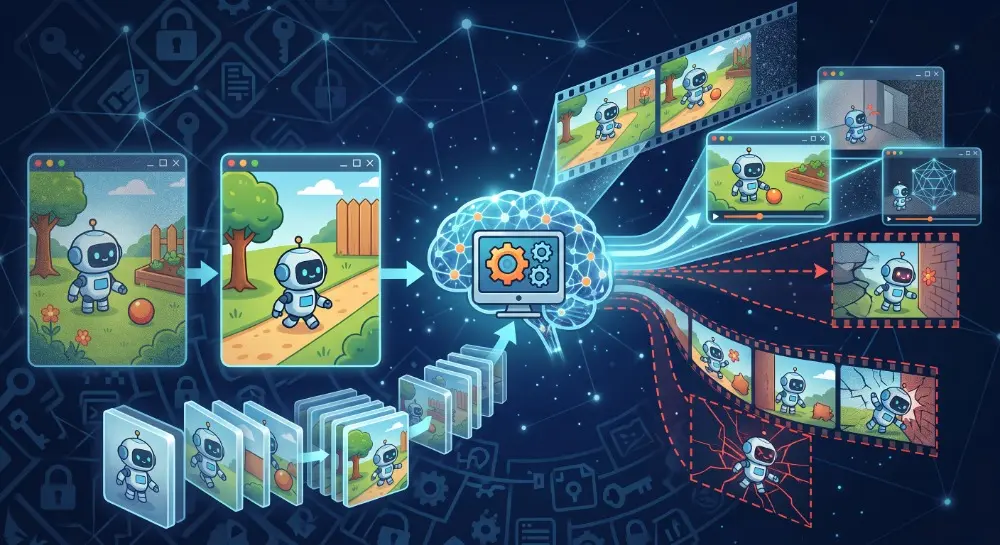
  • How Video Generation Enables Robots to Interact With the Physical World

    How Video Generation Enables Robots to Interact With the Physical World

    Redefining AI Slop: A Potential Gateway to Physical World Intelligence

    The prevailing view often dismisses low-quality, mass-generated synthetic content—commonly labeled as AI slop—as a mere nuisance cluttering the internet. However, a shifting perspective suggests this deluge of imperfect data may hold unexpected value for the next frontier of artificial intelligence: embodied AI and physical world interaction.

    The Misunderstood Value of Synthetic Noise

    Traditionally, “AI slop” refers to the high-volume, low-fidelity output generated by models prioritizing quantity over quality. It fills social feeds, search results, and content farms. While critics highlight the degradation of information ecosystems, researchers are increasingly investigating whether this chaotic data reservoir serves a functional purpose in training robust world models.

    From Digital Artifacts to Physical Reasoning

    Developing AI capable of navigating, manipulating, and understanding the physical world requires massive, diverse datasets representing real-world complexity. Curated, high-quality datasets are expensive and narrow. Conversely, the vast, messy spectrum of generated content—including errors, hallucinations, and bizarre compositions—may expose models to a wider range of edge cases, physical inconsistencies, and novel object interactions than pristine data alone.

    This exposure could be critical for training world models that predict the consequences of actions in physical environments. By learning to distinguish plausible physics from impossible geometries within “slop,” models may develop a more resilient understanding of spatial reasoning, causality, and object permanence.

    Implications for Embodied AI Development

    If validated, this approach reframes the current generative AI flood not just as pollution, but as a massive, automated data augmentation strategy. It suggests a pathway where the byproducts of today’s content mills become the training fuel for tomorrow’s robots and autonomous agents, bridging the gap between digital simulation and tangible reality.

  • Hajra Arbab Knows What Happens Before a Story Reaches the Screen

    Hajra Arbab Knows What Happens Before a Story Reaches the Screen

    A media executive, producer, and arts leader operates across global entertainment, independent film, and The Colony Lahore to connect stories with the audiences they were made for.

  • Dan Zabrotski Is Betting That AI Will Change What Human Teaching Is Worth

    Dan Zabrotski Is Betting That AI Will Change What Human Teaching Is Worth

    AI’s Growing Role in Language Learning Reshapes Tutor Marketplaces

    The software engineer behind a zero-commission language marketplace is confronting an uncomfortable possibility: AI may take some lessons from human tutors while increasing the value of the work that still requires a person.

    Shifting Dynamics in Language Education

    As artificial intelligence capabilities advance, language learning platforms face a fundamental restructuring. Automated systems increasingly handle foundational instruction—vocabulary drills, grammar exercises, and basic conversation practice—tasks that once filled tutor schedules.

    Human Expertise Gains New Premium

    This displacement creates a paradoxical effect. While AI absorbs routine teaching functions, the remaining human-centered work—nuanced cultural context, complex pronunciation coaching, personalized motivation, and advanced fluency development—commands higher value. Tutors who adapt to complement rather than compete with AI tools may find their services more sought after, not less.

    Platform Strategy at an Inflection Point

    For marketplace operators, the challenge involves redefining tutor roles, adjusting commission structures, and integrating AI as a feature rather than a threat. The zero-commission model adds pressure to demonstrate sustainable value for both educators and learners in an AI-augmented ecosystem.