Tag: BookTok

  • Viral X Post Suggesting Whiskey as Lube Ruthlessly Mocked

    Viral X Post Suggesting Whiskey as Lube Ruthlessly Mocked

    Key Highlights

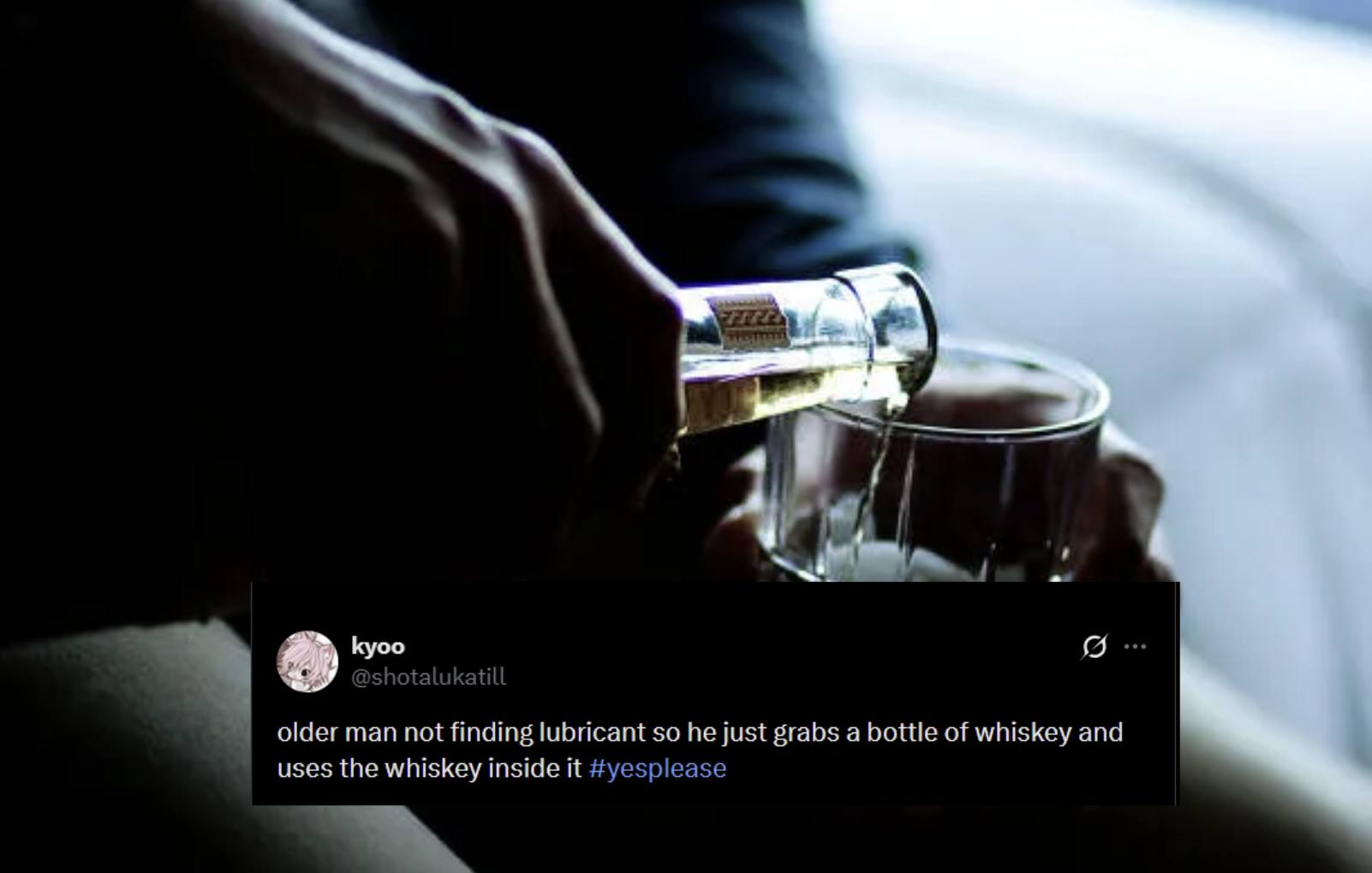
    • A viral X post from late September 2026, dubbed “Whiskey Lubricant,” described a sexual scenario involving an older man substituting whiskey for personal lubricant.
    • The post drew widespread mockery for its premise and prose style, with critics comparing it to low-quality BookTok romance tropes and Archive of Our Own (AO3) erotica.
    • Commentators suggested the depiction reflected a lack of firsthand sexual experience, arguing the author’s understanding of intimacy appeared shaped primarily by internet fanfiction conventions.

    Viral X Post Sparks Debate Over Literary Quality and Sexual Representation

    A short-form post published on X in late September 2026 ignited a wave of ridicule and critical analysis across the platform, centering on a scenario quickly labeled “Whiskey Lubricant” by the user base. The narrative described an older male protagonist who, upon discovering an absence of personal lubricant, opts to use whiskey as a substitute during a sexual encounter. While the platform routinely surfaces absurdist or deliberately provocative content, this specific entry garnered attention for the intensity of the negative reception directed at its literary execution rather than merely its shock value.

    Critics Target Prose Style and Narrative Plausibility

    Responses to the post coalesced around two primary vectors of criticism. First, users lampooned the writing style itself, drawing direct parallels to the often-maligned prose found in viral BookTok recommendations and amateur erotica hosted on Archive of Our Own (AO3). The comparison to AO3—a massive fanfiction repository known for its vast range of quality—served as a specific cultural shorthand for awkward phrasing, improbable anatomy, and melodramatic pacing. Second, the core premise of using whiskey, a high-proof alcohol, as a lubricant alternative was cited as a glaring indicator of biological implausibility, prompting jokes about the immediate physical consequences such an act would entail.

    Discourse Highlights Disconnect Between Tropes and Lived Experience

    Beyond the immediate mockery, a meta-discussion emerged regarding the origins of the post’s specific flavor of erotic writing. A significant portion of the commentary posited that the author’s conceptualization of sex bore the hallmarks of someone whose primary exposure to sexual narratives derives from online fanfiction ecosystems and social media-driven romance trends, rather than practical experience. Critics argued that the scenario relied heavily on established internet tropes—such as the “improvised lubricant” scenario common in hurt/comfort or “first time” fanfiction tags—without accounting for the physiological realities that would make the specific substitution of whiskey painful and dangerous. This line of critique framed the post as a case study in how algorithmic content consumption can distort understanding of human intimacy.

    Why This Matters

    The “Whiskey Lubricant” episode underscores the evolving dynamic between social media virality, fanfiction culture, and mainstream discourse on sexual literacy. As platforms like X (formerly Twitter) and TikTok’s BookTok community become primary vectors for erotic literature discovery—especially among younger demographics—the gap between performative, trope-heavy writing and anatomical reality widens. The incident reflects broader concerns among educators and cultural critics regarding the sources from which individuals derive sexual scripts. While fanfiction communities like AO3 have long self-regulated through tagging systems and reader feedback, the algorithmic amplification of decontextualized excerpts on general-purpose platforms strips away those guardrails, potentially cementing harmful misconceptions. The discourse also highlights the participatory nature of modern critique, where “hate-reading” and quote-tweeting function as a form of collective media literacy, publicly dissecting and rejecting narratives that fail plausibility tests.

    Frequently Asked Questions

    What was the “Whiskey Lubricant” post?

    It was a viral X post from late September 2026 describing a sexual scenario where an older man uses whiskey as a substitute for personal lubricant.

    Why did the post go viral?

    The post attracted widespread mockery for its implausible premise and writing style, which users compared to low-quality BookTok romance novels and amateur AO3 fanfiction erotica.

    What broader discussion did the post generate?

    Critics argued the post exemplified how internet and fanfiction tropes can shape unrealistic depictions of sex, suggesting the author lacked firsthand experience and relied on recycled online conventions rather than biological reality.
  • Viral X Post Recommending Whiskey as Lube Draws Ruthless Mockery

    Viral X Post Recommending Whiskey as Lube Draws Ruthless Mockery

    Key Highlights

    • A viral X post titled “Whiskey Lubricant” circulated in late September 2026, describing a sexual fantasy in which an older man substitutes whiskey for personal lubricant.
    • The post attracted widespread mockery for its implausible premise and prose style, with users likening it to low-quality BookTok content and Archive of Our Own (AO3) erotica.
    • Commentators argued the depiction of sex reflected a lack of firsthand experience, suggesting the author’s understanding was shaped primarily by internet and fanfiction tropes.

    The Viral Post and Its Premise

    In late September 2026, an X post labeled “Whiskey Lubricant” gained rapid traction across the platform. The post presented a fictional scenario centered on an older male protagonist who, upon discovering he had no lubricant available, opts to use whiskey during sexual activity. The narrative framed the substitution as a deliberate erotic choice rather than an improvised necessity, a framing that immediately struck many readers as physically improbable and narratively contrived. The post did not identify its author by name, nor did it link to a longer work; it existed as a standalone micro-fiction thread typical of the platform’s “thirst post” subculture.

    Online Reaction and Mockery

    Response to the post was overwhelmingly derisive. Quote-posts and replies flooded the thread with sarcastic commentary, meme formats, and explicit comparisons to amateur writing communities. Users specifically invoked BookTok—the TikTok subcommunity focused on romance and fantasy novels—and Archive of Our Own (AO3), the dominant fanfiction archive, as benchmarks for the post’s perceived literary quality. The consensus held that the scenario read less like a credible erotic vignette and more like a parody of the genre’s clumsiest tropes, including the fetishization of age gaps and the use of household substances as lubricants, a motif that has circulated in fanfiction for years but is widely recognized as unsafe in practice.

    Critique of Writing Style and Authenticity

    Beyond the premise, the prose itself became a target. Critics described the sentence structure, vocabulary, and pacing as hallmarks of someone mimicking erotic writing without understanding its mechanics or its physical realities. Several highly engaged replies posited that the author’s conception of sex appeared to be derived entirely from consuming fanfiction and social-media erotica rather than from lived experience. This line of criticism touched on a recurring discourse within online writing spaces: the feedback loop in which inexperienced writers replicate stylized, often anatomically inaccurate depictions of sex, which are then consumed by similarly inexperienced readers, reinforcing a distorted collective script.

    Why This Matters

    The “Whiskey Lubricant” episode illustrates how platform algorithms amplify fringe micro-fiction into mass spectacle, subjecting niche writing to mainstream scrutiny it was never designed to withstand. It also highlights the growing influence of fanfiction-derived tropes on broader erotic discourse, particularly among younger demographics whose primary exposure to sexual narratives comes from AO3, Wattpad, and BookTok rather than traditional publishing or comprehensive sex education. The safety implications are non-trivial: the casual depiction of alcohol as a lubricant normalizes a practice that can cause chemical irritation, mucosal damage, and condom degradation. While the post itself was almost certainly intended as fantasy, the volume of engagement demonstrates how quickly such content escapes its original context and enters the informational ecosystem.

    Frequently Asked Questions

    What exactly was the “Whiskey Lubricant” post?

    It was a short, fictional X post from late September 2026 describing an older man using whiskey as a substitute for personal lubricant during sex. The post went viral primarily because users mocked its premise and writing quality.

    Why did people compare it to BookTok and AO3 erotica?

    Critics felt the post’s tropes—improvised lubricants, age-gap dynamics, and stylized prose—mirrored the lowest-common-denominator content found in TikTok’s book-recommendation community and on the fanfiction archive Archive of Our Own, suggesting the author was imitating those styles poorly.

    Is using whiskey as lubricant actually dangerous?

    Yes. Alcohol can irritate sensitive mucosal tissue, disrupt the vaginal or anal microbiome, and degrade latex condoms, increasing the risk of breakage and sexually transmitted infections. Medical professionals strongly advise against using any substance not specifically formulated as a personal lubricant.

  • The Love Hypothesis Review: Does BookToks Beloved STEM Romance Get the Adaptation It Deserves?

    The Love Hypothesis Review: Does BookToks Beloved STEM Romance Get the Adaptation It Deserves?

    Key Highlights

    • Prime Video’s The Love Hypothesis adapts Ali Hazelwood’s bestselling BookTok novel, starring Lili Reinhart and Tom Bateman in a fake-dating romance set within Stanford’s STEM academia.
    • The film captures beloved book details like the “unicorn socks” and Chapter 16 intimacy, with strong comedic chemistry between leads during early fake-dating sequences.
    • Critics note a missing emotional core: the adaptation lacks the interior yearning and angst that define the fake-dating trope, leaving the third-act romance feeling unearned despite solid performances.

    From Beaker to Screen: Adapting a BookTok Phenomenon

    Remember making elephant toothpaste in science class? You’d combine water, yeast, soap, hydrogen peroxide, and food coloring, and watch a tower of colorful foam erupt from a beaker. Not long after, the foam would subside, leaving nothing but soapy water and the fond memories of a brief foray into the world of chemistry. Watching The Love Hypothesis is a lot like that. Adapted from Ali Hazelwood’s novel of the same name, a BookTok favorite, The Love Hypothesis details the fake dating romance between biology PhD student Olive Smith (Lili Reinhart) and professor Adam Carlsen (Tom Bateman). It’s full of chemistry, both figurative and literal, and like the elephant toothpaste, it’s a bubbly blast that’ll have your insides fizzing. Yet despite this pure fun, not to mention two solid leading performances, The Love Hypothesis is missing one key ingredient that would truly make its experiment stick the landing: yearning.

    Fake Dating Meets STEM Academia

    Like Hazelwood’s book, itself reworked from her Reylo fanfiction, The Love Hypothesis cannily deploys several beloved romance tropes within the world of STEM academia, with fake dating chiefest among them. Stanford PhD candidate Olive is a ball of sunshine who’s as sweet as the sugar bomb coffees she loves to order. She cares deeply about her research into pancreatic cancer, as well as her found family: fellow students Anh (Rachel Marsh), Jeremy (Nicholas Duvernay), and Malcolm (Jaboukie Young-White). While Olive has harbored a crush on Jeremy, she also knows that he’s interested in Anh, and vice versa. However, Anh refuses to date Jeremy because she doesn’t want to hurt Olive. For Olive, that leaves her one choice: pretend to be dating someone else so Anh thinks she’s over Jeremy.

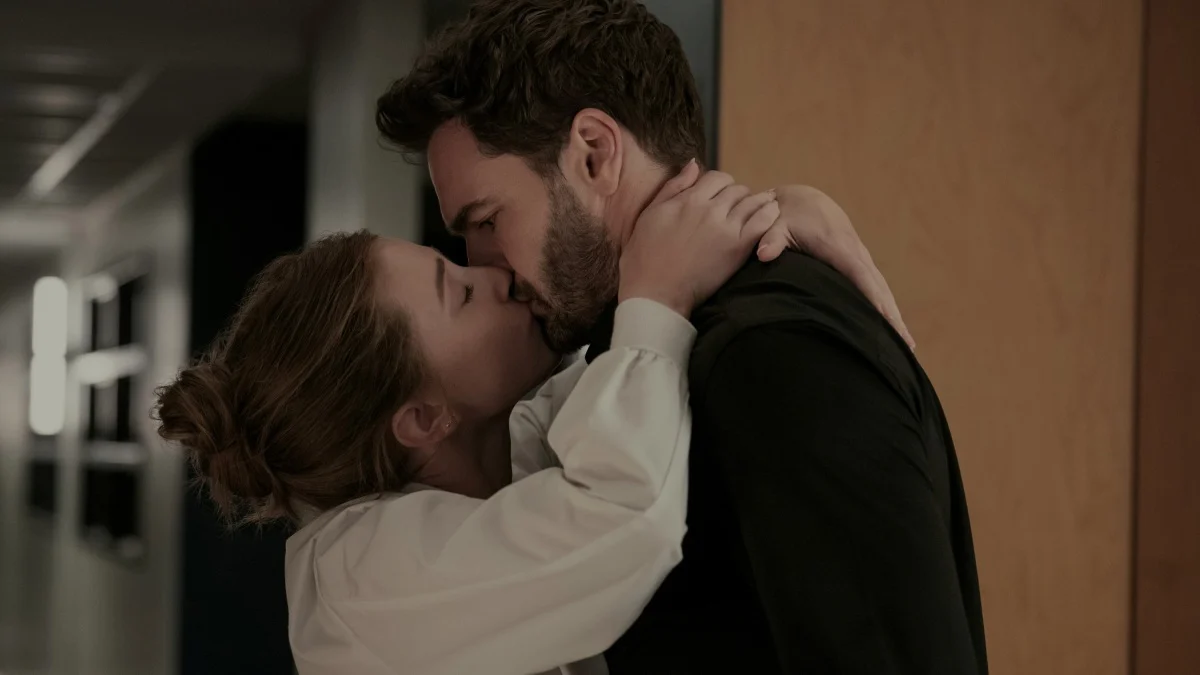
    Olive’s lie spirals until she kisses the first man she can find in front of Anh. Unfortunately for her, that man happens to be the brilliant but intimidating Dr. Adam Carlsen. Due to his demanding nature and bluntness verging on rudeness, he’s earned the nickname “Dr. Evil.” That he only ever dresses in black does nothing to lessen the supervillain vibes. (One music cue tied to Adam sounds like a riff on “The Imperial March,” a riff on The Love Hypothesis‘ Star Wars roots.) The pair’s kiss could result in disaster. Surprisingly, though, Adam agrees to help Olive with her fake dating ruse. (Notably, he was never her professor, so The Love Hypothesis avoids those power dynamic issues.) This way, Anh and Jeremy will get the chance to get together. The arrangement also benefits Adam. Stanford believes he’s a flight risk and might not renew funding for his research. If they know he has a serious girlfriend, they may reconsider. So begins Olive and Adam’s fake relationship, which, as decreed by the laws of rom-coms, winds up being not so fake after all.

    Faithful Details and Charismatic Leads

    Avid The Love Hypothesis fans, you’ll be happy to know that the film, directed by Claire Scanlon (Set It Up), captures several of the book’s beloved details, including the unicorn socks Olive wears during her and Adam’s steamy first night together, aka the infamous Chapter 16. You’ll also be overjoyed to see how Reinhart and Bateman bring the Adam-Olive pairing to life. Reinhart falls right into step alongside the leading ladies of rom-coms past, tempering Olive’s klutzy quirks — she sweats a lot! — with her deeper desire to prove herself and maintain a lasting community, two needs that stem from a tough upbringing in the foster care system. Bateman, on the other hand, delivers almost every line with a clipped precision, which only makes the moments when Adam softens up around Olive all the clearer.

    The two are a delightful pair, especially in classic fake dating scenarios where they have to pretend to truly love each other. A very public coffee shop date leads to squeal-worthy moments of cringe comedy, as do Olive’s attempts to loudly fake laugh and flirt with an utterly confused Adam. However, somewhere between these disastrous first “dates” and the intimacy of the much-anticipated Chapter 16 sequence, The Love Hypothesis‘s romance loses steam.

    The Missing Element: Yearning and Interiority

    The Love Hypothesis could have used more yearning. A key component of any fake dating story is the moment the characters realize they may actually have developed real feelings (shout out to To All the Boys I’ve Loved Before). Cue the yearning, and with it, the angst that if they act on their feelings, they may irreparably damage the genuine connection they’ve developed. It’s a delicious trademark of the trope, yet it’s sorely lacking in The Love Hypothesis.

    The film sees Olive and Adam growing closer via a heart-to-heart about Olive’s late mother, as well as a lode-bearing montage of fake dates and Adam helping Olive with an important presentation. But The Love Hypothesis rarely lets us in on their true feelings, never giving Olive or Adam a moment of interiority to consider their burgeoning romance. (Given that Hazelwood’s book keeps us inside Olive’s head the whole time, this omission feels especially glaring.) Instead, the movie expects us to make the leap because it expects us to be familiar with fake dating stories in general. “He’s starving,” Malcolm remarks while watching Adam’s passionate goodbye kiss to Olive. Yet that level of being romantically famished is hard to find elsewhere in the film. By the time Chapter 16 rolls around, Olive and Adam’s sex feels inevitable, but not earned. The same goes for the confessions of love in the third act, itself a wildly disjointed conclusion featuring such a sinister turn, you may get whiplash.

    Why This Matters: Adaptation Challenges in the BookTok Era

    The reception of The Love Hypothesis highlights a growing tension in streaming-era romance adaptations: the challenge of translating first-person interiority and fan-favorite tropes from page to screen. Hazelwood’s novel thrived on BookTok precisely because of its deep access to Olive’s internal monologue—the yearning, the scientific metaphors for emotion, the gradual thaw of a guarded protagonist. Director Claire Scanlon’s choice to externalize the narrative through montages and comedic set pieces sacrifices the psychological scaffolding that made the fake-dating premise emotionally resonant. For Prime Video, the film represents a test case in whether algorithm-driven IP acquisitions can sustain franchise potential when core emotional mechanics are lost in adaptation. The movie’s strong opening sequences suggest a viable rom-com engine, but the third-act collapse raises questions about whether future BookTok adaptations will prioritize visual fidelity to “aesthetic” details (unicorn socks, Chapter 16 staging) over the narrative architecture that made the source material viral.

    Frequently Asked Questions

    When does The Love Hypothesis premiere on Prime Video?
    The Love Hypothesis premieres September 23 on Prime Video.
    Who stars in the film adaptation?
    Lili Reinhart stars as Olive Smith and Tom Bateman as Dr. Adam Carlsen, with supporting performances from Rachel Marsh (Anh), Nicholas Duvernay (Jeremy), and Jaboukie Young-White (Malcolm).
    Does the movie follow the book’s plot closely?
    The film captures several beloved book details—including the unicorn socks and Chapter 16 intimacy—but critics note it lacks the novel’s interior monologue and emotional yearning, making the central romance feel less earned despite faithful visual references.