Tag: BNB Chain

  • AI Crypto Presales 2026: MemeToro’s Agent Rejects Proposals With Weak Evidence

    AI Crypto Presales 2026: MemeToro’s Agent Rejects Proposals With Weak Evidence

    AI Crypto Presales Need Validation, Not Just Hype: MemeToro’s Approach

    AI-driven crypto presales often promise that an agent can “find the next trend.” Yet a truly useful system must also know when not to act. If every viral post automatically becomes a token proposal, the result is more noise, more weak launches, and more risk for users.

    MemeToro is building its AI agent around this second, critical task. The agent is designed to propose launches from live data, but its validator is intended to reject proposals when the evidence or rules do not meet the required standard.

    Why an AI Agent Should Not Approve Every Trend

    A trend can be popular without being suitable for a memecoin launch. Social posts can be copied, manipulated, or linked to harmful events. News can be incomplete, and online discussion can be driven by bots rather than real communities.

    MemeToro’s AI agent is designed to scan market, social, and news signals before creating a launch proposal. Each proposal is intended to include a public launch manifest with reasoning, evidence, supply, price, and funding terms. The important step comes after the proposal: the project’s validation system checks whether the AI output follows defined rules.

    When a Proposal Gets Rejected

    The validation layer can reject a proposal when:

    • The cited URLs were not collected by the data connector.
    • The allocation percentages do not equal 100%.
    • The proposal contains an insider allocation above zero.
    • Funding targets, limits, or payment terms conflict with the manifest.

    This gives the agent a limited, well-defined role. It can research and propose, but it should not be able to force an unsupported idea into a public funding round.

    Deterministic Validation Reduces Data and Rule Errors

    AI systems can produce incorrect answers even when they appear confident. A launch system that relies only on AI text would therefore create a major trust problem.

    MemeToro’s model separates AI generation from deterministic validation. “Deterministic” means the same input should receive the same rule-based result. If the allocation adds up incorrectly or a source is missing, the validator can reject the proposal regardless of how convincing the AI description sounds.

    This separation is especially important for AI crypto presales because the product is connected to user funds. A proposal should not move forward because it sounds exciting; it should meet visible conditions that users can inspect.

    The planned launch manifest is also designed to make the evidence public before funding opens. Users should be able to review the proposed supply, fixed rate, contribution caps, and reasoning rather than relying on a private developer decision.

    The AI agent cannot guarantee that a proposed token will perform well. It is designed to make the first stage of launch research more structured and reviewable.

    The Fair-Launch Contract Adds a Second Limit

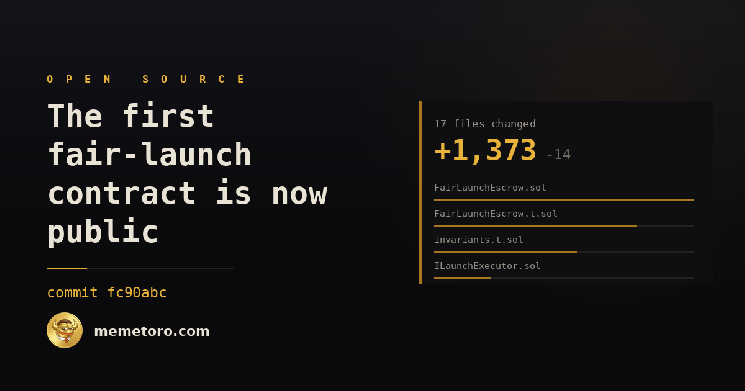
    MemeToro has published its first fair-launch contract draft, including FairLaunchEscrow.sol. The update added 1,373 lines across 17 files and includes tests, interfaces, and supporting documentation.

    The escrow is designed to lock round settings when a funding round is created. The current design has no owner, admin role, or upgrade path. Contributor funds are intended to go only toward refunds or the planned liquidity process.

    Important limits buyers should understand: the actual token executor, automated liquidity routing, manifest connection, BNB Chain testnet deployment, and independent security review remain unfinished.

    $MT is in Stage 7 at $0.00430 under the latest supplied project information. It is intended to support access, funding, staking, rewards, memecoin trading, and prediction markets.

    Key Takeaway

    The core principle is that AI crypto presales should not reward an agent for always saying yes. MemeToro’s model is designed to reject weak proposals before they reach a funding round, then place the surviving rules inside a public contract process.

    More Information on MemeToro ($MT) Presale

  • Zcash Price Prediction 2026: Can ZEC Reach $2,200 After 2,000% Rally as MemeToro Targets AI Crypto Growth?

    Zcash Price Prediction 2026: Can ZEC Reach $2,200 After 2,000% Rally as MemeToro Targets AI Crypto Growth?

    Zcash Surges 2,000% to Multi-Year High, Fueling 2026 Price Debate

    Zcash ($ZEC) has become a focal point for cryptocurrency traders after climbing thousands of percent over the past year to reach a multi-year high near $1,254. The rally has pushed the privacy-focused cryptocurrency’s market capitalization to approximately $20 billion and ignited intense debate around Zcash price predictions for 2026.

    Key Drivers Behind the $ZEC Rally

    The extraordinary performance stems from a convergence of institutional adoption and market mechanics:

    • Institutional ETF Access: The approval of the Grayscale Zcash Trust (ZCSH) on NYSE Arca created a regulated pathway for traditional investors to gain exposure to $ZEC.
    • Short-Squeeze Momentum: Forced covering of short positions amplified buying pressure as the price ascended rapidly.
    • Shift in Market Narrative: The conversation has moved from whether $ZEC could recover from a prolonged decline to whether it can sustain momentum after an explosive advance.

    Can $ZEC Reach $2,200 or Higher in 2026?

    Analysts are now modeling scenarios that see $ZEC targeting $2,200, with some discussing a potential $2,500 objective by year-end 2026. Achieving these levels would require:

    • Sustained institutional demand through the ZCSH vehicle
    • Supportive broader cryptocurrency market conditions
    • Continued risk appetite among digital asset investors

    A move from the current $1,254 area to $2,200 represents an additional 75% gain, while $2,500 would require roughly a 100% increase from recent highs. However, rapid rallies often trigger profit-taking, and sentiment shifts can precipitate sharp corrections. The 2026 outlook is best viewed through probability-based scenarios rather than fixed price targets.

    Institutional Demand as a Structural Catalyst

    The ZCSH ETF represents more than a short-term catalyst—it structurally broadens the investor base beyond crypto-native participants. This development arrived concurrently with short-seller distress, creating a feedback loop that propelled $ZEC above $1,200.

    Market observers emphasize that the Zcash price prediction for 2026 hinges on whether ETF-driven demand persists after initial excitement subsides. Liquidity conditions, macroeconomic sentiment, and sustained inflows will determine if the rally has staying power.

    MemeToro Pursues AI Crypto Infrastructure on BNB Chain

    While Zcash captures attention through price action, MemeToro is advancing a fundamentally different strategy: building open-source infrastructure for AI-driven memecoin launches on BNB Chain.

    Stage 7 Presale and Transparent Launch Mechanics

    The project has progressed to Stage 7 of its presale, reporting over $121,171 raised according to its latest update. A core technical component is the FairLaunchEscrow Solidity contract, which is open-source and designed with zero insider allocation to prevent hidden developer distributions and support transparent community token launches.

    AI Agent Scripts and Ecosystem Development

    MemeToro is also developing open-source AI agent scripts as part of its broader vision for AI-powered memecoin deployment. This positions the project at the intersection of two dominant crypto narratives: artificial intelligence and community-driven token launches.

    Two Distinct Market Narratives

    The contrast is clear: Zcash is riding a mature asset’s explosive re-rating driven by institutional access and short-covering dynamics, while MemeToro is attempting to establish foundational infrastructure for a nascent AI-crypto niche. Both reflect shifting capital flows and narrative evolution within digital asset markets.

    MemeToro ($MT) Presale Resources

  • MemeToro’s Agent Develops Fair Launch Protocol to Improve Memecoin Investing on BNB Chain in 2026

    MemeToro’s Agent Develops Fair Launch Protocol to Improve Memecoin Investing on BNB Chain in 2026

    Why Fair Launches Matter on BNB Chain

    BNB Chain has emerged as a highly active environment for new token and memecoin launches. The network’s low transaction costs and high speed lower the barrier to entry for creators and traders alike, but these same characteristics can expose retail investors to opaque launch mechanics and hidden insider advantages.

    A fair-launch model addresses this by codifying the rules of a token launch before buyers participate. The objective is to eliminate scenarios where insiders receive undisclosed allocations or where launch parameters can be altered without community knowledge. MemeToro’s approach replaces verbal promises with programmed rules enforced by smart contracts. Its new architecture incorporates an escrow mechanism designed to hold launch funds strictly under predefined conditions.

    The project states its system aims for zero insider allocation. In practical terms, the goal is to prevent a hidden group of insiders from securing a preferential token allocation before public participants. For BNB Chain traders, this structure makes launch conditions significantly easier to audit and verify.

    How the MemeToro AI Agent Fits Into the Process

    The fair-launch protocol operates as a core component of MemeToro’s broader AI Memecoin Agent. The agent is engineered around the end-to-end lifecycle of memecoin creation and launch, combining automated software tooling with immutable blockchain-based rules.

    The latest development update discloses 1,373 additional lines of open-source code. This work encompasses the fair-launch contract, the funding escrow module, and a comprehensive test suite. A critical architectural distinction is that the AI agent is not positioned as a substitute for blockchain-layer security. Rather, software automation handles operational aspects of the launch process while smart contracts enforce the defined ruleset.

    MemeToro says the new fair-launch contract has no owner, admin role, or upgrade path. This design choice is intended to remove the capacity for any single party to modify critical launch parameters post-deployment. However, the current implementation remains a development draft. It requires independent security review and mainnet deployment before traders should consider it production-ready infrastructure.

    How Programmatic Rules Could Improve Investor Trust

    Memecoin investing presents acute information asymmetry for newer traders. Launch decisions—token distribution, team allocations, liquidity handling—are frequently controlled opaquely by project teams. A buyer often cannot verify who holds tokens, whether allocations are mutable, or how funds are managed during the launch event.

    Programmatic rules encoded into smart contracts mitigate this opacity by making system behavior inspectable and verifiable. MemeToro’s model is built on five transparency pillars:

    • Public source code
    • Defined launch conditions
    • Funding escrow
    • No stated insider allocation
    • Automated enforcement

    This framework does not eliminate all risk. Smart contracts may contain vulnerabilities, and even well-designed systems remain subject to post-launch market dynamics. Consequently, the next development phase is critical: an independent audit must examine the production contract before users commit real capital.

    What the Latest Memecoin News Means for Traders

    The prevailing narrative in memecoin news is shifting from pure hype toward infrastructure development. MemeToro’s progress illustrates a targeted attempt to solve a specific structural problem: how to make new token launches more intelligible and trustworthy for retail participants.

    The 1,373-line code milestone provides tangible, measurable evidence of development velocity. Yet code volume alone is not a safety guarantee. Traders must continue to perform due diligence on contract addresses, liquidity depth, token distribution metrics, audit status, and prevailing market conditions before participating in any new memecoin launch.

    If MemeToro successfully transitions the fair-launch protocol from public repository to audited production infrastructure, it could establish itself as a significant primitive in the BNB Chain launch ecosystem. For now, its strongest signal is not a price projection, but the demonstrable effort to encode launch rules into visible, testable, and verifiable software.

    Frequently Asked Questions

    What is MemeToro’s fair-launch protocol?

    It is a planned system that uses smart-contract rules and escrow to make token launches more transparent.

    Why is BNB Chain important?

    BNB Chain supports fast, lower-cost token activity, making it a major environment for memecoin launches.

    Is the new protocol already fully live?

    The latest information describes the new fair-launch code as a development draft that still needs independent review and deployment.

    More Information on MemeToro ($MT) Presale

  • Bitcoin Slips to $78,800 as BNB, DeFi Tokens Buck Selloff

    Bitcoin Slips to $78,800 as BNB, DeFi Tokens Buck Selloff

    Bitcoin Slips Below $79K as Macro Pressures Weigh; BNB Chain Tokens Lead Gainers

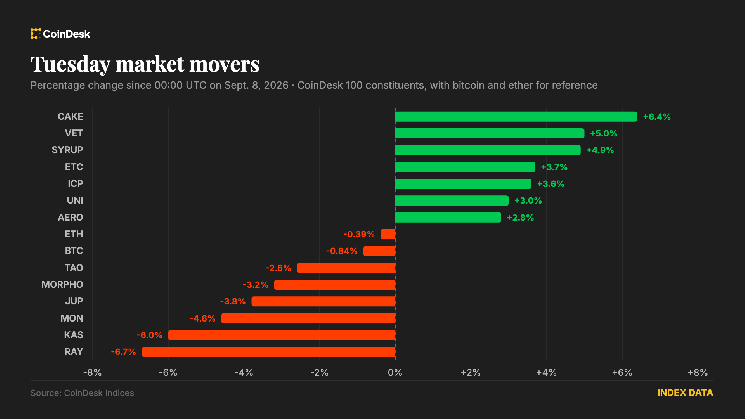
    Bitcoin (BTC) traded around $78,800 on Tuesday, down 0.42% since midnight UTC and 0.75% over the past 24 hours, according to CoinDesk data. The decline leaves the largest cryptocurrency 4.1% below the $82,320 resistance level it failed to breach last week. Ether (ETH) held relatively steady at $2,490, shedding just 0.02%, while Solana (SOL) dipped 0.06% to $103.77.

    Market Breadth Mixed as BNB Ecosystem Outperforms

    Among the 100 assets in the CoinDesk 100 Index, 42 traded in negative territory. BNB Chain tokens emerged as notable exceptions, with BNB rising 2% to $754 since midnight. Related assets CAKE (PancakeSwap) and SYRUP also advanced, benefiting from a rotation into the BNB Chain ecosystem.

    The CoinDesk 5 Index slipped 0.47%, while the broader CoinDesk 20 Index edged up 0.2%. The CoinDesk Memecoin Index outperformed with a 0.41% gain.

    Derivatives Signal Caution Amid Macro Headwinds

    Taker Flow Remains Bearish

    The buy-sell ratio of takers—traders who remove liquidity by executing at market prices—in crypto futures stayed bearish. Major tokens came under pressure from rising oil prices, speculation around Federal Reserve rate increases, and elevated bond yields.

    Open Interest Flat, Volume Rises 5%

    Twenty-four-hour open interest (OI) remained largely unchanged at $141 billion, but trading volume climbed 5% to $149.85 billion. The divergence suggests increased churn rather than fresh positional conviction, indicating traders are rotating capital without adding significant new leverage.

    Aerodrome’s AERO Leads Top-100 Gainers with 17% Surge

    Decentralized exchange Aerodrome Finance’s native token AERO surged 17% in 24 hours, topping the leaderboard among top-100 assets by market value. The rally coincided with a sharp rise in futures open interest to a record 129 million tokens, a combination that points to a buildup of long positions supporting the spot-price move.

    Positive CVD Confirms Aggressive Buying

    AERO’s bullish momentum is reinforced by a positive 24-hour open-interest-adjusted cumulative volume delta (CVD), signaling that buyers are executing market orders more aggressively than passive limit orders.

    Injective’s INJ Mirrors Bullish Futures Structure

    INJ, up 10%, displays a similar bullish futures setup, lending credibility to its spot-price breakout above $6—a level that has acted as a supply zone since mid-June, capping previous advances.

    Bitcoin Futures OI Rises Despite Price Drop

    Overall Bitcoin open interest remains below the 700,000 BTC mark, reflecting still-low appetite for leverage. However, open interest in major USDT- and USD-margined futures increased to 265,000 BTC from 257,000 BTC even as spot prices fell to $78,700 from $80,000. The uptick suggests some traders may have initiated short positions anticipating further downside.

    Bears Dominate Most Majors; AVAX, XLM, DOGE Show Strength

    Negative 24-hour cumulative volume deltas across most major tokens indicate bears are leading price action. Exceptions include Avalanche (AVAX), Stellar (XLM), and Dogecoin (DOGE), which posted positive CVDs.

    Volatility Indexes Calm; Deribit Options Lean Bullish Short-Term

    Bitcoin and ether volatility gauges remain near recent lows, signaling no scramble to buy options or hedge positions. On Deribit, weekly-expiry calls dominated 24-hour volume rankings for both BTC and ETH, reflecting short-term bullish expectations despite the broader bearish taker flow.

    Token Movers: CAKE, VET, SYRUP Lead; RAY, KAS, TAO Lag

    • PancakeSwap (CAKE): +4.9% since midnight UTC, +7.5% over 24 hours to $2.29, extending a rally driven by BNB Chain rotation and the exchange’s tokenized-stocks initiative.
    • VeChain (VET): +8% on the day, +9% over 24 hours to $0.00735.
    • SYRUP: +8% to $0.23, placing three DeFi and enterprise-chain names atop the gainers board while major assets sold off.
    • Raydium (RAY): -5.5% since midnight to $1.10, tracking Solana’s decline.
    • Kaspa (KAS): -4.7% to $0.034, unwinding most of a weekend surge that made it a top 24-hour gainer on Monday.
    • Bittensor (TAO): -1.5% on the day, -3.7% over 24 hours to $256, after leading the market on Sunday.
    • Aerodrome (AERO): +18% over 24 hours to $0.64, though momentum cooled to a 2.8% gain since midnight.
    • Jupiter (JUP): -3.8% to $0.24, a second consecutive heavy session following Monday’s 9% drop with no clear catalyst identified.
  • BNB Chain Captures 50% of Tokenized Equities: What’s Driving the Surge?

    BNB Chain Captures 50% of Tokenized Equities: What’s Driving the Surge?

    BNB Chain has emerged as the leading blockchain for tokenized equities after the launch of bStocks, overtaking Ethereum in total tokenized-equity supply. Before bStocks launched, Ethereum held the largest supply, while BNB Chain remained below $500 million despite months of gradual growth.

    Growth accelerated after June. By the end of August, BNB Chain’s tokenized-equity supply had surpassed $1.3 billion, compared with approximately $800 million on Ethereum. Solana also increased its tokenized-equity supply to around $550 million, while Avalanche remained near $170 million and smaller networks attracted only minimal amounts.

    According to BlockWorks data, BNB Chain now accounts for nearly 50% of the sector’s total supply, which stands at approximately $2.9 billion. In addition to providing greater liquidity, bStocks offers two advantages that traditional shares do not: 24/7 settlement and composability.

    bStocks drives BNB Chain’s tokenized-equity growth

    BNB Chain’s broader lead is largely concentrated in bStocks rather than being evenly distributed across the network’s tokenized-equity ecosystem.

    bStocks has accumulated more than $500 million in assets under management (AUM) since June and now supports more than 67 active assets, according to data from BNBChain.org.

    Trading volume has already exceeded $19 billion, indicating that the assets are actively circulating rather than simply remaining issued on-chain. On a narrower measure of tokenized equities and assets, bStocks typically represents more than half of the available tokenized-equity supply.

    Continued use of bStocks for new issuances and trading could further strengthen BNB Chain’s position as the leading decentralized exchange platform. However, a slowdown in bStocks activity would highlight the network’s reliance on the bStocks product family.

    BNB Chain’s broader RWA market share still trails Ethereum

    BNB Chain’s tokenized-equity lead becomes less dominant when viewed across the wider real-world asset (RWA) market. BNB Chain represents $5.7 billion of the $38.4 billion total distributed RWA market, giving it approximately 15% of the sector.

    Ethereum remains the largest RWA network, with $17.27 billion and an estimated 45% market share. Solana follows BNB Chain with $4.06 billion. As a result, BNB Chain’s leadership in tokenized equities has not yet translated into comparable dominance across the broader RWA market, according to RWA.xyz.

    BNB Chain continues to expand in tokenized equities, while Ethereum attracts capital across multiple asset classes. That broader diversification increases Ethereum’s overall liquidity and reduces its reliance on a single RWA segment.

    Expansion into Treasuries and funds could help BNB Chain diversify demand and retain more capital. Without that growth, a slowdown in tokenized-equity activity could limit BNB Chain’s ability to close Ethereum’s overall RWA lead.

    Key takeaway

    BNB Chain now leads the tokenized-equity market, largely because of bStocks’ rapid growth. Ethereum, however, continues to dominate the broader RWA market with an approximately 45% share.

  • Crypto Presale to Buy Now: MemeToro Tokenomics and AI Agent Shape the Best Memecoin Narrative for 2026

    Crypto Presale to Buy Now: MemeToro Tokenomics and AI Agent Shape the Best Memecoin Narrative for 2026

    The 2026 crypto presale market is moving beyond simple meme branding as investors look for projects with clearer utility. MemeToro is positioning itself around that shift with an AI-powered launchpad on the $BNB Chain, focused on token creation, automated security screening, and AI-driven market ideas.

    MemeToro has reached Stage 6 of its presale, with $MT priced at $0.00350 and fundraising approaching $100,000. For investors searching for a crypto presale to buy now, the project combines the attention of the memecoin market with an infrastructure-focused approach.

    MemeToro Tokenomics and Stage 6 Presale Progress

    MemeToro’s current presale structure places $MT at a baseline price of $0.00350 during Stage 6. The project is nearing the $100,000 fundraising milestone, giving investors a clear indication of its current presale progress.

    The $MT token is designed to support the broader MemeToro ecosystem rather than function solely as a social meme asset. Its utility is connected to a platform focused on AI-assisted memecoin creation and launch infrastructure.

    Tokenomics are an important consideration for investors evaluating a crypto presale because they show how a token connects to the underlying product. MemeToro links $MT to an ecosystem designed to launch and evaluate new meme assets, giving the project a more defined utility narrative than a token based only on community speculation.

    This approach also places MemeToro within the growing AI crypto presale sector, where blockchain projects are combining artificial intelligence with automated tools and infrastructure.

    AI Agent Supports Memecoin Creation

    MemeToro’s AI agent is designed to identify market trends and transform those signals into new token concepts. Rather than relying entirely on developers to manually spot trends, the platform aims to automate parts of the creative and analytical process.

    This could make memecoin creation more systematic. The AI model can assist with concept generation, while the launchpad provides the infrastructure required to move an idea toward deployment.

    MemeToro also includes an automated security scanner designed to detect developer backdoors and honeypot-style mechanisms before tokens are deployed. The platform’s broader presale narrative is built around:

    • AI-assisted token creation
    • Automated security screening
    • $BNB Chain infrastructure
    • Ecosystem-focused $MT utility

    For readers following crypto presale news, the project reflects the growing connection between artificial intelligence and blockchain automation. MemeToro applies that trend to the memecoin market. A video is also available for people who prefer a visual overview of the MemeToro ecosystem.

    Combining AI Infrastructure with the Meme Coin Market

    Meme coins have traditionally relied on speed, community attention, and cultural relevance. AI may help make the process of identifying trends and developing new concepts faster and more structured.

    MemeToro is built around that intersection. Its stated objective is not simply to launch another meme token, but to create an environment where AI can help generate and screen future memecoin projects.

    This positioning gives MemeToro relevance among investors researching the best crypto presale opportunities in 2026. It also places the project alongside DeFi presale initiatives and other utility-focused blockchain launches.

    The Stage 6 milestone adds to the project’s current presale narrative. With $MT priced at $0.00350 and fundraising approaching $100,000, MemeToro is progressing through its presale while developing its underlying launchpad.

    For anyone researching the latest crypto presale market, MemeToro represents a combination of early-stage token exposure and an AI-focused infrastructure narrative.

    More Information on the MemeToro ($MT) Presale

    Source: cryptonews.net

  • MemeToro vs AlphaPepe Tokenomics Compared: Top 2026 Crypto Presales

    MemeToro vs AlphaPepe Tokenomics Compared: Top 2026 Crypto Presales

    MemeToro vs. AlphaPepe: Comparing Two 2026 Crypto Presale Contenders

    Two projects are drawing attention in the 2026 crypto presale landscape: MemeToro and AlphaPepe. While both operate in the memecoin presale category, their strategies, progress, and utility narratives differ significantly. MemeToro has reached Stage 6 at $0.00350 and is approaching $100,000 raised, whereas AlphaPepe has advanced to Stage 20 with more than $2.5 million raised from over 11,100 unique wallet holders.

    Understanding their tokenomics and utility models helps clarify why investors are tracking both as potential best crypto presale opportunities for 2026.

    MemeToro: AI-Powered Launch Infrastructure on BNB Chain

    MemeToro’s $MT token anchors an ecosystem built around AI-assisted memecoin creation and launch infrastructure. Currently in Stage 6 with a token price of $0.00350, the project’s fundraising is nearing $100,000.

    The project’s defining feature is its AI-powered launchpad on BNB Chain. The platform employs an AI agent to help identify trends and develop memecoin concepts, while an automated security scanner is designed to detect developer backdoors and honeypot-style mechanisms before deployment.

    This infrastructure focus gives MemeToro a clear utility narrative within the AI crypto presale category. Rather than relying solely on community hype, the project is building a product around the process of creating and evaluating new meme tokens. For investors comparing a crypto presale with established meme assets, that infrastructure focus is an important distinction. The $MT narrative is tied directly to the platform’s future ecosystem.

    Video overview of the MemeToro ecosystem

    AlphaPepe: Broad Ecosystem With Rewards, Rankings, and CEX Roadmap

    AlphaPepe has progressed considerably further through its fundraising cycle. The project has surpassed $2.5 million raised and attracted more than 11,100 unique wallet holders. Its Stage 20 presale is priced between $0.02789 and $0.02817, and a 48-hour Bonus Drop gives buyers an opportunity to unlock additional ALPE tokens.

    AlphaPepe’s ecosystem includes several features designed around user engagement and participation:

    • Rewards programs
    • Rankings and leaderboards
    • Referral incentives
    • Marketplace activity
    • Planned exchange partnerships

    Project updates highlight upcoming trading partnerships with centralized exchanges (CEXs) including Azbit and BiFinance. That gives AlphaPepe a strong listing and community-growth narrative alongside its presale momentum.

    Side-by-Side Comparison: MemeToro vs. AlphaPepe

    The clearest way to compare the projects is to examine what each is attempting to build. MemeToro positions itself around AI and launch infrastructure, while AlphaPepe builds an ecosystem around community activity, rewards, rankings, referrals, and exchange access.

    Metric MemeToro ($MT) AlphaPepe (ALPE)
    Presale Stage Stage 6 Stage 20
    Token Price $0.00350 $0.02789–$0.02817
    Funds Raised Approaching $100,000 Over $2.5 million
    Wallet Holders Not disclosed 11,100+
    Core Utility AI launchpad & security scanner Rewards, rankings, referrals, CEX roadmap
    Chain BNB Chain Not specified in source

    This comparison is useful for investors researching the latest crypto presale market. MemeToro offers exposure to an AI-powered BNB Chain launchpad, while AlphaPepe offers a broader community and rewards ecosystem with established presale momentum.

    Both fit into the expanding memecoin presale category, but their product narratives are distinct. MemeToro’s strongest differentiator is AI-driven infrastructure, while AlphaPepe’s strength lies in its established presale momentum and engagement-focused ecosystem.

    MemeToro ($MT) Presale Links

  • Top 5 Altcoins vs. Meme Coins in 2026: Where MemeToro Presale Fits in Crypto Portfolios

    Top 5 Altcoins vs. Meme Coins in 2026: Where MemeToro Presale Fits in Crypto Portfolios

    The 2026 cryptocurrency market is highlighting a distinct division between established altcoins and emerging meme-focused projects. While dominant networks like Bitcoin, Ethereum, Solana, $XRP, and Hyperliquid provide mature, foundational ecosystems, newer initiatives like MemeToro are capturing the attention of investors seeking early-stage growth potential.

    MemeToro enters this competitive landscape not merely as another speculative token, but as an AI-driven launchpad built on the $BNB Chain. The project’s native token, $MT, is currently in Stage 6 of its presale at a price of $0.00350, as it rapidly approaches a key $100,000 fundraising milestone.

    For strategic investors weighing the options between utility altcoins and speculative meme assets, the primary goal is not just identifying which token will pump first. Instead, it is about understanding how these diverse digital assets can complement one another within a balanced, diversified crypto portfolio.

    The Evolving Dynamics of Altcoins and Meme Coins

    In the current market environment, altcoins and meme coins serve fundamentally different purposes:

    • Altcoins sustain their value through robust blockchain infrastructure, decentralized applications (dApps), deep liquidity, and active developer ecosystems. Ethereum remains the premier smart-contract standard, while Solana dominates fast, low-cost decentralized finance (DeFi) and tokenization. Meanwhile, $XRP continues to lead cross-border payment narratives, and Hyperliquid secures its position through decentralized perpetual trading.
    • Meme Coins thrive on community engagement, social media velocity, culture, and retail investor sentiment. While Dogecoin (DOGE) stands as the gold standard of established meme assets, newer projects offer higher volatility and rapid growth potential when market focus shifts.

    To construct a resilient portfolio, market participants often categorize their holdings into distinct tiers:

    • Ecosystem Exposure: Established Layer-1 and Layer-2 networks.
    • Market Participation: Large-cap liquid altcoins.
    • High-Growth Narratives: High-velocity meme coins.
    • Early-Stage Opportunities: Utility-driven presales.

    MemeToro positions itself at the intersection of these categories. Rather than relying solely on viral marketing, it pairs the excitement of the meme coin sector with a functional, AI-powered launchpad engineered to generate, deploy, and evaluate new tokens.

    The project highlights its onboarding experience and ecosystem design through interactive media, sharing a step-by-step video demonstrating how easy it is to participate in the MemeToro presale, alongside a deep dive into MemeToro Ecosystem Development.

    How MemeToro Integrates Utility into the Meme Coin Space

    MemeToro is built on the premise that token creation should involve more than just catchy branding and social media hype. Operating on the $BNB Chain, the platform utilizes advanced AI agents to monitor market trends, generate conceptual frameworks, and streamline the entire deployment pipeline.

    A standout utility feature of the platform is its integrated automated security scanner. This tool is designed to scan smart contracts for developer backdoors, honeypot risks, and malicious code before any token is launched. This proactive security focus provides a layer of trust and utility rarely seen in the speculative meme coin market.

    Currently priced at $0.00350 during its Stage 6 presale, the $MT token offers early participants a structured entry point. As the project nears its $100,000 funding milestone, its development roadmap continues to draw attention from those tracking the latest Web3 innovations.

    For investors monitoring the modern presale landscape, MemeToro successfully unifies three powerful market trends:

    • Artificial Intelligence: Leveraging AI for trend analysis and automated creation.
    • Meme Coin Infrastructure: Providing tools to make meme token launches safer and more accessible.
    • $BNB Chain Growth: Capitalizing on the scalability and liquidity of the Binance Smart Chain ecosystem.

    Strategizing Portfolio Allocation

    A well-rounded digital asset portfolio does not require an exclusive choice between high-utility altcoins and speculative meme assets. Diversification allows investors to capture upside across multiple sectors.

    While Ethereum and Solana provide essential infrastructure, $XRP facilitates global payments, and Hyperliquid powers decentralized trading, MemeToro offers niche exposure to automated, AI-driven token incubation. For those looking to participate in early-stage Web3 infrastructure, the MemeToro presale represents a unique entry point into the evolving AI-meme narrative.

    Learn More About the MemeToro ($MT) Presale:

  • Kalshi and Analysts Eye $2,800 ETH as MemeToro Presale Pushes to $100K

    Kalshi and Analysts Eye $2,800 ETH as MemeToro Presale Pushes to $100K

    The broader cryptocurrency market is experiencing a significant resurgence, with Ethereum leading the charge alongside Bitcoin’s upward momentum. While high-cap assets test critical resistance levels, decentralized finance (DeFi) developers are simultaneously targeting long-standing structural issues within the memecoin ecosystem—specifically the lack of transparency during token launches on the BNB Chain.

    Ethereum Tests Key Resistance Zone Around $2,500

    Following a strong weekly rally of more than 30%, Ethereum ($ETH) has climbed back into the $2,450 to $2,510 trading range after spending several months depressed below these levels. This recovery has been fueled by a combination of robust spot Ethereum ETF inflows, short liquidations, and a broader market rebound led by Bitcoin.

    Market analysts and Kalshi participants are closely monitoring the $2,550 to $2,600 zone, which represents a major technical resistance barrier. A successful breakout above this range could clear the path toward $2,800. Conversely, if Ethereum faces rejection at these current levels, traders expect the $2,300 to $2,400 region to serve as the primary support zone. The sustainability of this rally remains closely tied to macroeconomic factors, including upcoming inflation data and Federal Reserve monetary policy decisions.

    Addressing the Transparency Deficit in Memecoin Launches

    While major assets deal with macro-driven price volatility, the memecoin sector faces a different set of challenges. Historically, participating in new memecoin launches has carried high risk due to information asymmetry. Investors are often required to commit capital with minimal visibility into essential parameters such as token allocations, wallet limits, funding terms, and final distribution schedules.

    To address this issue, a new project called MemeToro is developing an AI-driven launchpad on the BNB Chain designed to standardize and open-source these critical launch conditions before any investor capital is committed.

    How MemeToro Integrates AI with Smart Contract Enforcement

    MemeToro’s proposed ecosystem aims to separate token discovery from contract execution. The platform’s development pipeline utilizes artificial intelligence to scan social media platforms like X (formerly Twitter) and global news outlets for market signals. The AI then compiles these insights, attaches verification links, and drafts a comprehensive “launch manifest” detailing the token’s parameters.

    To prevent bad actors from manipulating the launchpad, the AI system includes built-in verification protocols. The current development build is programmed to reject unverified sources, ticker collisions, and insider allocation attempts. Crucially, the AI is also designed with a refusal mechanism, allowing it to decline a token launch entirely if the underlying market signals appear manipulative, harmful, or unreliable.

    Once a launch proposal is validated by the AI, the terms are hardcoded into smart contracts. This structural division ensures that while the AI acts as the research and screening tool, immutable smart contracts handle the actual enforcement of the fair-launch rules.

    A Fair-Launch Model Without Insider Allocations

    MemeToro’s architecture is structured around a strict fair-launch model. The proposed design eliminates common pain points such as premines and hidden insider allocation tiers. Instead, the platform plans to utilize fixed-rate pricing structures and strict wallet purchase limits, with funding supported via BNB, select stablecoins, and the native MT token.

    It is important to note that these features are still in the development phase. MemeToro’s public repository states that its smart contracts are not yet audited, deployed on the mainnet, or ready to secure live funds. The project’s roadmap outlines a step-by-step rollout, starting with a deployment on the BNB Chain testnet, followed by an independent third-party security audit, and the integration of ERC-8004 standards for decentralized agent identity and reputation management.

    Two Parallel Dynamics Shaping the Crypto Market

    The cryptocurrency space is currently moving in two distinct directions. On one hand, mature assets like Ethereum are navigating liquidations, ETF dynamics, and macroeconomic resistance levels near $2,500. On the other hand, early-stage infrastructure projects like MemeToro are leveraging AI and smart contract automation to bring transparency and security to decentralized token launches.

    While MemeToro’s full technical architecture remains a work in progress, its public repository gives developers and market participants an early look at how AI might soon govern safer, contract-enforced token launches on the BNB Chain.

    For those interested in learning more about the project, watch this detailed video explaining the mechanics of the ecosystem:

    Watch the MemeToro Ecosystem Video on YouTube

    For more updates and details regarding the MemeToro ($MT) presale, visit the official channels: