Tag: Blockchain

  • Sui Network Launches AI Builder Lab to Empower Users

    Sui Network Launches AI Builder Lab to Empower Users

    Key Highlights

    • Sui Network launches AI Builder Lab with 15 hands-on sessions scheduled for October 7–8, open to participants without coding experience.
    • The initiative reflects Sui’s strategy to expand ecosystem engagement and lower barriers to AI agent development on its blockchain.
    • Industry observers note the program could drive broader user adoption and signal growing institutional interest in user-driven blockchain innovation.

    Sui Network Opens AI Builder Lab to Non-Technical Users

    Sui Network has officially announced the launch of its AI Builder Lab, a two-day interactive program designed to enable participants to create their own AI agents through guided, hands-on sessions. Scheduled for October 7–8, the lab features 15 dedicated workshops structured to be accessible to users regardless of programming background. According to the project’s official communications, the initiative underscores Sui’s commitment to fostering innovation and deepening user engagement across its Layer 1 blockchain ecosystem.

    Lowering Barriers to On-Chain AI Development

    The AI Builder Lab represents a deliberate strategic move by Sui to broaden participation in decentralized application development. By removing the requirement for coding expertise, the program targets a wider demographic including creators, entrepreneurs, and curious users who have previously been excluded from technical blockchain activities. Each session is structured to walk participants through the practical steps of conceptualizing, building, and deploying AI agents that can operate within the Sui environment, leveraging the network’s Move programming language and object-centric architecture.

    Ecosystem Growth and Institutional Signaling

    Market analysts suggest that initiatives like the AI Builder Lab serve a dual purpose: they stimulate grassroots innovation while also sending a signal to institutional stakeholders about the maturity and direction of the Sui ecosystem. As blockchain platforms compete for developer mindshare and user retention, programs that translate complex infrastructure into tangible, user-facing tools are increasingly viewed as leading indicators of long-term platform viability. The lab’s timing coincides with Sui’s ongoing efforts to position itself as a premier environment for decentralized applications requiring high throughput and low latency.

    Why This Matters

    The launch of the AI Builder Lab reflects a broader industry trend where blockchain protocols are investing heavily in application-layer accessibility to unlock network effects. By enabling non-technical users to build and deploy AI agents, Sui is experimenting with a model that could accelerate the emergence of novel use cases—ranging from automated trading strategies to personalized on-chain assistants—without relying solely on professional developer communities. If successful, this approach may influence how other Layer 1 networks structure their outreach and education programs, potentially reshaping the relationship between blockchain infrastructure and end-user creativity. Participants and observers alike will be watching closely to measure post-event activity, including new agent deployments, wallet activations, and any uptick in transaction volume attributable to lab graduates.

    Frequently Asked Questions

    When and how can I join the Sui AI Builder Lab?
    The AI Builder Lab runs on October 7–8 and consists of 15 hands-on sessions. Registration details and access links are available through Sui Network’s official channels, including their website and social media announcements.
    Do I need programming skills to participate?
    No. The program is explicitly designed to be accessible to users without coding experience, with guided sessions that walk participants through building AI agents step by step.
    What is the strategic goal behind this initiative?
    Sui aims to expand ecosystem engagement, lower barriers to AI and blockchain integration, and stimulate user-driven innovation that could attract both retail participants and institutional interest over time.
  • Binance Announces Support for Altcoin Network Upgrade

    Binance Announces Support for Altcoin Network Upgrade

    Key Highlights

    • Binance will suspend LUNA deposits and withdrawals on September 21, 2026, at approximately 5:00 PM UTC to support the Terra network upgrade at block height 22,942,000.
    • Spot trading and other market transactions for Terra-based tokens will remain fully operational during the upgrade window.
    • Binance will manage all technical requirements on behalf of users; deposits and withdrawals will resume automatically once the network is confirmed stable, with no separate announcement planned.

    Binance Prepares for Terra Network Upgrade with Temporary Transfer Pause

    Global cryptocurrency exchange Binance has confirmed its support for an upcoming network upgrade on the Terra (LUNA) blockchain, implementing a temporary suspension of deposit and withdrawal services to ensure the transition proceeds securely for its user base. The move aligns with standard industry practice for major blockchain protocol upgrades, where centralized exchanges pause on-chain transfers to mitigate risks such as transaction failures, chain splits, or replay attacks during the migration.

    Upgrade Timeline and Operational Impact

    According to the official announcement, deposit and withdrawal operations via the Terra network are scheduled to be halted on September 21, 2026, at approximately 5:00 PM UTC. The Terra network upgrade itself is expected to activate roughly one hour later, at block height 22,942,000, at approximately 6:00 PM UTC. This buffer allows Binance to finalize internal node updates and validate network stability before the protocol change takes effect.

    Critically, the suspension applies exclusively to on-chain deposit and withdrawal transactions. The exchange emphasized that spot trading and all other market operations for Terra-based tokens will continue without interruption. Users retain full ability to buy, sell, and trade LUNA and associated assets on Binance markets throughout the upgrade period.

    User Experience and Technical Management

    Binance has stated that it will execute all necessary technical procedures on behalf of its customers, including node software updates and any required consensus participation. No action is required from users during this process. The exchange’s infrastructure team will monitor the upgrade in real time, validating block production, finality, and network health before re-enabling transfer services.

    The announcement did not specify a fixed resumption time for deposits and withdrawals. Instead, Binance indicated that services will be restored once the Terra network is assessed to be operating stably and securely following the upgrade’s completion. Notably, the exchange confirmed it will not issue a separate announcement regarding the reopening of these operations. Users are advised to monitor their account interfaces directly for the restoration of transfer functionality and to anticipate potential delays as the network settles.

    Why This Matters

    Network upgrades are pivotal events for proof-of-stake blockchains like Terra, often introducing protocol improvements, security patches, or governance changes. For exchanges, supporting these upgrades is a core operational responsibility that balances user asset safety with service continuity. Binance’s decision to pause only on-chain transfers—while keeping markets live—reflects a mature risk management approach: it prevents users from sending funds into a potentially unstable chain state while preserving liquidity and price discovery. The absence of a follow-up resumption announcement places the onus on users to verify service status proactively, a common practice among major exchanges during non-contentious upgrades. As Terra continues to evolve its ecosystem, seamless exchange support remains critical for maintaining token accessibility and investor confidence.

    Frequently Asked Questions

    Will I be able to trade LUNA on Binance during the upgrade?

    Yes. Binance confirmed that spot trading and all other market transactions for Terra network tokens will remain fully operational throughout the upgrade window. Only deposit and withdrawal functions via the Terra blockchain are temporarily suspended.

    Do I need to take any action with my LUNA holdings on Binance?

    No. Binance will handle all technical requirements for the network upgrade on behalf of users. No manual steps—such as token swaps, wallet migrations, or consensus participation—are required from account holders.

    How will I know when deposits and withdrawals are available again?

    Binance stated it will not publish a separate announcement for the resumption of transfer services. Users should monitor the deposit and withdrawal pages within their Binance accounts directly; functionality will be restored automatically once the exchange confirms the Terra network is stable and secure post-upgrade.

  • 30-Year Veteran Analyst: “This Trend Could Fuel Bitcoin in the Coming Period”

    30-Year Veteran Analyst: “This Trend Could Fuel Bitcoin in the Coming Period”

    Key Highlights

    • Macro investor Jordi Visser argues AI agents will drive Bitcoin adoption by requiring blockchain infrastructure for machine-to-machine transactions.
    • Visser predicts tokenization will unlock dormant assets as programmable collateral, creating a growth dynamic independent of traditional liquidity cycles.
    • The analyst identifies privacy-focused projects like Zcash and NEAR as early beneficiaries of the AI-agent economy.

    AI Agents Poised to Reshape Cryptocurrency Fundamentals, Says Macro Investor Jordi Visser

    Experienced macro investor Jordi Visser has articulated a thesis positioning artificial intelligence agents as a transformative catalyst for Bitcoin and the broader cryptocurrency market. In a detailed analysis, Visser contends that evaluating Bitcoin’s trajectory exclusively through conventional macroeconomic lenses—global liquidity, interest-rate regimes, or money-supply metrics—is becoming an increasingly incomplete framework. While acknowledging that Bitcoin’s price history shows strong correlation with liquidity conditions, he argues that the maturation of genuine cryptocurrency utility could decouple the asset class from traditional economic cycles.

    Blockchain as Essential Infrastructure for Machine-to-Machine Economies

    Central to Visser’s argument is the inevitability of advanced AI agents interacting directly with one another, a dynamic he asserts will require blockchain settlement rails. “Agents will interact with each other. Blockchain is necessary,” Visser stated, emphasizing that the proliferation of autonomous software actors is “extremely positive for the cryptocurrency sector.” He envisions these agents evolving from analytical tools into full-fledged economic participants capable of executing purchases, payments, reservations, and complex financial decisions. Digital wallets controlled by such agents, he predicts, could become critical infrastructure in the emerging machine-to-machine economy.

    Tokenization and Programmable Finance Unlock Dormant Capital

    Visser further argues that this shift will accelerate the tokenization of assets currently dormant within the traditional financial system, enabling them to serve as programmable collateral. He describes a mechanism distinct from legacy liquidity indicators, where automated, code-driven financial transactions become commonplace. This programmable layer, he suggests, could foster competition between corporate-owned AI agents and consumers’ personal agents over pricing, privacy protections, and transaction terms—creating novel use cases for privacy-centric crypto projects and decentralized finance applications.

    Why This Matters: The Convergence of AI and Crypto Economics

    Visser’s framework highlights a structural inflection point: as AI agents multiply, traditional employment and productivity metrics may lose relevance. He notes his own firm operates with fewer than 15 human employees while deploying nearly 100 digital AI agents, illustrating how current economic statistics struggle to capture this transformation. For Bitcoin specifically, Visser maintains a 30-year conviction horizon, viewing the convergence of AI autonomy and blockchain verification as a powerful拓展 of real-world cryptocurrency utility that could sustain value appreciation independent of fiat monetary cycles. The heightened September interest in privacy-oriented protocols such as Zcash and NEAR, he suggests, reflects early market recognition of this AI-agent privacy narrative.

    Frequently Asked Questions

    How does Jordi Visser believe AI agents will use blockchain technology?

    Visser argues that advanced AI agents will need to transact directly with each other—making purchases, payments, and financial decisions autonomously—and that blockchain provides the necessary trust-minimized settlement layer for these machine-to-machine interactions.

    What is the significance of tokenization in Visser’s thesis?

    Tokenization, according to Visser, will bring currently dormant assets into active economic circulation as programmable collateral, creating a new growth mechanism for crypto that operates independently of traditional liquidity indicators like interest rates or money supply.

    Which crypto projects does Visser associate with the AI-agent privacy trend?

    Visser specifically links increased September interest in Zcash and NEAR to the strengthening narrative around AI agents requiring privacy-preserving transaction infrastructure for commercial negotiations.

    This is not investment advice.

  • Iran-Linked Ripple XRP Study Reveals Surprising Facts as US-Iran War Escalates

    Iran-Linked Ripple XRP Study Reveals Surprising Facts as US-Iran War Escalates

    Escalating tensions between the United States and Iran have renewed interest in an Iran-backed study examining Ripple’s XRP for cross-border payments. The research has resurfaced as financial sanctions and disruptions to international money transfers dominate headlines, drawing fresh scrutiny to the digital asset’s potential utility in restricted financial corridors.

    Sanctions Pressure Highlights Alternative Payment Rails

    The recent conflict has thrust the mechanics of global value transfer into sharp focus. As traditional banking channels face restrictions, analysts and policymakers are revisiting technical assessments of blockchain-based settlement systems. The Iranian study, which evaluates XRP’s speed and cost efficiency for cross-border transactions, is being cited in discussions about circumventing financial blockades.

    XRP Gains Attention Amid Financial Uncertainty

    Market observers note that the geopolitical climate has turned heads toward XRP specifically. The asset’s design for institutional liquidity management and its existing partnerships with financial institutions position it as a frequently referenced case study in debates over the future of sanctioned economies’ access to global markets.

  • Illegal influence on sec? In addition to XRP, Ethereum should also be classified as securities

    Illegal influence on sec? In addition to XRP, Ethereum should also be classified as securities


    • Coinbase reveals internal discussions of the SEC about the security status of XRP and New York’s advance for ETH classification.
    • The developing attitude of the SEC for crypto regulation in the middle of the XRP and ETH debates generate uncertainty.

    Coinbase has published more than 10,000 documents that disclose the internal communication of the US Securities and Exchange Commission (SEC) with regard to the regulatory status of XRP and Ethereum (ETH). These documents received by inquiries about the Freedom of Information Act (FOIA) show the ongoing discussions about whether XRP should be classified as securities.

    They also revealed the pressure from the New York general prosecutor’s office to classify ETH as security. The disclosure throws a light on regulatory uncertainty in connection with digital assets in the United States.

    Internal SEC debate about the status of XRP

    One of the most important findings from the publication The Coinbase document is an internal SEC discussion about whether XRP can be classified as security. In 2021, the SEC officials examined whether XRP has the characteristics of a securities. An e-mail revealed an inquiry about possible risks for the XRP blockchain if Ripple, the company behind XRP, “went away or disappear.”

    This question arose as part of the ongoing legal dispute of the SEC with Ripple, which began in December 2020 when the SEC Ripple accused a non -registered securities offer.

    The documents show that the SEC has weighed the classification of XRP for years. The ongoing legal case that has attracted great attention in the crypto industry. These internal emails throw a light on the uncertainties with which the regulatory authorities are faced with the determination of the legal status of certain cryptocurrencies.

    New York Attorney General is committed to the classification of ETH as security

    The New York general prosecutor’s office has put pressure on the Sec as securities classifying ETH. This print came to light in a recently published document of Coinbase. In June 2023 demanded Shamiso maswawn, derHead of the investor Protection Bureau in the office of the New York General Prosecutor’s Attorney, the SEC to submit an Amicus letter in which he argues that ether is a securities. This application was part of the state’s procedure against Kucoin, which was accused of violating state securities and goods laws.

    Maswoswe said that the participation of the SEC in the case would have no direct influence on the result, but that a court ruling that ETH classifies as security would be a big cause for the efforts to protect investors. She wants this clarity.

    The SEC has not yet taken a fixed point of view on this matter. First of all, the authority indicated that ETH was probably a goods. Since then, however, she has not made any final statements.

    Further effects of the SEC approach for crypto regulation

    The authority has been trying to classify certain digital assets as securities for some time. But the crypto industry has opposed it and claims that these classifications are unclear and inconsistent. This has led to increased uncertainty in crypto regulation in the United States.

    As shown in our latest reporting, Gary Gensler pursued a more aggressive approach to crypto regulation during his term as a SEC chairman. However, the latest developments indicate a shift towards a more moderate and more flexible approach.

    This change is shown in the recent round table discussion of the SEC entitled “Between a Block and a Hard Place: Tailoring Regulation for Crypto Trading”, which took place in April 2025.

    In the meantime, the SEC recently dropped charges against large crypto companies such as Coinbase. This is followed by Ripple’s legal victory, which forced the Sec to rethink its unclear and inconsistent approach to crypto regulation.

    The Chief Legal Officer of Ripple, Stuart Alderoty, said that the SEC’s decision to drop the XRP case shows that the authority recognizes its failure to determine clear regulations. He believes that it is time for the SEC to go beyond the courtroom and work with the congress in order to create effective, permanent regulations.

    Ripple is progressing. The Hidden Roads takeover worth $ 1.25 billion has been completed and now focuses on the growth of the company and the cooperation with the regulatory authorities in order to create a clear regulatory framework for the industry.

  • Trump-Coin: May 22nd brings the mega bullrun or mega crash

    Trump-Coin: May 22nd brings the mega bullrun or mega crash


    • The Trump coin can trigger a massive run on May 22nd after Trump’s appearance-or a massive sale.
    • Despite the initial profits for the top walls, over 764,000 Trump token owners are now in the minus in view of the growing political counter reaction.

    The Trump coin is once again under intensive market observation. The course of the memoin is $ 11 and, after the recent turbulence, has settled down just above its sliding 50-day average of $ 10.50.

    As CNF reported, a gala dinner on May 22nd in the White House can determine the further path of the Memecoin for the top owners. Investors weigh the chance of a 10-fold rally against the risk of a crash.

    Gala hype heats speculations while critics express ethical concerns

    Trump-Coin rose to over $ 16 at the end of April after President Trump announced that the 220 largest investment in the White House would be invited to dinner. As CNF reported, this triggered a widespread Fomo and a short -term rally that later reversed. The announcement also caused criticism from Congress MPs.

    Senator Jon Ossoff accused the President that he sells “access” by binding coins to a high -ranking political event – a reproach that could have far -reaching consequences. Senator Elizabeth Warren also renewed her criticism of the Trump family’s participation in cryptocurrencies and aimed at her StableCoin project USD1 under World Liberty Financial.

    Despite the counter reaction, May 22nd is an appointment and turns out to be a critical date. Market observers suspect that media attention could trigger another rally if Trump is personally present or expresses itself politically. The Trump coin had already reached $ 70 in January, so a strong increase is theoretically possible when demand increases.

    Most owners have to accept losses

    The blockchain data show a familiar pattern in the cycles of the meme coins. Report According to only 58 Wallets have substantial profits with the Trump coin-in the millions. These wallets acquired the tokens at the market launch and sold them in the high phase. In contrast, over 764,000 wallets are now in the minus after buying during the rally.

    This discrepancy has caused a lot of trouble in the crypto community. The centralized nature of the project gives rise to great concern. CIC Digital LLC and Fight Fight Fight LLC – both connected to Trump – hold 80% of the offer, although the coins are closed for three years.

    Although Trump described himself as a “crypto president” and, together with Elon Musk and Vivek Ramaswamy, leads the new Doge (Department of Government Efficiency), the skepticism remains great.

    Volatility expected because both economic and political pressure work

    The Trump coin is also under general market pressure. As CNF reported, Trump announced a “earth -shattering” announcement to X, which fueled speculation that she could relate to cryptopolitics. However, others believe that they could be non -related national issues. The time of the announcement, shortly before dinner on May 22, contributes to helplessness.

    In the meantime, the dealers are waiting for economic signals. The upcoming meeting of the Federal Reserve could put new pressure on risk systems. Inflation worries and hesitant politics create an unfavorable environment for speculative crypto projects such as Trump.

    Analysts warn that the gala could become a “Sell the News” event. If Trump is not present or no important announcements are made, investors could rush out. The first coin launch in January showed how quickly the hype can subside. There is a lot at stake, because Trump’s assessment exceeds $ 31 billion in full dilution.

    As CNF reported, the “Trump” brand used to use digital assets-from NFTS, for example-but the political overlap of this coins canceled it from others. With 200 million tokens in circulation and an offer target of 1 billion over three years, market dynamics could change quickly.

  • Bitwise identifies three success factors for XRP as a long -term facility

    Bitwise identifies three success factors for XRP as a long -term facility


    • BitWise predicts that XRP can reach $ 29.30 by 2030, driven by transaction fees, token burning and RWA tokenization.
    • XRP depends on its function as a bridge currency, the clarity of US regulation and increasing international acceptance.

    The potential of XRP as a leading cryptocurrency depends on several factors, the tokenomics focused on the promise of value. A current one Message BitWise Asset Management identifies three main factor drivers for the long -term value of XRP. This includes transaction fees and burning, spam prevention and its role as a bridge currency. Each factor plays a key role for the growth potential of XRP.

    The company predicts that XRP could achieve a price of $ 29.30 by 2030, based on the acceptance of the assets, the growth of the tokenization market and the efficient blockchain structure. With a current price of $ 2.09, the forecast growth of an increase of over 850 %.

    Transaction fees and tokenburn

    On the XRP Ledger, transaction fees play a decisive role in the entire tokenomics of the system. Each transaction costs about 0.00001 XRP, which is permanently burned, which reduces the circumferential amount of token.

    In January 2025, around 13.46 million XRP was burned, which has dropped the circulating offer to almost 100 billion XRP. This property has a significant impact on the value of the token, especially with regard to the potentially growing turnover.

    BitWise assumes that with a 100-time increase in the transaction volume, 0.75 % of the XRP could be pulled out of circulation annually, which would lead to higher prices. This combustion mechanism could increase the value of XRP, since the demand for cross -border payments and tokenization increases.

    Spam protection and requirements for the account reserves

    Another important factor for the value of XRP is the basic reserve, which ensures that the network remains free of spam and the accounts are properly managed. To avoid disorders, each account in the XRP Ledger must keep at least 1 XRP as a basic reserve.

    This reserve is not a significant driver for the XRP stock in the system, but fulfills an important function to secure network integrity. With currently over 6 million active accounts, the total requirement of XRP for account management is relatively low and is less than 1% of the tokens as a whole.

    However, the reserve mechanism ensures the longevity and safety of the network, while its use increases and gives the XRP ecosystem an additional level of stability.

    Bridge currency and liquidity reserve

    According to Bitwise, the best application for XRP is use as a bridge currency in a growing global ecosystem. Due to the low transaction costs and the fast resolution times (3-5 seconds), XRP is perfect for cross-border payments.

    The token is particularly attractive for the tokenization of real assets such as bonds and real estate. As it is expected that the market for tokenization will be $ 10.9 trillion by 2030, Bitwise believes that XRP can take 1-2% of this market and reach $ 2.9 trillion.

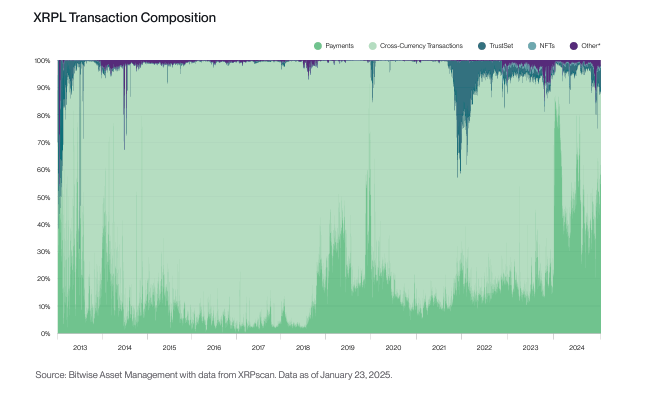
    XRPL Transaction Composition. Quelle: Bitwise

    The role of XRP as a bridge currency can be further strengthened with the advent of decentralized identity systems and multi-purpose token. These will make XRP more attractive for regulated financial institutions. The ability of XRP to serve as a liquidity reserve for a large ecosystem, especially for cross -border transactions, makes it an important player in the financial landscape. Bitwise also expects that the role of XRP in cross-border payment transactions, which McKinsey estimates at $ 150 trillion in 2022, will grow to $ 250 trillion by 2027.

    The regulatory uncertainty has disappeared with a crypto -friendly government in the United States. The SEC has dropped the lawsuit against Ripple, which strengthens the trust of investors. As CNF reported, the Defacto marks the end of cryptor regulation through compulsory measures at the end of the sec./.ripple process and replaces it with a legal rules.

    XRP forms a wedge on the chart, ready to break out 3 dollars. The course is $ 2.09 and has fallen by 3.74% in the last 24 hours. The increasing interest of institutions, the submission of XRP-ETF applications and the takeover of Hidden Road by Ripple worth $ 1.25 billion can be expected to have a good future for XRP.

  • VECHAINS LEDGER is not only a financial instrument but also mirror of global truths

    VECHAINS LEDGER is not only a financial instrument but also mirror of global truths


    • Vechain also defines the blockchain as an instrument that makes hidden supply chain and sustainability data visible.
    • Over 3.24 million actions were verified by the premium -controlled DAPPS of the Vebetterdao on the Chain.

    Vechain not only follows data – it makes it public. The blockchain not only stores history, but also triggers consequences. In a world that is damaged by marketing wear and opaque supply chains, the design of Veakain makes the invisible visible. Supporters say that Vechain promotes the acquisition of responsibility by revealing truths that hide other systems.

    Evidence of visible evidence of invisible effects

    In a number of articles on X, Vechain ambassador Sebastian_rok emphasized a growing global problem: visibility. According to him, modern civilization has not lost its data, but hides – deliberately.

    Carbon Ledger Sit often behind Paywalls. Complex supply chains hide the product origin. Some consider ESG reviews as fabricated stories, not as an accounting instrument.

    Sebastian called this a “visibility crisis”, not just a problem problem. He described Vechain as a mirror, not just as a major – one that reflects. In the articles it was argued that most platforms aim to build trust through curated stories, while Vechain shows the consequences instead. The question is no longer whether something was said, but whether it happened. The articles expressly say:

    “Vechain is not a trust. It makes reality visible again.”

    With this concept, the blockchain is not only a storage medium, but also a truth medium – reliable not because of faith, but due to visibility.

    Accountability by technology

    The benefits of Vechain lies in verification. Every step in a process – from origin to distribution – is recorded unchangeable. In Sebastian’s words: “Did it happen? Who touched it? Can it be fake?” The blockchain does not give any answers, it shows it. This transparency enables users to pursue the life cycle of a product and to check sustainability claims.

    As mentioned in our previous contribution, this reflects a broader shift in the role of blockchain – from the digital financial world to the verifiable reality. While other networks market hypothetical applications, delivers VeChain Functional tools that deal with real problems.

    Most blockchain networks are still based on speculation or undestected frameworks. In contrast, Vechain uses an established infrastructure to combine digital records with physical actions. This has applications in the areas of emission tracking, sustainable procurement and ethical production.

    The idea is to eliminate the puzzle rates. When the supply chain is recorded in the chain, the room for manipulations decreases. Sebastian compared this to a mirror that does not twist stories, but simply reflects them.

    Sustainability through decentralization

    As CNF reported, Vechain has created real benefits with four decentralized applications as part of the Vebetterdao system. These DAPPS reward customers with B3TR tokens for sustainable action.

    Instead of speculating or keeping tokens, the participants can earn tokens by performing dogs, recycling bottles or making environmentally friendly decisions. Each action is recorded transparently so that there is no green washing.

    Users can output B3TR tokens directly via the new Stella Pay Visa card, as described in our latest blog post. This enables the tokens, B3TR, VET and VTHO to be used in 130 million locations worldwide via the Visa network. The card is available for online orders, personal inquiries or digitally via Google Wallet and Apple Pay.

    The Cleanify Dapp was presented during a cleaning campaign in Miami Beach with 4ocean and the UFC Foundation. As CNF reports, this DAPP documents real environmental impacts in the chain, without central control.

    Vechain-Büchter Sebastian said the problem of Web3 was not the technology, but the relevance. According to Sebastian, billions have flowed into token projects, but the average citizen has no reference because there is no real application. He said Veakain solves this problem by rewarding purpose -oriented behavior.

    CNF has already reported that Vebetterdao users have logged over 3.24 million sustainable actions. This proves that the platform has passed from a narrative commitment to verifiable sustainability.

  • Ethereum news: Does a system simplification strengthen the trust of investors?

    Ethereum news: Does a system simplification strengthen the trust of investors?


    • Vitalik Buterin proposes Beam Chain and RISC-V to reduce the complexity of the Ethereum system protocol.
    • Despite ETF inflows and positive signals, ETH fights under $ 2,000 before the Pectra upgrade on May 7th.

    Ethereum is traded near $ 1,800 because investors are waiting for the Pectra upgrade on May 7th and Vitalik Buterins evaluate proposed protocol changes.

    Buterin has proposed to replace the Beacon Chain with Beam Chain and switch the EVM to RISC-V to reduce complexity.

    Redesign should reduce complexity

    In a recently published Blog post He wrote that the complexity of Ethereum leads to security and cost problems in the long term. He says the Bitcoin protocol is much easier:

    “Every clever high school student could understand it, and hobby programmers could easily create clients.”

    This is not the case with Ethereum’s execution layer, which the Ethereum Virtual Machine (EVM) uses. According to the butterin, this is because she is still optimized for outdated cryptographic operations. He wants to change that. He suggests taking over the RISC-V architecture, which could make the execution up to 100 times more efficient.

    That would have some problems with the downward compatibility, but he has a gradual approach in mind to migrate the consensus to a native RISC V environment. He also suggests replacing the Beacon Chain with the Beam Chain to simplify the peer-to-peer infrastructure.

    In this way, Ethereum, in his opinion, could reduce the development costs, minimize the risk of errors and achieve a stronger participation of the community in protocol development. He believes that this could happen with some coordinated upgrades within five years.

    Technical charts show uncertainty – ETH tests support zones

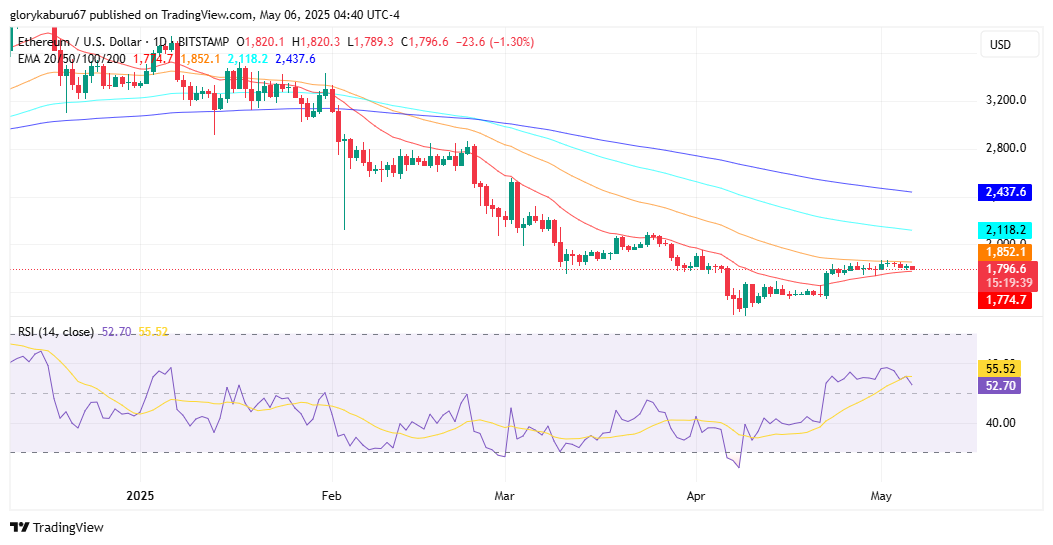
    According to Buterin’s blog post, the price of Ethereum fell 1 % and is currently traded at $ 1,803.51. ETH has not managed to rise over the 9-week exponential moving average (EMA) since January. Ethereum printed a Doji candle last week, which reflects the uncertainty between buyers and sellers. A rejection of the EMA level indicates a declining upward moment.

    ETH/USD Daily Chart.quelle: Tradingview

    According to the youngest CNF-Analyse ETH shows a tight Bollinger band squeeze at the ETH/BTC couple, which was last observed in June 2020. Such a squeeze usually precedes a volatility outbreak.

    On the downward side, support levels must be observed at $ 1,785, $ 1,750 and $ 1,685. The resistance is $ 1,830 and $ 1,880, a further increase is limited at $ 1,920. The technical indicators show the MACD on the daily chart in the declining area and the RSI under the 50 mark, which indicates continuing pressure.

    The ETH liquidations of the last 24 hours amounted to $ 44.45 million, with $ 35.71 million in long positions. The futures data of Coinglass show the continued restraint of the dealers. The current range between $ 1,749 and $ 1,855 indicates a low pressure to buy.

    Institutional demand speaks for a positive outlook

    Sea Socal recorded US spot ETFs for Ethereum last week net inflows of $ 106.75 million. This is the second week in a row with positive tributaries and reflects the traditional interest of investors despite the recent price stagnation.

    As CNF reported, the historical performance speaks for a bullish May. Since 2016, ETH has increased an average of 27.36 % in May, and 24.65 % last year. Technical analysts indicate that the relative strength index (RSI) has once again tested a multi-level level of support, a pattern that preceded earlier relaxation.

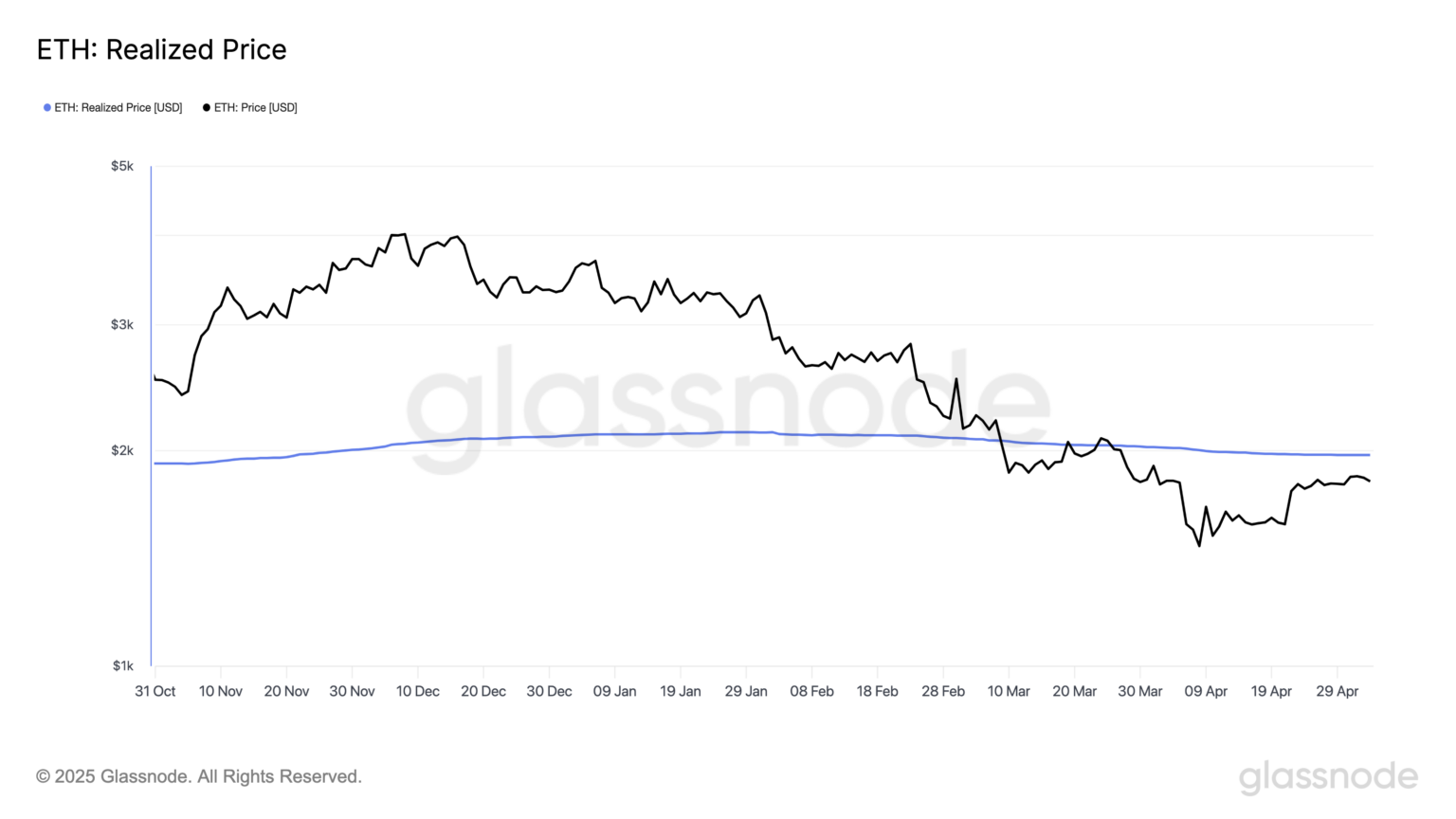
    In the meantime, Ethereum continues to act under his on-chain Realized Price of $ 1,972. This level, as from Glass node defined, the average cost basis for ETH represents in circulation. Remaining under this brand signals a weak upward dynamics and underlines the bearish mood.

    Ethereum-realized-price. Quelle. Coinglass

    The Pectra upgrade, which is planned for May 7th, aims to increase the ETH operating limits from 32 to 2,048 per validator. In addition, the number of “Blob” data units per block is increased and the transition to the EVM object format (EOF) is carried out. These changes aim at improved scalability, lower Layer 2 costs and improved Smart Contract efficiency.

    Despite these upgrades and institutional interest, Ethereum has not yet recaptured the psychological brand of $ 2,000. An outbreak of $ 1,880 could trigger a movement towards $ 2,050. Until then, the market remains careful in the run-up to the Pectra introduction.

  • VECHAINS LEDGER is not only a financial instrument but also mirror of global truths

    VECHAINS LEDGER is not only a financial instrument but also mirror of global truths


    • Vechain also defines the blockchain as an instrument that makes hidden supply chain and sustainability data visible.
    • Over 3.24 million actions were verified by the premium -controlled DAPPS of the Vebetterdao on the Chain.

    Vechain not only follows data – it makes it public. The blockchain not only stores history, but also triggers consequences. In a world that is damaged by marketing wear and opaque supply chains, the design of Veakain makes the invisible visible. Supporters say that Vechain promotes the acquisition of responsibility by revealing truths that hide other systems.

    Evidence of visible evidence of invisible effects

    In a number of articles on X, Vechain ambassador Sebastian_rok emphasized a growing global problem: visibility. According to him, modern civilization has not lost its data, but hides – deliberately.

    Carbon Ledger Sit often behind Paywalls. Complex supply chains hide the product origin. Some consider ESG reviews as fabricated stories, not as an accounting instrument.

    Sebastian called this a “visibility crisis”, not just a problem problem. He described Vechain as a mirror, not just as a major – one that reflects. In the articles it was argued that most platforms aim to build trust through curated stories, while Vechain shows the consequences instead. The question is no longer whether something was said, but whether it happened. The articles expressly say:

    “Vechain is not a trust. It makes reality visible again.”

    With this concept, the blockchain is not only a storage medium, but also a truth medium – reliable not because of faith, but due to visibility.

    Accountability by technology

    The benefits of Vechain lies in verification. Every step in a process – from origin to distribution – is recorded unchangeable. In Sebastian’s words: “Did it happen? Who touched it? Can it be fake?” The blockchain does not give any answers, it shows it. This transparency enables users to pursue the life cycle of a product and to check sustainability claims.

    As mentioned in our previous contribution, this reflects a broader shift in the role of blockchain – from the digital financial world to the verifiable reality. While other networks market hypothetical applications, delivers VeChain Functional tools that deal with real problems.

    Most blockchain networks are still based on speculation or undestected frameworks. In contrast, Vechain uses an established infrastructure to combine digital records with physical actions. This has applications in the areas of emission tracking, sustainable procurement and ethical production.

    The idea is to eliminate the puzzle rates. When the supply chain is recorded in the chain, the room for manipulations decreases. Sebastian compared this to a mirror that does not twist stories, but simply reflects them.

    Sustainability through decentralization

    As CNF reported, Vechain has created real benefits with four decentralized applications as part of the Vebetterdao system. These DAPPS reward customers with B3TR tokens for sustainable action.

    Instead of speculating or keeping tokens, the participants can earn tokens by performing dogs, recycling bottles or making environmentally friendly decisions. Each action is recorded transparently so that there is no green washing.

    Users can output B3TR tokens directly via the new Stella Pay Visa card, as described in our latest blog post. This enables the tokens, B3TR, VET and VTHO to be used in 130 million locations worldwide via the Visa network. The card is available for online orders, personal inquiries or digitally via Google Wallet and Apple Pay.

    The Cleanify Dapp was presented during a cleaning campaign in Miami Beach with 4ocean and the UFC Foundation. As CNF reports, this DAPP documents real environmental impacts in the chain, without central control.

    Vechain-Büchter Sebastian said the problem of Web3 was not the technology, but the relevance. According to Sebastian, billions have flowed into token projects, but the average citizen has no reference because there is no real application. He said Veakain solves this problem by rewarding purpose -oriented behavior.

    CNF has already reported that Vebetterdao users have logged over 3.24 million sustainable actions. This proves that the platform has passed from a narrative commitment to verifiable sustainability.