Key Highlights
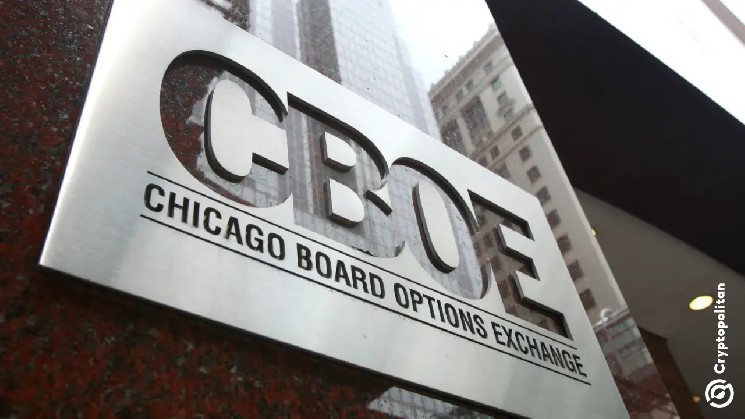
- Cboe and S&P Dow Jones Indices are exploring the next stage of tokenization through derivatives, including $SPX options.
- The SEC’s Sept. 17 Innovation Exemption covers certain tokenized NMS stocks but does not extend to tokenized options or other derivatives.
- Tokenized equities reached $4.43 billion by September 15, while Citi has projected a potential $5.5 trillion tokenized financial-asset market by 2030.
Cboe and S&P DJI target tokenized derivatives
Cboe CEO Craig Donohue said the extension will give the company “significant runway to pursue the next frontier of innovation.” The initiative with S&P Dow Jones Indices points toward applying blockchain-based tokenization to derivatives, potentially taking the technology beyond tokenized stocks, bonds and funds.
S&P DJI CEO Catherine Clay said both companies envision “a future where every investor, everywhere, can access this benchmark in the format that best suits their needs.” She added that Cboe’s knowledge of derivatives enables the companies to “keep innovating for the next generation of investors.”
Most tokenization projects to date have focused on creating blockchain-based versions of equities, bonds and investment funds. Options could broaden the use case because institutions rely on them to hedge risk, obtain leverage and trade volatility. Moving derivatives onto blockchain infrastructure could therefore position tokenization as more than a method of representing property rights; it could also make it relevant to risk-management and market-structure processes.
Why tokenized options face a separate SEC pathway
The SEC’s Sept. 17 Innovation Exemption provides qualifying trading venues with temporary relief to trade tokenized NMS stocks through permissioned automated market makers and liquidity pools. The exemption, however, is limited to tokenized stocks. It does not cover $SPX options or tokenized derivatives of any kind.
As a result, any Cboe-S&P DJI product involving tokenized $SPX options would require a separate regulatory process. The distinction is significant because regulatory approval for tokenized equities would not automatically establish a framework for blockchain-based options or other derivatives.
Tokenized-equity market expands rapidly
The regulatory debate is unfolding as tokenized equities record rapid growth. According to Binance Research, tokenized equities had reached $4.43 billion as of September 15, representing a 390.4% year-on-year increase. Their Capital Activation Rate also rose from 1.95% to 7.54%.
Cryptopolitan reported that monthly trading volume for tokenized equities increased from $1 billion in January to $9 billion in July. The figures indicate rising activity in blockchain-based financial products, while also underscoring the need to determine whether the infrastructure supporting equities can accommodate the more complex requirements of options markets.
What global institutions are watching
Citi’s Tokenization 2030 report projected that the market for tokenized financial assets could reach $17 billion in April 2026. It also outlined a scenario in which the market grows to as much as $5.5 trillion by 2030, with U.S. Treasuries and equities expected to lead adoption.
Citi has said that improved technology will be necessary to reach that scale. Regulatory consistency, sufficient liquidity and systems capable of operating across platforms will also be required. Those challenges are likely to be just as important for tokenized options as the technical task of placing an options contract on a blockchain.
Why This Matters
The potential expansion from tokenized securities into tokenized derivatives would test whether blockchain infrastructure can support instruments used for hedging, leverage and volatility trading. The SEC’s current exemption provides a limited opening for tokenized NMS stocks, but the absence of coverage for $SPX options and other derivatives means that the Cboe-S&P DJI effort would face a distinct regulatory review.
The next stage of development will depend on more than market interest. The growth figures from Binance Research and Cryptopolitan show increasing activity in tokenized equities, while the forecasts from Citi highlight the scale of the opportunity. For tokenized options to develop, however, market participants will also need interoperable systems, dependable liquidity and a regulatory framework that addresses the risks of derivatives trading.
Frequently Asked Questions
What are Cboe and S&P DJI exploring?
Cboe and S&P DJI are pursuing an extension focused on innovation in tokenized financial products, including the potential application of blockchain technology to $SPX options and other derivatives.
Does the SEC’s Sept. 17 Innovation Exemption cover tokenized options?
No. The exemption provides temporary relief for qualifying venues trading tokenized NMS stocks through permissioned automated market makers and liquidity pools. It does not apply to $SPX options or other tokenized derivatives.
How large could the tokenization market become?
Citi’s Tokenization 2030 report projected a $17 billion market for tokenized financial assets in April 2026 and described a scenario in which the market could reach $5.5 trillion by 2030, led by U.S. Treasuries and equities.