Tag: BlackRock IBIT

  • Positive Trend Continues for US Spot Bitcoin and Ethereum ETFs, Latest Data Shows

    Positive Trend Continues for US Spot Bitcoin and Ethereum ETFs, Latest Data Shows

    Key Highlights

    • U.S. spot Bitcoin ETFs posted a sixth straight day of net inflows on September 24, totaling approximately $190.7 million, led by BlackRock’s IBIT with $162.6 million.
    • Spot Ether ETFs extended their winning streak to five consecutive sessions, attracting roughly $66.1 million in net inflows, with BlackRock’s ETHA ($26.8M) and Fidelity’s FETH ($21.5M) pacing the category.
    • While most Bitcoin funds saw inflows, WisdomTree’s BTCW recorded a $4 million net outflow, highlighting divergent investor preferences within the product lineup.

    Bitcoin ETF Momentum Extends to Six Sessions as BlackRock Dominates Flows

    U.S. spot Bitcoin exchange-traded funds maintained their upward trajectory on September 24, marking the sixth consecutive trading session of positive net capital inflows. According to data compiled by SoSoValue, the cohort of Bitcoin investment products attracted approximately $190.7 million in combined net inflows during the session. The momentum underscores sustained institutional and retail appetite for regulated Bitcoin exposure amid a constructive macro backdrop for digital assets.

    BlackRock’s iShares Bitcoin Trust (IBIT) continued to function as the primary conduit for new capital, capturing $162.6 million of the day’s total — representing roughly 85% of aggregate inflows across all spot Bitcoin ETFs. The fund’s dominance reflects its first-mover advantage, deep liquidity profile, and widespread adoption across advisory platforms. Trailing significantly behind, Fidelity’s Wise Origin Bitcoin Fund (FBTC) recorded $12.9 million in net subscriptions, while Morgan Stanley’s Bitcoin Trust (MSBT) added $10.2 million. Franklin Templeton’s Digital Holdings Trust (EZBC) and Bitwise’s Bitcoin ETF (BITB) rounded out the positive contributors with $4.9 million and $4.1 million, respectively.

    WisdomTree BTCW Bucks Trend With Modest Outflow

    Not every fund participated in the rally. WisdomTree’s Bitcoin Fund (BTCW) registered a net outflow of $4 million, the sole negative print among Bitcoin ETFs on the day. The divergence suggests investors are discriminating based on factors such as expense ratios, custodial arrangements, or distribution reach. Despite the single-fund redemption, the category’s overall net flow remained firmly in positive territory, reinforcing the broader accumulation narrative.

    Ether ETFs Build on Momentum With Fifth Straight Day of Inflows

    A parallel trend emerged in the spot Ether ETF complex, where net inflows reached approximately $66.1 million on September 24 — extending the positive streak to five consecutive trading sessions. BlackRock’s iShares Ethereum Trust (ETHA) led the category with $26.8 million in net creations, followed closely by Fidelity’s Ethereum Fund (FETH) at $21.5 million. Grayscale’s Mini Ethereum Trust (ETHE), the lower-fee successor to the firm’s legacy Grayscale Ethereum Trust, continued to attract capital with a $17.8 million net inflow, signaling successful migration of assets from its higher-cost predecessor.

    The synchronized inflows across both Bitcoin and Ether vehicles indicate broadening demand for diversified crypto exposure within traditional portfolio frameworks. Market participants note that the dual-asset momentum coincides with improved regulatory clarity, evolving institutional custody infrastructure, and growing advisor comfort with digital asset allocations.

    Why This Matters

    The six-day Bitcoin ETF inflow streak and five-day Ether ETF streak represent the longest sustained periods of simultaneous positive flows since the products launched earlier this year. This consistency suggests the initial post-launch volatility has given way to a more structural demand phase, where allocators treat spot crypto ETFs as core portfolio building blocks rather than tactical trades. BlackRock’s outsized share of flows across both asset classes highlights the asset manager’s distribution advantage and the trust advisors place in its brand. Meanwhile, Grayscale’s Mini ETHE success demonstrates that fee competition can recapture assets even from entrenched incumbents. Going forward, market observers will monitor whether inflows persist during periods of price consolidation or if they remain tightly correlated with bullish price action. The next inflection point may come from options approvals on spot ETFs, which could unlock additional institutional strategies and deepen liquidity.

    Frequently Asked Questions

    Which spot Bitcoin ETF attracted the most capital on September 24?

    BlackRock’s iShares Bitcoin Trust (IBIT) led all spot Bitcoin ETFs with a net inflow of $162.6 million on September 24, accounting for the vast majority of the category’s $190.7 million total.

    How many consecutive days of inflows have spot Ether ETFs recorded?

    Spot Ether ETFs posted net inflows for the fifth consecutive trading session on September 24, with total inflows of approximately $66.1 million on that day.

    Did any spot Bitcoin ETFs see outflows on September 24?

    Yes. WisdomTree’s Bitcoin Fund (BTCW) recorded a net outflow of $4 million, making it the only spot Bitcoin ETF with negative flows for the session.


  • ‘Only hedge funds, retail sold’ — Will BTC Sustain Rally as Bitcoin ETF Flows Turn Positive?

    ‘Only hedge funds, retail sold’ — Will BTC Sustain Rally as Bitcoin ETF Flows Turn Positive?

    Key Highlights

    • U.S. Spot Bitcoin ETFs recorded $2.65 billion in net inflows across five consecutive trading days, flipping year-to-date flows positive with $349 million, led by BlackRock commanding half of all demand.
    • Bitcoin surged to an eight-month high of $87,000 before retreating below $84,000 as 10-year Treasury yields climbed to 5.1% and CME FedWatch data priced a 64% probability of a Federal Reserve rate hike in October.
    • Galaxy Research data reveals cumulative ETF flows have recovered half of the $12 billion deficit since October 2023, though Bloomberg analyst James Seyffart identifies hedge funds and retail traders as the primary sellers over the past year.

    Five-Day Inflow Surge Turns YTD Flows Positive

    U.S. Spot Bitcoin exchange-traded funds extended a winning streak to five consecutive sessions, amassing $2.65 billion in net inflows and marking a decisive shift in market sentiment. According to Galaxy Research data, the complex attracted $1 billion on Monday alone, followed by $714 million on Tuesday and $346 million on Wednesday. The sustained demand lifted year-to-date flows into positive territory for the first time, registering a net $349 million inflow since January. The bullish wave propelled Bitcoin to an eight-month peak of $87,000, signaling renewed institutional conviction after months of sideways price action.

    BlackRock Leads Institutional Demand Amid Cumulative Flow Recovery

    BlackRock’s IBIT fund drove approximately half of the five-day inflow total, underscoring the asset manager’s dominant position in the Bitcoin ETF landscape. The recent surge has significantly repaired cumulative flow metrics that had deteriorated sharply since October 2023. Galaxy Research figures show cumulative flows had contracted by $12 billion, equivalent to 77,800 BTC, during the preceding drawdown. The current rebound has erased roughly half that deficit, with cumulative flows now down only 5.7% from inception highs, standing at approximately $55 billion in total assets despite the crypto winter.

    Bloomberg analyst James Seyffart noted that the recent traction could soon help the cumulative flows (aggregate demand since inception) turn positive too. Seyffart added that the outflows were mainly driven by hedge funds and retail. “By far, the biggest sellers of the ETFs over the last ~year were hedge funds and retail traders/investors.” This distinction highlights a structural shift: while speculative participants exited positions during the downturn, institutional allocators have maintained or expanded exposure, providing a more resilient demand base.

    Macro Headwinds: Bond Yields and Fed Rate Hike Fears

    Despite the ETF momentum, Bitcoin’s advance stalled mid-week as macroeconomic pressures intensified. The 10-year U.S. Treasury yield climbed to 5.1%, while oil prices ticked higher, reigniting inflation concerns across risk markets. Interest rate traders, per CME FedWatch data, priced a 64% probability of another Federal Reserve rate hike at the October meeting. This repricing dampened risk appetite and dragged Bitcoin from its $87,000 high to below $84,000, a decline of approximately 4% in short order.

    Historical precedent offers a nuanced perspective. In the past, U.S. Treasury intervention plans to control bond yields have been viewed as net inflationary and an overall boost to scarce assets such as BTC and gold. Whether that narrative will hold and drive BTC higher remains to be seen. For the rate hike fears, however, the asset typically remains muted before the Fed decision and tends to push higher afterwards. Market participants are closely monitoring whether the current ETF demand can withstand sustained bond market volatility.

    Technical Analysis: $82K Weekly Close as Key Confirmation Level

    From a technical standpoint, analyst Benjamin Cowen projected that the uptrend could only be confirmed if there is a weekly candlestick close above $82K (May peak). This level, corresponding to Bitcoin’s previous local high from May, serves as a critical structural reference point. A weekly close above this threshold would validate the breakout structure and suggest the recent ETF-driven rally has legs beyond short-term momentum. Conversely, failure to reclaim and hold $82,000 on a weekly basis could expose the asset to further consolidation or retest of lower support levels.

    Why This Matters

    The five-day inflow streak represents the most sustained institutional accumulation since the ETFs’ January launch, suggesting that the “crypto winter” narrative has fundamentally shifted for professional allocators. BlackRock’s outsized participation signals deepening integration of Bitcoin into traditional portfolio construction. However, the immediate price reversal underscores that Bitcoin remains acutely sensitive to Federal Reserve policy expectations and Treasury market dynamics. The interplay between ETF flow momentum—now structurally positive on a cumulative basis—and macro liquidity conditions will likely dictate Bitcoin’s trajectory through the fourth quarter. Investors should watch the October Fed meeting, weekly close above $82,000, and whether cumulative flows breach inception highs as key catalysts.

    Frequently Asked Questions

    How much have U.S. Spot Bitcoin ETFs accumulated in the recent five-day streak?

    The ETF complex recorded $2.65 billion in net inflows across five consecutive trading days, with $1 billion on Monday, $714 million on Tuesday, and $346 million on Wednesday, per Galaxy Research data.

    Who were the primary sellers during the previous outflow period?

    According to Bloomberg analyst James Seyffart, hedge funds and retail traders/investors were by far the biggest sellers of the ETFs over the last year, driving the $12 billion cumulative flow deficit since October 2023.

    What technical level must Bitcoin reclaim to confirm the uptrend?

    Analyst Benjamin Cowen projects that a weekly candlestick close above $82,000—the May peak—is required to confirm the uptrend structure following the recent ETF-driven rally.

  • BlackRock’s IBIT Attracts $1 Billion Inflows as Bitcoin Retreats From $87K

    BlackRock’s IBIT Attracts $1 Billion Inflows as Bitcoin Retreats From $87K

    Key Highlights

    • BlackRock’s iShares Bitcoin Trust (IBIT) recorded approximately $1.02 billion in net inflows across four consecutive trading sessions from September 17 to 22, capturing 44% of total U.S. spot Bitcoin ETF flows.
    • Total U.S. spot Bitcoin ETFs attracted $2.31 billion during the same period, signaling sustained institutional and retail appetite for regulated crypto exposure despite Bitcoin’s pullback from $87,283.
    • Bitcoin retreated to roughly $84,175 after testing intraday highs near $87,283, but remains above key moving averages with critical support at $80,000; a break below could see a retest of the $75,000–$76,000 demand zone.

    BlackRock’s IBIT Leads Record Inflow Streak as Bitcoin ETF Demand Surges

    BlackRock’s iShares Bitcoin Trust (IBIT) has cemented its dominance in the U.S. spot Bitcoin exchange-traded fund landscape, drawing just over $1.02 billion in net inflows across four straight trading sessions between September 17 and September 22, according to data compiled by Farside Investors. The flagship fund captured 44% of the $2.31 billion that flowed into all U.S. spot Bitcoin ETFs combined during the window, underscoring its status as the primary vehicle for institutional and retail investors seeking regulated exposure to the world’s largest cryptocurrency.

    Daily Flow Breakdown Reveals Accelerating Momentum

    The inflow trajectory showed notable acceleration as the week progressed. IBIT opened the streak with $183.7 million on September 17, followed by $108.4 million on September 18. Momentum then surged dramatically, with $381.4 million entering the fund on September 21 and a further $350.3 million on September 22. The combined four-day total of roughly $1.02 billion represents one of the strongest sustained inflow runs since the ETF suite launched in January 2024. Farside Investors emphasized that these figures reflect investor capital allocated to the fund for Bitcoin exposure, not direct Bitcoin purchases by BlackRock itself.

    Bitcoin Price Action Diverges from ETF Demand Strength

    The robust ETF buying occurred against a backdrop of fading Bitcoin price momentum. After rallying to an intraday peak near $87,283, Bitcoin reversed course and slipped to approximately $84,175, marking a 2.35% intraday decline at the time of reporting. Despite the pullback, the asset continues to trade above its major moving averages, preserving the broader uptrend structure that has been in place since the summer lows. Technical analysts are closely monitoring the $80,000 level, which previously acted as stiff resistance before flipping to support during the recent breakout.

    Key Technical Levels Frame Next Directional Move

    Market structure suggests two primary scenarios. If Bitcoin holds above the $80,000 support zone, the breakout remains intact, potentially setting the stage for a fresh assault on the $87,300 high and, upon a successful breach, opening a path toward the psychologically significant $90,000 threshold. Conversely, a decisive daily close below $80,000 would signal structural weakening and could trigger a deeper correction back toward the $75,000–$76,000 region where buying interest previously emerged. The current price action reflects short-term profit-taking rather than a fundamental shift in demand, with the persistent ETF inflows providing a potential floor for further downside.

    Why This Matters

    The divergence between record ETF inflows and Bitcoin’s price consolidation highlights a maturing market dynamic: regulated investment vehicles are increasingly absorbing supply and smoothing volatility, even as spot markets digest gains. IBIT’s outsized share of flows — nearly half of all U.S. spot Bitcoin ETF capital — reinforces BlackRock’s distribution advantage and the trust institutional allocators place in its custody and operational infrastructure. For the broader crypto ecosystem, sustained inflows at these levels suggest the 2024–2025 adoption cycle is being driven less by speculative retail frenzy and more by strategic portfolio allocation, a development that could support higher equilibrium pricing over the medium term. Upcoming macroeconomic catalysts, including Federal Reserve policy decisions and quarterly earnings from major financial institutions, will likely determine whether the current accumulation phase transitions into the next leg higher or extends into a broader consolidation.

    Frequently Asked Questions

    How much did BlackRock’s IBIT ETF attract in the latest four-day inflow streak?

    IBIT recorded approximately $1.02 billion in net inflows across the four trading sessions from September 17 to September 22, with daily amounts of $183.7 million, $108.4 million, $381.4 million, and $350.3 million, respectively.

    What percentage of total U.S. spot Bitcoin ETF flows did IBIT capture?

    IBIT accounted for 44% of the $2.31 billion that flowed into all U.S. spot Bitcoin ETFs combined during the same four-day period, reinforcing its position as the dominant fund in the category.

    What are the key price levels to watch for Bitcoin following the recent pullback?

    Immediate support sits at $80,000, a former resistance level that now underpins the breakout structure. A hold above this zone keeps a move toward $87,300 and $90,000 in play, while a break below could see Bitcoin retest the $75,000–$76,000 demand area.

  • Bitcoin, Ethereum Spot ETFs See Strong Net Inflows as BTC Rises

    Bitcoin, Ethereum Spot ETFs See Strong Net Inflows as BTC Rises

    Key Highlights

    • U.S. Bitcoin spot ETFs attracted a combined $999 million in net inflows on September 21, marking the third straight day of positive flows.
    • BlackRock’s IBIT led with $381 million in daily inflows, pushing its total historic net inflows past $64.5 billion; Ethereum ETFs added $270 million net, led by BlackRock’s ETHA at $110 million.
    • Total Bitcoin ETF assets reached $110.1 billion (6.3% of BTC market cap), while Ethereum ETF assets hit $17.8 billion (5.24% of ETH market cap), signaling sustained institutional adoption.

    Bitcoin ETFs Extend Inflow Streak to Three Days as IBIT Dominates

    U.S.-listed Bitcoin spot exchange-traded funds recorded a $999 million net inflow on September 21, according to data from SoSoValue, extending a streak of consecutive positive trading sessions to three days. The surge underscores renewed institutional appetite for regulated Bitcoin exposure amid a stabilizing macroeconomic backdrop and growing confidence in the ETF structure as a primary vehicle for digital-asset allocation.

    BlackRock’s iShares Bitcoin Trust (IBIT) again captured the lion’s share of new capital, drawing $381 million in a single session. That inflow lifts IBIT’s cumulative net inflows since its January inception to $64.506 billion, cementing its position as the dominant Bitcoin ETF by a wide margin. Trailing in second place, the Ark 21Shares Bitcoin ETF (ARKB) posted a $289 million daily net inflow, bringing its total historic inflows to $1.370 billion.

    Ethereum ETFs Join the Rally with $270 Million in Fresh Capital

    The positive momentum was not confined to Bitcoin. Ethereum spot ETFs logged a combined $270 million in net inflows on the same day, reflecting broadening demand across the major crypto-asset complex. BlackRock’s iShares Ethereum Trust (ETHA) paced the Ether fund cohort with a $110 million daily intake, pushing its cumulative net inflows to $13.067 billion since launch. Fidelity’s Ethereum Fund (FETH) followed with $72.958 million in new money, lifting its total to $2.320 billion.

    Aggregate Metrics Highlight Scale of Institutional Adoption

    Across the Bitcoin ETF complex, total net asset value now stands at $110.135 billion, representing 6.3% of Bitcoin’s total market capitalization. Since inception, the combined funds have amassed $56.160 billion in net inflows. On the Ethereum side, aggregate assets under management reached $17.817 billion, or 5.24% of Ether’s market cap, with cumulative net inflows of $13.520 billion. These ratios illustrate the growing footprint of regulated investment products within the broader crypto market structure.

    Why This Matters

    The third consecutive day of billion-dollar-scale inflows into Bitcoin ETFs—and the simultaneous strength in Ethereum funds—signals that institutional allocators are treating the current price environment as an accumulation zone rather than a distribution event. BlackRock’s overwhelming dominance in both the Bitcoin (IBIT) and Ethereum (ETHA) categories reinforces the asset manager’s role as the primary gateway for traditional finance entering digital assets. The rising asset-to-market-cap ratios (6.3% for BTC, 5.24% for ETH) suggest ETFs are becoming a structural source of demand that could dampen volatility and support price floors over time. Market participants will now watch whether the inflow streak extends into a fourth session and whether smaller issuers can begin to capture a larger share of new subscriptions.

    Frequently Asked Questions

    Which Bitcoin ETF saw the largest single-day inflow on September 21?

    BlackRock’s iShares Bitcoin Trust (IBIT) recorded the highest daily net inflow at $381 million.

    What is the total cumulative net inflow into U.S. Bitcoin spot ETFs since inception?

    As of September 21, the combined net inflow across all U.S. Bitcoin spot ETFs stands at $56.160 billion.

    How do Ethereum ETF assets compare to Ethereum’s total market capitalization?

    Ethereum spot ETFs hold $17.817 billion in net assets, representing 5.24% of Ether’s total market capitalization.

  • Spot Bitcoin ETFs Attract Nearly $1 Billion Monday, Marking 9th Largest Inflow Ever

    Spot Bitcoin ETFs Attract Nearly $1 Billion Monday, Marking 9th Largest Inflow Ever

    Key Highlights

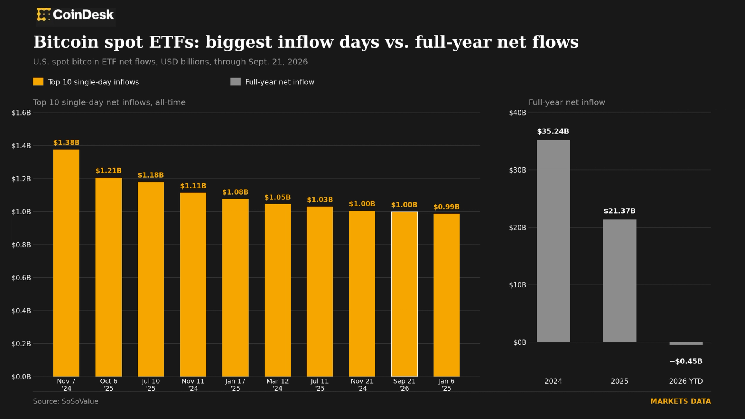
    • U.S. spot Bitcoin ETFs recorded a $998.95 million net inflow on Monday, the largest single-day haul since October 6, 2025, when Bitcoin traded near its all-time high of $126,200.
    • BlackRock’s IBIT led the surge with $381.37 million, followed by Ark’s ARKB ($289.12 million) and Fidelity’s FBTC ($238.84 million), marking the ninth-largest inflow day since the funds launched in January 2024.
    • The three-day winning streak lifts month-to-date inflows to $1.31 billion, extending August’s $3.52 billion pace and signaling sustained institutional conviction despite macroeconomic headwinds.

    Record-Breaking Inflow Signals Institutional Conviction

    U.S.-listed spot Bitcoin exchange-traded funds posted a staggering $998.95 million in net inflows on Monday, according to data from SoSoValue, marking the most significant single-day capital allocation since October 6, 2025. That date coincides with Bitcoin’s previous all-time high of approximately $126,200, a level the asset has yet to reclaim. Monday’s haul also ranks as the ninth-largest daily inflow since the ETF suite debuted on January 11, 2024, underscoring the magnitude of institutional appetite returning to the digital asset space.

    BlackRock, Ark, and Fidelity Lead the Charge

    The inflow was broad-based but heavily concentrated among the market’s dominant issuers. BlackRock’s iShares Bitcoin Trust (IBIT) captured $381.37 million, maintaining its position as the primary vehicle for institutional exposure. Ark Invest’s ARKB attracted $289.12 million, while Fidelity’s Wise Origin Bitcoin Fund (FBTC) drew $238.84 million. The combined strength across these three funds alone accounted for more than $900 million of the day’s total, reflecting a flight to liquidity and brand recognition among large allocators.

    Three-Day Streak Defies Legislative and Monetary Headwinds

    Monday’s print extends a three-day streak of positive flows—the first such run in two weeks—and arrives at a pivotal juncture. The cryptocurrency market recently absorbed a dual shock: a failed Senate cloture vote on the Clarity Act, which would have established a regulatory framework for digital assets, and a Federal Reserve interest-rate increase that typically pressures risk assets. Despite these headwinds, the persistent buying pressure suggests institutions are looking past near-term policy uncertainty and focusing on Bitcoin’s long-term portfolio role as a non-sovereign store of value.

    Monthly Momentum Builds on August’s Historic Pace

    The latest surge pushes month-to-date net inflows to $1.31 billion, building directly on August’s record-setting $3.52 billion tally. That two-month cumulative figure exceeds $4.8 billion, a pace that rivals the initial launch frenzy earlier this year. Analysts interpret the sustained flow data as evidence that allocators—ranging from registered investment advisors to hedge funds and corporate treasuries—are treating Bitcoin exposure as a strategic allocation rather than a tactical trade, even as fiscal debt concerns mount across advanced economies.

    Why This Matters

    The resilience of ETF flows amid legislative gridlock and restrictive monetary policy marks a maturation of the Bitcoin investment thesis. With the Clarity Act stalled, regulatory clarity remains elusive, yet capital continues to flow into the regulated ETF wrapper—a sign that institutions are comfortable navigating the current framework. The Fed’s rate hike cycle, while a traditional negative for non-yielding assets, has not deterred buyers, suggesting Bitcoin’s narrative as an inflation hedge and diversification tool is gaining traction in portfolio construction models. Upcoming catalysts include the next Federal Open Market Committee meeting, potential lame-duck session movement on crypto legislation, and the fourth-quarter rebalancing window that could amplify institutional positioning.

    Frequently Asked Questions

    Which Bitcoin ETFs saw the largest inflows on Monday?

    BlackRock’s IBIT led with $381.37 million, followed by Ark’s ARKB at $289.12 million and Fidelity’s FBTC at $238.84 million. These three funds accounted for the vast majority of the $998.95 million total net inflow.

    How does Monday’s inflow compare to historical levels?

    It was the largest single-day net inflow since October 6, 2025—the day Bitcoin hit its all-time high near $126,200—and ranks as the ninth-largest inflow day since the ETFs launched on January 11, 2024.

    What does the current flow trend suggest about institutional sentiment?

    The three-day winning streak and month-to-date total of $1.31 billion—following August’s $3.52 billion—indicate that institutions are maintaining conviction in Bitcoin despite the failed Clarity Act vote, a Fed rate hike, and broader fiscal debt concerns.

  • Bitcoin Bullish Phase Forms, but Overbought Conditions Signal Caution

    Bitcoin Bullish Phase Forms, but Overbought Conditions Signal Caution

    Key Highlights

    • CryptoQuant analysis indicates Bitcoin has exited extreme bubble-or-crash conditions and is gradually approaching a full-fledged bullish rally after a period of correction and consolidation.
    • JPMorgan reports institutional investors are more defensively positioned toward Bitcoin than gold, with heavy put-option activity around ETFs such as BlackRock’s IBIT creating potential for $1 trillion in hedge unwinding and short-covering pressure if prices rise.
    • Technical indicators flash mixed signals: Bitcoin trades near $78,241 with RSI in overbought territory and widening Bollinger Bands signaling elevated volatility, while macro headwinds including a Fed rate hike and stronger dollar cloud the Q4 outlook.

    Bitcoin Exits “Weakness Zone” as Cycle Structure Shifts

    The digital asset market is undergoing a notable sentiment shift in the second half of 2027. After failing to breach a long-standing resistance level during the first half of the year, Bitcoin ($BTC) appears to be transitioning toward a bullish phase, according to a recent analysis by on-chain analytics firm CryptoQuant. The firm’s bubble-versus-crash market structure indicator shows that the extreme conditions historically associated with either a speculative bubble or a severe crash have dissipated.

    Bitcoin has already navigated a period of correction and consolidation, yet it has not experienced the kind of extreme speculative mania that typically marks major cycle tops. This suggests the asset may still have room to enter a stronger upward trend. As CryptoQuant stated directly in its report:

    The full-fledged bullish rally has not yet begun. Currently, it is in the process of gradually approaching that stage.

    Institutional Positioning: Bitcoin vs. Gold Dynamics

    Adding weight to the constructive outlook, JPMorgan has highlighted a striking divergence in institutional positioning. The bank notes that investors are currently more defensively positioned toward Bitcoin than toward gold. This defensive stance manifests in elevated short interest and significant put-option activity around Bitcoin exchange-traded funds, most notably BlackRock’s IBIT.

    While gold ETFs have recovered more of their 2026 outflows, Bitcoin carries relatively heavier bearish hedging. However, JPMorgan emphasizes that this hedging does not necessarily reflect outright bearish conviction. Instead, it creates a coiled spring effect: if Bitcoin rallies, these protective hedges could be unwound rapidly, generating additional buying pressure. The potential market impact of such hedge unwinding and short covering is estimated to be worth approximately $1 trillion.

    Technical Crosscurrents: Overbought RSI Meets Expanding Volatility

    At press time, Bitcoin was changing hands at $78,240.79, representing a 2.5% gain over the preceding 24 hours. Despite the upward momentum, technical indicators are flashing caution. The Relative Strength Index (RSI) has entered overbought territory, a classic warning sign that bears may attempt to pull back the recent advance. Simultaneously, widening Bollinger Bands indicate that volatility is expanding significantly, suggesting the current price action may be unstable.

    These conflicting signals—bullish structure on-chain versus overbought momentum and rising volatility on the chart—create a tug-of-war that traders will need to navigate carefully in the near term.

    Macro Headwinds Complicate Q4 Outlook

    Further complicating the picture, a recent report from AMBCrypto projects a cautious outlook for the fourth quarter. The Federal Reserve’s 25 basis-point rate hike, rising Treasury yields, and a strengthening U.S. dollar are converging to threaten global liquidity and risk-asset appetite. These macroeconomic forces could act as a ceiling on Bitcoin’s upside, even as on-chain fundamentals and institutional positioning improve.

    Why This Matters

    The convergence of improving on-chain market structure, massive institutional hedge positions, and tightening macro liquidity creates a high-stakes inflection point for Bitcoin. The CryptoQuant indicator suggests the worst of the bearish structural damage is in the rearview mirror, while the JPMorgan data reveals a Wall Street positioning that is defensive but not defeatist—potentially setting the stage for a violent short-covering rally if momentum sustains. However, the overbought RSI, expanding Bollinger Bands, and the Fed’s hawkish trajectory represent genuine headwinds that could trigger a pullback before any “full-fledged” rally materializes. Market participants should monitor the interplay between ETF flow data, put/call ratios, and the dollar index for clues on which force prevails in Q4 2027.

    Frequently Asked Questions

    Has the Bitcoin bull market officially started according to CryptoQuant?

    No. CryptoQuant explicitly states that “the full-fledged bullish rally has not yet begun” and that the market “is in the process of gradually approaching that stage.” The firm’s bubble-versus-crash indicator shows extreme conditions have faded, but the decisive upward phase has not yet arrived.

    Why does JPMorgan say institutions are more defensive on Bitcoin than gold?

    JPMorgan observes heavier bearish hedging—specifically elevated short interest and put-option activity—around Bitcoin ETFs like BlackRock’s IBIT compared to gold ETFs. Gold ETFs have recovered more of their 2026 outflows, indicating greater comfort, while Bitcoin’s defensive positioning reflects uncertainty but also creates potential fuel for a rally through hedge unwinding.

    What are the main risks to Bitcoin’s price in Q4 2027?

    The primary risks are technical and macroeconomic. Technically, the RSI is in overbought territory and Bollinger Bands are widening, signaling potential for a pullback and high volatility. Macroeconomically, the Federal Reserve’s 25 bps rate hike, rising Treasury yields, and a stronger U.S. dollar threaten liquidity and risk-asset demand, according to AMBCrypto’s analysis.

  • US Bitcoin ETFs See $159.5M Net Inflows as Ethereum ETF Outflows Continue

    US Bitcoin ETFs See $159.5M Net Inflows as Ethereum ETF Outflows Continue

    Key Highlights

    • U.S. spot Bitcoin ETFs attracted a net inflow of $159.45 million on September 17, rebounding after a single day of outflows, led by BlackRock’s IBIT with $183.66 million.
    • Spot Ethereum ETFs saw a third consecutive day of net outflows totaling $39.24 million, with BlackRock’s ETHA recording the largest single-fund withdrawal of $42.86 million.
    • The divergent flows signal a clear split in institutional sentiment, with investors favoring Bitcoin exposure while reducing positions in Ethereum products on the same trading session.

    Bitcoin ETFs Rebound with Strong Inflows Led by BlackRock’s IBIT

    U.S. spot Bitcoin exchange-traded funds returned to positive territory on September 17, recording a combined net inflow of approximately $159.45 million, according to data aggregated by SoSoValue. The rebound follows a one-day pause in inflows and underscores sustained institutional appetite for regulated Bitcoin exposure. BlackRock’s iShares Bitcoin Trust (IBIT) dominated the session, single-handedly attracting $183.66 million in net new capital, a figure that exceeded the entire sector’s net total and highlighted the fund’s continued status as the primary vehicle for institutional Bitcoin allocation.

    Fidelity and VanEck See Modest Outflows Amid Sector Strength

    While the overall Bitcoin ETF complex posted healthy inflows, not every fund participated in the rally. Fidelity’s Wise Origin Bitcoin Fund (FBTC) registered a net outflow of $16.64 million, and VanEck’s Bitcoin Trust (HODL) saw $7.57 million exit the fund. These outflows were more than offset by IBIT’s massive intake, along with smaller inflows into other issuers’ products, resulting in the sector’s positive net result. The mixed performance among individual funds suggests active portfolio rebalancing rather than a broad-based retreat from the asset class.

    Ethereum ETFs Extend Losing Streak to Three Days

    In stark contrast to Bitcoin’s resilience, U.S. spot Ethereum ETFs suffered their third consecutive trading day of net outflows. Data from Farside Investors and SoSoValue show a combined withdrawal of approximately $39.24 million on September 17. BlackRock’s iShares Ethereum Trust (ETHA) led the exodus with a substantial $42.86 million net outflow, dwarfing the modest inflows seen elsewhere in the Ethereum complex. The persistent selling pressure on ETHA, the largest Ethereum ETF by assets, indicates a concentrated institutional repositioning away from Ether exposure, at least in the near term.

    Fidelity and VanEck Ethereum Funds Buck the Outflow Trend

    Despite the sector-wide retreat, two Ethereum funds managed to attract fresh capital. Fidelity’s Ethereum Fund (FETH) recorded a net inflow of $1.83 million, while VanEck’s Ethereum ETF (ETHV) added $1.79 million. These inflows, though modest relative to ETHA’s outflow, demonstrate that investor sentiment toward Ethereum is not uniformly negative. The divergence between ETHA and its peers may reflect fund-specific factors such as fee structures, liquidity profiles, or the composition of each fund’s shareholder base.

    Why This Matters: Diverging Institutional Sentiment on Crypto’s Two Largest Assets

    The opposing flow dynamics on September 17 reveal a nuanced institutional landscape where Bitcoin and Ethereum are being treated as distinct asset classes with separate risk-return profiles and narrative drivers. Bitcoin ETFs continue to benefit from the “digital gold” narrative and expectations around macroeconomic tailwinds, including potential Federal Reserve rate cuts. Ethereum, meanwhile, faces headwinds from competitive Layer 1 blockchains, uncertainty around staking yields in a falling rate environment, and a less defined institutional narrative post-Merge. ETF flow data has become a critical real-time barometer for gauging professional investor conviction, and the current divergence suggests capital is rotating toward Bitcoin as the preferred crypto beta play. Market participants will closely monitor whether Ethereum’s outflow streak extends further or if the asset can reclaim inflows alongside improving on-chain fundamentals or regulatory clarity.

    Frequently Asked Questions

    Which Bitcoin ETF saw the largest inflow on September 17?
    BlackRock’s iShares Bitcoin Trust (IBIT) recorded the largest single-day net inflow of $183.66 million.
    How many consecutive days have Ethereum ETFs seen net outflows?
    September 17 marked the third consecutive trading day of net outflows for U.S. spot Ethereum ETFs.
    What was the net flow difference between Bitcoin and Ethereum ETFs on September 17?
    Bitcoin ETFs saw a net inflow of $159.45 million, while Ethereum ETFs saw a net outflow of $39.24 million, a swing of nearly $199 million between the two asset classes.
  • Senate Cloture Vote on H.R. 3633 Falls 11 Votes Short as Four Republicans Oppose

    Senate Cloture Vote on H.R. 3633 Falls 11 Votes Short as Four Republicans Oppose

    The U.S. Senate failed to advance the Digital Asset Market Clarity Act on Tuesday, rejecting a procedural motion to begin debate on the legislation by a narrow 49-50 vote. The measure, formally known as H.R. 3633, required 60 votes to overcome a filibuster and fell 11 votes short of the threshold needed to proceed.

    Party Lines Fracture on Procedural Vote

    Every senator voting in favor of the motion was a Republican. However, four Republican senators broke with their party to vote against proceeding: Susan Collins of Maine, Josh Hawley of Missouri, Jerry Moran of Kansas, and Thom Tillis of North Carolina. No Democrat or independent supported the motion. Senator Chris Coons of Delaware did not cast a vote.

    The vote occurred at 2:19 p.m. ET and was recorded as Roll Call 234. Because the motion to proceed failed, the Senate never took up the bill for debate, amendment, or a final passage vote.

    Bill Would Define Crypto Oversight and Restrict CBDC

    The Digital Asset Market Clarity Act aimed to establish a regulatory framework dividing oversight of digital commodities between the Securities and Exchange Commission (SEC) and the Commodity Futures Trading Commission (CFTC). The legislation also included provisions prohibiting Federal Reserve banks from offering products directly to individuals and barring the use of a central bank digital currency (CBDC) in monetary policy operations.

    Bitcoin ETFs See $160 Million Inflow as Ether Products Extend Gains

    In market activity on Monday, U.S. spot bitcoin exchange-traded funds (ETFs) recorded a net inflow of $160.04 million, reversing four consecutive sessions of outflows from the prior week. Ether ETFs continued their positive momentum with a second straight day of inflows, adding $121.02 million.

    BlackRock’s IBIT dominated bitcoin fund flows, attracting $134.35 million. Fidelity’s FBTC followed with $53.33 million in inflows. Ark and 21Shares’ ARKB was the notable exception, posting a $41.95 million outflow.

    According to SoSoValue data, total bitcoin ETF trading volume reached $2.69 billion for the session. Combined net assets across the funds rose back above the $100 billion milestone to $100.09 billion after dipping below that level during last week’s selling pressure.

    BlackRock’s ETHA Leads Ether Inflows; XRP and Solana Funds Gain

    BlackRock’s ETHA paced ether ETF inflows with $80.50 million. XRP-focused ETFs added $11.26 million, all directed to Bitwise’s XRP fund. Solana ETFs attracted $11.01 million in new capital.

    Weekly Context Shows Volatility Amid Institutional Accumulation

    The Monday inflows follow a turbulent week for bitcoin ETFs, which posted $462.7 million in net outflows for the week ending Sept. 12 — the first weekly reversal after three straight weeks of inflows. Thursday alone saw $282.7 million exit the funds, marking the largest single-day withdrawal since July.

    Despite the weekly outflows, on-chain data from Arkham Intelligence shows BlackRock’s IBIT accumulated approximately $1.08 billion worth of bitcoin over the preceding 20 days, with inflows recorded on seven of those sessions. By comparison, Grayscale’s GBTC shed a net $254.7 million during the same period.

  • Crypto ETFs Attract $2.07 Billion as Bitcoin and Ether Lead Weekly Inflows

    Crypto ETFs Attract $2.07 Billion as Bitcoin and Ether Lead Weekly Inflows

    Crypto ETF demand broadened this week as Bitcoin funds recorded $924.48 million in net inflows and Ether funds attracted $824.42 million. Capital also moved into altcoin ETFs, with Solana, $XRP and $HYPE funds posting positive flows in every trading session.

    Bitcoin ETFs record $924.48 million in weekly inflows

    Bitcoin ETFs received $337.56 million on Monday and $314.37 million on Tuesday. Inflows continued with $232.12 million on Wednesday and $242.24 million on Thursday, lifting combined assets above $100 billion for the first time in weeks.

    The streak ended on Friday with a $201.81 million outflow. The withdrawal closed a nine-session run of inflows worth roughly $3 billion and brought the weekly total to $924.48 million.

    BlackRock’s IBIT led the market with $938.3 million in weekly inflows. Grayscale’s Bitcoin Mini Trust added $81.9 million, Fidelity’s FBTC attracted $62 million and Morgan Stanley’s MSBT recorded $25.3 million.

    Outflows included $85.2 million from ARK 21Shares’ ARKB, $77.6 million from Grayscale’s GBTC and $16 million from Bitwise’s BITB.

    Bitcoin ETFs end August with net inflows worth $3.31 billion. Source: Sosovalue

    Ether ETF inflows reach $824.42 million

    Ether ETFs maintained stronger momentum throughout the week. Daily inflows increased from $115.57 million on Monday to $179.80 million on Tuesday, $192.35 million on Wednesday and $234.51 million on Thursday. A further $102 million entered the funds on Friday, taking the weekly total to $824.42 million.

    Macroeconomic conditions remained sensitive to interest-rate expectations. U.S. GDP grew at a 1.5% annualized pace in the second quarter, while July core PCE inflation remained at 3.3% year over year. Personal spending rose 0.2% during the month, keeping inflation data and Federal Reserve policy central to investor decisions.

    Solana, $XRP and $HYPE ETFs attract consistent demand

    The widening demand for altcoin ETFs was reflected in the weekly performance of Solana, $XRP and $HYPE funds.

    Solana ETFs attracted $153.87 million, more than five times the previous week’s $28.34 million and the second-largest weekly inflow since inception. Flows remained positive across all five trading sessions, while weekly turnover more than doubled to approximately $699 million. SOL ended near $103.41, around 14% above the previous week’s level.

    Solana ETFs delivered the second-biggest weekly inflow since inception. Source: Sosovalue

    $XRP ETFs recorded $110.49 million in inflows, compared with $39.78 million a week earlier. Positive creations were reported every day, and weekly trading turnover increased to approximately $363 million.

    $HYPE posted an even sharper acceleration. Weekly inflows reached $56.86 million, up from $3.89 million in the previous period, after five consecutive positive sessions. Assets ended the week near $439 million.

    The sustained daily inflows mark an important development for the altcoin ETF market. Previous weekly gains often relied on one or two strong sessions, but Solana, $XRP and $HYPE funds attracted new capital from Monday through Friday.

    Two consecutive weeks of more than $2 billion in combined crypto ETF inflows have placed institutional demand among its strongest stretches of the year. The latest data also indicates that investors are increasingly allocating capital beyond Bitcoin and Ether.

  • Bitcoin Needs Sustained ETF Demand as Fed Rate Hike Risks Grow, Analysts Say

    Bitcoin Needs Sustained ETF Demand as Fed Rate Hike Risks Grow, Analysts Say

    Bitcoin’s August rally is facing a tougher test as investors assess whether sustained spot exchange-traded fund (ETF) demand can offset rising expectations of a September Federal Reserve rate hike.

    Bitfinex analysts said in an Aug. 31 market report shared with crypto.news that Bitcoin’s latest advance has increasingly been driven by spot buying rather than excessive leverage. That could leave the market better positioned to absorb selling even as U.S. monetary conditions become less supportive.

    Bitcoin ($BTC) was trading near $78,700 at the time of writing, down about 0.4% over 24 hours, according to crypto.news data. The cryptocurrency briefly climbed above $81,000 last week before falling to $76,857 after Federal Reserve Chair Kevin Warsh used his Jackson Hole address to signal that interest rates may still need to rise.

    The decline interrupted a rally that lifted Bitcoin from below $65,000 in mid-August to above $80,000. As previously reported by crypto.news, Bitcoin gained about 24% during the preceding week as Treasury buybacks, ETF demand and forced short covering fueled the recovery.

    Bitcoin ETF demand faces a tougher test

    Bitfinex analysts said the derivatives market has not displayed the rapid leverage buildup typically associated with an overheated rally. Bitcoin open interest stood at $55.6 billion, more than 20% above its level at the start of August, but the increase has been gradual and basis levels have remained relatively low.

    “We are in a market driven by spot buying and, notwithstanding large short liquidations, open interest has only gradually increased, while basis has remained relatively low and at healthy levels historically,” the analysts said.

    According to the report, Bitcoin holding the $77,100 level, which Bitfinex identified as important lower-timeframe support, alongside continued spot buying would suggest that market conditions remain relatively balanced.

    ETF flows offer another indication of whether that demand can continue. U.S. spot Bitcoin ETFs absorbed about $3.04 billion during nine consecutive positive sessions from Aug. 17 through Aug. 27, according to Bitfinex. Friday marked the first net outflow in 10 sessions, with investors withdrawing $201.9 million as Bitcoin reversed from above $81,000.

    Despite those redemptions, the funds recorded $924.5 million in net inflows for the week. Inflows over the preceding two weeks totaled about $2.8 billion.

    BlackRock’s IBIT accounted for just $33.4 million of Friday’s withdrawals after attracting roughly $2.3 billion during the previous nine sessions. ARKB and BITB recorded a combined $164.6 million in outflows.

    Institutional demand has also absorbed Bitcoin sold by larger holders, Bitfinex said. Whale addresses holding between 1,000 and 10,000 $BTC reduced their balances by 50,500 $BTC since the end of June, while institutional custodial holdings associated with exchanges and ETF platforms increased by 59,100 $BTC.

    During the latest August advance, custodial balances rose by 31,500 $BTC, closely tracking ETF inflows, according to the analysts.

    “While whales took profits during the rally, institutional demand absorbed that supply, indicating that assets moving into these regulated vehicles may be less prone to sudden liquidation on the basis of short-term macroeconomic news.”

    $80K–$83K could test the strength of real demand

    Jeff Ko, chief analyst at CoinEx, told crypto.news that part of Bitcoin’s August rally resulted from Treasury buybacks pushing yields and the dollar lower while traders held large short positions.

    Ko said the mechanical portion of the resulting short squeeze has now “largely played out,” making spot demand increasingly important around $80,000.

    “Treasury buybacks pushed yields and the dollar lower, and that impulse collided with crowded short positioning to produce the squeeze,” Ko said. “What matters from here is whether spot buyers keep absorbing supply around $80K.”

    The Treasury catalyst had already produced a sharp market response earlier in August. On Aug. 19, the department announced that it would at least double the maximum size of liquidity-support buybacks for 10-to-20-year and 20-to-30-year nominal coupon securities from $2 billion to at least $4 billion per operation from Sept. 9 through Nov. 4.

    The change helped compress long-term yields as Bitcoin surged. An Aug. 20 analysis of the buybacks found that $BTC rose 8.2% from an intraday low of $64,100 to $69,500 within 12 hours of the Treasury announcement, while $1.44 billion in short positions were liquidated.

    Ko views the $80,000–$83,000 range as more than a technical resistance zone. The area could reveal whether new investment can replace the buying pressure previously generated by forced short covering.

    “It is a major supply zone, and the point at which the rally stops being a short squeeze and becomes a test of real capital allocation.”

    Ether could provide another signal of broader cryptocurrency risk appetite. Ko said ETH traded near $2,490 heading into Jackson Hole but subsequently lagged Bitcoin in price performance. If Treasury yields and the dollar remain elevated while Ether begins outperforming Bitcoin in both price and investment flows, he would view that as evidence of stronger crypto demand.

    Bitfinex also identified Ether ETFs as a potential demand gauge. U.S. spot Ether products attracted $815.7 million last week, extending their positive streak to 10 sessions, according to the firm. Nearly 12.3% of cumulative Ether ETF inflows since launch arrived during August, while demand adjusted for the relative size of the assets was roughly four times stronger than Bitcoin ETF demand during the past week.

    Fed rate hike risk threatens Bitcoin’s liquidity support

    Bitcoin is now facing pressure from a less favorable interest-rate outlook. Warsh’s Jackson Hole remarks lifted the market-implied probability of a September rate increase to about 57%, according to Bitfinex.

    Ko said CME-implied odds rose from 39.9% on Aug. 21 to 57% following the speech. The two-year Treasury yield moved to around 4.31%, while the dollar returned toward a two-week high.

    Bitfinex analysts said persistent inflation remains a key obstacle to easier monetary policy. Headline Personal Consumption Expenditures inflation stood at 3.7%, with core inflation at 3.3%, while private domestic demand expanded at a 4.2% annualized pace during the second quarter.

    Jeff Mei, chief operating officer of BTSE, told crypto.news that Warsh’s speech raised the hurdle for Bitcoin because higher interest rates could reduce the liquidity available to cryptocurrency assets.

    “For a sustained rally, we need a few things to happen. First, ETF demand has to stay strong across all ETF products, and not just BlackRock’s IBIT ETF. Second, we need better inflation data for the Fed to back off and keep rates steady.”

    Mei also warned that the boost from Treasury buybacks could fade quickly. Earlier in August, Bitcoin broke above $76,000 as ETF inflows accelerated alongside improving U.S. liquidity conditions. Spot Bitcoin ETFs attracted $606 million on Aug. 20 alone, extending the institutional demand that accompanied the recovery from mid-August lows.

    U.S. economic data could shape Bitcoin’s next move

    Market attention is turning to a series of U.S. economic releases that could change interest-rate expectations before the Federal Reserve’s September meeting.

    Ko identified Friday’s August payroll report as the most important immediate event and the final jobs report before the FOMC decision. July payrolls fell by 23,000 compared with an 80,000 consensus estimate, while May and June payrolls were revised lower by a combined 103,000 jobs, according to figures cited by Ko. The unemployment rate currently stands at 4.1%.

    Before the payrolls report, ISM Manufacturing and JOLTS data are due Tuesday. ADP employment figures and the Federal Reserve’s Beige Book are scheduled for Wednesday, followed by ISM Services data on Thursday. Bitfinex analysts also identified the August labor-market and inflation reports as the next major tests for rate expectations.

    The August inflation report is scheduled for Sept. 11, placing another important data release immediately before the Sept. 15–16 FOMC meeting.

    Ko also pointed to the CLARITY Act as a crypto-specific U.S. catalyst, with a Senate procedural vote currently scheduled for Sept. 15. He considers the vote one of the largest asset-specific events on the September calendar, while the Federal Reserve meeting will determine the monetary backdrop for Bitcoin and other risk assets.

    For Bitcoin’s price, Mei sees $87,000 as the next level that would materially strengthen the bullish case after the cryptocurrency clears nearer resistance zones.

    “If we break the $87k mark and hold, $100K becomes the real target, and we could be looking at a bull market.”