Tag: Bitfinex

  • Crypto Traders Braced for Total Wipeout, But Bitcoin Defied Expectations

    Crypto Traders Braced for Total Wipeout, But Bitcoin Defied Expectations

    Key Highlights

    • Bitcoin demonstrated unexpected resilience, holding near $75,000 despite a Federal Reserve rate hike and the failure of the Clarity Act in the U.S. Senate.
    • Market analysts indicate Bitcoin remains insulated from legislative setbacks, with derivatives traders having largely priced in the Senate’s rejection of the crypto bill.
    • Bitfinex’s Jag Kooner notes the modest spot market reaction reflects a market that was not positioned for a legislative breakthrough.

    Market Defies Bearish Expectations Amid Macro and Legislative Headwinds

    Just one week ago, sentiment across the cryptocurrency sector bordered on panic. The prevailing consensus among market participants was that a dual catalyst—a Federal Reserve interest rate hike combined with the anticipated failure of the Clarity Act in the Senate—would trigger a sharp correction for Bitcoin and the broader digital asset complex. However, that predicted sell-off failed to materialize. Even as the Fed tightened monetary policy and the landmark crypto legislation stalled on Capitol Hill, Bitcoin not only stabilized but continued its ascent, brushing against the psychologically significant $75,000 level.

    Senate Vote Dynamics and Price Action

    The tension peaked on the night of September 14, as senators prepared to cast their ballots on the Clarity Act. In the hours leading up to the vote, Bitcoin experienced a dip driven by pre-vote jitters. Rumors of partisan gridlock—specifically concerning stablecoin yield provisions and ethics amendments attached to the bill—circulated rapidly through trading desks and social media, amplifying uncertainty. Despite this noise, the selling pressure proved shallow. By the time the Senate session commenced, Bitcoin had already recovered its footing, marching toward $75,000 and effectively shrugging off the legislative defeat once the final tally confirmed the bill’s failure.

    Derivatives Market Signals Resilience and Priced-In Outcomes

    The disconnect between the legislative outcome and the market’s muted reaction finds its clearest explanation in the derivatives arena. According to Jag Kooner, head of derivatives at Bitfinex, derivatives traders largely anticipated the Senate’s failure to approve the law. The modest spot reaction reflects a market that was already not positioned for a legislative breakthrough, he said. This insight suggests that sophisticated market participants had hedged or reduced exposure well in advance, neutralizing the potential for a cascading liquidation event. The data implies that the Clarity Act’s passage was viewed as a potential upside catalyst rather than a baseline expectation, meaning its failure represented a maintenance of the status quo rather than a negative surprise.

    Why This Matters

    The market’s ability to absorb simultaneous hawkish monetary policy and legislative disappointment signals a maturation of the Bitcoin market structure. It suggests that institutional participation and derivatives sophistication have created a buffer against binary political events that historically caused violent volatility. For investors, the key takeaway is that Bitcoin’s price discovery is increasingly decoupling from U.S. regulatory timelines, relying instead on global liquidity conditions and adoption metrics. The next critical inflection points will likely come from Federal Reserve policy signals regarding the terminal rate and incoming inflation data, rather than Congressional action on market structure bills.

    Frequently Asked Questions

    Why did Bitcoin not crash after the Clarity Act failed in the Senate?

    Derivatives traders had largely anticipated the bill’s failure and adjusted positioning accordingly. The market was not priced for a legislative breakthrough, so the negative outcome was already reflected in prices, resulting in only a modest spot market reaction.

    What role did the Federal Reserve rate hike play in Bitcoin’s price action?

    Despite the Fed hiking rates—a traditionally bearish signal for risk assets—Bitcoin continued its upward trajectory toward $75,000. This suggests that current market dynamics, including derivatives positioning and supply constraints, are overriding traditional macro correlations in the near term.

    What is the significance of the $75,000 level for Bitcoin?

    The $75,000 level represents a key psychological and technical resistance zone. Bitcoin’s ability to approach and hold near this level amid adverse legislative and macro news is being interpreted by analysts as a sign of underlying structural strength and buying conviction.

  • SEC Advances Despite Clarity Act Stall, Bitfinex Says

    SEC Advances Despite Clarity Act Stall, Bitfinex Says

    Key Highlights

    • The SEC is advancing regulatory initiatives independently while the Clarity Act remains stalled in Congress, per a Bitfinex announcement.
    • Bitfinex warns the SEC’s proactive enforcement stance could heighten scrutiny on crypto exchanges and trading activities.
    • Market participants face prolonged uncertainty as legislative clarity remains elusive, potentially driving volatility.

    SEC Accelerates Crypto Oversight Amid Legislative Gridlock

    The U.S. Securities and Exchange Commission is moving forward with its own regulatory agenda for the digital asset sector even as the Clarity Act—a bipartisan bill designed to establish a comprehensive framework for crypto markets—languishes in Congress. The development was highlighted in a recent communication from Bitfinex, one of the world’s longest-operating cryptocurrency exchanges, which signaled that the regulator is not awaiting congressional action before tightening its supervisory grip. This divergence between legislative intent and executive enforcement underscores a growing tension in U.S. crypto policy, where the absence of statutory guardrails has not prevented the SEC from pursuing what it views as necessary investor protections through existing securities laws.

    Bitfinex Flags Regulatory Uncertainty for Traders

    Bitfinex’s assessment suggests the SEC’s willingness to act unilaterally could introduce a new layer of unpredictability for market participants. The exchange noted that trading volumes and order book dynamics across major assets are already reflecting mixed signals, a pattern consistent with a cautious sentiment among traders who are closely parsing every regulatory signal. Without the definitional clarity the Clarity Act would provide—particularly around which tokens constitute securities versus commodities—exchanges like Bitfinex and their users remain exposed to shifting enforcement priorities. The SEC’s jurisdiction over securities markets gives its actions outsized influence over platform operations, listing decisions, and the broader liquidity environment.

    Market Dynamics Reflect Wait-and-See Posture

    Current market data shows no significant price dislocations or volume spikes directly attributable to the latest regulatory signaling, yet the underlying mood is described as cautious. Participants are monitoring for formal SEC announcements regarding rulemaking, enforcement actions, or guidance updates that could crystallize the regulatory perimeter. Analysts suggest that until either Congress passes the Clarity Act or the SEC finalizes its approach through rulemaking or litigation, the market will likely continue to price in a risk premium for regulatory uncertainty. This environment may favor compliant, well-capitalized platforms while pressuring those operating in jurisdictional gray zones.

    Why This Matters

    The standoff between legislative delay and regulatory acceleration defines the current phase of U.S. crypto policy. The Clarity Act, formally known as the Digital Asset Market Structure and Investor Protection Act, was crafted to resolve long-standing ambiguities by assigning clear regulatory authority between the SEC and the Commodity Futures Trading Commission. Its stagnation leaves a vacuum the SEC is filling through enforcement—most notably in cases against major exchanges and token issuers. For industry stakeholders, the practical consequence is a compliance landscape shaped by litigation risk rather than statutory certainty. The next inflection points will likely come from either a congressional breakthrough, a landmark court ruling on token classification, or a formal SEC rule proposal that tests the boundaries of its authority under the Howey test.

    Frequently Asked Questions

    What is the Clarity Act and why is it stalled?

    The Clarity Act (Digital Asset Market Structure and Investor Protection Act) is a bipartisan bill that would establish a comprehensive regulatory framework for digital assets, defining which tokens are securities versus commodities and assigning oversight between the SEC and CFTC. It remains stalled in Congress due to competing legislative priorities, jurisdictional disputes between committees, and the broader political calendar.

    How does the SEC’s current approach affect exchanges like Bitfinex?

    Without legislative clarity, the SEC is applying existing securities laws through enforcement actions and guidance. This creates compliance uncertainty for exchanges regarding token listings, custody, and operational requirements. Bitfinex and similar platforms must navigate evolving expectations while facing potential enforcement risk if the SEC determines their listed assets or services violate securities regulations.

    What should traders watch for in the coming weeks?

    Traders should monitor formal SEC communications—including rule proposals, enforcement announcements, and speeches by Commissioners—as well as any movement on the Clarity Act in Congressional committees. Court rulings in pending SEC cases against crypto firms could also set precedents that reshape the regulatory landscape rapidly.

  • Bitcoin ETFs Still $1 Billion Short of Breaking Even in 2026

    Bitcoin ETFs Still $1 Billion Short of Breaking Even in 2026

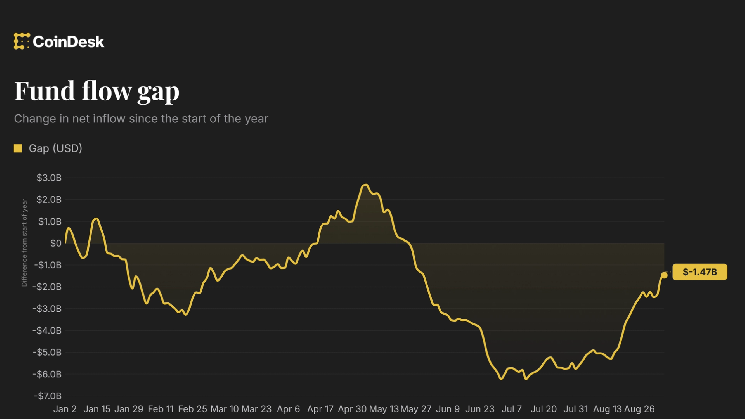
    Investor appetite for U.S.-listed spot bitcoin exchange-traded funds (ETFs) has surged in recent weeks, yet cumulative flows for 2024 remain deeply negative.

    Strong Summer Inflows Fail to Offset Spring Selloff

    Data from SoSoValue shows a dramatic turnaround in August, which attracted a massive $3.52 billion in fresh capital. Momentum carried into September, adding another $770.15 million through the early part of the month. While the winning streak signals that the worst of the mid-year market doldrums may be over, the broader arithmetic reveals a persistent deficit.

    Despite the recent rally, the funds are still down roughly $1 billion on a year-to-date basis. The primary driver of this lingering shortfall is the brutal two-month stretch in May and June, when institutional capital exited the funds at an alarming pace. June alone wiped out a staggering $4.51 billion, completely erasing the gains accumulated during March and April. Consequently, bulls still have significant ground to cover before ETF flows break even for the year.

    Macro Catalysts Loom as Critical Test

    Market participants are now focused on whether the positive momentum can withstand upcoming macroeconomic events. “The key test now is whether those inflows survive this week’s CPI and Treasury buyback,” analysts at crypto exchange Bitfinex said in a note to CoinDesk.

  • Bitfinex Signals Start of Bitcoin Bull Market as Gold Correlation Hits Record High

    Bitfinex Signals Start of Bitcoin Bull Market as Gold Correlation Hits Record High

    Bitfinex has highlighted Bitcoin’s rising price correlation with gold as the market’s debasement trade narrative evolves. Analysts say Bitcoin is increasingly behaving like digital gold as investors seek protection against rising debt and monetary manipulation.

    The exchange warned that the correlation between gold and Bitcoin has reached levels that typically do not persist for long, potentially signaling a shift in the current trend.

    “Both trade as one debasement hedge, $BTC the higher-beta version, but this reading has broken before. A potential risk-off environment shows whether bitcoin holds with gold or falls with stocks,”

    Bitfinex said the correlation comes as the macroeconomic backdrop shifts away from the artificial intelligence boom and toward the debasement trade. Recent actions by the U.S. Treasury, along with worsening concerns about U.S. debt, are influencing economic forecasts and prompting renewed questions about the dollar’s role as the world’s reserve currency.

    Bitcoin enters price expansion phase

    Bitfinex also described Bitcoin as a key asset for technology-focused investors pursuing the debasement trade. The exchange said Bitcoin has moved beyond its accumulation phase and entered a period of price expansion.

    “The Delta-Thermo Market Multiple reads 2.03, at the 2.5x threshold where the bull phase begins, with the 3.5x distribution top well above. The model marks this as the start of the bull phase, not a run into a top,”

    The current market setup resembles conditions seen in 2024, when JPMorgan strategists tied the investment trend to “concerns about ‘debt debasement’ due to persistently high government deficits across major economies, waning confidence in fiat currencies in certain emerging markets, and to a broader diversification away from the dollar.”

    However, Federal Reserve Chairman Kevin Warsh challenged the debasement trade narrative in his Jackson Hole debut by adopting a hawkish stance. He stressed that the central bank’s 2% inflation target remained achievable and hinted at potential interest rate increases ahead.