Tag: Bitcoin volatility

  • Bond Volatility Surges While Bitcoin and Wall Street Remain Calm

    Bond Volatility Surges While Bitcoin and Wall Street Remain Calm

    Key Highlights

    • The U.S. 10-year Treasury yield briefly touched 5.2% on Thursday before settling at 5.163%, driven by Middle East conflict pushing oil and diesel prices higher and complicating the global inflation outlook.
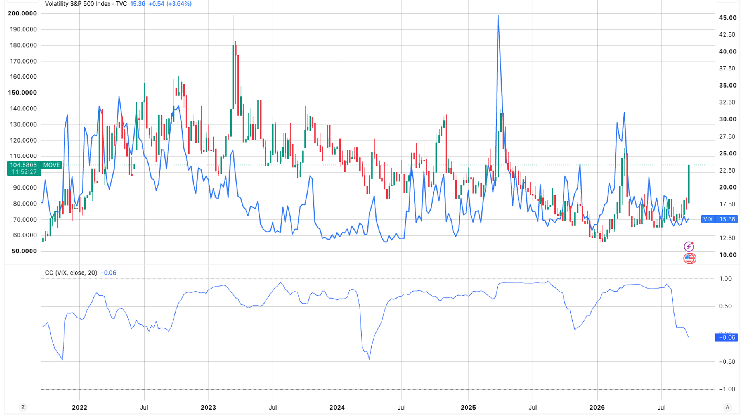
    • The ICE BofA MOVE Index ($MOVE) shows bond traders are paying significantly more for interest-rate volatility protection despite the S&P 500 rising roughly 21% since March when $MOVE was last at similar levels.
    • The 20-day correlation between the VIX and $MOVE turned negative (-0.06) for the first time since April 2024, while the BVIV-$MOVE correlation sits at -0.37, indicating a historic divergence between equity and bond volatility expectations as Bitcoin’s implied volatility hovers near yearly lows.

    Global Bond Yields Surge Amid Middle East Tensions

    A broad-based climb in government bond yields is rippling through global markets this week, with the benchmark U.S. 10-year Treasury yield briefly piercing the 5.2% threshold on Thursday before retreating slightly to 5.163%. The selloff in fixed income comes as the widening conflict in the Middle East drives crude oil and diesel prices higher, injecting fresh uncertainty into the inflation outlook and prompting traders to reassess how much further major central banks may need to tighten monetary policy. The move underscores the fragile nature of the disinflation narrative that had previously anchored market expectations for rate cuts.

    MOVE Index Signals Rising Rate Volatility Premium

    The ICE BofA MOVE Index, a widely watched gauge of expected volatility in U.S. Treasury markets, has climbed to levels last seen in March. However, the equity market backdrop has shifted dramatically: the S&P 500 stood near 6,350 when $MOVE previously traded at this level, but the index has since surged to 7,704, a gain of approximately 21%. This divergence highlights a critical shift—bond traders are now paying a considerably higher premium for protection against interest-rate swings even as equity markets rally, suggesting fixed-income participants see risks that stock investors are currently disregarding.

    Correlation Breakdown Between Asset Class Volatility

    The structural relationship between equity and bond volatility measures is showing signs of fracture. Over a 20-day rolling window, the correlation between the Cboe Volatility Index (VIX) and the MOVE Index has slipped to -0.06, turning negative for the first time since April 2024, though the reading remains statistically close to zero. The correlation between the Cboe Bitcoin Volatility Index (BVIV) and $MOVE is more distinctly negative at -0.37, marking one of its lowest readings in years. This decoupling occurs as bond volatility rises while Bitcoin’s expected volatility remains anchored near its yearly low, a dynamic that challenges traditional cross-asset hedging assumptions.

    Bitcoin’s Detachment from Yield Narrative

    Adding to the complexity, recent analysis from CoinDesk indicates that rising yields alone have demonstrated little consistent relationship with Bitcoin’s returns. The cryptocurrency’s implied volatility, as measured by BVIV, has failed to respond to the spike in rate volatility, remaining near annual lows. This suggests that Bitcoin is currently trading on idiosyncratic drivers—such as ETF flow dynamics and regulatory developments—rather than macroeconomic interest-rate sensitivity, further isolating the digital asset from traditional fixed-income turbulence.

    Why This Matters

    The simultaneous rise in bond yields and volatility premiums, coupled with a breakdown in cross-asset correlations, signals a potential regime shift for multi-asset portfolios. For institutional investors, the negative VIX-MOVE correlation undermines the traditional negative equity-bond correlation that has underpinned 60/40 portfolio construction for decades. The fact that Bitcoin volatility remains suppressed while rate volatility spikes suggests the asset is not currently functioning as a macro hedge against inflation or rate uncertainty. Market participants should monitor whether the $MOVE index sustains these elevated levels, as persistent bond volatility could force a repricing of risk assets broadly, including equities and digital assets, particularly if the Federal Reserve signals a higher-for-longer rate stance in response to energy-driven inflation pressures.

    Frequently Asked Questions

    What is the MOVE Index and why is it important?

    The ICE BofA MOVE Index ($MOVE) measures the implied volatility of U.S. Treasury securities across the 2-, 5-, 10-, and 30-year maturities. It serves as the bond market’s equivalent of the VIX, reflecting how much traders are paying to hedge against interest-rate swings. A rising $MOVE indicates growing uncertainty about the path of monetary policy and inflation.

    Why has the correlation between VIX and MOVE turned negative?

    The 20-day correlation between the VIX (equity volatility) and MOVE (bond volatility) fell to -0.06, its first negative reading since April 2024. This suggests equity traders are complacent—pricing in a soft landing and continued rally—while bond traders are hedging aggressively against sticky inflation and higher-for-longer rates, creating a rare divergence in risk perception across asset classes.

    Is Bitcoin acting as a hedge against rising yields?

    According to CoinDesk’s analysis, rising yields alone have shown little consistent relationship with Bitcoin’s returns. Currently, Bitcoin’s implied volatility (BVIV) is near yearly lows while bond volatility ($MOVE) spikes, and the BVIV-MOVE correlation sits at -0.37. This indicates Bitcoin is not currently functioning as a macro hedge against interest-rate volatility.


  • Bitcoin Bear Markets Growing Milder, Signaling Potential Bull Market Ahead

    Bitcoin Bear Markets Growing Milder, Signaling Potential Bull Market Ahead

    Key Highlights

    • Bitcoin ETFs have shifted ownership toward financial advisers and professional investors who typically allocate around 2% of portfolios to the asset, compared to 20–30% or more for crypto-native retail investors.
    • Institutional rebalancing behavior—buying after declines and selling after surges to maintain target weights—is expected to soften sell-offs but also cap the magnitude of rallies.
    • Risk Dimensions CIO Mark Connors predicts smaller drawdowns than the 70–80% crashes of prior cycles, but warns that reduced volatility comes with moderated returns and “smaller blow-off tops.”

    ETFs Reshape Bitcoin Ownership From Retail to Professional Hands

    Before the launch of spot bitcoin exchange-traded funds, ownership of the largest cryptocurrency was concentrated among retail investors, crypto-native funds, and traders making tactical bets. According to Rasmussen, the introduction of ETFs provided financial advisers and other professional investors with a familiar, regulated vehicle to add bitcoin to traditional portfolios. This structural shift has fundamentally altered the composition of the investor base, bringing in participants who approach the asset through the lens of portfolio construction rather than speculative conviction.

    Allocation Discipline Creates Divergent Risk Profiles

    The difference in allocation size creates starkly different risk experiences. Rasmussen noted that a professional investor might allocate roughly 2% of a portfolio to bitcoin, whereas crypto-focused retail investors often commit 20%, 30%, or more of their capital to the asset. Consequently, a 50% price decline impacts these groups in vastly different ways. “If it goes down 50%, my portfolio is only down 1%,” Rasmussen said in an interview, describing how an investor with a 2% allocation might view the decline. For a retail holder with a 30% allocation, the same drop would erase 15% of total portfolio value.

    Rebalancing Mechanics May Dampen Volatility Cycles

    Beyond allocation size, the discipline of periodic rebalancing introduces a mechanical counter-cyclical force. An adviser targeting a 2% bitcoin weight may buy after a steep decline to restore the target allocation, providing a floor of demand during sell-offs. Conversely, if bitcoin surges and grows to 5% of the portfolio, that same investor may sell a portion at the next rebalancing date, creating natural supply at higher prices. This dynamic could soften the depth of corrections while simultaneously limiting the explosive upside that characterized earlier market cycles.

    Institutionalization Brings Trade-Offs: Smaller Drawdowns, Moderated Returns

    Mark Connors, chief investment officer at Risk Dimensions, expects growing institutional participation to contribute to smaller drawdowns than the 70–80% declines observed in previous bitcoin cycles. However, he cautioned that investors should not expect to get something for nothing. Connors said bitcoin’s volatility has fallen over time, but its returns have moderated as well. More institutional investors could mean “smaller blow-off tops due to rebalancing,” he said, highlighting the trade-off between reduced downside risk and capped upside potential as the asset matures within traditional financial infrastructure.

    Why This Matters

    The transition from a retail-dominated market to one with significant professional participation marks a structural maturation for bitcoin as an asset class. The introduction of spot ETFs in the United States has accelerated this shift by lowering operational and custody barriers for registered investment advisors, family offices, and institutional allocators. As these investors apply modern portfolio theory—fixed allocations, systematic rebalancing, and risk-budgeting frameworks—the statistical properties of bitcoin’s price action are likely to evolve. Historically, bitcoin’s boom-bust cycles were amplified by homogeneous, high-conviction holders prone to panic selling and euphoric buying. A more diverse holder base with differentiated time horizons and mandate constraints could produce a return profile that resembles other alternative assets: lower volatility, reduced tail risk, but also diminished alpha relative to the asset’s early years. For allocators, this raises strategic questions about bitcoin’s role in a portfolio—whether it remains a high-beta growth sleeve or transitions toward a diversifier with equity-like risk and modestly enhanced returns.

    Frequently Asked Questions

    How does a typical professional investor’s bitcoin allocation differ from a retail crypto investor’s?

    Professional investors such as financial advisers typically allocate around 2% of a portfolio to bitcoin, while crypto-focused retail investors often hold 20%, 30%, or more of their total capital in the asset.

    What effect does portfolio rebalancing have on bitcoin’s price cycles?

    Systematic rebalancing creates counter-cyclical flows: advisers buy bitcoin after price declines to restore target weights, supporting prices during corrections, and sell after sharp rallies to trim overweight positions, capping upside momentum.

    Will institutional adoption eliminate bitcoin’s volatility entirely?

    No. Mark Connors of Risk Dimensions notes that while institutional participation may reduce the severity of drawdowns compared to historical 70–80% crashes, volatility will persist and returns are likely to moderate, resulting in “smaller blow-off tops due to rebalancing.”

  • Bitcoin Still Far From ‘Digital Gold,’ Says Bybit’s Ben Zhou

    Bitcoin Still Far From ‘Digital Gold,’ Says Bybit’s Ben Zhou

    Key Highlights

    • Bybit CEO Ben Zhou states Bitcoin remains a “considerable distance” from achieving mature ‘digital gold’ status due to persistent volatility.
    • Zhou suggests stablecoins may prove more effective than Bitcoin for everyday transactional use, signaling a potential divergence in crypto utility.
    • Bitcoin’s market-cap dominance has surged to 45%, reflecting shifting trader sentiment amid fluctuating stablecoin demand.

    Bybit CEO Ben Zhou Questions Bitcoin’s ‘Digital Gold’ Maturity Amid Volatility Concerns

    In a recent statement reported by prominent crypto commentator @WuBlockchain, Bybit Chief Executive Officer Ben Zhou offered a sobering assessment of Bitcoin’s evolution as a store-of-value asset. Zhou emphasized that the flagship cryptocurrency is still a “considerable distance from being considered mature ‘digital gold’,” arguing that its ongoing price volatility creates a significant barrier for traditional financial institutions seeking a reliable store of value. The remarks, delivered from the helm of one of the world’s leading cryptocurrency exchanges, underscore the persistent gap between Bitcoin’s narrative as a sovereign hedge and its current market behavior.

    Volatility Cited as Primary Obstacle to Institutional Adoption

    Zhou elaborated that Bitcoin’s price instability remains the core impediment preventing traditional financial players from embracing the asset as a dependable reserve. “He noted that its current volatility makes it difficult for traditional financial institutions to view it as a reliable store of value,” the report detailed. This perspective carries particular weight given Bybit’s position as a major liquidity venue; the exchange’s leadership has a front-row view of institutional order flow and risk-appetite dynamics. The CEO’s commentary suggests that until Bitcoin’s volatility profile compresses meaningfully, the “digital gold” moniker remains aspirational rather than descriptive for the conservative capital allocators who dominate traditional finance.

    Stablecoins Positioned as Superior Transactional Medium

    Beyond the store-of-value debate, Zhou introduced a functional distinction between asset classes within the crypto ecosystem. He “pointed out that stablecoins might be more effective for everyday transactions, indicating a potential shift in how cryptocurrencies are utilized in commerce.” This observation aligns with growing on-chain data showing stablecoins like USDT and USDC settling trillions in annual transaction volume, far outpacing Bitcoin’s base-layer throughput for payments. The Bybit executive’s framing implies a bifurcating future: Bitcoin as a volatile, long-duration investment asset, and fiat-pegged stablecoins as the pragmatic rails for daily commerce and cross-border settlement.

    Market Structure Reflects Diverging Trader Sentiment

    The comments arrive against a backdrop of notable market structure shifts. The source highlights that “Bitcoin’s market-cap dominance has recently surged to 45%, reflecting traders’ sentiments amidst fluctuating demand for stablecoins.” This dominance metric, often viewed as a barometer of risk appetite within the digital asset sector, suggests capital is rotating toward Bitcoin even as its volatility profile remains elevated. The interplay between rising BTC dominance and stablecoin demand fluctuations creates a complex signaling environment for market participants attempting to forecast the asset’s next structural move.

    Why This Matters

    Ben Zhou’s assessment cuts to the heart of Bitcoin’s identity crisis thirteen years after its inception. While proponents champion BTC as “digital gold,” the CEO of a top-tier exchange—tasked with managing risk for millions of users—publicly disputes its current fitness for that role. This tension has direct implications for regulatory frameworks, exchange-traded product designs, and corporate treasury strategies. If the primary gateway for institutional crypto access views Bitcoin as too volatile for conservative allocation, the timeline for sovereign wealth fund and pension fund adoption extends significantly. Simultaneously, the explicit endorsement of stablecoins for payments reinforces regulatory scrutiny on that sector, as policymakers globally draft frameworks for payment stablecoins. Traders and investors must now navigate a market where the leading asset’s narrative (store of value) conflicts with its observed behavior (high-beta risk asset), while the assets actually functioning as money (stablecoins) face the steepest regulatory headwinds.

    Frequently Asked Questions

    What specific volatility metrics did Ben Zhou reference?

    The source does not cite specific volatility metrics or timeframes referenced by Zhou. His assessment appears qualitative, based on observed market behavior and institutional feedback channels available to Bybit as a major exchange operator.

    How does Bitcoin’s 45% market-cap dominance relate to Zhou’s comments?

    The 45% dominance figure is presented as concurrent context reflecting current trader sentiment. It suggests capital concentration in Bitcoin despite the volatility concerns Zhou raised, highlighting a potential disconnect between market positioning and institutional readiness.

    Did Zhou specify a timeline or conditions for Bitcoin achieving ‘digital gold’ maturity?

    No. The source indicates Zhou stated Bitcoin is a “considerable distance” from that status but does not report any specific milestones, volatility thresholds, or time horizons he associated with achieving maturity.

  • Kaiko Data Reveals Bitcoin Volatility

    Kaiko Data Reveals Bitcoin Volatility

    Bitcoin Volatility Surges Amid Federal Reserve Policy Uncertainty

    Bitcoin’s recent volatility has surged, reflecting renewed uncertainty surrounding Federal Reserve policy decisions. According to data from KaikoData, the 30-day rolling volatility for Bitcoin spiked following the August Jackson Hole speech, eased temporarily, and then climbed again into September. This pattern suggests traders should closely monitor future Fed communications for clearer guidance on interest rates, which directly impacts market sentiment across digital asset markets.

    Mixed Signals Across Crypto Markets

    The broader cryptocurrency market indicates mixed signals, with various assets experiencing different momentum shifts. As Bitcoin grapples with climbing volatility, reduced forward guidance from the Federal Reserve adds an element of unpredictability. This uncertainty is particularly relevant for traders engaged in the derivatives market, where open interest and funding rates serve as crucial indicators of market sentiment. The potential for liquidation cascades also rises as traders navigate this volatile landscape.

    Key Data Points

    • Bitcoin’s 30-day rolling volatility spiked after the August Jackson Hole speech
    • Volatility eased before climbing again into September
    • Reduced Fed forward guidance leaves markets uncertain about interest rate trajectory
    • Traders are advised to watch for clearer Fed signals moving forward

    Market Conditions and Trading Activity

    Bitcoin’s price remains relatively unchanged as volatility increases, with no significant trading volume reported in the past 24 hours. The current market environment showcases hesitancy among traders as they respond to the Federal Reserve’s policy indications. This volatility trend may lead to increased caution in the market as traders reassess their positions amid the shifting landscape.

    As the leading cryptocurrency, Bitcoin’s price volatility and market influence make it particularly sensitive to macroeconomic policy shifts. The Federal Reserve’s policy decisions significantly affect financial markets, including cryptocurrencies, given their impact on interest rates and overall economic conditions.

    Levels to Watch

    Traders are monitoring potential shifts in Bitcoin’s volatility based on upcoming Fed announcements. Key levels to watch will be the reactions to new guidance, which could either stabilize or exacerbate current volatility trends. Risks remain high, especially if traders encounter sudden market movements that could lead to significant liquidations.

    This article is for informational purposes only and does not constitute financial advice.

  • Bitcoin Remains Unfazed by Trump’s Iran Threats

    Bitcoin Remains Unfazed by Trump’s Iran Threats

    Bitcoin remained largely unchanged despite escalating tensions in the Middle East and U.S. President Donald Trump’s vow on Monday to hit Iran hard.

    The price of Bitcoin, the world’s largest cryptocurrency, recently stood at $79,076, showing no movement over 24 hours. The asset was also virtually unchanged from its level seven days earlier.

    Bitcoin gains nearly 30% in a month

    Bitcoin began a powerful rally two weeks ago, marking its strongest performance in three years. The cryptocurrency is now up nearly 30% over the past month.

    Bitcoin’s price began rising after the U.S. Treasury announced that it would at least double the size of its liquidity-support buyback operations. The announcement weakened the dollar, while non-yielding assets such as Bitcoin and gold benefited.

    Positive cryptocurrency regulation developments have also supported Bitcoin this month. Last week, President Donald Trump described the long-awaited crypto Clarity Act as a “very, very powerful” piece of legislation and urged lawmakers to pass it.

    The Clarity Act is intended to establish a framework for determining whether digital assets should be classified as securities, commodities or payment stablecoins. The cryptocurrency industry has long called for such legislation.

    Crypto ETF inflows support Bitcoin

    Investors have also returned to exchange-traded funds linked to cryptocurrencies, providing further support for Bitcoin’s price. Between August 17 and August 27, investors put more than $2.8 billion into the funds, the highest total since October.

    JUST IN: Crypto ETFs attracted $3.2 billion in inflows last week, “their largest weekly intake since October 2025”, The Kobeissi Letter reports. BlackRock’s IBIT led with $928 million last week, adding to their $1.3 billion from the prior week, and marking the biggest 2-week…

    — Bitcoin Magazine (@BitcoinMagazine), August 31, 2026

    Bitcoin reached a weekly high of $81,281 before declining again on Friday.

    Geopolitical conflict has weighed on Bitcoin’s price this year. The cryptocurrency has typically come under pressure following news of war and rallied when investors saw prospects for a ceasefire.

    When the United States and Israel first attacked Iran in February, Bitcoin’s price plunged. The cryptocurrency also remained volatile after reports of war in March and April.

    However, analysts say Bitcoin’s volatility has eased in recent months. Monday followed that pattern: Trump threatened to strike Iran again, but the digital asset showed little reaction.

    The United States and Iran resumed strikes on Sunday, marking the first such action in more than one month.

    “We’re going to hit them hard,” President Trump was quoted telling a Fox News reporter on Monday.

    Source: cryptonews.net