Tag: Bitcoin resistance

  • Bitcoin Could Test $90,000 After Short Squeeze, but Traders Warn Leverage Is Building

    Bitcoin Could Test $90,000 After Short Squeeze, but Traders Warn Leverage Is Building

    Key Highlights

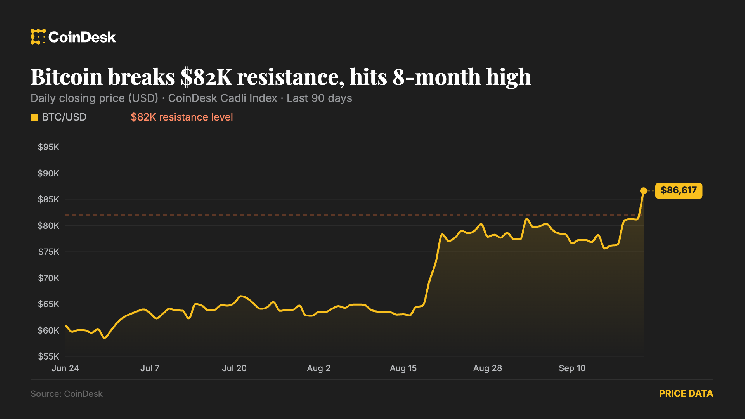
    • Bitcoin surged to an eight-month high of $86,000 on Monday, clearing the $82,000 resistance level that had capped prices since August and triggering roughly $750 million in bearish derivative liquidations.
    • Futures open interest rose faster than price, with approximately $2 billion in new leveraged exposure added since the breakout, signaling aggressive fresh positioning even as short sellers were wiped out.
    • While renewed spot ETF demand and short covering drove the rally, crypto-native investor positioning has been slower to flip from bearish to bullish, according to Nansen analytics.

    Bitcoin Breaks Key Resistance at $82,000

    Bitcoin pushed to a fresh eight-month high of $86,000 on Monday, extending a rally that forced bearish traders out of their short positions and drew fresh leverage bets back into the market. The move cleared the $82,000 level that had acted as a ceiling for prices since August, unleashing a cascade of liquidations across crypto derivative markets.

    Short Liquidations Fuel Momentum

    Roughly $750 million in bearish crypto derivative positions were liquidated as bitcoin cleared $82,000, according to CoinGlass data. When short positions are liquidated, exchanges execute buy orders to close them, adding fuel to an already upward market. “Bitcoin up 5% this morning due to short perpetual futures contracts being liquidated,” Schwab’s head of crypto research Jim Ferraioli told CoinDesk.

    Leveraged Bets Return Aggressively

    Meanwhile, futures open interest — the value of outstanding derivatives bets — rose even faster than bitcoin’s price. Since the breakout, about $2 billion in new leveraged exposure has been added, according to Coinalyze data, suggesting traders are placing fresh bets even as shorts got wiped out. The rapid rebuild in open interest indicates strong conviction among market participants that the breakout has legs.

    ETF Demand vs. Crypto-Native Caution

    While the rally has been fueled by a mix of renewed ETF demand and short covering, crypto-native positioning has been slower to shift from bearish to bullish, according to crypto analytics firm Nansen’s senior research analyst, Nicolai Sondergaard. This divergence suggests that while institutional flows via exchange-traded products are driving near-term price action, the core crypto trading community remains cautious about the sustainability of the move.

    Why This Matters

    The $82,000 level had served as a critical technical barrier since August, and its decisive breach marks the first time bitcoin has traded above this threshold in eight months. The combination of massive short liquidations and a rapid $2 billion rebuild in open interest creates a feedback loop that can sustain upward momentum in the near term. However, the reluctance of crypto-native traders to fully embrace the rally introduces a potential vulnerability: if ETF flows slow or macro conditions shift, the market may lack the deep conviction needed to hold gains. Market participants will be watching whether open interest continues to expand alongside price — a sign of healthy trend development — or if the current leverage buildup sets the stage for a volatile unwind.

    Frequently Asked Questions

    What triggered Bitcoin’s surge to $86,000?

    The rally was driven by a combination of renewed spot Bitcoin ETF demand and a massive short squeeze. As Bitcoin cleared the $82,000 resistance level — a ceiling since August — roughly $750 million in bearish derivative positions were liquidated, forcing exchanges to execute buy orders that accelerated the move higher.

    How much new leverage has entered the market since the breakout?

    According to Coinalyze data, approximately $2 billion in new leveraged exposure has been added to futures open interest since Bitcoin broke above $82,000, with open interest rising faster than price itself.

    Are crypto-native traders bullish on this move?

    Not yet. Nansen senior research analyst Nicolai Sondergaard notes that crypto-native positioning has been slower to shift from bearish to bullish, suggesting the core trading community remains cautious despite the price breakout and ETF-driven inflows.

  • Tom Lee Identifies Key Signs of Crypto Winter Dynamics

    Tom Lee Identifies Key Signs of Crypto Winter Dynamics

    Key Highlights

    • BitMine Chairman Tom Lee identifies ‘rage quitting’ as a defining investor behavior during crypto winters, alongside sharp price declines and leverage liquidations.
    • Bitcoin is testing the pivotal $64,000–$65,000 resistance zone, with buyers struggling to overcome dominant selling pressure.
    • Lee’s cyclical framework suggests current skepticism and forced exits historically align with potential market bottoms, offering a roadmap for traders navigating volatility.

    Tom Lee Maps the Anatomy of a Crypto Winter

    During a recent interview with Wealthion, Tom Lee, Chairman of BitMine, laid out a framework for understanding the recurring phenomenon known as the crypto winter. Lee emphasized that these downturns are not random collapses but structured cycles characterized by three distinct features: steep price declines, widespread leverage liquidation, and a behavioral pattern he explicitly labels ‘rage quitting’ among investors. According to Lee, this capitulation event—where participants abandon positions in frustration—typically clusters near the bottom of the cycle, making it a critical signal for market observers rather than a reason for panic.

    Bitcoin Tests Critical $64K–$65K Battleground

    The theoretical framework meets real-time market action as Bitcoin contends with the $64,000 to $65,000 range, a level that has repeatedly acted as both support and resistance in recent sessions. Current order-flow data shows aggressive selling defending this ceiling, while buying attempts have so far lacked the volume to sustain a decisive breakout. Lee’s observation that ‘rage quitting’ intensifies as sentiment sours aligns with on-chain metrics showing a spike in realized losses and short-term holder exits. Traders interpreting this confluence of technical resistance and behavioral capitulation are weighing whether the zone represents a distribution top or the final shakeout before a new leg higher.

    Sentiment Signals and Historical Rhymes

    Lee’s analysis draws a direct line between public skepticism—often amplified by high-profile critics—and the psychological trough of the cycle. The current wave of cautious commentary from financial media and institutional voices mirrors patterns observed in prior bear markets, where maximum pessimism preceded sustained recoveries. By framing ‘rage quitting’ as a feature of the bottoming process rather than a bug, Lee reframes the narrative: the absence of retail euphoria and the prevalence of forced selling may, paradoxically, reduce the supply overhang required for the next uptrend.

    Why This Matters

    Understanding the cyclical mechanics of crypto winters is essential for risk management and position sizing in an asset class defined by boom-bust dynamics. Lee’s framework provides a mental model that separates structural market forces—leverage flushes, miner capitulation, holder base rotation—from emotional decision-making. For institutional allocators and active traders alike, recognizing that ‘rage quitting’ signals exhaustion of weak hands rather than fundamental failure can prevent premature exits at the point of maximum financial opportunity. As Bitcoin’s price action hinges on the $64K–$65K pivot, the interplay between technical structure and behavioral extremes will likely dictate the near-term trajectory for the broader digital asset complex.

    Frequently Asked Questions

    What does Tom Lee mean by ‘rage quitting’ in crypto markets?

    ‘Rage quitting’ refers to the phenomenon where investors, frustrated by sustained losses and volatility, abruptly exit their positions near the bottom of a market cycle. Lee identifies this as a behavioral hallmark of crypto winters that historically coincides with maximum pessimism and the exhaustion of selling pressure.

    Why is the $64,000–$65,000 range so critical for Bitcoin right now?

    This price zone has acted as a key pivot point in recent trading, representing a confluence of technical resistance, psychological round numbers, and options market open interest. A decisive break above could signal renewed bullish momentum, while failure may invite a deeper correction toward lower support levels.

    How can traders use Lee’s crypto winter framework practically?

    Traders can monitor on-chain metrics such as realized loss spikes, short-term holder MVRV ratios, and funding rates to quantify ‘rage quitting’ intensity. When these indicators peak alongside extreme negative sentiment and price testing of major support, the framework suggests elevated probability of a cyclical bottom forming.

  • Bitcoin Surpasses $80,000 Amid Bullish Sentiment; Chinese Analyst Forecasts Next Moves

    Bitcoin Surpasses $80,000 Amid Bullish Sentiment; Chinese Analyst Forecasts Next Moves

    Key Highlights

    • Bitcoin surged past $80,000 to trade near $81,000, triggering over $457 million in short-position liquidations over 24 hours.
    • Prominent miner Jiang Zhuoer forecasts a potential test of the $83,000–$84,000 resistance zone before a sharp correction to $72,000–$74,000.
    • Short positions accounted for 89% of total liquidations in the past 24 hours, signaling a aggressive bearish squeeze.

    Bitcoin Breaks $80,000 Barrier as Short Squeeze Accelerates

    Bitcoin ($BTC) surged above the psychologically significant $80,000 level in recent trading hours, climbing rapidly from a consolidation range near $78,000 to reach approximately $81,000. The sharp upward move unleashed a wave of forced liquidations across cryptocurrency derivatives markets, with short positions bearing the brunt of the losses. According to on-chain and exchange data, the rally has wiped out hundreds of millions of dollars in bearish bets, underscoring the fragility of leveraged short exposure at current price levels.

    Jiang Zhuoer Projects Next Resistance at $83,000–$84,000

    Jiang Zhuoer, a well-known Chinese cryptocurrency miner and market analyst, noted in his latest analysis that Bitcoin has validated his earlier thesis by recovering without breaching the $75,000 support level. Zhuoer stated that the velocity of the current ascent increases the probability of Bitcoin testing the strong resistance zone between $83,000 and $84,000 in the next phase. However, he cautioned that such a move would likely set the stage for a subsequent sharp correction, as the liquidation of short positions at those elevated levels could exhaust buying momentum and trigger a reversal.

    Analyst Warns of Correction Toward $72,000–$74,000 After Resistance Test

    Zhuoer believes that once short positions are flushed out near the $83,000–$84,000 region, Bitcoin could retreat toward the $72,000–$74,000 range. This pullback, he argues, would then target long positions accumulated during the rally, creating a two-sided liquidation event that could reset market structure. The miner’s framework suggests a classic high-leverage washout pattern: an initial short squeeze to clear overhead supply, followed by a deep retracement to cleanse excessive long leverage before the next directional move.

    Liquidation Data Reveals Magnitude of Short Squeeze

    The scale of the short squeeze is evident in the liquidation metrics across major derivatives venues. In the most recent four-hour window, total liquidations reached $306.55 million, of which $286.14 million — approximately 93% — were short positions. Long liquidations during the same period amounted to just $20.41 million. Extending the horizon to 12 hours, total liquidations climbed to $411.62 million, with shorts accounting for $372.53 million versus $39.09 million for longs. Over the full 24-hour period, cumulative liquidations hit $515.05 million, with short positions representing $457.26 million (89%) and longs $57.79 million. The overwhelming skew toward short liquidations confirms that the rally was driven predominantly by forced covering rather than fresh spot demand.

    Why This Matters

    The current price action highlights the outsized influence of leveraged derivatives on Bitcoin’s short-term price discovery. With open interest remaining elevated across major exchanges, the market remains vulnerable to violent two-way moves as liquidation clusters act as magnetic price targets. Zhuoer’s projected $83,000–$84,000 resistance aligns with key technical levels, including prior local highs and dense liquidation clusters visible on exchange heatmaps. A successful breach could attract momentum-driven flows, but the subsequent correction risk to $72,000–$74,000 underscores the importance of risk management for leveraged traders. For longer-term holders, the sequence reinforces Bitcoin’s tendency to purge excess leverage before establishing sustainable trends.

    Frequently Asked Questions

    What triggered Bitcoin’s surge past $80,000?

    The rally appears to have been fueled by a short squeeze in the futures market, where rapidly rising prices forced bearish traders to buy back positions, amplifying upward momentum. Over $457 million in short positions were liquidated in 24 hours.

    What is Jiang Zhuoer’s price prediction for Bitcoin?

    Jiang Zhuoer expects Bitcoin to potentially test the $83,000–$84,000 resistance zone before correcting sharply to the $72,000–$74,000 range as long positions are subsequently liquidated.

    How significant were the recent liquidations?

    Extremely significant. In the last 24 hours, total liquidations reached $515.05 million, with short positions accounting for 89% ($457.26 million). The 4-hour window alone saw $286.14 million in short liquidations versus only $20.41 million in longs.

  • Bitcoin Faces Critical Two Weeks as Wintermute Reveals Key Price Levels: “The Next Two Weeks Are Very Critical,” and “Below This Is…

    Bitcoin Faces Critical Two Weeks as Wintermute Reveals Key Price Levels: “The Next Two Weeks Are Very Critical,” and “Below This Is…

    Bitcoin rose above $81,000 last week before falling back to approximately $78,000 after Federal Reserve Chairman Kevin Warsh delivered a hawkish speech in Jackson Hole. With BTC trading near $78,000 in recent days, cryptocurrency market maker Wintermute has outlined its latest expectations for Bitcoin.

    Bitcoin Could Trade Between $75,000 and $82,000 Before the Fed Meeting

    Wintermute expects Bitcoin to remain between $75,000 and $82,000 until the Federal Open Market Committee (FOMC) meeting scheduled for September 15–16.

    According to Wintermute’s latest market analysis, Warsh’s speech at the Jackson Hole Annual Meeting increased expectations of a September rate hike to 64.4%. The company expects the September FOMC meeting to become a major catalyst for risk assets, particularly cryptocurrencies.

    Wintermute said market expectations for interest rates will be a decisive factor in Bitcoin’s next move. Economic data due during the first two weeks of September could significantly alter those expectations ahead of the FOMC meeting.

    US nonfarm payrolls data, scheduled for release on September 4, will be closely watched for its potential impact on interest-rate expectations and the direction of BTC.

    $82,000 Resistance Remains Key for Bitcoin

    Wintermute also noted that Bitcoin has faced repeated selling pressure near $82,000 following its recent rally. The company identified the following key levels:

    “$82,000: As a significant resistance$75,000: As the first significant support$72,000: As a critical support”

    Wintermute warned that a weekly Bitcoin close below $72,000 could alter the current market outlook. Below that level, the company sees no clearly defined support zone, potentially increasing the risk of further declines.

    In the current market environment, Wintermute considers a pullback toward $75,000 a healthier short-term move for Bitcoin. Such a decline could clear leveraged positions before the market makes another attempt to move higher.

    Based on this outlook, Wintermute expects Bitcoin to consolidate within the $75,000–$82,000 range until the September FOMC meeting.

    This is not investment advice.