Tag: Bitcoin price drop

  • Why Crypto Market Is Falling Today: Bitcoin and Altcoins Under Pressure

    Why Crypto Market Is Falling Today: Bitcoin and Altcoins Under Pressure

    Crypto Market Correction Deepens as Bitcoin Slides Below $78K Amid Macroeconomic Pressure

    The cryptocurrency market is facing renewed selling pressure, with Bitcoin (BTC) failing to sustain its recent recovery and sliding toward the $77,000 level. Over the past 24 hours, BTC has dropped from approximately $78,500 to around $77,225, dragging the broader market down with it. Total crypto market capitalization has fallen 1.55% to $2.62 trillion, while 24-hour trading volume has risen 3.1% to roughly $84.3 billion, indicating heightened activity amid the decline.

    Broad-Based Weakness Across Major Altcoins

    The sell-off is not confined to Bitcoin. Major altcoins are posting significant losses, signaling a market-wide risk-off move rather than an isolated correction:

    • Ethereum (ETH) remains capped below $2,500 but is showing relative strength against Bitcoin, holding above $2,450.
    • XRP has plunged over 3% to $1.34.
    • BNB trades around $714.
    • Solana (SOL) and Hyperliquid (HYPE) have both dropped below key support levels at $100 and $80, respectively.

    Stablecoins continue to dominate market activity, with their combined 24-hour volume exceeding $90 billion, underscoring the ongoing rotation of capital through stablecoin pairs.

    Top Gainers and Losers Highlight Divergence

    Amid the broad decline, a few assets are bucking the trend. Among the top 100 cryptocurrencies by market cap:

    • Raydium (RAY) leads gainers with a 27.23% jump.
    • ether.fi (ETHFI) follows with a 9.60% gain.
    • Aptos (APT) and Polkadot (DOT) are up 3.64% and 2.10%, respectively.

    On the downside, Zcash (ZEC) has plunged 13.23% but continues to hold above the $1,000 support level.

    Key Drivers Behind Today’s Crypto Market Sell-Off

    The correction is being driven by a convergence of macroeconomic headwinds that are pushing investors toward a defensive posture across global financial markets.

    Middle East Tensions Push Oil Prices Above $100

    Escalating geopolitical tensions around critical Middle East shipping routes have sent Brent crude soaring to $109.97 per barrel. The benchmark is on track for an approximate 11% weekly gain, raising fears of sustained energy-supply disruptions that could reignite inflation.

    FED Rate-Hike Expectations Surge

    Markets are increasingly pricing in the possibility that the Federal Reserve may need to maintain tighter monetary policy to combat renewed inflationary pressures. The probability of a 25-basis-point rate hike at the next FOMC meeting has risen to ~71%, up from 61% in prior sessions.

    Inflation Concerns Return to the Forefront

    The latest U.S. Producer Price Index (PPI) showed producer prices rising 0.4% month-over-month in August and 5.4% year-over-year. A hotter-than-expected reading reinforces the case for prolonged restrictive policy, adding another layer of pressure on risk assets like crypto.

    Treasury Yields Approach Critical 5% Threshold

    U.S. Treasury yields have surged as investors reassess the inflation and rate outlook. The 10-year yield hit 4.979%, flirting with the psychologically important 5% level, while the 30-year yield climbed to ~5.38%.

    Stronger Dollar Tightens Global Liquidity

    The U.S. Dollar Index (DXY) is hovering near 99, supported by rising yields and safe-haven demand. A stronger dollar typically tightens global financial conditions and weighs on dollar-denominated risk assets, including cryptocurrencies.

    Bitcoin ETF Outflows Accelerate

    Spot Bitcoin ETFs recorded $120.2 million in net outflows in the latest session, following a $46.6 million outflow the prior day. That brings total withdrawals over two consecutive sessions to roughly $166.8 million, signaling weakening institutional buying pressure.

    Leveraged Liquidations Amplify Downside Volatility

    High leverage is exacerbating the sell-off. Recent data shows over $386 million in leveraged positions liquidated, including approximately $270 million in long positions, fueling a cascading effect as stop-losses trigger further selling.

    What’s Next for Bitcoin and the Crypto Market?

    The near-term trajectory for crypto will likely hinge on three key macro variables: oil prices, U.S. inflation data, and Federal Reserve policy expectations. If these pressures ease, Bitcoin and altcoins could find a footing to stabilize and recover. However, a further spike in energy costs, hotter inflation prints, or sustained ETF outflows could extend the current correction deeper into key support zones.

  • Bitcoin Falls Below $77K as US-Iran Strikes Resume: Who Else Could Be Behind the Drop?

    Bitcoin Falls Below $77K as US-Iran Strikes Resume: Who Else Could Be Behind the Drop?

    Bitcoin fell sharply at the start of the new business week after briefly rising above $79,000 on Sunday evening. The cryptocurrency dropped below $77,000 within roughly an hour as renewed geopolitical tensions weighed on global financial markets.

    The sell-off followed fresh fighting between the United States and Iran after nearly a month of relative calm, during which the US reportedly focused on increasing economic pressure. US forces struck two Iranian launchers on Larak Island on Sunday, while Iran retaliated with attacks on military targets in Jordan.

    US President Trump’s AI video depicting Iran’s key oil region, Kharg Island, as being “blown to smithereens” also did little to ease tensions.

    Oil Prices Rise as Asian Markets Fall

    Brent crude rose nearly 3% to above $90 per barrel, reviving concerns about another energy-driven inflation shock. The increase comes shortly after Fed Chair Kevin Warsh delivered a hawkish speech at Jackson Hole on Friday, making higher oil prices particularly concerning for the inflation outlook.

    Asian stock markets moved lower after news of the attacks emerged. Japan’s Nikkei fell by about 2%, while South Korea’s Kospi and Chinese equities also declined. US and European stock futures followed the broader risk-off trend, and the Japanese yen weakened beyond 160 against the US dollar.

    Bitcoin lost more than $2,000, falling below $77,000. Additional selling pressure came from Wintermute after on-chain data showed that the entity had transferred 5,100 $BTC, worth nearly $400 million, to Binance over the previous two days. The transfer may indicate an intention to sell.

    Although the transaction does not confirm that Wintermute sold its holdings, similar activity by the market maker last week preceded another decline in $BTC and altcoins.

    You may also like:

    • From Record Short Squeezes to Massive ETF Inflows: Everything Driving Bitcoin Right Now
    • US Secures 65 Billion Barrels of Venezuelan Oil: Could This Be Bullish for Bitcoin?
    • Bitcoin Suddenly Dumped by $3K as Liquidations Hit $200M Hourly: Is the Fed to Blame?

    Ethereum performed even worse, dropping from above $2,500 to below $2,400 within an hour. Lookonchain reported that a whale or institution had deposited nearly 41,000 $ETH, worth more than $100 million, onto exchanges. Such transfers are typically made ahead of a potential sale.

    Crypto Liquidations Surge

    The sharp market decline resulted in more than $400 million in liquidated positions over a 24-hour period, with most of the losses occurring earlier in the morning. According to CoinGlass, $ETH long positions accounted for nearly $100 million of the liquidations, while $BTC longs represented $62.60 million.

    The largest individual liquidation involved Ethereum, with a trader losing $6.12 million on Aster. More than 100,000 overleveraged traders were liquidated during the past day.

    Liquidation Data on CoinGlass

  • Bitcoin and Gold Plunge as Kevin Warsh Signals Tighter Federal Reserve Policy

    Bitcoin and Gold Plunge as Kevin Warsh Signals Tighter Federal Reserve Policy

    Investors turned cautious on August 28 as the U.S. dollar strengthened and markets assessed more hawkish comments from Federal Reserve Chair Kevin Warsh during his first speech as Fed chair at Jackson Hole, Wyoming.

    Bitcoin dropped below $79,000, while gold and silver also suffered steep losses. The sell-off reportedly erased approximately $670 billion in market value in just seven minutes.

    The common factor was a stronger dollar and rising expectations that the Federal Reserve may need to keep interest rates high to bring inflation under control.

    Warsh Signals That Further Tightening Remains Possible

    Warsh suggested that the Fed’s fight against inflation may not be over, saying that financial conditions don’t seem restrictive enough right now. Although he did not promise an immediate rate hike, the Fed chair made clear that additional monetary tightening remains on the table.

    That outlook is changing investor positioning, particularly for assets that tend to perform well when money is inexpensive and interest rates are low.

    What the Sell-Off Means for Bitcoin and Gold

    Warsh’s remarks and the broader market sell-off have added uncertainty for investors. The key question is whether Bitcoin’s and gold’s recent gains reflected genuine, long-term market shifts or were driven largely by expectations that monetary policy would become increasingly supportive.

    Investors are now watching the dollar, Treasury yields and interest-rate expectations for further signals. A stronger dollar could make conditions more difficult for both Bitcoin and gold by reducing their appeal.

    If the dollar continues to rise and yields remain elevated, Bitcoin may face further pressure. However, if markets interpret Warsh’s comments as a warning rather than a signal of aggressive rate hikes, the latest decline could prove to be another sharp market swing rather than the start of a prolonged downturn.

    Warsh’s speech was not the only factor behind the decline. Markets were already highly sensitive, with investors preparing for a significant signal on the future direction of monetary policy.

    For now, Bitcoin’s decline and gold’s underperformance suggest that investor sentiment has shifted away from hedging against currency devaluation and toward assessing how many additional interest-rate hikes markets may still need to price in.

    Source: cryptonews.net

  • Fed Chair Kevin Warsh Triggers $488 Million Crypto Liquidation Cascade as Rate Hike Expectations Rise

    Fed Chair Kevin Warsh Triggers $488 Million Crypto Liquidation Cascade as Rate Hike Expectations Rise

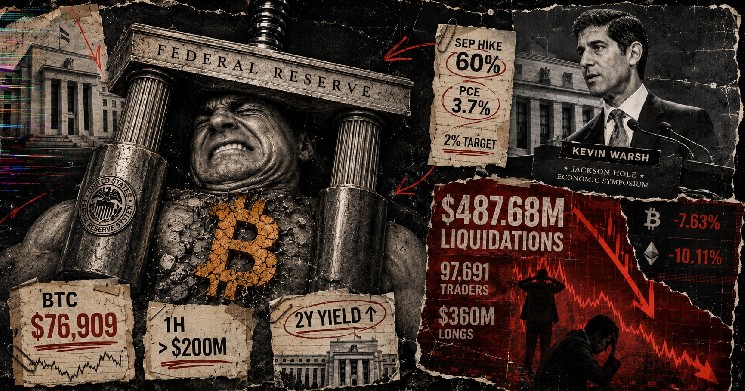
    Bitcoin fell below $77,000 on Friday after Fed Chair Kevin Warsh revived concerns that interest rates could move higher at Jackson Hole.

    Data from CryptoSlate showed Bitcoin, the largest cryptocurrency by market capitalization, dropping as low as $76,909 before recovering to $77,712 at press time. The cryptocurrency remained down about 4% over the previous 24 hours.

    The decline intensified a broader crypto deleveraging event that wiped out nearly $488 million from derivatives traders as markets sharply repriced expectations for Federal Reserve policy.

    Warsh revives rate-hike fears

    Traders raised the probability of a September rate increase to about 60%, up from roughly 35% before Warsh’s remarks. Short-term Treasury yields also climbed, while the US dollar strengthened.

    Warsh gave investors several reasons to reassess expectations that the Federal Reserve was preparing to ease monetary policy. He argued that inflation remained too high despite improved price data during the summer.

    The Fed’s preferred personal consumption expenditures price index was running at 3.7% over the past year and at a 4.1% annualized pace over the past six months. Both readings remain well above the central bank’s 2% target.

    Recent inflation reports had not convinced Warsh that the underlying trend had changed. He said:

    “We must be confident that underlying inflation is moving to our objective, clearly and at sufficient speed. Otherwise, we have work to do.”

    Warsh also questioned whether current borrowing conditions were restraining demand sufficiently. Credit markets showed limited signs of policy restraint, while corporate bond spreads remained historically narrow and bank lending standards relatively easy.

    He added:

    “I would be hard pressed to describe broad financial conditions as restrictive.”

    The combination delivered a hawkish signal to financial markets. Warsh described labor conditions as consistent with full employment, pointed to healthy consumer spending and strong business investment, and said the Fed’s “predominant focus right now should be on prices.”

    For crypto traders, the implication was immediate. A resilient economy gives the Fed more room to keep monetary policy tight, while persistent inflation increases the risk that its next move could be another rate increase rather than the easier financial conditions that risk assets had been anticipating.

    The two-year Treasury yield rose to a one-month high after the remarks as investors increased their bets on another rate increase.

    Leveraged crypto traders suffer nearly $488 million in liquidations

    The shift in rate expectations hit a crypto market that had entered Friday with substantial leveraged exposure following Bitcoin’s recent rally above $80,000.

    CoinGlass recorded $487.68 million in liquidations across the cryptocurrency market during the previous 24 hours, affecting 97,691 traders. More than $200 million in positions were closed within one hour of Warsh’s speech.

    Bitcoin and Ethereum led crypto liquidations as 24-hour losses reached $487.81 million across 97,772 traders. Source: CoinGlass

    Long positions accounted for more than $360 million of the losses, indicating that traders positioned for further gains absorbed most of the reversal. Bitcoin positions generated about $141 million of the liquidations.

    The largest individual liquidation was an $11.66 million ETH-USDT position on Binance.

    Warsh’s speech also affected the gold market. Reports said gold and silver lost more than $700 billion in combined market value following the remarks.

    Higher interest-rate expectations create several simultaneous headwinds for cryptocurrency markets. Rising Treasury yields increase the returns available from dollar-denominated assets, while a stronger dollar typically tightens financial conditions for speculative investments.

    Expectations for more restrictive monetary policy can also reduce the liquidity that helped drive Bitcoin’s recent advance.

    Friday’s reaction showed how quickly that relationship can reassert itself. Bitcoin had been trading near $80,000 before Warsh’s speech became the dominant macroeconomic catalyst. Contemporaneous reports showed the cryptocurrency falling more than 3% as rate-hike expectations increased.

    Less Fed guidance could increase crypto rate volatility

    Warsh offered little certainty about the Federal Reserve’s next move.

    The chairman has moved away from the forward guidance used heavily by his predecessors, arguing that telegraphing policy paths can distort markets and limit the central bank’s flexibility when economic conditions change.

    He also rejected the idea of giving investors a mechanical reaction function that would dictate how interest rates should respond to individual economic reports.

    This approach could make upcoming inflation and employment data more important for Bitcoin and other risk assets. Traders will have fewer signals from the Fed about how policymakers intend to respond to new economic information.

    Apollo Global Management Chief Economist Torsten Slok has argued that this type of policy regime could push more interest-rate moves outside Federal Reserve meeting days. Investors would continuously reprice economic data instead of waiting for policymakers to validate existing expectations.

    Slok noted that since the Fed began raising rates in 2022, much of the increase in longer-term Treasury yields has occurred outside Federal Open Market Committee meetings. Inflation reports, employment data, Treasury issuance and the term premium became larger drivers of the bond market.

    Warsh reinforced that philosophy on Friday, saying markets should form their own expectations rather than look primarily to the Fed for their “next trade.”

    For Bitcoin, Friday offered an early example of what that environment could look like.

    Warsh stopped short of committing to a September rate increase, leaving incoming data to determine whether the Fed follows through. However, his insistence that inflation remains too high, financial conditions are not particularly restrictive and interest rates remain the central bank’s main policy tool was enough to revive fears of tighter monetary policy.