
Tag: Bitcoin liquidations

  • Bitcoin Shorts Squeezed for $6.55 Billion in August as Weak Demand Raises September Doubts

    Bitcoin Shorts Squeezed for $6.55 Billion in August as Weak Demand Raises September Doubts

    After a bullish August rally, Bitcoin is entering September with momentum—and growing uncertainty over whether its gains can continue.

    According to CoinGlass data, Bitcoin is set to close August with a return of more than 24%, its strongest monthly performance since the 2017 cycle. The rally also triggered a major short squeeze across the derivatives market, forcing bearish traders to liquidate their positions.

    More than $9.71 billion has been liquidated from the cryptocurrency market over the past two weeks, including $6.55 billion in short positions and $3.16 billion in long positions. Shorts represented roughly two-thirds of total liquidations, showing that bearish traders were heavily squeezed as Bitcoin moved higher.

    Source: X

    Bitcoin funding rates rise as traders assess the next move

    The key question now is where Bitcoin ($BTC) is headed next.

    Data from CryptoQuant suggests that market participants remain bullish. Bitcoin’s funding rates on Binance increased by more than 42% in less than a week, even as $BTC consolidated below the $80,000 level.

    With many leveraged positions liquidated, the market has undergone a reset that could leave room for another move higher. However, on-chain data may be pointing to a different explanation for Bitcoin’s latest advance.

    The rally may have resulted from the unwinding of excessive leverage rather than fresh spot demand. If that is the case, the move could prove to be a short-term relief rally and set the stage for a more bearish September.

    Bitcoin faces $9 billion in liquidations and weakening demand

    A sustained breakout above resistance requires strong investor conviction. Yet that conviction appears to be fading as the market approaches September.

    According to SoSoValue, Bitcoin exchange-traded funds recorded more than $201 million in net outflows on August 28, ending a nine-day streak of inflows.

    Another trend in the current market cycle could also affect Bitcoin’s momentum. As the chart below shows, smaller holders accumulated Bitcoin as its price fell below $67,000. Wallets holding fewer than 100 $BTC recorded heavy gross inflows.

    However, short-term holders are often among the first market participants to take profits when sentiment turns risk-off or Bitcoin fails to break through key resistance. That behavior could increase selling pressure around the $80,000 level.

    Source: Glassnode

    Ethereum-Bitcoin ratio adds to September uncertainty

    Technical factors are adding to the risks facing Bitcoin. The $ETH/$BTC ratio is currently at a key breakout level, with analysts anticipating a major move.

    At the same time, weakening Bitcoin spot demand, rising short-term holder supply and increasingly bearish sentiment have made the asset’s setup less convincing. If $ETH/$BTC breaks higher while Bitcoin struggles, it could indicate that capital is rotating away from Bitcoin and place additional pressure on the September outlook.

    Against this backdrop, Bitcoin’s late-August rally may fail to deliver on its bullish promise. The more than $9 billion in crypto liquidations are central to that concern: because most of the liquidations came from short positions, the recent advance may have been driven primarily by a short squeeze rather than strong underlying buying.

    If that interpretation is correct, Bitcoin’s latest rally could lose momentum and leave the cryptocurrency market facing a bearish September.

  • Crypto Futures See $275 Million in Liquidations as Long Positions Bear the Brunt

    Crypto Futures See $275 Million in Liquidations as Long Positions Bear the Brunt

    Crypto derivatives traders faced a sharp market reversal over the past 24 hours, triggering approximately $275 million in liquidations across major perpetual futures markets. Long positions accounted for most of the forced closures, suggesting that many traders were positioned for further price gains before the downturn.

    Bitcoin, Ethereum and Solana Lead Crypto Liquidations

    Bitcoin (BTC) recorded the largest liquidation volume, with $154.85 million in positions wiped out. Long positions made up 85.44% of Bitcoin liquidations.

    Ethereum (ETH) followed with $97.65 million in liquidations, including 77.97% from long positions. Solana (SOL) saw $23.12 million in positions liquidated, with longs representing 68.67% of the total.

    The high concentration of long liquidations indicates that many traders were betting on continued upside. A sudden decline forced those positions to close, adding selling pressure and potentially accelerating the market’s price drop.

    What the Liquidation Wave Means for Traders

    The latest data highlights the risks of using leverage in cryptocurrency markets. Even a relatively modest price movement can trigger a cascade of liquidations when traders are heavily positioned in the same direction.

    The dominance of long liquidations also points to a rapid shift in market sentiment, as bullish positions were unwound. Liquidation events can sometimes coincide with short-term market bottoms or tops, depending on the broader trend, but the current outlook remains uncertain.

    Macroeconomic developments and regulatory news continue to influence cryptocurrency prices, making it difficult to determine whether the latest move represents a temporary reversal or the beginning of a broader trend.

    Why Crypto Liquidations Matter

    Liquidation data offers insight into market leverage, trader positioning and overall risk appetite. While forced closures directly affect individual traders, they can also amplify volatility across the wider crypto market.

    For investors and market observers, a sharp increase in liquidations can serve as an early warning of heightened volatility and provide clues about how traders are positioned ahead of potential price moves.

    Key Takeaways From the Crypto Futures Sell-Off

    • Approximately $275 million in major perpetual futures positions were liquidated over 24 hours.
    • Long positions made up the majority of liquidations across Bitcoin, Ethereum and Solana.
    • Bitcoin accounted for $154.85 million in liquidations, followed by Ethereum at $97.65 million and Solana at $23.12 million.
    • The liquidation wave underscores the risks of high leverage and one-sided positioning.
    • Traders are watching for signs of stabilization or additional volatility as the market absorbs the move.

    FAQs About Crypto Futures Liquidations

    What are crypto futures liquidations?

    Liquidations occur when a trader’s position is forcibly closed because of insufficient margin, typically after an adverse price movement. In futures trading, an exchange closes the position when losses pass a predetermined threshold.

    Why are most liquidations long positions?

    When cryptocurrency prices fall sharply, long positions—bets that prices will rise—lose value quickly. If the losses exceed the trader’s margin, the exchange closes the position, resulting in a long liquidation. High long-liquidation volumes often signal a sudden market decline.

    How can traders reduce the risk of liquidation?

    Traders can lower liquidation risk by using less leverage, setting stop-loss orders and maintaining sufficient margin. Diversifying positions and staying informed about market conditions can also help limit potential losses.

    Source: cryptonews.net

  • Bitcoin Rejects $81,500 as Whales Build Massive Sell Wall at $81K

    Bitcoin Rejects $81,500 as Whales Build Massive Sell Wall at $81K

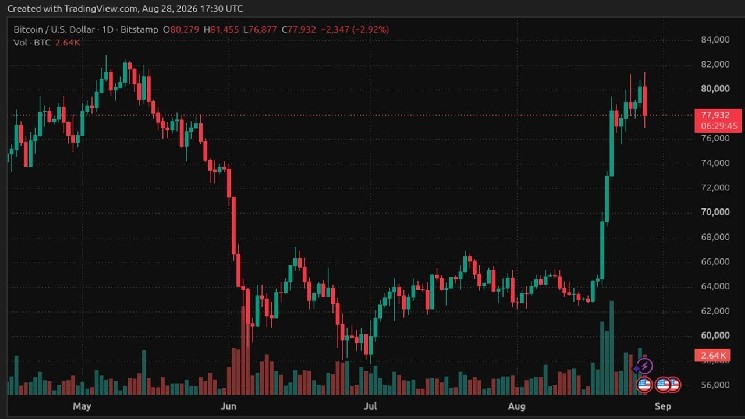
    Bitcoin lost momentum after briefly breaking above $81,000 as traders awaited Federal Reserve Chair Kevin Warsh’s inaugural Jackson Hole speech. The cryptocurrency fell soon after reaching the key resistance level for the second time this week, echoing its Aug. 25 retreat after bitcoin climbed above $80,000 for the first time in more than three months.

    Market data showed bitcoin reaching a high of $81,455 shortly after 9:30 p.m. Thursday, temporarily overcoming bearish pressure that had intensified since Tuesday. A sharp sell-off then erased the gains recorded on Aug. 27, pushing bitcoin to a session low of $78,442 at around 10:15 a.m.

    More than an hour after Warsh’s speech, bitcoin dropped to a new low of $76,877 before quickly recovering above $77,000 and testing $78,000.

    Bitcoin’s Weekly Gains Narrow as Liquidations Rise

    The retreat reduced bitcoin’s weekly gain to 2% and lowered its market capitalization to $1.58 trillion from more than $1.61 trillion. Despite the pullback, bitcoin remains on track for double-digit monthly gains following its sharp rally between Aug. 19 and Aug. 21.

    In the derivatives market, bitcoin’s reversal less than 24 hours after reclaiming $80,000 triggered $107 million in liquidations across long and short positions. Data from Coinglass showed a relatively even split, with $50 million in long positions and $57 million in short positions wiped out. Across the wider cryptocurrency market, approximately $300 million in leveraged positions disappeared.

    According to market analysis outlet Cryptoreviewing, bitcoin’s early-morning surge to $81,500 followed by an immediate decline below $79,300 contributed to $465 million in 24-hour liquidations. That figure was significantly higher than the standard derivatives losses indicated by exchange data alone.

    In a post on X, Cryptoreviewing said bitcoin swept the upside liquidity zone between $80,400 and $81,600 almost perfectly but failed to hold above $80,000. The failure weakened short-term momentum and shifted the near-term market bias back toward caution.

    Bitcoin Order-Book Liquidity Skews Lower

    Cryptoreviewing also highlighted a sharp imbalance in liquidity distribution. Approximately $5.7 billion is positioned below the market between $75,000 and $78,500, compared with about $2.8 billion above between $81,500 and $84,000. The analysis said the imbalance leaves a deeper bitcoin pullback as a meaningful higher-timeframe risk.

    On lower timeframes, the largest liquidity pockets are concentrated around $78,600 and $79,100 below the market, and $81,300 and $81,900 above it. The analysis identified these levels as the most likely sweep zones in the near term.

    In its order-flow analysis, Cryptoreviewing said whales were maintaining significant sell walls between $80,800 and $83,000. Large bids remained stacked around $78,000 to $79,000 and at lower levels, suggesting institutional buyers were continuing to buy dips while bitcoin faced a formidable ceiling for further gains.

    Open interest has rebuilt, futures traders are adding exposure, and the Coinbase Premium has turned positive. However, weakening spot demand suggests leverage is returning faster than organic buying.

    Warsh Rejects Forward Guidance

    In his address, Warsh reiterated his rejection of “forward guidance”—the signaling strategy favored by previous Federal Reserve chairs—arguing that persistent inflation continues to threaten economic momentum despite recent positive data.

    He called for a return to traditional central banking, with interest rates adjusted as economic conditions change to maintain price stability without destabilizing employment.

    The Iran war and surging crude oil prices have clouded the outlook for U.S. economic growth. However, Warsh maintained a resilient tone, pointing to unprecedented corporate spending on technology and artificial intelligence infrastructure as a powerful counterweight.