Bitcoin futures open interest across major derivatives venues stood at 695,020 BTC, equivalent to $54.82 billion, according to weekend data from Coinglass. Aggregate open interest declined 0.26% over one hour and 0.38% over four hours, but remained 1.15% higher over the past 24 hours. The mixed readings suggest traders are trimming exposure at the margins rather than making a broad exit from the market.
Binance Leads as $54.82 Billion Remains at Stake
Binance, the largest cryptocurrency exchange by trading volume, held the biggest share of tracked futures open interest, with 142,500 BTC valued at $11.24 billion. That represented 20.5% of the total. CME followed with 116,040 BTC worth $9.15 billion on Sunday, giving it a 16.69% share. CME’s position is particularly significant because it offers a useful measure of institutional positioning.
MEXC accounted for another $5.01 billion, followed by Bybit with $4.58 billion and Gate with $4.57 billion. OKX held $2.79 billion, while Bitget and KuCoin accounted for $2.16 billion and $1.62 billion, respectively.
Most major venues recorded lower open interest over the previous four hours on Sunday. BingX, however, posted a 34.50% increase, while Bitunix rose approximately 1.29%.
The broader futures market has recovered substantially from its June lows. Historical data shows Bitcoin futures open interest falling toward the mid-$40 billion range in June before recovering above $54 billion in late August, as Bitcoin rebounded past $81,000. The key concern is that leverage has returned alongside the price, leaving more capital exposed if volatility suddenly increases.
One popular crypto X account this weekend wrote:
“Leverage is piling up over the weekend. This won’t end well.”
Calls Dominate Open Interest as New Flows Seek Protection
Bitcoin options are showing a similarly leveraged setup. Total options open interest approached approximately $44 billion over the weekend, recovering sharply from around $25 billion in early August.
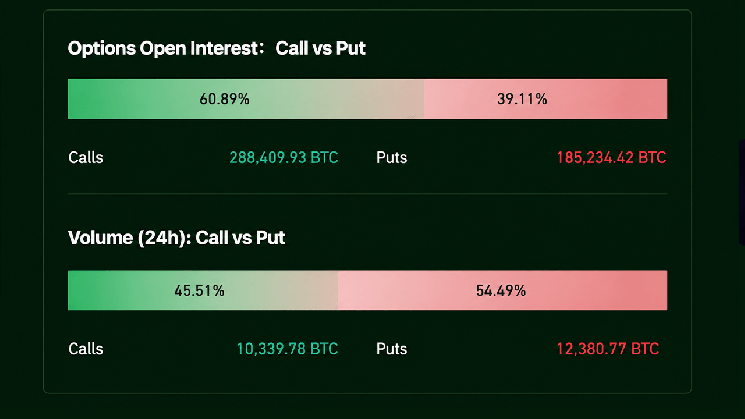
The latest call-and-put breakdown showed 288,409.93 BTC in calls versus 185,234.42 BTC in puts. Calls therefore represented 60.89% of outstanding options open interest, compared with 39.11% for puts.
Bitcoin options data via Coinglass.com.
Trading volume presents a more defensive picture. Over the latest 24-hour period, puts represented 54.49% of options volume, with 12,380.77 BTC traded, compared with 10,339.78 BTC in calls. While the existing options book remains tilted toward upside exposure, newer trading flows are leaning toward downside protection.
At Deribit, the largest individual open-interest contract is the Sept. 25 $70,000 call, with 11,018.2 BTC. It is followed by the Dec. 25 $80,000 call at 8,590 BTC, the Sept. 25 $85,000 call at 8,373.9 BTC and the Sept. 25 $100,000 call at 7,323.4 BTC. The Sept. 25 $70,000 put holds 7,227.3 BTC, indicating substantial positioning on both sides of the market.
CME adds another institutional dimension. Expiration-stacked data shows CME options open interest rebuilding into late August, with contracts expiring within one to two months forming the largest visible block. Position-stacked data also shows calls expanding sharply during the final August sessions, while puts remain active but account for a smaller share of the newest bars.
Max Pain Creates a Volatile September Setup for Bitcoin
Max pain refers to the strike price at which option holders would theoretically face the greatest aggregate losses at expiration. Data from the largest Bitcoin options exchanges, including Coinbase and Deribit, shows near-term max-pain levels ranging from $70,000 to $80,000.
Deribit’s levels include approximately $78,500 for Aug. 31 and Sept. 1, $75,000 for Sept. 4 and $70,000 for Sept. 25. Longer-dated Deribit expirations generally cluster near $70,000, with the exception of Nov. 27, which is positioned around $80,000.
Binance and OKX show a similarly uneven distribution. Binance’s max pain is near $78,500 for Aug. 31, $75,000 for Sept. 4, $80,000 for Sept. 11 and Sept. 18, and approximately $73,000 for Sept. 25. On OKX, Aug. 31 is near $78,500, Sept. 4 is around $75,000, Sept. 11 is near $80,000 and Sept. 25 is around $70,000.
With Bitcoin trading at $78,425, derivatives traders are not positioned for a quiet September. Futures exposure remains elevated, calls control most outstanding options open interest, puts lead the latest volume figures, and several max-pain levels sit below the current spot price. The positioning indicates that traders continue to seek upside, while significant capital is also buying downside protection.
Feature/Hero image via Coinglass.com