Tag: Bitcoin ETFs

  • Bitcoin Holds Near $78,000 as Arbitrum Surges 30% on Robinhood Chain Revenue

    Bitcoin Holds Near $78,000 as Arbitrum Surges 30% on Robinhood Chain Revenue

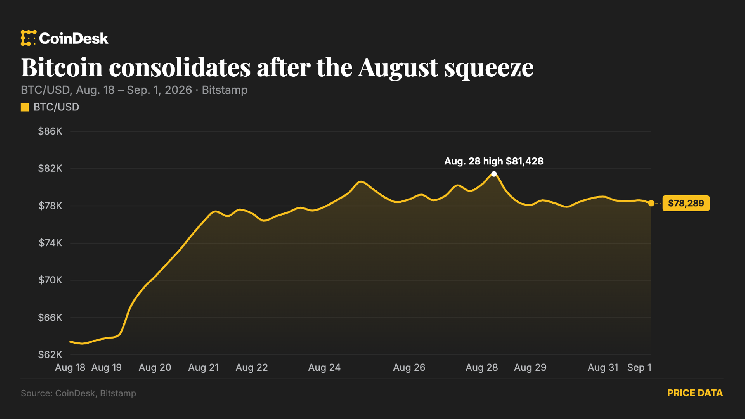
    Bitcoin is trading near $78,000, down 0.4% since midnight UTC and about 0.7% over the past seven days as the market consolidates after a short squeeze lifted the price from below $63,000 to nearly $81,400 last week.

    Bitcoin’s relative strength has remained intact despite the calmer conditions. Nasdaq 100 futures are down 0.5% since midnight, meaning bitcoin is once again outperforming equities.

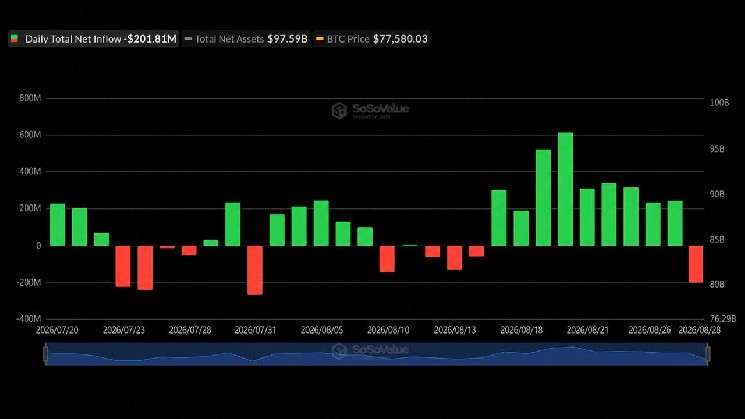
    Spot bitcoin exchange-traded funds recorded $3.04 billion in net inflows across nine consecutive sessions, their longest streak since April. The run ended Friday with a $202 million outflow before resuming Monday with $217 million in fresh inflows, according to SoSoValue data.

    Altcoins are mixed in the latest session. The Altcoin Season index has fallen to 26 out of 100 from 34 on Friday, its lowest reading in more than 90 days.

    Crypto derivatives positioning remains balanced

    Balanced positioning: The 24-hour taker buy-sell volume ratio in crypto futures markets has remained balanced for a second consecutive day. Open interest has held near $136 billion, while trading volume has declined 7%. The combination suggests traders are adding neither significant long nor short exposure and are waiting for a clearer market signal.

    Arbitrum leads gainers: Arbitrum’s $ARB is the best-performing token among the top 100 cryptocurrencies over the past 24 hours, gaining nearly 30%. The rally is supported by increased futures participation, with open interest rising more than 10%. The data points to a buildup of long positions as $ARB attempts to establish support above chart resistance at 11 cents. Annualized funding rates near 8% suggest the market is not overheated.

    Monero open interest continues to rise: Open interest in privacy-focused Monero futures has climbed to 640,000 tokens, the highest level since February 2024. The signals are mixed. Funding rates have dropped to 15% from more than 50%, suggesting bullish positions are no longer overcrowded. However, the 24-hour open-interest-adjusted cumulative volume delta is negative, indicating bearish leadership. XMR has already pulled back to around $525 from Monday’s high of $548.

    Demand for $TRX shorts: Tron’s $TRX stands out with funding rates at minus 80%, signaling crowded bearish positioning. Short sellers are accepting a high cost to maintain their positions. $TRX is trading near 33 cents after falling for a third consecutive day.

    Light positioning in bitcoin and ether: Open interest in $BTC and $ETH remains subdued, hovering near multi-week lows.

    Volatility cools: Bitcoin’s and ether’s 30-day implied volatility indexes, BVIV and EVIV, have reversed their mid-August spikes, pointing to calmer market conditions.

    Options flow turns bullish: In options listed on Deribit, the $80,000 bitcoin call expiring Sept. 25 was the most-traded position over the past 20 hours. A call represents a bullish bet on the underlying asset. For ether, the $2,500 call attracted the most activity.

    Arbitrum leads the altcoin market

    Arbitrum’s surge is the clearest standout across the altcoin sector. The rally is linked to Robinhood Chain, which operates as a dedicated Arbitrum chain and sends 10% of net protocol revenue to the Arbitrum ecosystem.

    Offchain Labs co-founder Steven Goldfeder said Monday that Robinhood Chain’s 24-hour transaction revenue had exceeded $2 million, up from approximately $1.22 million the previous day. At that pace, Arbitrum’s share would amount to roughly $73 million annually.

    ARK Invest’s Lorenzo Valente calculated that gross revenue on Robinhood Chain rose from $54,676 on Aug. 22 to $1.088 million on Aug. 30, an increase of nearly 20 times. Arbitrum’s share increased from $5,400 to $108,000 over the same period.

    Curve DAO’s CRV$0.3586 rose 14% over 24 hours to approximately 35.13 cents on $119 million in trading volume. The move forms part of the broader decentralized finance rally that has lifted lending and decentralized exchange tokens through the second half of August.

    Uniswap’s $UNI extended its gains, rising 8% since midnight to around $5.80 after advancing 12% over the previous 24 hours. The token is now up 34% over the past seven days on $519 million in volume.

    Among the day’s smaller movers, Aave’s AAVE$126.93 gained 1.9% to $126.54, while Morpho’s MORPHO$2.5549 rose 2%. The moves suggest decentralized finance assets are holding up better than the broader crypto market during Tuesday’s session.

  • Bitcoin Holds Above $78,000 as HYPE Leads While Major Cryptocurrencies Slip on Hawkish Fed Bets

    Bitcoin Holds Above $78,000 as HYPE Leads While Major Cryptocurrencies Slip on Hawkish Fed Bets

    Oil is increasingly driving the rates market, with the U.S. 10-year Treasury yield rising to 4.78%. Traders now see roughly 64% odds of an interest-rate hike at the Federal Reserve’s September 16 meeting, up from about 36% before Chair Kevin Warsh’s Jackson Hole address. Gold fell to approximately $4,435 an ounce after gaining 10% in August.

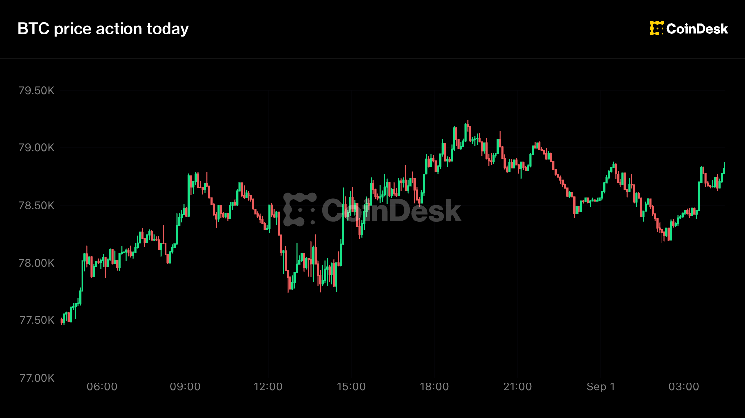
    Bitcoin has held near $78,000 following a 23% rally, a sign that may be more significant than the rally itself. “Holding around $78,000 after a 23% surge is more telling than the surge itself,” said Yusuf Fakhro, partner at ARP Digital, in an email. He added that perpetual open interest is at its lowest level since May, while U.S. spot bitcoin ETFs recorded their strongest week of demand since October 2025. Together, those trends suggest the August advance was driven by spot demand rather than crowded leveraged positions that could trigger further selling.

    Bitcoin ETF flows have since weakened. Trading firm Wintermute recorded $924 million in bitcoin ETF inflows during nine consecutive positive sessions before a $202 million outflow ended the run on Friday. Bitcoin has been rejected at the $82,000 level each time since.

    “Market’s on edge but lacks directional conviction in the short term,” said Jasper De Maere, OTC trader at Wintermute, in an email.

    U.S. jobs data could set bitcoin’s next move

    Friday’s August payrolls report will be the final major labor-market indicator released before the September Federal Open Market Committee meeting. With interest-rate hike expectations already close to two-thirds, a stronger-than-expected jobs report could push Treasury yields higher and send bitcoin back toward the overnight low of $77,200.

  • Bitcoin, Ethereum, Tron, and Cardano Reveal Four Very Different Stories Through Active Addresses

    Bitcoin, Ethereum, Tron, and Cardano Reveal Four Very Different Stories Through Active Addresses

    Bitcoin, Ethereum, Tron, and Cardano are showing sharply different patterns in active addresses, highlighting major differences in blockchain usage and network demand.

    Bitcoin Activity Reflects Changing Investor Behavior

    Bitcoin’s active-address count has fallen significantly compared with previous major market cycles, even though its price remains well above historical levels. According to the latest analysis from Alphractal founder Joao Wedson, the decline does not necessarily signal weaker network usage.

    Bitcoin investors increasingly hold their coins for longer periods and move them less frequently. At the same time, ETFs, custodians, exchanges, and the Lightning Network are playing a larger role in the ecosystem.

    The growing influence of exchange-traded funds is particularly notable. US-based spot Bitcoin ETFs have recorded $3.31 billion in inflows so far in August. This shift in how investors access and hold $BTC may help explain why on-chain activity has not risen at the same pace as Bitcoin’s price.

    Rather than showing that Bitcoin is being used less, the trend may reflect its expanding role as a reserve asset. More activity is now taking place through financial products and other market structures instead of directly on the blockchain.

    Ethereum and Tron Show Strong Network Usage

    Ethereum’s network activity has started accelerating again, with active addresses approaching 1 million. This is happening even though a significant portion of the ecosystem operates on Layer 2 networks, indicating that Ethereum remains highly relevant as financial infrastructure.

    Tron has recorded more than 4 million active addresses, giving it the strongest performance among the four blockchains by this measure. Wedson said much of Tron’s activity appears to be driven by payments and stablecoins, particularly USDT, rather than speculation surrounding the price of TRX.

    The network has become a major infrastructure layer for transferring digital dollars, helping support its high level of address activity.

    Is Cardano Struggling to Gain Usage?

    Cardano presents a starkly different picture. Its network activity has fallen sharply since 2021 and remains at very low levels compared with its historical performance.

    Wedson explained that prices can rise because of narratives, liquidity, and speculation, while on-chain activity provides a clearer indication of whether people are actively using a blockchain.

    Cardano’s weak activity follows years of criticism over the network’s slow development and its difficulty converting its technology into broader real-world usage. More recently, the blockchain has faced significant pressure, including a public warning from founder Charles Hoskinson about a “wave of failures” and the closure of important dApps.

    In the market, $ADA briefly reached $0.254 this month before retreating to $0.196 at the time of writing. Despite the recent price weakness, some market commentators remain optimistic. Analyst Sssebi said he expects $ADA to return to its previous all-time high of $3.10 during the coming bull market and believes it could move above that level.

  • Crypto ETFs Attract $2.07 Billion as Bitcoin and Ether Lead Weekly Inflows

    Crypto ETFs Attract $2.07 Billion as Bitcoin and Ether Lead Weekly Inflows

    Crypto ETF demand broadened this week as Bitcoin funds recorded $924.48 million in net inflows and Ether funds attracted $824.42 million. Capital also moved into altcoin ETFs, with Solana, $XRP and $HYPE funds posting positive flows in every trading session.

    Bitcoin ETFs record $924.48 million in weekly inflows

    Bitcoin ETFs received $337.56 million on Monday and $314.37 million on Tuesday. Inflows continued with $232.12 million on Wednesday and $242.24 million on Thursday, lifting combined assets above $100 billion for the first time in weeks.

    The streak ended on Friday with a $201.81 million outflow. The withdrawal closed a nine-session run of inflows worth roughly $3 billion and brought the weekly total to $924.48 million.

    BlackRock’s IBIT led the market with $938.3 million in weekly inflows. Grayscale’s Bitcoin Mini Trust added $81.9 million, Fidelity’s FBTC attracted $62 million and Morgan Stanley’s MSBT recorded $25.3 million.

    Outflows included $85.2 million from ARK 21Shares’ ARKB, $77.6 million from Grayscale’s GBTC and $16 million from Bitwise’s BITB.

    Bitcoin ETFs end August with net inflows worth $3.31 billion. Source: Sosovalue

    Ether ETF inflows reach $824.42 million

    Ether ETFs maintained stronger momentum throughout the week. Daily inflows increased from $115.57 million on Monday to $179.80 million on Tuesday, $192.35 million on Wednesday and $234.51 million on Thursday. A further $102 million entered the funds on Friday, taking the weekly total to $824.42 million.

    Macroeconomic conditions remained sensitive to interest-rate expectations. U.S. GDP grew at a 1.5% annualized pace in the second quarter, while July core PCE inflation remained at 3.3% year over year. Personal spending rose 0.2% during the month, keeping inflation data and Federal Reserve policy central to investor decisions.

    Solana, $XRP and $HYPE ETFs attract consistent demand

    The widening demand for altcoin ETFs was reflected in the weekly performance of Solana, $XRP and $HYPE funds.

    Solana ETFs attracted $153.87 million, more than five times the previous week’s $28.34 million and the second-largest weekly inflow since inception. Flows remained positive across all five trading sessions, while weekly turnover more than doubled to approximately $699 million. SOL ended near $103.41, around 14% above the previous week’s level.

    Solana ETFs delivered the second-biggest weekly inflow since inception. Source: Sosovalue

    $XRP ETFs recorded $110.49 million in inflows, compared with $39.78 million a week earlier. Positive creations were reported every day, and weekly trading turnover increased to approximately $363 million.

    $HYPE posted an even sharper acceleration. Weekly inflows reached $56.86 million, up from $3.89 million in the previous period, after five consecutive positive sessions. Assets ended the week near $439 million.

    The sustained daily inflows mark an important development for the altcoin ETF market. Previous weekly gains often relied on one or two strong sessions, but Solana, $XRP and $HYPE funds attracted new capital from Monday through Friday.

    Two consecutive weeks of more than $2 billion in combined crypto ETF inflows have placed institutional demand among its strongest stretches of the year. The latest data also indicates that investors are increasingly allocating capital beyond Bitcoin and Ether.

  • Bitcoin Holds Above $78K as U.S.–Iran Clash Pushes Oil Prices Higher

    Bitcoin Holds Above $78K as U.S.–Iran Clash Pushes Oil Prices Higher

    Bitcoin traded near $77,900 on Aug. 31 as renewed fighting between the United States and Iran pushed oil prices higher and pressured global equity markets. The cryptocurrency remained relatively stable despite sharp moves across energy, bond and stock markets after U.S. strikes on Iran’s Larak Island.

    Bitcoin holds near $78,000 as oil prices climb

    Bitcoin was down approximately 0.4% over 24 hours after trading between $77,162 and $79,343. The limited move contrasted with a stronger reaction in other markets following the strikes.

    An unnamed U.S. official confirmed that American forces targeted two Iranian rocket launchers. According to Reuters, the official claimed Iran’s Islamic Revolutionary Guard Corps was preparing rockets carrying sea mines for deployment in the Strait of Hormuz.

    Iran said the attack killed and wounded soldiers and civilians. The Revolutionary Guards promised a “response and punishment,” but did not immediately provide casualty figures or details of further action.

    Brent crude climbed approximately 2.7% to $90.51 per barrel during Monday’s Asian session. West Texas Intermediate traded near $85.23 after gaining more than 2%.

    The oil price increases reflected renewed concern about shipping through the Strait of Hormuz, a key route for global oil and liquefied natural gas movements. Military activity near the waterway can therefore affect energy prices and inflation expectations.

    Asian equities declined, while Nasdaq 100 futures fell between 0.5% and 0.7% across early market readings. Gold also failed to attract sustained safe-haven demand, falling approximately 0.8% to around $4,418 per ounce in the cited market snapshot.

    Bitcoin remained close to $78,000. Its stability does not prove that $BTC has permanently become a geopolitical hedge, but it shows that the latest escalation did not trigger the immediate cryptocurrency sell-off seen during some earlier risk events.

    Bitcoin’s daily chart also pointed to short-term strength. $BTC traded near $78,084, comfortably above the Bollinger Bands’ $72,471 midpoint but below the $86,255 upper band. The bands widened after the latest rally, indicating higher volatility.

    The relative strength index stood at 69.91, just below overbought territory, after recently crossing 70. The reading reflects strong momentum but also leaves Bitcoin vulnerable to consolidation. Daily volume of about 4,200 $BTC remained below the initial breakout spike, suggesting buyers may need stronger participation to challenge $80,000.

    Bitcoin ($BTC) price chart, source: crypto.news

    Bitcoin also held above $62,000 during July’s U.S.–Iran strikes, even as oil, bonds and Asian stocks recorded larger moves.

    Bitcoin outperformed gold and Nasdaq in August

    Bitcoin gained approximately 23% during August, compared with reported advances of 9% for gold and 4% for the Nasdaq. The cryptocurrency was therefore the strongest performer among the three assets over the month.

    The broader crypto market showed less resilience on Monday. XRP declined approximately 0.8%, while Solana lost around 0.6%. Ether traded near $1,625 as traders reduced exposure to several major altcoins.

    Part of Bitcoin’s monthly performance followed renewed institutional demand through U.S. spot exchange-traded funds. The products accumulated approximately $2.8 billion across eight consecutive inflow sessions during the recovery from Bitcoin’s August lows.

    The streak ended on Friday. U.S. spot Bitcoin ETFs recorded an estimated $201.9 million in net outflows on Aug. 28, according to Farside. The reversal indicates that ETF demand should not be characterized as uninterrupted.

    Bitcoin’s rally from approximately $63,500 had previously been supported by eight consecutive ETF inflow sessions, although declining futures exposure indicated that leverage was not the only source of demand.

    Federal Reserve policy adds uncertainty to Bitcoin’s outlook

    The geopolitical escalation followed Federal Reserve Chair Kevin Warsh’s restrictive policy message at the Jackson Hole symposium on Aug. 28.

    Warsh said inflation remained too high, while labor markets were stable and economic output was solid. According to his published remarks, he said most Federal Open Market Committee members preferred to await more information before deciding whether another policy change was appropriate.

    Markets interpreted the speech as increasing the possibility of another interest-rate rise. Fed funds futures placed the probability of a September increase near 57% to 60%, up from approximately 35% before the address. The estimate represents market pricing rather than a Federal Reserve commitment.

    Higher oil prices could further complicate the outlook. Sustained energy price increases can raise transportation and production costs, making it more difficult for inflation to return toward the Federal Reserve’s 2% objective.

    Sept. 4 jobs report is the next major Bitcoin catalyst

    The next major U.S. market catalyst is the August employment report, scheduled for Sept. 4 at 8:30 a.m. ET, according to the Bureau of Labor Statistics calendar.

    Strong employment data could reinforce expectations for tighter monetary policy. A weaker report could reduce rate-hike forecasts, although the market response would also depend on wage growth and unemployment.

    Bitcoin’s immediate technical range remains between support around $77,000 and resistance extending from approximately $79,400 to $80,800. These levels are market observations rather than guaranteed reversal points.

    The durability of Bitcoin’s relative strength will depend on whether it remains stable if oil prices continue rising, equity losses deepen or interest-rate expectations move higher. ETF flows and the Sept. 4 labor report will provide the next evidence.

  • Bitcoin ETFs End Nine-Day Inflow Streak as Ethereum Funds Extend Their Run

    Bitcoin ETFs End Nine-Day Inflow Streak as Ethereum Funds Extend Their Run

    U.S. spot Bitcoin exchange-traded funds recorded $201.9 million in net outflows on Aug. 28, ending a nine-day inflow streak and reducing cumulative net inflows to approximately $55.1 billion. Ethereum ETFs continued to attract investor capital, recording $102.1 million in inflows and extending their own streak to 10 consecutive days.

    Bitcoin ETFs reverse after strong inflow streak

    U.S. spot Bitcoin ETFs broke a nine-day winning streak on Friday as investors withdrew money while Ethereum ETFs continued to pull in fresh capital.

    According to SoSoValue data, the Bitcoin funds posted $201.9 million in net outflows on Aug. 28. The reversal ended a run of consecutive inflows that had continued since mid-August, lowering cumulative net inflows to about $55.1 billion. The funds held approximately $93.9 billion in total net assets. Decrypt’s ETF flow tracker changed its Bitcoin sentiment reading to “bearish” on the day.

    Myriad: Bitcoin’s next price move? Click to make your prediction.

    An exchange-traded fund, or ETF, is an investment vehicle that holds an underlying asset and trades on a traditional stock exchange. It allows investors to buy and sell shares through a standard brokerage account. A spot Bitcoin ETF holds Bitcoin directly, with each share representing a claim on a portion of the fund’s holdings. This structure gives investors indirect exposure to Bitcoin’s price without requiring them to purchase the cryptocurrency themselves.

    The convenience of spot Bitcoin ETFs has helped attract traditional and institutional investors. U.S. spot Bitcoin ETFs launched in January 2024 after years of regulatory rejections and quickly became some of the fastest-growing ETFs in history.

    Daily ETF flows now shift between heavy accumulation and sharp withdrawals as Bitcoin prices and the broader macroeconomic environment change. As a result, market observers closely monitor fund flows as a measure of investor sentiment.

    Bitcoin ETF Net Flows. Image: Decrypt

    Ethereum ETFs extend 10-day inflow streak

    Friday’s pullback followed an otherwise strong period for Bitcoin ETFs. The funds attracted $2.8 billion during an eight-day inflow streak as Bitcoin tested $80,000. They also recorded their largest single-day inflow since May, with daily inflows repeatedly exceeding $300 million and reaching more than $600 million on Aug. 20.

    Ethereum ETFs showed no comparable weakness. The funds brought in $102.1 million on Aug. 28, extending their inflow streak to 10 days, according to SoSoValue. Their cumulative net inflows rose to approximately $12.9 billion, while total net assets reached $13.8 billion.

    Ethereum ETF Net Flows. Image: Decrypt

    Decrypt’s tracker maintained its Ethereum reading at “bullish.” The sustained demand represents a notable shift, with Ethereum products in recent sessions nearly matching or exceeding Bitcoin’s daily inflows despite having a much smaller asset base.

    The divergent ETF flows emerged as Bitcoin declined after Federal Reserve Chair Kevin Warsh delivered hawkish remarks at Jackson Hole. The comments cooled a rally that had pushed Bitcoin toward $80,000, although the cryptocurrency later recovered to around $79,000 over the weekend.

    The single-day Bitcoin ETF outflow remains modest compared with the tens of billions of dollars the funds have accumulated since their launch. The end of a nine-day inflow streak does not necessarily indicate a broader decline in institutional demand, which has remained strong across both Bitcoin and Ethereum.

  • Global ETF Demand Could Drive Bitcoin’s Next Bull Cycle Peak

    Global ETF Demand Could Drive Bitcoin’s Next Bull Cycle Peak

    Bitcoin’s current bull-cycle peak could be driven by institutional capital and exchange-traded funds (ETFs) outside the United States, according to Ki Young Ju, founder and CEO of cryptocurrency market analytics platform CryptoQuant.

    Ju outlined the forecast in an Aug. 27 post on X, arguing that international market access could become a significant source of demand after U.S. products expanded regulated exposure to bitcoin.

    Ju stated:

    “The peak of this bull cycle will likely be driven by institutional money and ETFs outside the US.”

    South Korea Highlights Barriers to Bitcoin ETF Access

    Ju cited South Korea as an example of the restrictions that remain in international markets. The country does not have a spot bitcoin ETF, retail investors cannot purchase foreign-listed spot bitcoin ETFs, and most companies are still unable to open exchange accounts to buy $BTC.

    South Korea has begun allowing corporate participation in stages. A Financial Services Commission (FSC) roadmap includes a phase covering about 3,500 listed companies and qualified professional investors, while financial companies and other corporations remain outside the framework.

    Ju described widespread retail access as a possible signal that the market cycle is reaching its peak:

    “This cycle’s top might be when a banker at a regional bank in Korea recommends a spot bitcoin ETF to a granny for her savings.”

    The forecast shifts attention away from U.S. fund flows and toward markets where regulated bitcoin investment products are unavailable or have limited distribution. The U.S. Securities and Exchange Commission (SEC) approved spot bitcoin exchange-traded products in January 2024, enabling investors to gain exposure through conventional brokerage and investment accounts.

    Ju argues that similar access in other countries could broaden participation during the next phase of bitcoin’s cycle.

    Institutions Build Bitcoin and Tokenization Infrastructure

    Institutional adoption extends beyond direct bitcoin purchases and spot ETF holdings, although access and service offerings remain uneven. Strategy’s Bitcoin Banking Adoption Index assessed 25 major institutions across trading, custody, digital asset products, financing, and corporate participation.

    The index placed overall bank adoption at 32%, indicating substantial room for financial institutions to expand their digital asset capabilities.

    Tokenized real-world assets (RWAs) could provide another part of the financial infrastructure that Ju expects to support broader adoption. As of Aug. 29, RWA.xyz’s Global Market Overview reported $38.63 billion in distributed asset value, an increase of 2.65% over the previous 30 days.

    These products are part of the tokenized RWA market, which transfers claims on assets such as government securities and private credit to blockchain-based systems for issuance, settlement, and transfer.

    Stablecoin Liquidity Could Expand Market Access

    Deeper stablecoin markets could provide institutions with greater liquidity for trading, settlement, and cross-border transfers as regulated bitcoin access expands.

    The Bank for International Settlements (BIS) said stablecoins show potential for faster, programmable payments but warned that current designs can create financial integrity, liquidity, and monetary risks. The assessment underscores that expanding on-chain financial infrastructure does not remove regulatory or operational concerns.

    Bitcoin’s fixed supply limit and decentralized settlement remain distinct from the regulated funds and tokenized financial systems that give investors access to the asset. Wider ETF distribution could increase bitcoin access without changing the network’s underlying design.

    Ju expects both investment access and the infrastructure supporting it to expand beyond the U.S. market. His comments follow rapid adoption of U.S. bitcoin ETFs, with spot funds attracting about $57 billion in net inflows during their first two years.

    “So far this has been a US adoption story, but the next phase is global institutionalization with deeper stablecoin liquidity and RWA rails,” Ju noted, adding:

    “More institutions will hold $BTC as a strategic asset, and access will improve in the many countries that still lack ETFs.”

    The outlook centers on wider international ETF availability, increased institutional bitcoin holdings, and blockchain-based financial infrastructure as factors that could shape the cryptocurrency’s next stage of adoption.

  • Bitcoin ETFs End 9-Day Inflow Streak With $202 Million Outflow as Ether ETFs Gain $102 Million

    Bitcoin ETFs End 9-Day Inflow Streak With $202 Million Outflow as Ether ETFs Gain $102 Million

    Bitcoin ETFs End Nine-Day Inflow Streak

    U.S. spot bitcoin exchange-traded funds (ETFs) ended a nine-session run of daily inflows on August 28, recording approximately $202 million in net outflows. The streak began on August 17 and had attracted roughly $3.04 billion before breaking.

    The nine-day inflow period pushed total bitcoin ETF assets beyond a milestone that few expected to arrive so quickly. Bitcoin.com News reported that the funds surpassed $100 billion in net assets on August 27. BlackRock’s iShares Bitcoin Trust (IBIT) led that day with $277.6 million in inflows, while Fidelity’s FBTC recorded $83.6 million in outflows and Grayscale’s GBTC lost another $27.2 million.

    Bitcoin ETFs have experienced sharp moves in both directions this year. In May, the same group of funds recorded a then-record nine-day outflow streak, losing approximately $2.8 billion as bitcoin’s price fell from about $80,000 to $73,000.

    Spot Ether ETFs Extend Buying Streak

    Spot ether ETFs moved in the opposite direction on August 28, attracting $102 million and extending their own inflow streak to 10 consecutive sessions.

    Ether ETFs have also benefited from strong demand earlier in August, when the category recorded $2.6 billion in inflows during its strongest week since October. BlackRock’s ETHA accounted for much of the activity and helped triple the sector’s typical trading volume.

    Ether’s price has broadly followed bitcoin’s performance, even as the two cryptocurrency ETF markets have briefly moved in different directions.

    Bitcoin Price Holds Near $77,500

    The bitcoin ETF outflows came at a notable point for the cryptocurrency market. Bitcoin opened August 28 at $80,261.86 before falling to its current level of approximately $77,500.

    Bitcoin is up only 1% over the past week, making a single day of ETF selling appear more consistent with profit-taking than panic selling. The market was also preparing for the expiration of roughly $6.4 billion in Deribit options that Friday.

    One negative session does not erase the previous $3 billion inflow run. ETF investors will be watching the next session’s data to determine whether the outflows were a temporary setback or the beginning of a longer trend. Spot ether ETFs, meanwhile, enter the new week with their 10-day inflow streak intact.

    Source: cryptonews.net

  • Cardone Capital Adds 1,200 BTC, Doubles Down on Bitcoin and Multifamily Housing

    Cardone Capital Adds 1,200 BTC, Doubles Down on Bitcoin and Multifamily Housing

    U.S. real estate investment firm Cardone Capital has expanded its Bitcoin treasury by purchasing 1,200 $BTC. The company, led by founder Grant Cardone, announced the acquisition on X, formerly Twitter, while also reporting growth in its multifamily housing portfolio.

    Cardone Capital Expands Its Bitcoin Holdings

    Grant Cardone said Cardone Capital had added approximately 2,000 apartment units and another 1,200 $BTC. The purchase brings the firm’s total Bitcoin holdings to more than 4,000 $BTC, following an earlier disclosure that it held over 2,800 $BTC.

    The move reflects Cardone’s public support for Bitcoin as a potential hedge against inflation and a store of value. He has repeatedly emphasized diversification into hard assets, and Cardone Capital’s treasury strategy now combines multifamily real estate with cryptocurrency.

    Institutional Interest in Bitcoin and Real Estate

    Cardone Capital’s Bitcoin purchase comes as more institutions and corporations add the cryptocurrency to their balance sheets. While some companies are shifting their focus toward data centers and artificial intelligence infrastructure, Cardone Capital continues to prioritize multifamily housing alongside Bitcoin.

    This approach reflects the view among some investors that Bitcoin can complement traditional real estate holdings. The firm’s continued accumulation also highlights changing institutional attitudes toward digital assets as regulatory clarity improves and Bitcoin exchange-traded funds gain traction in the U.S. market.

    Why Cardone Capital’s Bitcoin Strategy Matters

    Cardone Capital’s decision to increase its Bitcoin holdings indicates that mid-sized investment firms are becoming more comfortable allocating capital to cryptocurrency, beyond the large technology companies and hedge funds that have already entered the market.

    Maintaining a portfolio that combines multifamily housing with Bitcoin also gives the firm exposure to income-producing real estate and a volatile asset with potentially higher growth prospects. For investors, the strategy underscores the importance of diversification and the growing acceptance of Bitcoin as a potential corporate treasury asset.

    The move may also encourage other real estate companies to consider digital assets as part of their long-term investment strategies.

    What Cardone Capital’s Bitcoin Purchase Means

    Cardone Capital’s latest acquisition reinforces its commitment to both real estate and cryptocurrency. By expanding its multifamily housing portfolio while increasing its $BTC reserves, the firm is positioning itself across two major asset classes and participating in the broader institutional shift toward digital assets.

    Frequently Asked Questions

    How much Bitcoin does Cardone Capital now hold?

    Based on the latest announcement, Cardone Capital holds more than 4,000 $BTC after adding 1,200 $BTC to its previous holdings of over 2,800 $BTC.

    Why is Cardone Capital investing in Bitcoin?

    Grant Cardone has publicly described Bitcoin as a hedge against inflation and a store of value. The firm is using Bitcoin to diversify its treasury assets beyond traditional real estate investments.

    Is Cardone Capital’s move part of a broader trend?

    Yes. Institutions and corporations have been adding Bitcoin to their balance sheets, particularly as regulatory clarity improves and Bitcoin ETFs become more established in the U.S. market.

    Related Reading

    • Bitcoin and Gold Slide as Fed Chair Signals Hawkish Stance
    • Crypto Futures Liquidations Top $213M in One Hour as Market Volatility Spikes
    • Bitcoin Drops Below $77,000 as Market Faces Renewed Selling Pressure
    • Crypto Futures Liquidations Top $107 Million in One Hour as Market Volatility Spikes
    • Bitcoin Slips Below $78,000 as Crypto Market Faces Renewed Selling Pressure