
Tag: Bitcoin ETF

  • ‘Only hedge funds, retail sold’ — Will BTC Sustain Rally as Bitcoin ETF Flows Turn Positive?

    ‘Only hedge funds, retail sold’ — Will BTC Sustain Rally as Bitcoin ETF Flows Turn Positive?

    Key Highlights

    • U.S. Spot Bitcoin ETFs recorded $2.65 billion in net inflows across five consecutive trading days, flipping year-to-date flows positive with $349 million, led by BlackRock commanding half of all demand.
    • Bitcoin surged to an eight-month high of $87,000 before retreating below $84,000 as 10-year Treasury yields climbed to 5.1% and CME FedWatch data priced a 64% probability of a Federal Reserve rate hike in October.
    • Galaxy Research data reveals cumulative ETF flows have recovered half of the $12 billion deficit since October 2023, though Bloomberg analyst James Seyffart identifies hedge funds and retail traders as the primary sellers over the past year.

    Five-Day Inflow Surge Turns YTD Flows Positive

    U.S. Spot Bitcoin exchange-traded funds extended a winning streak to five consecutive sessions, amassing $2.65 billion in net inflows and marking a decisive shift in market sentiment. According to Galaxy Research data, the complex attracted $1 billion on Monday alone, followed by $714 million on Tuesday and $346 million on Wednesday. The sustained demand lifted year-to-date flows into positive territory for the first time, registering a net $349 million inflow since January. The bullish wave propelled Bitcoin to an eight-month peak of $87,000, signaling renewed institutional conviction after months of sideways price action.

    BlackRock Leads Institutional Demand Amid Cumulative Flow Recovery

    BlackRock’s IBIT fund drove approximately half of the five-day inflow total, underscoring the asset manager’s dominant position in the Bitcoin ETF landscape. The recent surge has significantly repaired cumulative flow metrics that had deteriorated sharply since October 2023. Galaxy Research figures show cumulative flows had contracted by $12 billion, equivalent to 77,800 BTC, during the preceding drawdown. The current rebound has erased roughly half that deficit, with cumulative flows now down only 5.7% from inception highs, standing at approximately $55 billion in total assets despite the crypto winter.

    Bloomberg analyst James Seyffart noted that the recent traction could soon help the cumulative flows (aggregate demand since inception) turn positive too. Seyffart added that the outflows were mainly driven by hedge funds and retail. “By far, the biggest sellers of the ETFs over the last ~year were hedge funds and retail traders/investors.” This distinction highlights a structural shift: while speculative participants exited positions during the downturn, institutional allocators have maintained or expanded exposure, providing a more resilient demand base.

    Macro Headwinds: Bond Yields and Fed Rate Hike Fears

    Despite the ETF momentum, Bitcoin’s advance stalled mid-week as macroeconomic pressures intensified. The 10-year U.S. Treasury yield climbed to 5.1%, while oil prices ticked higher, reigniting inflation concerns across risk markets. Interest rate traders, per CME FedWatch data, priced a 64% probability of another Federal Reserve rate hike at the October meeting. This repricing dampened risk appetite and dragged Bitcoin from its $87,000 high to below $84,000, a decline of approximately 4% in short order.

    Historical precedent offers a nuanced perspective. In the past, U.S. Treasury intervention plans to control bond yields have been viewed as net inflationary and an overall boost to scarce assets such as BTC and gold. Whether that narrative will hold and drive BTC higher remains to be seen. For the rate hike fears, however, the asset typically remains muted before the Fed decision and tends to push higher afterwards. Market participants are closely monitoring whether the current ETF demand can withstand sustained bond market volatility.

    Technical Analysis: $82K Weekly Close as Key Confirmation Level

    From a technical standpoint, analyst Benjamin Cowen projected that the uptrend could only be confirmed if there is a weekly candlestick close above $82K (May peak). This level, corresponding to Bitcoin’s previous local high from May, serves as a critical structural reference point. A weekly close above this threshold would validate the breakout structure and suggest the recent ETF-driven rally has legs beyond short-term momentum. Conversely, failure to reclaim and hold $82,000 on a weekly basis could expose the asset to further consolidation or retest of lower support levels.

    Why This Matters

    The five-day inflow streak represents the most sustained institutional accumulation since the ETFs’ January launch, suggesting that the “crypto winter” narrative has fundamentally shifted for professional allocators. BlackRock’s outsized participation signals deepening integration of Bitcoin into traditional portfolio construction. However, the immediate price reversal underscores that Bitcoin remains acutely sensitive to Federal Reserve policy expectations and Treasury market dynamics. The interplay between ETF flow momentum—now structurally positive on a cumulative basis—and macro liquidity conditions will likely dictate Bitcoin’s trajectory through the fourth quarter. Investors should watch the October Fed meeting, weekly close above $82,000, and whether cumulative flows breach inception highs as key catalysts.

    Frequently Asked Questions

    How much have U.S. Spot Bitcoin ETFs accumulated in the recent five-day streak?

    The ETF complex recorded $2.65 billion in net inflows across five consecutive trading days, with $1 billion on Monday, $714 million on Tuesday, and $346 million on Wednesday, per Galaxy Research data.

    Who were the primary sellers during the previous outflow period?

    According to Bloomberg analyst James Seyffart, hedge funds and retail traders/investors were by far the biggest sellers of the ETFs over the last year, driving the $12 billion cumulative flow deficit since October 2023.

    What technical level must Bitcoin reclaim to confirm the uptrend?

    Analyst Benjamin Cowen projects that a weekly candlestick close above $82,000—the May peak—is required to confirm the uptrend structure following the recent ETF-driven rally.

  • Bitcoin Could Test $90,000 After Short Squeeze, but Traders Warn Leverage Is Building

    Bitcoin Could Test $90,000 After Short Squeeze, but Traders Warn Leverage Is Building

    Key Highlights

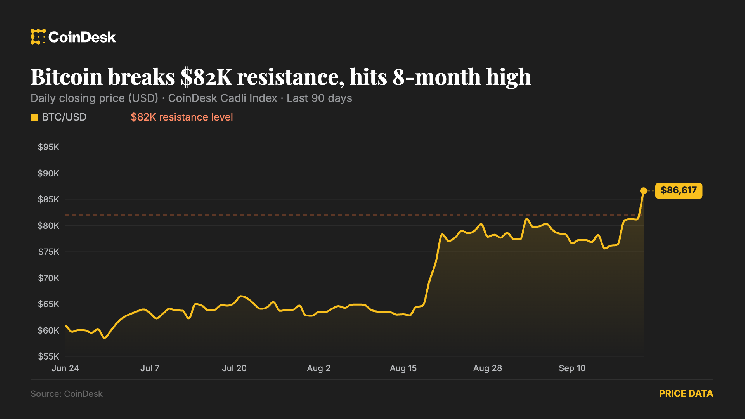
    • Bitcoin surged to an eight-month high of $86,000 on Monday, clearing the $82,000 resistance level that had capped prices since August and triggering roughly $750 million in bearish derivative liquidations.
    • Futures open interest rose faster than price, with approximately $2 billion in new leveraged exposure added since the breakout, signaling aggressive fresh positioning even as short sellers were wiped out.
    • While renewed spot ETF demand and short covering drove the rally, crypto-native investor positioning has been slower to flip from bearish to bullish, according to Nansen analytics.

    Bitcoin Breaks Key Resistance at $82,000

    Bitcoin pushed to a fresh eight-month high of $86,000 on Monday, extending a rally that forced bearish traders out of their short positions and drew fresh leverage bets back into the market. The move cleared the $82,000 level that had acted as a ceiling for prices since August, unleashing a cascade of liquidations across crypto derivative markets.

    Short Liquidations Fuel Momentum

    Roughly $750 million in bearish crypto derivative positions were liquidated as bitcoin cleared $82,000, according to CoinGlass data. When short positions are liquidated, exchanges execute buy orders to close them, adding fuel to an already upward market. “Bitcoin up 5% this morning due to short perpetual futures contracts being liquidated,” Schwab’s head of crypto research Jim Ferraioli told CoinDesk.

    Leveraged Bets Return Aggressively

    Meanwhile, futures open interest — the value of outstanding derivatives bets — rose even faster than bitcoin’s price. Since the breakout, about $2 billion in new leveraged exposure has been added, according to Coinalyze data, suggesting traders are placing fresh bets even as shorts got wiped out. The rapid rebuild in open interest indicates strong conviction among market participants that the breakout has legs.

    ETF Demand vs. Crypto-Native Caution

    While the rally has been fueled by a mix of renewed ETF demand and short covering, crypto-native positioning has been slower to shift from bearish to bullish, according to crypto analytics firm Nansen’s senior research analyst, Nicolai Sondergaard. This divergence suggests that while institutional flows via exchange-traded products are driving near-term price action, the core crypto trading community remains cautious about the sustainability of the move.

    Why This Matters

    The $82,000 level had served as a critical technical barrier since August, and its decisive breach marks the first time bitcoin has traded above this threshold in eight months. The combination of massive short liquidations and a rapid $2 billion rebuild in open interest creates a feedback loop that can sustain upward momentum in the near term. However, the reluctance of crypto-native traders to fully embrace the rally introduces a potential vulnerability: if ETF flows slow or macro conditions shift, the market may lack the deep conviction needed to hold gains. Market participants will be watching whether open interest continues to expand alongside price — a sign of healthy trend development — or if the current leverage buildup sets the stage for a volatile unwind.

    Frequently Asked Questions

    What triggered Bitcoin’s surge to $86,000?

    The rally was driven by a combination of renewed spot Bitcoin ETF demand and a massive short squeeze. As Bitcoin cleared the $82,000 resistance level — a ceiling since August — roughly $750 million in bearish derivative positions were liquidated, forcing exchanges to execute buy orders that accelerated the move higher.

    How much new leverage has entered the market since the breakout?

    According to Coinalyze data, approximately $2 billion in new leveraged exposure has been added to futures open interest since Bitcoin broke above $82,000, with open interest rising faster than price itself.

    Are crypto-native traders bullish on this move?

    Not yet. Nansen senior research analyst Nicolai Sondergaard notes that crypto-native positioning has been slower to shift from bearish to bullish, suggesting the core trading community remains cautious despite the price breakout and ETF-driven inflows.

  • $1.5T and Counting: 2026 ETF Inflows Surpass 2025’s Record

    $1.5T and Counting: 2026 ETF Inflows Surpass 2025’s Record

    Key Highlights

    • Bitcoin ETFs dominated 24-hour inflows with $433.03 million, leading a broad-based rally that saw Ethereum attract $143.80 million and Solana draw $47.62 million, per SoSo Value data.
    • Grayscale’s newly launched Spot Zcash ($ZEC) ETF recorded $37.67 million in inflows within its first month, outperforming many established altcoin ETF products.
    • Bloomberg’s Eric Balchunas noted global ETFs have already surpassed 2025’s full-year record of $1.5 trillion in flows with 3.5 months remaining, while Coinbase Derivatives filed with the CFTC to launch cash-settled perpetual futures on U.S. stocks and ETFs.

    Broad-Based Crypto ETF Inflows Signal Renewed Investor Appetite

    The cryptocurrency exchange-traded fund landscape experienced a decisive shift in momentum over the past 24 hours, with net inflows turning positive across nearly every major digital asset category. According to data compiled by SoSo Value, Bitcoin [BTC] products commanded the lion’s share of fresh capital, absorbing $433.03 million in net subscriptions. Ethereum [ETH] followed at a considerable distance with $143.80 million, while Solana [SOL] continued its institutional adoption trajectory with $47.62 million in new allocations.

    Grayscale’s Zcash ETF Defies Altcoin Skepticism

    Perhaps the most striking data point emerged from Grayscale Investments’ recently launched Spot Zcash ($ZEC) ETF. Despite being on the market for less than a month, the fund has already accumulated $37.67 million in net inflows—a figure that exceeds the early traction of numerous longer-standing altcoin ETFs. Smaller but notable inflows were also recorded for Hyperliquid [HYPE] at $1.03 million and Chainlink [LINK] at $2.19 million. XRP [$XRP] stood alone on the negative side of the ledger, registering modest outflows of approximately $43,700, suggesting lingering hesitation among investors toward the token’s ETF prospects.

    Balchunas: ETF Industry Rewriting Flow Records at Historic Pace

    The surge in crypto fund flows mirrors a broader structural expansion across the entire ETF ecosystem. Bloomberg Senior ETF Analyst Eric Balchunas highlighted the milestone on X, stating:

    ETFs have now surpassed last year’s record flows of $1.5T with 3.5mo to spare.

    Balchunas provided critical historical context, noting that roughly two decades ago—when he began covering the industry—$100 billion in annual flows was considered a banner year. Today, the global ETF complex is attracting more than $100 billion every month, translating to roughly $8.5 billion per trading day. This acceleration has occurred despite what Balchunas characterized as a challenging 2026 for cryptocurrency markets, which have contended with Middle Eastern geopolitical tensions, rising oil prices, Federal Reserve rate hikes, and the legislative setback of the CLARITY Act. The analyst emphasized that even after a strong August rally gave way to September selling pressure, the downturn proved temporary, with flows rapidly reasserting their upward trajectory.

    Coinbase Derivatives Pushes Into Equity-Linked Perpetual Futures

    Balchunas’s commentary arrived alongside a significant regulatory filing from Coinbase Derivatives. The exchange has petitioned the U.S. Commodity Futures Trading Commission (CFTC) for approval to launch cash-settled perpetual futures contracts tied to individual U.S.-listed stocks and ETFs. If cleared, the product would enable eligible U.S. traders to obtain leveraged long or short exposure to single-name equities and exchange-traded funds without purchasing the underlying securities. These instruments would be structured as security futures products, placing them under the joint regulatory purview of the CFTC and the Securities and Exchange Commission (SEC). The move represents Coinbase’s most ambitious push yet to diversify its derivatives franchise beyond digital assets and establish a regulated U.S. venue for equity-linked perpetual contracts.

    Global Expansion Narrative Gains Momentum

    Optimism extends beyond U.S. borders. Japan-based DeFi asset manager xWin Finance projects that the country’s forthcoming Spot Bitcoin ETFs could attract up to $18.4 billion in assets, underscoring the global dimension of institutional crypto adoption. Combined with the Coinbase filing and record-breaking flow data, the developments suggest a maturing market infrastructure that is increasingly bridging traditional finance and digital asset ecosystems.

    Why This Matters

    The convergence of record-breaking global ETF flows, successful launches of niche crypto products like Grayscale’s Zcash ETF, and major exchanges like Coinbase seeking to replicate crypto’s perpetual futures model in equity markets signals a profound structural shift. For investors, the data confirms that institutional capital allocation to digital assets is deepening beyond Bitcoin and Ethereum into a wider spectrum of protocols. For regulators, the Coinbase filing tests the boundaries of security futures frameworks and could establish a precedent for crypto-native firms entering traditional derivatives markets. The resilience of flows amid macroeconomic headwinds—geopolitical instability, monetary tightening, and legislative uncertainty—suggests that crypto ETFs are evolving from speculative vehicles into permanent portfolio building blocks. Market participants should monitor the CFTC’s review of Coinbase’s application and the trajectory of Japan’s Spot Bitcoin ETF launch as key indicators of the next phase of institutional integration.

    Frequently Asked Questions

    Which crypto assets saw the largest ETF inflows in the latest 24-hour period?

    Bitcoin led with $433.03 million in net inflows, followed by Ethereum at $143.80 million and Solana at $47.62 million, according to SoSo Value data. Grayscale’s new Spot Zcash ETF also attracted a notable $37.67 million in its first month.

    What is the significance of Eric Balchunas’s comment about $1.5 trillion in ETF flows?

    Balchunas, a senior ETF analyst at Bloomberg, noted that global ETFs have already exceeded the full-year 2025 flow record of $1.5 trillion with 3.5 months remaining in 2026. He contrasted this with the industry standard of two decades ago, when $100 billion in annual flows was considered exceptional, versus the current pace of over $100 billion monthly.

    What would Coinbase Derivatives’ proposed perpetual futures on stocks and ETFs enable?

    If approved by the CFTC, the cash-settled perpetual futures would allow eligible U.S. traders to take leveraged long or short positions on individual U.S.-listed stocks and ETFs without owning the underlying shares. The contracts would be regulated as security futures products under joint CFTC and SEC oversight, expanding Coinbase’s derivatives offerings beyond cryptocurrency.

  • Eric Balchunas Highlights Bitcoin’s Growing Appeal

    Eric Balchunas Highlights Bitcoin’s Growing Appeal

    Key Highlights

    • Bloomberg ETF analyst Eric Balchunas identifies a generational shift driving Bitcoin ETF interest, with younger investors favoring cryptocurrency over traditional assets like gold.
    • Despite current low trading volume across the broader crypto market, Bitcoin ETF discussions signal growing institutional confidence and potential reshaping of investment strategies.
    • Market participants are monitoring potential new Bitcoin ETF approvals, regulatory sentiment shifts, and resistance levels as institutional fund entry could test Bitcoin’s price dynamics.

    Generational Shift Fuels Bitcoin ETF Momentum Over Gold

    The cryptocurrency investment landscape is witnessing a notable transformation as Bitcoin exchange-traded funds capture heightened attention from market participants. Bloomberg ETF analyst Eric Balchunas has spotlighted a decisive generational shift, observing that younger, tech-savvy investors are increasingly gravitating toward Bitcoin as a preferred store of value over traditional safe-haven assets such as gold. This demographic trend carries significant implications for future market dynamics, suggesting that as this cohort accumulates wealth, institutional engagement with digital assets could accelerate substantially.

    Mixed Market Conditions Contrast With ETF Enthusiasm

    While the buzz surrounding Bitcoin ETFs continues to build, the broader cryptocurrency market remains in a mixed state characterized by notably low trading volume. This subdued activity reflects potential hesitation among investors even as confidence in Bitcoin-focused financial products grows. Traders and analysts are closely tracking how this divergence between product enthusiasm and spot market liquidity might influence future ETF approval timelines and the overall regulatory landscape. The increasing visibility of Bitcoin among large institutional investors further underscores the asset’s progression toward mainstream financial acceptance.

    Institutional Entry Poised to Test Market Structure

    The evolving regulatory environment represents a critical variable for the sector’s trajectory. As traditional banks and investment funds seek exposure to the younger demographic driving crypto adoption, regulators may adapt frameworks to accommodate these novel financial products. Market observers note that the entry of institutional funds could test existing resistance levels in Bitcoin’s price, while ongoing investor education around ETF structures may further catalyze demand. The interplay between approval pipelines, liquidity conditions, and regulatory sentiment will likely define the next phase of cryptocurrency integration into traditional portfolios.

    Why This Matters

    The convergence of demographic preferences, product innovation, and institutional adoption marks a pivotal inflection point for cryptocurrency’s role in global finance. Eric Balchunas’ analysis highlights that the shift away from gold among younger investors is not merely speculative but reflects fundamental changes in how value preservation is perceived across generations. For market participants, the current low-volume environment coupled with high ETF interest creates a unique setup where structural changes—such as new fund approvals or regulatory clarity—could trigger outsized market movements. Understanding this dynamic is essential for navigating the evolving intersection of traditional finance and digital assets.

    Frequently Asked Questions

    Who is Eric Balchunas and why is his analysis significant?

    Eric Balchunas is a senior ETF analyst at Bloomberg Intelligence specializing in the exchange-traded fund industry. His commentary on Bitcoin ETFs and generational investment trends carries weight due to Bloomberg’s authoritative position in financial data and his track record analyzing fund flows and market structure developments.

    What does the current low trading volume indicate about the crypto market?

    Low trading volume suggests investor hesitation or a wait-and-see approach despite growing enthusiasm for Bitcoin ETF products. This divergence between product interest and spot market activity often precedes significant directional moves once catalysts such as regulatory decisions or institutional allocations materialize.

    How might new Bitcoin ETF approvals affect market liquidity and price?

    Additional ETF approvals could expand institutional access, potentially increasing demand and testing Bitcoin’s price resistance levels. However, the actual impact on liquidity will depend on the size of fund inflows, the regulatory conditions attached to approvals, and whether new products attract fresh capital or merely redistribute existing crypto exposure.

  • Morgan Stanley’s $50.6M Bitcoin Purchase Bolsters Market, But Rally to $82K Faces Key Hurdle

    Morgan Stanley’s $50.6M Bitcoin Purchase Bolsters Market, But Rally to $82K Faces Key Hurdle

    Morgan Stanley Expands Bitcoin ETF Holdings as Institutional Demand Strengthens

    Institutional appetite for Bitcoin accelerated this week as Morgan Stanley continued building its position in the MSBT Bitcoin ETF, while broader spot ETF flows remained positive and exchange netflows signaled tightening supply.

    Morgan Stanley Adds 51.58 BTC to MSBT Fund

    Morgan Stanley’s MSBT Bitcoin ETF received an additional 51.58 BTC, valued at approximately $4 million, transferred from Coinbase Prime. The transaction extends a two-week accumulation streak that has brought the fund’s total inflows to 641.87 BTC, worth roughly $50.6 million.

    Notably, the accumulation occurred through multiple smaller transfers rather than a single large transaction, a pattern that coincided with Bitcoin consolidating below the $82,000 resistance level. This steady buying pressure reinforces the institutional demand narrative as price action stabilizes.

    Broader Spot ETF Flows Remain Positive

    Beyond Morgan Stanley, the wider Bitcoin spot ETF market recorded $6 million in daily net inflows during the latest reporting period, equivalent to approximately 78.39 BTC. Cumulative net inflows across all spot ETFs have now reached nearly $55.63 billion, representing roughly 695,820 BTC.

    While the daily figure remains modest relative to the cumulative total, the consistent positive flows complement MSBT’s accumulation and strengthen the broader demand outlook. Sustained ETF inflows could provide additional buying support if Bitcoin continues defending its current demand zone.

    Source: CoinGlass

    Persistent Exchange Outflows Restrict Supply

    Exchange activity added another supportive element, with Bitcoin spot netflows remaining predominantly negative across the observed period. The most recent reading on September 12 showed a netflow of -$6.66 million, continuing a pattern of frequent spot outflows.

    Negative netflows indicate that withdrawals exceeded deposits during these sessions, suggesting more BTC is leaving exchanges than entering them. This trend limits immediate supply pressure even as institutional players continue accumulating.

    Source: CoinGlass

    Technical Analysis: Bitcoin Defends Key Order Block

    At press time, Bitcoin traded near $77,257 after retreating from the $82,000 resistance area and returning toward its daily order block. On 24-hour charts, price continues holding above the $76,500 support level, keeping the demand structure intact despite the recent pullback.

    The Relative Strength Index (RSI) offers additional context, having cooled rapidly from earlier overbought conditions. The latest reading stands at 55.02, while the RSI average signal remains higher at 63.71. Despite softened buying momentum, the indicator stays above the neutral 50 level as Bitcoin defends the order block.

    Source: TradingView

    Outlook: $76,500 Support Determines Next Move

    A decisive defense of the $76,500 support could encourage another recovery attempt toward $82,000, particularly if institutional demand persists. Conversely, a loss of that support would weaken the technical structure and increase the probability of a deeper price correction.

    Key Takeaways

    • Morgan Stanley’s MSBT ETF accumulated 641.87 BTC ($50.6M) over two weeks via multiple Coinbase Prime transfers.
    • Spot Bitcoin ETFs posted $6M daily net inflows (78.39 BTC), with cumulative inflows reaching $55.63B (695,820 BTC).
    • Exchange netflows stayed negative (-$6.66M on Sept 12), signaling net withdrawals and constrained supply.
    • Bitcoin holds $76,500 support with RSI at 55.02; defense of this level keeps $82,000 recovery in play.