Tag: Bitcoin ETF inflows

  • BlackRock’s IBIT Attracts $1 Billion Inflows as Bitcoin Retreats From $87K

    BlackRock’s IBIT Attracts $1 Billion Inflows as Bitcoin Retreats From $87K

    Key Highlights

    • BlackRock’s iShares Bitcoin Trust (IBIT) recorded approximately $1.02 billion in net inflows across four consecutive trading sessions from September 17 to 22, capturing 44% of total U.S. spot Bitcoin ETF flows.
    • Total U.S. spot Bitcoin ETFs attracted $2.31 billion during the same period, signaling sustained institutional and retail appetite for regulated crypto exposure despite Bitcoin’s pullback from $87,283.
    • Bitcoin retreated to roughly $84,175 after testing intraday highs near $87,283, but remains above key moving averages with critical support at $80,000; a break below could see a retest of the $75,000–$76,000 demand zone.

    BlackRock’s IBIT Leads Record Inflow Streak as Bitcoin ETF Demand Surges

    BlackRock’s iShares Bitcoin Trust (IBIT) has cemented its dominance in the U.S. spot Bitcoin exchange-traded fund landscape, drawing just over $1.02 billion in net inflows across four straight trading sessions between September 17 and September 22, according to data compiled by Farside Investors. The flagship fund captured 44% of the $2.31 billion that flowed into all U.S. spot Bitcoin ETFs combined during the window, underscoring its status as the primary vehicle for institutional and retail investors seeking regulated exposure to the world’s largest cryptocurrency.

    Daily Flow Breakdown Reveals Accelerating Momentum

    The inflow trajectory showed notable acceleration as the week progressed. IBIT opened the streak with $183.7 million on September 17, followed by $108.4 million on September 18. Momentum then surged dramatically, with $381.4 million entering the fund on September 21 and a further $350.3 million on September 22. The combined four-day total of roughly $1.02 billion represents one of the strongest sustained inflow runs since the ETF suite launched in January 2024. Farside Investors emphasized that these figures reflect investor capital allocated to the fund for Bitcoin exposure, not direct Bitcoin purchases by BlackRock itself.

    Bitcoin Price Action Diverges from ETF Demand Strength

    The robust ETF buying occurred against a backdrop of fading Bitcoin price momentum. After rallying to an intraday peak near $87,283, Bitcoin reversed course and slipped to approximately $84,175, marking a 2.35% intraday decline at the time of reporting. Despite the pullback, the asset continues to trade above its major moving averages, preserving the broader uptrend structure that has been in place since the summer lows. Technical analysts are closely monitoring the $80,000 level, which previously acted as stiff resistance before flipping to support during the recent breakout.

    Key Technical Levels Frame Next Directional Move

    Market structure suggests two primary scenarios. If Bitcoin holds above the $80,000 support zone, the breakout remains intact, potentially setting the stage for a fresh assault on the $87,300 high and, upon a successful breach, opening a path toward the psychologically significant $90,000 threshold. Conversely, a decisive daily close below $80,000 would signal structural weakening and could trigger a deeper correction back toward the $75,000–$76,000 region where buying interest previously emerged. The current price action reflects short-term profit-taking rather than a fundamental shift in demand, with the persistent ETF inflows providing a potential floor for further downside.

    Why This Matters

    The divergence between record ETF inflows and Bitcoin’s price consolidation highlights a maturing market dynamic: regulated investment vehicles are increasingly absorbing supply and smoothing volatility, even as spot markets digest gains. IBIT’s outsized share of flows — nearly half of all U.S. spot Bitcoin ETF capital — reinforces BlackRock’s distribution advantage and the trust institutional allocators place in its custody and operational infrastructure. For the broader crypto ecosystem, sustained inflows at these levels suggest the 2024–2025 adoption cycle is being driven less by speculative retail frenzy and more by strategic portfolio allocation, a development that could support higher equilibrium pricing over the medium term. Upcoming macroeconomic catalysts, including Federal Reserve policy decisions and quarterly earnings from major financial institutions, will likely determine whether the current accumulation phase transitions into the next leg higher or extends into a broader consolidation.

    Frequently Asked Questions

    How much did BlackRock’s IBIT ETF attract in the latest four-day inflow streak?

    IBIT recorded approximately $1.02 billion in net inflows across the four trading sessions from September 17 to September 22, with daily amounts of $183.7 million, $108.4 million, $381.4 million, and $350.3 million, respectively.

    What percentage of total U.S. spot Bitcoin ETF flows did IBIT capture?

    IBIT accounted for 44% of the $2.31 billion that flowed into all U.S. spot Bitcoin ETFs combined during the same four-day period, reinforcing its position as the dominant fund in the category.

    What are the key price levels to watch for Bitcoin following the recent pullback?

    Immediate support sits at $80,000, a former resistance level that now underpins the breakout structure. A hold above this zone keeps a move toward $87,300 and $90,000 in play, while a break below could see Bitcoin retest the $75,000–$76,000 demand area.


  • US Bitcoin ETFs See $159.5M Net Inflows as Ethereum ETF Outflows Continue

    US Bitcoin ETFs See $159.5M Net Inflows as Ethereum ETF Outflows Continue

    Key Highlights

    • U.S. spot Bitcoin ETFs attracted a net inflow of $159.45 million on September 17, rebounding after a single day of outflows, led by BlackRock’s IBIT with $183.66 million.
    • Spot Ethereum ETFs saw a third consecutive day of net outflows totaling $39.24 million, with BlackRock’s ETHA recording the largest single-fund withdrawal of $42.86 million.
    • The divergent flows signal a clear split in institutional sentiment, with investors favoring Bitcoin exposure while reducing positions in Ethereum products on the same trading session.

    Bitcoin ETFs Rebound with Strong Inflows Led by BlackRock’s IBIT

    U.S. spot Bitcoin exchange-traded funds returned to positive territory on September 17, recording a combined net inflow of approximately $159.45 million, according to data aggregated by SoSoValue. The rebound follows a one-day pause in inflows and underscores sustained institutional appetite for regulated Bitcoin exposure. BlackRock’s iShares Bitcoin Trust (IBIT) dominated the session, single-handedly attracting $183.66 million in net new capital, a figure that exceeded the entire sector’s net total and highlighted the fund’s continued status as the primary vehicle for institutional Bitcoin allocation.

    Fidelity and VanEck See Modest Outflows Amid Sector Strength

    While the overall Bitcoin ETF complex posted healthy inflows, not every fund participated in the rally. Fidelity’s Wise Origin Bitcoin Fund (FBTC) registered a net outflow of $16.64 million, and VanEck’s Bitcoin Trust (HODL) saw $7.57 million exit the fund. These outflows were more than offset by IBIT’s massive intake, along with smaller inflows into other issuers’ products, resulting in the sector’s positive net result. The mixed performance among individual funds suggests active portfolio rebalancing rather than a broad-based retreat from the asset class.

    Ethereum ETFs Extend Losing Streak to Three Days

    In stark contrast to Bitcoin’s resilience, U.S. spot Ethereum ETFs suffered their third consecutive trading day of net outflows. Data from Farside Investors and SoSoValue show a combined withdrawal of approximately $39.24 million on September 17. BlackRock’s iShares Ethereum Trust (ETHA) led the exodus with a substantial $42.86 million net outflow, dwarfing the modest inflows seen elsewhere in the Ethereum complex. The persistent selling pressure on ETHA, the largest Ethereum ETF by assets, indicates a concentrated institutional repositioning away from Ether exposure, at least in the near term.

    Fidelity and VanEck Ethereum Funds Buck the Outflow Trend

    Despite the sector-wide retreat, two Ethereum funds managed to attract fresh capital. Fidelity’s Ethereum Fund (FETH) recorded a net inflow of $1.83 million, while VanEck’s Ethereum ETF (ETHV) added $1.79 million. These inflows, though modest relative to ETHA’s outflow, demonstrate that investor sentiment toward Ethereum is not uniformly negative. The divergence between ETHA and its peers may reflect fund-specific factors such as fee structures, liquidity profiles, or the composition of each fund’s shareholder base.

    Why This Matters: Diverging Institutional Sentiment on Crypto’s Two Largest Assets

    The opposing flow dynamics on September 17 reveal a nuanced institutional landscape where Bitcoin and Ethereum are being treated as distinct asset classes with separate risk-return profiles and narrative drivers. Bitcoin ETFs continue to benefit from the “digital gold” narrative and expectations around macroeconomic tailwinds, including potential Federal Reserve rate cuts. Ethereum, meanwhile, faces headwinds from competitive Layer 1 blockchains, uncertainty around staking yields in a falling rate environment, and a less defined institutional narrative post-Merge. ETF flow data has become a critical real-time barometer for gauging professional investor conviction, and the current divergence suggests capital is rotating toward Bitcoin as the preferred crypto beta play. Market participants will closely monitor whether Ethereum’s outflow streak extends further or if the asset can reclaim inflows alongside improving on-chain fundamentals or regulatory clarity.

    Frequently Asked Questions

    Which Bitcoin ETF saw the largest inflow on September 17?
    BlackRock’s iShares Bitcoin Trust (IBIT) recorded the largest single-day net inflow of $183.66 million.
    How many consecutive days have Ethereum ETFs seen net outflows?
    September 17 marked the third consecutive trading day of net outflows for U.S. spot Ethereum ETFs.
    What was the net flow difference between Bitcoin and Ethereum ETFs on September 17?
    Bitcoin ETFs saw a net inflow of $159.45 million, while Ethereum ETFs saw a net outflow of $39.24 million, a swing of nearly $199 million between the two asset classes.
  • Senate Cloture Vote on H.R. 3633 Falls 11 Votes Short as Four Republicans Oppose

    Senate Cloture Vote on H.R. 3633 Falls 11 Votes Short as Four Republicans Oppose

    The U.S. Senate failed to advance the Digital Asset Market Clarity Act on Tuesday, rejecting a procedural motion to begin debate on the legislation by a narrow 49-50 vote. The measure, formally known as H.R. 3633, required 60 votes to overcome a filibuster and fell 11 votes short of the threshold needed to proceed.

    Party Lines Fracture on Procedural Vote

    Every senator voting in favor of the motion was a Republican. However, four Republican senators broke with their party to vote against proceeding: Susan Collins of Maine, Josh Hawley of Missouri, Jerry Moran of Kansas, and Thom Tillis of North Carolina. No Democrat or independent supported the motion. Senator Chris Coons of Delaware did not cast a vote.

    The vote occurred at 2:19 p.m. ET and was recorded as Roll Call 234. Because the motion to proceed failed, the Senate never took up the bill for debate, amendment, or a final passage vote.

    Bill Would Define Crypto Oversight and Restrict CBDC

    The Digital Asset Market Clarity Act aimed to establish a regulatory framework dividing oversight of digital commodities between the Securities and Exchange Commission (SEC) and the Commodity Futures Trading Commission (CFTC). The legislation also included provisions prohibiting Federal Reserve banks from offering products directly to individuals and barring the use of a central bank digital currency (CBDC) in monetary policy operations.

    Bitcoin ETFs See $160 Million Inflow as Ether Products Extend Gains

    In market activity on Monday, U.S. spot bitcoin exchange-traded funds (ETFs) recorded a net inflow of $160.04 million, reversing four consecutive sessions of outflows from the prior week. Ether ETFs continued their positive momentum with a second straight day of inflows, adding $121.02 million.

    BlackRock’s IBIT dominated bitcoin fund flows, attracting $134.35 million. Fidelity’s FBTC followed with $53.33 million in inflows. Ark and 21Shares’ ARKB was the notable exception, posting a $41.95 million outflow.

    According to SoSoValue data, total bitcoin ETF trading volume reached $2.69 billion for the session. Combined net assets across the funds rose back above the $100 billion milestone to $100.09 billion after dipping below that level during last week’s selling pressure.

    BlackRock’s ETHA Leads Ether Inflows; XRP and Solana Funds Gain

    BlackRock’s ETHA paced ether ETF inflows with $80.50 million. XRP-focused ETFs added $11.26 million, all directed to Bitwise’s XRP fund. Solana ETFs attracted $11.01 million in new capital.

    Weekly Context Shows Volatility Amid Institutional Accumulation

    The Monday inflows follow a turbulent week for bitcoin ETFs, which posted $462.7 million in net outflows for the week ending Sept. 12 — the first weekly reversal after three straight weeks of inflows. Thursday alone saw $282.7 million exit the funds, marking the largest single-day withdrawal since July.

    Despite the weekly outflows, on-chain data from Arkham Intelligence shows BlackRock’s IBIT accumulated approximately $1.08 billion worth of bitcoin over the preceding 20 days, with inflows recorded on seven of those sessions. By comparison, Grayscale’s GBTC shed a net $254.7 million during the same period.

  • Bitcoin (BTC) at a Critical Junction After Rally: Analysts Say Further Gains Depend on Two Events

    Bitcoin (BTC) at a Critical Junction After Rally: Analysts Say Further Gains Depend on Two Events

    Bitcoin surged 24% in August, marking its strongest monthly gain since November 2024. After the sharp rally, the cryptocurrency stabilized near $78,000 as high oil prices and rising U.S. Treasury yields limited further upside.

    At the same time, expectations for a September interest rate hike increased significantly following Federal Reserve Chairman Kevin Warsh’s speech in Jackson Hole. Despite the more hawkish outlook from the Fed, analysts say Bitcoin continues to hold key support levels.

    Bitcoin Holds Critical Support at $77,100

    According to Bitfinex analysts, Bitcoin is holding its critical support level at $77,100 despite signals that the Federal Reserve may pursue a more hawkish monetary policy.

    Bitfinex’s latest Alpha report said Bitcoin experienced a sharp pullback last week after climbing to $81,500 following Kevin Warsh’s remarks at Jackson Hole. However, Bitcoin’s ability to remain above $77,100 suggests that the broader uptrend has not yet been broken.

    Spot Bitcoin Buying Supports the Rally

    Bitfinex analysts said Bitcoin’s August surge was not driven solely by leveraged trading. Actual purchases in the spot market also contributed to the cryptocurrency’s rise.

    U.S. spot Bitcoin ETFs recorded total net inflows of $924.5 million during the week of August 24-28. Bitfinex said liquidity concentrated in ETFs and stablecoins is supporting the Bitcoin and broader crypto market uptrend, although high inflation and expectations of future interest rate hikes could restrict additional gains.

    U.S. employment data due on September 4 and inflation data scheduled for September 11 are expected to be important for market expectations surrounding the Federal Reserve’s September interest rate decision.

    Can Bitcoin Hold Above $80,000?

    Bitcoin fell below $80,000 after Kevin Warsh’s hawkish speech at Jackson Hole but has continued to hold the $77,100 support level.

    Questions remain over whether Bitcoin can sustain a move above $80,000. Bitfinex points to strong spot Bitcoin demand and approximately $925 million in net inflows into spot Bitcoin ETFs as factors supporting the market. However, some analysts remain cautious about the durability of the rally.

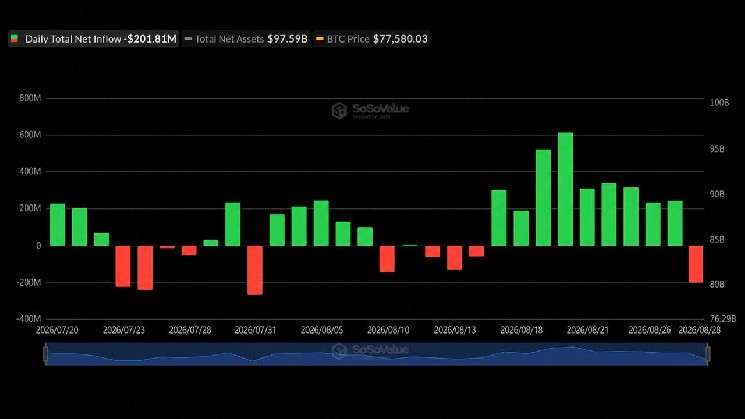
    Greeks.live analyst Adam said ETFs had recorded large inflows, but the strong inflow streak ended with a $202 million outflow on August 28. The analyst warned that continued ETF outflows, and the possibility that they could become permanent, may make it more difficult for Bitcoin to remain above $80,000.

    The analyst also discussed Strategy’s decision to resume Bitcoin purchases after a long pause. According to the analyst, Strategy’s purchases could support the price in the short term but may not be sufficient on their own to alter the long-term trend.

    Macroeconomic Risks Remain

    The analyst said the Federal Reserve’s hawkish stance and broader macroeconomic uncertainty remain among the main risks facing Bitcoin, echoing concerns raised by Bitfinex.

    These factors are putting additional pressure on investor confidence and the Bitcoin price. The analyst believes it is too early to describe the market as a new strong bull trend without a sustained move above $80,000. ETF flows and Federal Reserve policy are likely to play a decisive role in determining Bitcoin’s short-term direction.

    This is not investment advice.

  • BlackRock Drives $217M Bitcoin ETF Rebound as Altcoin Funds Extend Winning Streaks

    BlackRock Drives $217M Bitcoin ETF Rebound as Altcoin Funds Extend Winning Streaks

    US-listed spot Bitcoin exchange-traded funds (ETFs) returned to net inflows on Monday, led by BlackRock, while spot Ether, $XRP and Solana ETFs extended their positive streaks.

    Bitcoin ETFs recorded $216.7 million in net inflows, reversing Friday’s $201.8 million in outflows, according to SoSoValue. Friday’s withdrawals ended a nine-session inflow run that brought more than $3 billion into the funds.

    Bitcoin (BTC) was trading near $78,700 at the time of writing, up approximately 1.5% over the previous 24 hours, according to CoinGecko.

    BlackRock leads US spot Bitcoin ETF inflows

    BlackRock’s iShares Bitcoin Trust ETF (IBIT) accounted for most of Monday’s rebound, attracting $205.9 million in net inflows. The figure represented approximately 95% of the total daily inflows across US spot Bitcoin ETFs, according to Farside Investors.

    Fidelity’s Wise Origin Bitcoin Fund (FBTC) recorded $6.9 million in inflows, while the Bitwise Bitcoin ETF (BITB) added $4.3 million. Morgan Stanley’s Bitcoin Trust attracted $3.6 million, and Grayscale’s Bitcoin Mini Trust recorded $9.4 million in inflows.

    VanEck’s Bitcoin ETF (HODL) was the only fund to post net outflows, recording $13.4 million in withdrawals. The remaining funds reported no flows.

    US spot Bitcoin ETF flows. Source: SoSoValue

    US spot Bitcoin ETF flows per fund. Source: Farside Investors

    Ether, $XRP and Solana ETFs extend inflow streaks

    Spot Ether ETFs attracted $87.7 million on Monday, extending their inflow streak to 11 consecutive trading sessions.

    BlackRock’s iShares Ethereum Trust ETF (ETHA) led the category with $59.9 million in inflows, followed by Grayscale’s Ethereum Mini Trust with $13.5 million and Fidelity’s Ethereum Fund with $9.3 million, according to Farside Investors.

    $XRP ETFs recorded $5.64 million in net inflows, marking their 10th consecutive positive session, according to SoSoValue. The funds have attracted capital during every US trading session since Aug. 18.

    Solana ETFs also posted a 10th straight session of inflows. However, daily inflows fell to $925,010 from $18.1 million on Friday, making Monday’s total the weakest of the current run.

  • Major Outlets Criticize Winklevoss Bitcoin ETF Filing

    Major Outlets Criticize Winklevoss Bitcoin ETF Filing

    The Winklevoss Bitcoin ETF has faced sharp criticism from prominent media outlets, including Mad Magazine and The Atlantic, which described its filing as one of the year’s most foolish ideas. Despite the backlash, the fund has posted significant inflow records, highlighting strong demand for Bitcoin investment products.

    Bitcoin ETF Inflows Defy Media Skepticism

    The contrast between negative media coverage and strong investor activity underscores the changing cryptocurrency investment landscape, as commentator Eric Balchunas noted. While established media outlets have questioned the role of Bitcoin in mainstream finance, investor interest in Bitcoin-backed products appears undiminished.

    The broader crypto market remains mixed, with momentum varying among major digital assets. Bitcoin’s performance and the Winklevoss ETF’s inflows suggest continued appetite for regulated investment vehicles that provide exposure to the cryptocurrency.

    What the Winklevoss Bitcoin ETF Signals

    The Winklevoss Bitcoin ETF is intended to offer investors a regulated way to gain exposure to Bitcoin, which has attracted substantial interest and investment over the years. The criticism surrounding the filing reflects the ongoing debate over Bitcoin’s legitimacy and its prospects as a mainstream investment asset.

    At the same time, the fund’s inflow records may indicate that institutional and retail investors are becoming more receptive to cryptocurrency products, even as the wider market sends mixed signals. The divergence between media sentiment and market behavior could prove important in assessing future investment trends.

    What Traders Are Watching Next

    Traders will be watching for continued inflows into Bitcoin ETFs, which could signal growing acceptance and demand across the financial ecosystem. Market reactions to further media coverage may also influence investor sentiment.

    Bitcoin’s performance relative to traditional assets such as gold could provide additional insight into broader market trends and the evolving role of cryptocurrency in investment portfolios.

    This article does not constitute financial advice. Readers should conduct their own research before making investment decisions.

    Source: cryptonews.net

  • Bitcoin ETFs End 9-Day Inflow Streak With $202 Million Outflow as Ether ETFs Gain $102 Million

    Bitcoin ETFs End 9-Day Inflow Streak With $202 Million Outflow as Ether ETFs Gain $102 Million

    Bitcoin ETFs End Nine-Day Inflow Streak

    U.S. spot bitcoin exchange-traded funds (ETFs) ended a nine-session run of daily inflows on August 28, recording approximately $202 million in net outflows. The streak began on August 17 and had attracted roughly $3.04 billion before breaking.

    The nine-day inflow period pushed total bitcoin ETF assets beyond a milestone that few expected to arrive so quickly. Bitcoin.com News reported that the funds surpassed $100 billion in net assets on August 27. BlackRock’s iShares Bitcoin Trust (IBIT) led that day with $277.6 million in inflows, while Fidelity’s FBTC recorded $83.6 million in outflows and Grayscale’s GBTC lost another $27.2 million.

    Bitcoin ETFs have experienced sharp moves in both directions this year. In May, the same group of funds recorded a then-record nine-day outflow streak, losing approximately $2.8 billion as bitcoin’s price fell from about $80,000 to $73,000.

    Spot Ether ETFs Extend Buying Streak

    Spot ether ETFs moved in the opposite direction on August 28, attracting $102 million and extending their own inflow streak to 10 consecutive sessions.

    Ether ETFs have also benefited from strong demand earlier in August, when the category recorded $2.6 billion in inflows during its strongest week since October. BlackRock’s ETHA accounted for much of the activity and helped triple the sector’s typical trading volume.

    Ether’s price has broadly followed bitcoin’s performance, even as the two cryptocurrency ETF markets have briefly moved in different directions.

    Bitcoin Price Holds Near $77,500

    The bitcoin ETF outflows came at a notable point for the cryptocurrency market. Bitcoin opened August 28 at $80,261.86 before falling to its current level of approximately $77,500.

    Bitcoin is up only 1% over the past week, making a single day of ETF selling appear more consistent with profit-taking than panic selling. The market was also preparing for the expiration of roughly $6.4 billion in Deribit options that Friday.

    One negative session does not erase the previous $3 billion inflow run. ETF investors will be watching the next session’s data to determine whether the outflows were a temporary setback or the beginning of a longer trend. Spot ether ETFs, meanwhile, enter the new week with their 10-day inflow streak intact.

    Source: cryptonews.net

  • Bitcoin Cools After $3 Billion ETF-Driven Surge

    Bitcoin Cools After $3 Billion ETF-Driven Surge

    Bitcoin pulled back on Friday afternoon after a powerful rally fueled by heavy buying from U.S. spot Bitcoin exchange-traded funds (ETFs).

    The leading cryptocurrency was trading at $77,379 in New York on Friday afternoon, down more than 3% over 24 hours. Bitcoin reached a weekly high of $81,281 before losing momentum following Federal Reserve Chair Kevin Warsh’s first major speech as head of the central bank. Warsh said Friday that he had “more work to do” to fight inflation.

    Bitcoin has historically come under pressure when the Federal Reserve signals that inflation remains too high, reducing the likelihood of interest-rate cuts. The cryptocurrency generally performs better in a lower-interest-rate environment.

    JUST IN: U.S. Bitcoin ETFs have brought in $1.14 billion in inflows this week. Over $3 billion has been added in the past 9 days! pic.twitter.com/ri1jE7enTZ
    — Bitcoin Magazine (@BitcoinMagazine) August 28, 2026

    Bitcoin began surging last week after the U.S. Treasury said it would at least double the size of its liquidity-support buyback operations. The announcement weakened the dollar, while non-yielding assets benefited.

    Bitcoin ETFs managed by BlackRock, Fidelity and Grayscale recorded net inflows for nine consecutive days, according to data from Farside Investors. The funds had their strongest week since October, when Bitcoin reached a new all-time high, and the inflow streak continued into this week.

    Since August 17, investors have directed more than $3 billion into the funds. BlackRock’s iShares Bitcoin Trust received the largest share of the investment, while Morgan Stanley’s new Bitcoin Trust, which launched this year, also recorded significant inflows.

    Analysts have said the so-called debasement trade is encouraging investors to reconsider Bitcoin. The strategy involves buying assets as a hedge against the loss of value in a currency.

    Investors participating in the trade view Bitcoin, gold and other precious metals as potential protections against excessive government spending. Total U.S. government debt surpassed $40 trillion for the first time this month.