Tag: BIP-110

  • Bitcoin Unable to Activate Soft Forks Currently, Drivechain Creator States

    Bitcoin Unable to Activate Soft Forks Currently, Drivechain Creator States

    Bitcoin Soft Fork Failures Signal Frozen Upgrade Process, Drivechain Creator Warns

    Bitcoin has not activated a single proposed soft fork since Taproot went live in November 2021, a trend that LayerTwo Labs CEO and Drivechain creator Paul Sztorc says points to a fundamental inability to approve consensus changes for the foreseeable future. Speaking to crypto.news, Sztorc framed the recent collapse of BIP-110 as evidence of a systemic coordination failure that extends well beyond one disputed upgrade.

    “All soft forks since Taproot have failed to activate, and this was no exception,” Sztorc said.

    BIP-110 Collapse Illustrates Miner Signaling Deadlock

    BIP-110, formally known as the Reduced Data Temporary Softfork, sought to impose seven temporary consensus restrictions for roughly one year (52,416 blocks). The rules included an 83-byte cap on OP_RETURN outputs, a 256-byte limit on certain data pushes, and constraints on some Taproot functions. Supporters such as Bitcoin Knots maintainer Luke Dashjr argued the measures would curb arbitrary data storage linked to inscriptions and keep Bitcoin focused on monetary transactions. Critics including Strategy Executive Chairman Michael Saylor and Blockstream co-founder Adam Back countered that the proposal could undermine Bitcoin’s neutrality by rejecting transaction structures the network currently accepts.

    The proposal’s voluntary activation mechanism required 55% of blocks in a difficulty period to signal support. By August 2, that threshold had become mathematically unreachable: only 28 of the first 1,108 blocks had signaled, yielding a support rate of roughly 2.53%. When the mandatory signaling period began at block 961,632 on August 8, nodes enforcing BIP-110 began rejecting non-signaling blocks. Most miners continued building on the dominant chain, causing the minority branch to stall after producing just two blocks.

    By August 9, the minority chain remained frozen at block 961,633 while the main chain advanced 111 blocks. OCEAN’s BIP-110 endpoint showed approximately 257 petahashes per second assigned to the minority branch, while Saylor estimated that 99.85% of Bitcoin’s hash power stayed with the dominant chain. The stall was exacerbated because the minority branch inherited Bitcoin’s mining difficulty of 127.48 trillion; without sufficient computing power, its miners could not quickly produce the blocks needed to trigger a difficulty adjustment.

    Consensus Barrier Extends to OP_CAT and Other Proposals

    Sztorc emphasized that BIP-110 is not an isolated case. Since Taproot activated at block 709,632 via the Speedy Trial process, numerous proposals — including OP_CAT, BIP-360, and others — have remained in discussion without achieving activation. OP_CAT, a 13-line opcode originally present in Bitcoin’s codebase before being disabled by Satoshi Nakamoto in 2010, has garnered developer support for enabling covenants, vaults, and programmable spending conditions. Yet Sztorc argues it faces the same insurmountable coordination hurdle.

    “Nothing can — not even OP_CAT, which is just 13 lines of code and was in the original software and had lots of support,”

    he said when asked how BIP 300 could overcome resistance to consensus changes.

    “Bitcoin cannot activate any soft forks, for the foreseeable future.”

    Other proposals confront identical obstacles. BIP-360 proposes a new output type for post-quantum signatures via soft fork, offering a path for users to migrate funds to quantum-resistant addresses. Its activation would require the same broad network agreement that Sztorc believes Bitcoin can no longer achieve.

    Drivechains Aim to Shift Experimentation Off the Base Layer

    Drivechains, specified in BIP 300 and BIP 301, are designed to let developers test new rules and applications on opt-in sidechains rather than repeatedly seeking changes to Bitcoin’s base layer. Under the two-way peg design, users could move BTC between Bitcoin and independent sidechains, each with its own rules for privacy, smart contracts, faster transactions, or other functions. Sidechains would maintain separate brands and software, similar to existing systems like Liquid and Lightning.

    “Each Drivechain will have its own brand, same as Liquid, Lightning, etc.,”

    Sztorc said, comparing the model to developers launching separate altcoins.

    However, Drivechains themselves require a consensus change on Bitcoin to deploy the proposed withdrawal system. Without activation, BIP 300 cannot move forward.

    “It cannot,”

    Sztorc said when asked how BIP 300 could overcome the resistance that stopped other proposals.

    Miner-Controlled Withdrawals Remain Central Security Debate

    BIP 300 assigns Bitcoin miners a pivotal role in approving withdrawals from Drivechains. Withdrawal requests would remain pending while miners vote through Bitcoin blocks; a request receiving sufficient support over the voting period could release BTC from the sidechain peg. Sztorc argues security depends on the economic value a popular sidechain creates for miners.

    “If the chain is popular, it will be generating fees for miners. If this fee revenue is large, relative to the number of circulating coins on the L2, then it will be secure.”

    Users would need to evaluate the relationship between sidechain fee revenue, miner incentives, and the value of BTC locked in the peg. Critics warn that miners could collude to approve invalid withdrawals, while supporters contend that attacking a profitable sidechain would destroy future fee income and damage system confidence.

    U.S. Mining Operations Highlight Governance Risks

    The BIP-110 episode demonstrated how American mining operations can become directly involved in Bitcoin governance disputes. Foundry USA Pool asked its mining customers to vote on BIP-110 signaling before the mandatory period, while Strategy — a U.S.-listed company and one of the largest corporate Bitcoin holders — publicly opposed the proposal through Saylor.

    The failed fork also created practical risks for holders. Because BIP-110 lacked automatic replay protection, Bitcoin developer Kevin Loaec warned that a transaction sent on one branch could potentially be copied to the other, putting pre-fork coins at risk if users attempted to move or sell assets on the minority chain without first separating them. Meanwhile, BIP-110 supporters prepared code for a possible proof-of-work change that would allow the stalled branch to abandon Bitcoin’s existing mining algorithm, though developer Chris Guida described it as a contingency with no activation date set.


  • Luke Dashjr Exits Ocean Mining Pool After Dispute Over Bitcoin’s Future

    Luke Dashjr Exits Ocean Mining Pool After Dispute Over Bitcoin’s Future

    Longtime Bitcoin developer Luke Dashjr has resigned as chairman, chief technology officer and director of Ocean mining pool, ending his involvement with the company after its parent, Mummolin, repurchased his entire equity stake.

    The separation was agreed by both sides and reflects differing views on the future of Bitcoin mining and recent protocol developments. Mummolin and Dashjr did not disclose the value of the equity buyback.

    Luke Dashjr to launch Convoy mining venture

    Dashjr, who co-founded Ocean, plans to launch a new Bitcoin mining venture called Convoy. Ocean said it will continue operating its transparent, non-custodial mining pool, which pays rewards directly to participating miners.

    The split comes weeks after Dashjr began a sabbatical from Ocean following the failure of BIP-110, a controversial proposal that sought to temporarily restrict the storage of non-financial data on the Bitcoin network.

    Bitcoin mining market faces pressure

    Dashjr’s departure comes as the Bitcoin mining industry remains concentrated and under financial pressure. Publicly traded mining companies have been reducing their Bitcoin hashrate while leasing sites and power capacity to artificial intelligence and high-performance computing operations.

    Despite those shifts, Foundry USA, AntPool and F2Pool continue to produce well over half of recent Bitcoin blocks.

  • Veteran Bitcoin Developer Luke Dashjr Leaves OCEAN Pool: Will Hash Power Follow Him to a New Pool?

    Veteran Bitcoin Developer Luke Dashjr Leaves OCEAN Pool: Will Hash Power Follow Him to a New Pool?

    OCEAN Mining Completes Buyout of Co-Founder Luke Dashjr

    OCEAN Mining has completed the buyout of co-founder and 16-year Bitcoin Core developer Luke Dashjr, ending his ownership of the company and three leadership roles at the Bitcoin mining pool.

    Dashjr resigned as chairman, chief technology officer and director, while OCEAN repurchased all of his equity, according to an Aug. 29 joint statement. His positions placed him at the center of OCEAN’s corporate governance and mining-policy decisions.

    The privately held company did not disclose the repurchase price, its remaining ownership structure or the identities of any successors. OCEAN said it will continue operating its transparent, non-custodial mining pool, while Dashjr plans to pursue a new mining venture called CONVOY.

    At the reporting cutoff, publicly available information was insufficient to verify that CONVOY was operating a mining pool. Neither its public profile nor the announcement disclosed an endpoint, codebase, participating miners, infrastructure, fees or block-template policy. The materials also did not disclose any transfer of miners, staff other than Dashjr or infrastructure from OCEAN.

    OCEAN retains a measurable share of Bitcoin mining

    A Mempool.space snapshot taken at 07:07 UTC on Aug. 30 attributed four of the previous 163 Bitcoin blocks to OCEAN, representing 2.45%. Applying that percentage to the endpoint’s network-hashrate estimate produced a block-share-derived estimate of approximately 24.57 exahashes per second.

    The longer-term figures were similar. Mempool.space attributed 29 of the 1,007 blocks mined during the previous week to OCEAN, or 2.88%. Its latest weekly hashrate figure placed the pool at 25.33 EH/s, equivalent to 2.86% of the network.

    Across both measurement periods, OCEAN remained within a broad 2.5% to 3% range. That makes potential miner departures measurable without treating the discovery of a single block as evidence of a broader trend.

    These figures represent hashpower directed to OCEAN, not mining machines owned by the company. The trailing 24-hour measurement can also change quickly as blocks enter and leave the sample, making it a snapshot rather than a durable measure of market share.

    Protocol disagreements preceded the separation

    The joint statement said the separation reflected different visions following recent protocol developments. However, it did not identify BIP-110, Bitcoin Knots, a proof-of-work change or any other specific proposal as the cause.

    OCEAN added dedicated BIP-110 and no-signal endpoints in July. On Aug. 9, it returned its default endpoint to the non-BIP-110 chain while keeping both options available. OCEAN said its DATUM system allowed participating miners to control block construction.

    CryptoSlate’s earlier coverage described the surrounding fork and proof-of-work dispute, but the separation statement did not link the buyout to any particular development.

    A functioning CONVOY pool, published mining instructions or a sustained change in OCEAN’s share would offer the first measurable evidence that miners or block-template policy are shifting. The corporate split alone does not establish such a change.

  • Bitcoin Knots Attempts Another Bitcoin Fork After Previous Chain Died Within Two Blocks

    Bitcoin Knots Attempts Another Bitcoin Fork After Previous Chain Died Within Two Blocks

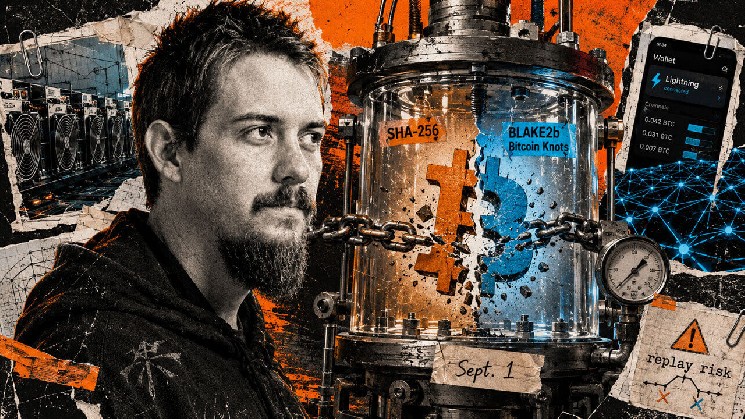
    Bitcoin Knots is preparing a Sunday rehearsal for a BLAKE2b proof-of-work fork after its previous BIP-110 breakaway chain stalled.

    On Aug. 29, Bitcoin developer Luke Dashjr told SHA-2 miners to stop mining ahead of an Aug. 30 test. The proposed breakaway network would replace Bitcoin’s SHA-256d proof of work with BLAKE2b.

    Dashjr said Bitcoin Knots 29.4.1rc4 would establish the final SHA-2 block before the change. If the rehearsal succeeds, a final 29.4.1 release could preserve the new chain on Sept. 1. Problems would instead trigger another release candidate and a reset to the last SHA-2 block.

    The attempt comes three weeks after BIP-110 split from the dominant Bitcoin chain and stalled after producing only two blocks. The new proposal aims to avoid relying on existing Bitcoin miners by permanently moving the breakaway network to hardware using BLAKE2b proof of work.

    Bitcoin Knots BLAKE2b test faces unresolved questions

    As of Aug. 29, the public Bitcoin Knots release page did not show rc4 or a final 29.4.1 build. Several key proof-of-work changes also remained open.

    The proposal had not publicly identified a major exchange, wallet, custodian, block explorer or Lightning implementation committed to supporting the new chain.

    A successful BLAKE2b block would demonstrate that the fork can operate, but it would not show that enough miners, infrastructure providers and users are ready to keep the network economically viable.

    How BLAKE2b is intended to solve the miner problem

    The central change is designed to address the weakness that crippled the earlier BIP-110 branch.

    Rather than asking the SHA-256d miners securing Bitcoin to continue producing blocks for a minority fork, the new chain would reject SHA-256d blocks after activation and rely on BLAKE2b mining hardware.

    Backers say machines originally built to mine Sia, including Bitmain’s Antminer A3 and Goldshell SC5 models, can support the new proof-of-work system. Testnet4 mining instructions and a compatible DATUM Gateway fork have also been published.

    It remains unclear whether enough miners will participate.

    A reviewer of the open implementation calculated that one version of the proposed initial difficulty would require roughly 870 terahashes per second to maintain 10-minute block intervals. Estimated testnet4 capacity stood at only 50 to 70 TH/s.

    Those figures were based on unfinished code and do not represent final launch parameters. They nevertheless highlight the challenge facing Sunday’s test: compatible mining machines do not guarantee committed hash rate. Public discussions had not disclosed how much capacity operators had pledged to the mainnet fork.

    Block production will therefore be an early measure of whether the new design improves on BIP-110 or simply replaces one mining constituency with another.

    Bitcoin Knots still needs final consensus rules

    Bitcoin Knots must also settle the precise rules that participating nodes will enforce.

    The BLAKE2b implementation and a related reduced-data proposal remained open as of Aug. 29. The reviewed public materials had also not fixed the mainnet activation height.

    A discrepancy remained over the temporary block-weight limit. The proposal’s FAQ and pull request described a 700,000-weight-unit cap, while a pinned source commit set the limit at 800,000.

    Nodes enforcing different limits could disagree about whether a block is valid, making the final rc4 configuration critical before participants attempt to follow the same chain.

    The proof-of-work change would be permanent. The reduced-data restrictions, including the smaller block cap, are scheduled to expire in 2027.

    Sunday’s rehearsal should clarify the activation height, block limit and other parameters needed for participating nodes to remain on a single ledger.

    A functioning chain still needs an economy

    Even if miners produce blocks under a common ruleset, the more difficult coordination test will take place outside Bitcoin Knots.

    The proposed fork changes the block header to a 164-byte format using BLAKE2b, while existing Electrum-style clients expect Bitcoin’s 80-byte SHA-256d headers.

    Light wallets, indexers, explorers and other infrastructure may therefore need updates before they can follow the new ledger. Dashjr said light-client compatibility falls outside Bitcoin Knots’ scope.

    The project’s FAQ tells exchanges to pause deposits and withdrawals around the split and announce which chain they will recognize. Lightning channels created before the fork would also exist on the BLAKE2b chain, requiring both peers to use compatible software and agree on the same ledger.

    Both networks would inherit the same pre-fork transaction history and coin balances. That creates replay risk because a transaction spending pre-fork coins could potentially be valid on both chains.

    Bitcoin Knots has proposed a SIGHASH_UNIFIED signing mode that can provide directional replay protection when explicitly selected. It would not automatically protect every existing wallet or transaction.

    The move to BLAKE2b addresses proof of work only. It does not replace Bitcoin’s existing addresses, private keys or transaction signatures, and therefore does not make ownership keys quantum-safe.

    The immediate question this weekend is whether Bitcoin Knots can produce and maintain a BLAKE2b chain after BIP-110 failed.

    The larger test will begin if it succeeds: whether miners continue producing blocks and whether exchanges, wallets, custodians and users recognize enough economic value in the new ledger to keep it alive.