Tag: Binance

  • Ethena Looks Beyond Crypto to Tap Yield From Booming Equity Perpetuals

    Ethena Looks Beyond Crypto to Tap Yield From Booming Equity Perpetuals

    Ethena is expanding its funding trade into equity perpetuals as the protocol seeks new sources of returns after the supply of $USDe fell below $5 billion from a peak of nearly $15 billion.

    The move follows Thursday’s major $ENA token overhaul, when the Ethena Foundation announced changes to $ENA’s token economics. The overhaul eliminates monthly venture capital unlocks and puts to a vote whether revenue from Ethena’s businesses should be used for token buybacks.

    Ethena adapts its funding strategy to equity markets

    The strategy is essentially the same trade Ethena has run since $USDe’s launch: hold exposure to an asset, short its perpetual contract and collect the funding paid by leveraged long traders. The assets involved have included bitcoin $BTC$79,389.75, ether ETH$2,496.79 and solana (SOL).

    However, the trade became far less lucrative in crypto this year as prices plunged and market activity cooled. Ethena said bitcoin $BTC$79,389.75 funding averaged 11% in 2024 and 4.9% in 2025 before falling to just 2.2% this year through Aug. 11.

    Equity perpetuals have shown the opposite trend. According to Ethena, funding was positive on 94% of days on Hyperliquid and 97% of days on Binance once those markets reached meaningful scale. The median equity funding rate was 13.9%, compared with 3.9% for bitcoin.

    “One other interesting characteristic which makes this more attractive versus crypto is the natural positive skew of funding distribution,” co-founder Guy Young said in an X post.

  • KuCoin Can Block Your Crypto Transactions Even If You Never Sent Funds to 17 Sanctioned Platforms

    KuCoin Can Block Your Crypto Transactions Even If You Never Sent Funds to 17 Sanctioned Platforms

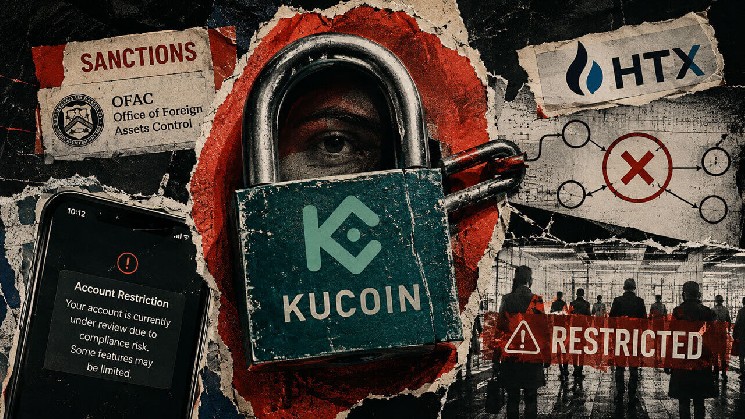
    KuCoin Expands Sanctions Screening to Indirect Crypto Transfers Across 17 Platforms

    KuCoin has broadened its sanctions compliance framework to cover indirect cryptocurrency transfers involving 17 platforms, including the Justin Sun-linked $HTX. The policy, outlined in an August 27 compliance notice, means users may face transaction holds or rejections even when they do not interact directly with a listed entity.

    Platforms Covered by the New Restrictions

    The affected platforms include:

    • Shelbit
    • Aban Tether
    • A7 Nigeria
    • A7 Africa
    • PilotFinance
    • Rapira
    • Aifory Pro
    • ABCeX
    • WhiteBird
    • NoOnecrypto
    • Tradex
    • Monease
    • BitPapa
    • Exnode
    • Exnode Pay
    • EXMO
    • $HTX (Huobi Global SA)

    How Indirect Screening Works

    Under the updated policy, KuCoin may screen the source of funds, originating and destination addresses, and intermediary service providers for connections to the listed entities. Transactions attempted to these platforms may undergo enhanced review or trigger temporary wallet and account restrictions. Repeated or serious violations could ultimately lead to suspension or withdrawal of KuCoin services for the user.

    The controls broadly align with recent U.S. and European sanctions actions, but their reach extends beyond direct counterparties. KuCoin has not disclosed how many transaction hops it traces or what level of on-chain attribution is sufficient to establish an indirect connection.

    $HTX Faces Growing Isolation From Major Exchange Rails

    $HTX is the most consequential name on KuCoin’s list by scale and is already facing similar restrictions elsewhere. Binance stopped processing transactions involving $HTX and 10 other platforms from August 23 as part of its own sanctions-compliance measures. This narrows the routes through which $HTX-linked funds can move across major exchanges even as $HTX itself remains operational.

    Corporate Identity Dispute

    $HTX continues to dispute the sanctions-related allegations and the corporate identity behind the designation. The EU regulation names “$HTX (Huobi Global SA)”, a label also used by KuCoin. However, $HTX said in May that Huobi Global S.A. is distinct from the online $HTX exchange.

    Meanwhile, the Justin Sun-linked exchange said it is pursuing legal and compliance discussions with authorities in the UK and EU as some users report funds being frozen on third-party platforms, including Kraken. $HTX said it has submitted materials relating to 17 Kraken user freeze cases to the courts and is working to reduce disruptions affecting customers.

    Operational Updates From $HTX

    Molly, $HTX’s head of markets, said the exchange processed more than 100,000 deposit and withdrawal transactions over two days without identifying new cases of indiscriminate freezes. She also said $HTX recently upgraded its wallet infrastructure and introduced a withdrawal-address rotation mechanism. The exchange described the changes as a security measure intended to reduce disruption from third-party risk controls and on-chain labeling.

    Implications for Users and Transaction Provenance

    For users, the practical effect is increasingly clear. Funds linked to $HTX or another listed provider can face restrictions before they reach KuCoin, depending on the transaction path and the intermediaries involved. That pushes sanctions enforcement beyond direct counterparties and deeper into transaction provenance, with exchanges increasingly assessing where funds originated, where they are headed, and which services they touched along the way.

  • XRP Selling Pressure Hits 2026 High as Price Holds Firm Above $1.40

    XRP Selling Pressure Hits 2026 High as Price Holds Firm Above $1.40

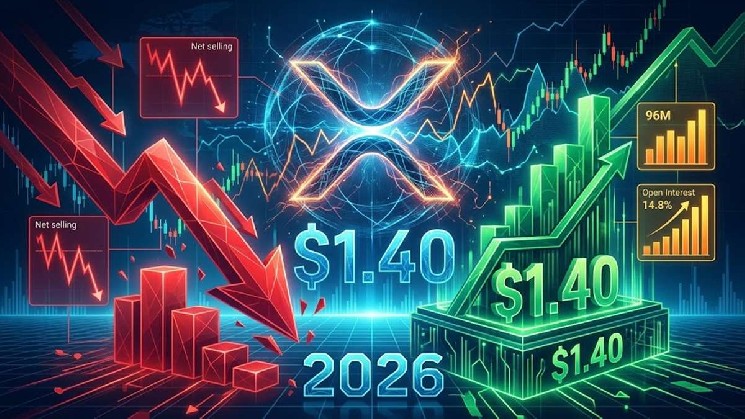
    XRP’s derivatives market is flashing its strongest net selling pressure of 2026, with Binance recording approximately $96 million in sell-side dominance. The surge follows a sharp 70% rally in XRP that has intensified speculative activity among derivatives traders. Despite the bearish signal, XRP continues to trade above $1.40 while Binance Open Interest has climbed 14.8%, signaling stronger market participation.

    Divergence Between Derivatives Selling and Spot Resilience

    The divergence between aggressive derivatives selling and resilient spot prices is giving traders a critical signal to monitor. The broader altcoin market has also strengthened in recent sessions, adding more than $183 billion in total capitalization within days. That represented an increase of roughly 20%, while XRP gained about 70% over the same period, making it one of the stronger performers during the recovery.

    XRP Selling Pressure Reaches 2026 Peak

    Data highlighted by CryptoQuant shows that XRP’s net taker volume on Binance has shifted sharply toward sellers. Sell-side dominance has reached approximately $96 million, marking the strongest reading recorded since the start of 2026.

    The metric tracks aggressive market orders and can provide insight into how traders are positioning around short-term price movements. In XRP’s case, the increase suggests that some derivatives participants are using the recent rally to take bearish positions or secure profits after the rapid advance.

    However, elevated selling activity does not automatically mean that XRP’s uptrend has ended. Strong spot demand can absorb derivatives selling, while liquidations or short-term hedging can also influence net taker volume. The current price structure therefore remains important. Holding above $1.40 despite heavier derivatives selling suggests buyers have so far absorbed the additional supply pressure.

    Binance Open Interest Adds Another Signal

    At the same time, XRP’s Binance Open Interest has increased by approximately 14.8%. The rise means more capital is entering outstanding derivatives positions as traders respond to the token’s recent move.

    Higher Open Interest combined with strong selling pressure can increase volatility because a larger number of leveraged positions are exposed to sudden price movements. If XRP continues to hold its support levels, short positions could eventually face pressure from another upside move. Conversely, a decisive break below $1.40 would strengthen the bearish interpretation and could encourage further profit-taking or liquidations.

  • Coinbase, Binance Whales Set XRP Profit Targets at $15, $32 as Bull Rally Resumes

    Coinbase, Binance Whales Set XRP Profit Targets at $15, $32 as Bull Rally Resumes

    XRP Faces Major Whale Sell Walls at $15 and $32 as Price Attempts Recovery

    XRP is encountering significant long-term selling pressure as whales on Binance and Coinbase maintain large sell walls at the $15 and $32 price levels. The order-book liquidity appears as the token attempts to resume its rally following a recent pullback.

    Binance and Coinbase Whales Stack Sell Orders

    According to CryptoQuant author CW, Binance whales previously established a sell wall extending to $15, and that liquidity remains in place. Meanwhile, Coinbase whales have created new sell walls reaching as high as $32 this month. CW emphasized the current dynamic in the order books.

    “Currently, it is Coinbase whales that are blocking the rise,” CW said, adding that the group has been forming multiple sell walls.

    These sell walls represent clustered limit-sell liquidity rather than firm price targets or guarantees that XRP will reach those levels. Analyst ChartNerd cautioned that order-book liquidity is transient because traders can cancel or move their orders at any time. While large sell walls can act as supply ceilings, they do not necessarily signal an impending rally.

    XRP Price Action: Pullback and Rebound

    The whale activity coincides with XRP’s attempt to recover from a correction after last week’s rally. The token climbed to $1.70 before declining 19.18% over the following days to reach $1.3632. At press time, XRP has rebounded to approximately $1.45, marking its intraday high. The recovery aligns with broader crypto market strength as Bitcoin reclaimed the $80,000 level, reviving bullish sentiment.

    Key Technical Levels: Support and Resistance

    ChartNerd identified $1.36 as key four-hour support. Immediate resistance sits between $1.51 and $1.55. A successful breakout above that zone opens the path toward $1.80 and $1.94. Conversely, rejection would likely send XRP back toward the $1.36 support area.

    $1.54: The Critical Battleground

    The analyst highlighted a confluence between XRP’s lower-timeframe resistance and the weekly 50 EMA (Exponential Moving Average) around $1.54. He stated that a close above this moving average remains the “main objective” for a continuation higher, as failure to reclaim it could signal renewed weakness.

    In a subsequent update, ChartNerd summarized the setup on X (formerly Twitter):

    Long story short..
    You’ve heard it enough times..
    Until $1.54 is reclaimed..$XRP’s upside move is under pressure
    — 🇬🇧 ChartNerd 📊 (@ChartNerdTA) August 27, 2026

    This makes the $1.51–$1.55 region a near-term battleground. A move above it could strengthen the bullish case and put the $1.70 high back within reach.

    Whale Accumulation Offsets Sell-Wall Pressure

    Adding a bullish counter-narrative, CryptoQuant author Darkfost reported that whales withdrew more than 231 million XRP from Binance in a single day, worth over $335 million at the time. The outflows represented a sharp increase from the 90-day average of $40 million and marked the highest level of whale withdrawals from Binance in six months.

    Such movements reduce the immediately tradable supply on exchanges, which typically supports a price rally. With whales accumulating XRP off-exchange while major holders maintain large sell walls at higher prices, the market awaits a decisive move.

    Whether XRP can overcome the $1.54 resistance and resume its advance remains the central question for traders in the coming sessions.

  • Venezuela Arrests Three ‘Los Binanceros’ Members Over Binance P2P Arbitrage

    Venezuela Arrests Three ‘Los Binanceros’ Members Over Binance P2P Arbitrage

    The Bolivarian National Police in Venezuela recently arrested three young men in Maracaibo, accusing them of running an illicit currency arbitrage ring through the peer-to-peer (P2P) platform of the cryptocurrency exchange Binance. The enforcement action has ignited a critical discussion among local crypto traders about where lawful P2P transactions end and criminal activity begins under Venezuelan law.

    How the Alleged Binance P2P Scheme Operated

    According to law enforcement authorities, the arrested individuals—identified as 18-year-old Adrián Jesús Gómez, 19-year-old José Ángel Hernández, and 22-year-old Guillermo José Roldán—operated out of a residence in the Francisco Eugenio Bustamante parish of Maracaibo. Police officials claim the trio belonged to an organized group dubbed ‘Los Binanceros’ and executed a highly structured financial loop:

    • Acquisition: The suspects acquired U.S. dollars at the subsidized, official rate through regulated exchange houses and official Central Bank of Venezuela (BCV) auctions.
    • Conversion: They deposited these funds into the Binance platform to purchase the dollar-pegged stablecoin $USDT.
    • Liquidation: Finally, they sold the stablecoin on the Binance P2P marketplace in exchange for local currency (bolivars) at the unofficial parallel market rate, which sits significantly higher than the government’s controlled rate.

    Following the raid, police confiscated several mobile phones, a laptop, and a motorcycle. The suspects and the seized physical evidence have been transferred to the jurisdiction of the Public Prosecutor’s Office for formal prosecution.

    Why Venezuelan Authorities Regulate Exchange Rate Arbitrage

    The core of the legal issue lies in Venezuela’s dual-rate currency system. Because the BCV strictly controls and rations foreign currency at a subsidized rate, a substantial gap often opens between the official rate and the parallel market rate. This discrepancy creates an immediate opportunity for risk-free profit: purchasing cheap dollars through government-regulated channels and selling them at the elevated market rate.

    Venezuelan regulators do not view this as standard market trading. Instead, they classify it as unauthorized currency arbitrage. Funding parallel-market transactions using state-subsidized currency directly violates local exchange control laws. Furthermore, Venezuela’s robust anti-money laundering policies allow financial prosecutors to freeze and investigate any bank accounts receiving funds linked to these illicit spreads, regardless of whether the account holders are licensed financial agents.

    Risks for Everyday P2P Crypto Users in Venezuela

    While owning, trading, and utilizing digital currencies like $USDT is entirely legal under Venezuela’s regulatory framework, standard peer-to-peer traders still navigate a landscape filled with potential legal hurdles. The primary risks for everyday users include:

    1. High-Frequency Compliance Flags

    Engaging in high-volume or rapid-fire P2P trades can trigger automated anti-money laundering (AML) alerts at domestic banking institutions. Even if a trader is not exploiting exchange rate gaps, sudden spikes in account activity can lead to frozen bank accounts and subsequent investigations.

    2. Third-Party Payment Vulnerabilities

    One of the most common security flaws in P2P trading is accepting payments from bank accounts that do not match the verified identity of the counterparty on the exchange. If those external funds are tied to fraud, extortion, or other criminal activities, the recipient’s account can be flagged for money laundering.

    3. Liability of Omission

    Under Venezuelan criminal law, individuals can be held liable for failing to act when presented with suspicious activity. Ignoring obvious red flags on incoming payments, rather than actively participating in a crime, can still expose a P2P trader to prosecution for negligence or complicity.

    Ultimately, Venezuelan authorities appear to distinguish between citizens using P2P platforms to preserve the purchasing power of their personal savings and those systematically exploiting government-regulated currency channels for parallel-rate profits, as seen in the case of ‘Los Binanceros’. For the average crypto user, maintaining strict transaction hygiene—such as verifying counterparty names and rejecting third-party bank transfers—remains the most effective way to avoid regulatory scrutiny.

  • Vaneck applies for the first BNB ETF with innovative staking

    Vaneck applies for the first BNB ETF with innovative staking


    • The BNB-ETF application submitted by Vaneck is the first attempt in the United States to offer direct engagement in BNB token.
    • The ETF would include staking through which investors earn BNB premiums through trustworthy partners.

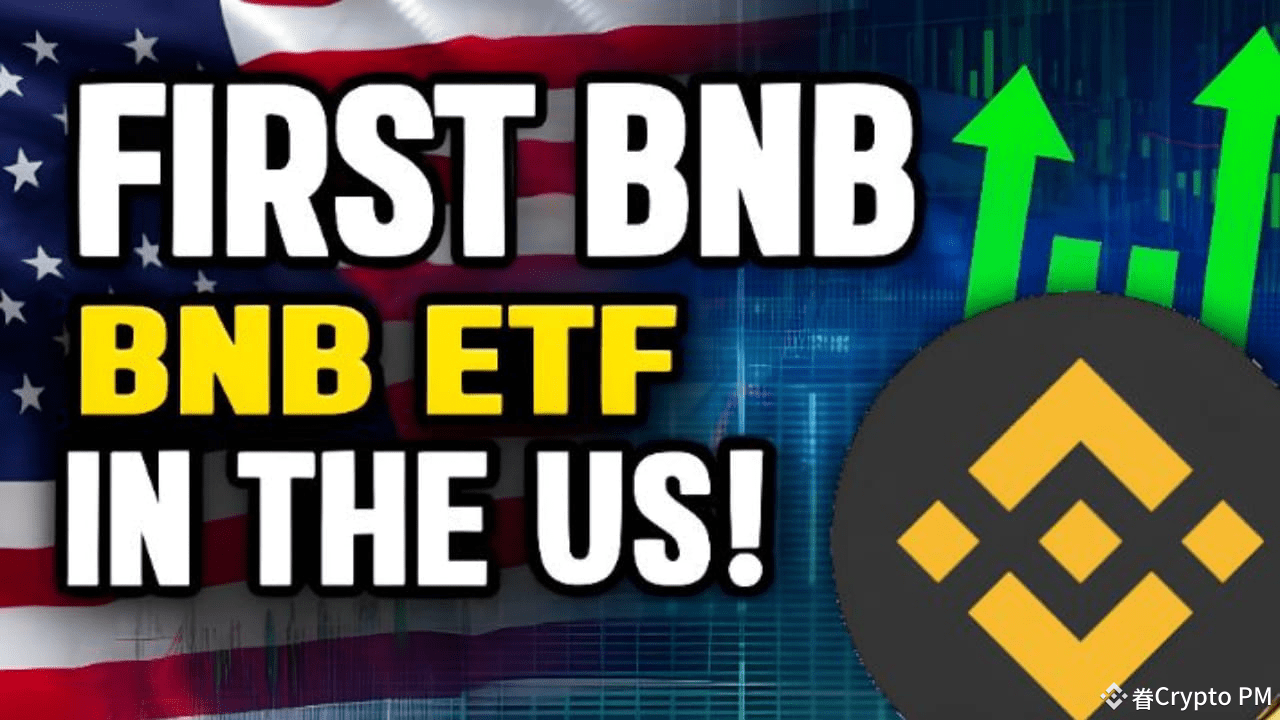
      Vaneck has taken an important step to expand its crypto investment offer in the United States with the application for a stock market-traded BNB fund (ETF). If this is approved, this would be the first ETF in the country, the BNB, the native asset of the BNB chain.

      The step signals a growing institutional interest in BNB as a digital asset and strengthens Vaneck’s position as an important player on the crypto ETF market. Since the interest of the regulatory authorities continues to increase in token-based ETFs, the US stock exchange supervision SEC will examine the application.

      Vaneck requests BNB-ETF with direct token engagement

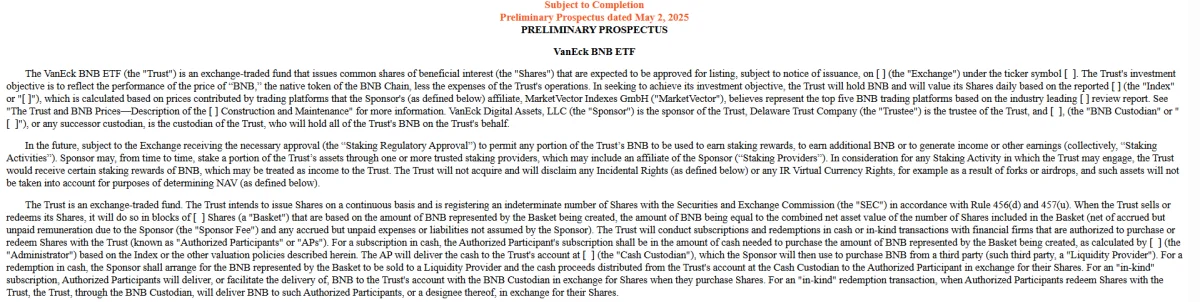
      The application, which was submitted on May 2 under the form S-1, outlines the plan of Vaneck to offer investors direct access to BNB. In the event of a permit, the Vaneck BNB ETF would be the first product listed in the USA that BNB holds directly and not over derivatives or futures. Vaneck has not announced a ticker symbol for the new fund. The ETF will reproduce the course of BNB and be kept by a regulated crypto deposit point (names have not yet been mentioned).

      According to the submission, Vaneck will also introduce staking into the ETF frames, whereby the approval of the stock market supervision is still pending. If the approval is granted, staking enables the ETF to achieve passive income by delegating BNB to trustworthy providers. In the prospectus, it is pointed out that the Staking partners could also include connected companies from Vaneck (subject to supervision). This would be the first time that a crypto-spot ETF in the USA uses staking as an earnings mechanism.

      The submission to the SEC follows the establishment of a trust company for the ETF in Delaware in the past month, which was a preliminary stage for this submission. The BNB ETF is the latest addition to Vaneck’s growing list of crypto ETF suggestions, which already includes Bitcoin, Ethereum, Solana and Avalanche.

      BNB becomes the fifth crypto asset in Vaneck’s ETF engagement

      As CNF reports, Vaneck is an early market leader in investment products for digital assets. The company was one of the first to launch Bitcoin and Ethereum ETFs in the United States after it received the approval of the SEC last year. Vaneck first entered the crypto area in 2017 when it suggested one of the first Bitcoin futures ETFs. With the submission of the BNB ETF, the asset manager extends his commitment to the most important blockchain ecosystems.

      According to our data, BNB, the fifth largest cryptocurrency after market capitalization, is traded at $ 608 and has not changed in the last 24 hours. The token is the heart of the BNB-Chain system and enables transaction fees, smart contracts and decentralized applications. He also plays a key role in the bony system and supports a number of financial services.

      Vaneck could have started a big step for BNB in ​​the United States, subject to approval. Since the SEC continues to check token-based ETFs, Vaneck’s application is a sign of institutional trust in the long-term use and investment of BNB.