Tag: Base blockchain

  • El Salvador Launches Stablecoin App Five Years After Making Bitcoin Legal Tender

    El Salvador Launches Stablecoin App Five Years After Making Bitcoin Legal Tender

    Key Highlights

    • Sivar is built on Modveon’s Verified Operating System, combining identity verification, trusted connections, communities, payments and AI-powered services.
    • Eligible US residents can send money to verified recipients in El Salvador for a flat $2 fee, regardless of the transfer amount.
    • The platform was refined through a pre-launch rollout involving more than 25,000 Salvadorans.

    Sivar Combines Identity Verification, Communities and Payments

    Sivar is built around Modveon’s Verified Operating System, a platform that brings together verified identity, trusted connections, communities, payments and AI-powered services. In El Salvador, users can verify their accounts with their national identity card, helping establish verified profiles within the service.

    The platform also allows Salvadoran users to join communities based on geography or interests. Users can follow official government announcements and take part in live discussions and town halls, giving Sivar a community and public-information role alongside its payment services.

    Sivar Offers $2 Transfers to Verified Recipients in El Salvador

    Sivar offers eligible US residents a flat $2 fee for sending money to verified recipients in El Salvador, regardless of the transfer amount. The company said the service is designed to support transfers between the United States and El Salvador through a verified recipient network.

    The service is integrated with Coinbase. Users can fund transfers through Coinbase Onramp using US bank accounts or debit cards, while the transfers settle in stablecoins on Base. This links Sivar’s remittance offering with Coinbase’s funding infrastructure and the Base blockchain network.

    Platform Tested With More Than 25,000 Salvadorans

    Modveon said Sivar was refined through a pre-launch rollout involving more than 25,000 Salvadorans. The rollout provided a testing phase for the platform’s identity, community, government-information and payment features before broader use.

    Why This Matters

    Sivar’s model brings several digital services into one verified platform: identity confirmation, community participation, access to official announcements and cross-border payments. Its $2 flat-fee transfer option, Coinbase integration and stablecoin settlement on Base are central elements of the service’s approach to sending money to verified recipients in El Salvador.

    The pre-launch participation of more than 25,000 Salvadorans indicates that the platform was developed and refined with substantial input from users in its target market. The next stage described in the source is the continued use of Sivar’s integrated services following that pre-launch rollout.

    Frequently Asked Questions

    What is Sivar?

    Sivar is a platform built around Modveon’s Verified Operating System. It combines verified identity, trusted connections, communities, payments and AI-powered services.

    How much does Sivar charge for eligible US-to-El Salvador transfers?

    Sivar offers a $2 flat fee for eligible US residents sending money to verified recipients in El Salvador, regardless of the transfer amount.

    How are Sivar transfers funded and settled?

    Users can fund transfers through Coinbase Onramp from US bank accounts or debit cards. The transfers settle in stablecoins on Base.

  • Coinbase CEO Brian Armstrong Predicts Bitcoin Will Reach $400,000 Within Four Years

    Coinbase CEO Brian Armstrong Predicts Bitcoin Will Reach $400,000 Within Four Years

    Key Highlights

    • Coinbase CEO Brian Armstrong predicts Bitcoin could reach $400,000 by 2030 based on historical halving cycles, though he emphasizes this is a possible outcome, not a fixed forecast.
    • Coinbase launches fixed-rate USDC loans backed by Bitcoin via the Morpho Midnight protocol on its Base blockchain, coexisting with its existing variable-rate Morpho Blue product.
    • U.S. spot Bitcoin ETFs attracted $2.4 billion in net inflows for the week ending September 25, the largest weekly intake since October 2025, while Defense Secretary Pete Hegseth disclosed personal Bitcoin holdings valued between $16,000 and $65,000.

    Armstrong’s $400,000 Bitcoin Prediction Rooted in Halving Cycles

    Coinbase Global (NASDAQ: COIN) Chief Executive Officer Brian Armstrong reiterated his long-term Bitcoin price target during a September 19 interview with MoneyRehabPodcast, stating he still sees a path for Bitcoin to reach $400,000 by 2030. Armstrong’s view is built around Bitcoin’s historical market cycles, specifically the network’s programmed halving events that cut the amount of new BTC entering circulation approximately once every four years.

    According to Armstrong, previous halving periods have often been followed by sharp price runs, then major pullbacks that can drag on for close to a year. He suggested another similar cycle could take Bitcoin to around three times its previous record price before 2030. However, Armstrong made clear that the estimate depends on Bitcoin behaving in a way that resembles earlier cycles, and that earlier price action cannot tell investors exactly what comes next. The target is therefore a possible outcome, not a fixed forecast.

    As of 16:01 WIB on September 25, Coinbase shares were priced at $198.85 on Pluang, down 0.18% over 24 hours. The crypto exchange held a market value of $52.27 billion, while COIN’s 52-week trading range stood between $141.09 and $387.27.

    Coinbase Expands Lending with Fixed-Rate Bitcoin-Backed Loans

    Coinbase has also expanded its lending business with fixed-rate USDC loans backed by Bitcoin. The new product allows borrowers to receive their interest charge and repayment deadline at the start of the loan instead of watching the cost move with market conditions.

    The fixed-rate offering works with Morpho Midnight, a decentralized lending protocol introduced in July. The protocol does not retain any customer funds and allows for lending with predetermined borrowing rates and fixed terms. Transactions on the network will be settled using Base, Coinbase’s second-layer blockchain built upon Ethereum.

    Coinbase currently provides another cryptocurrency lending product called Morpho Blue, which uses variable borrowing rates that depend on available liquidity and demand for loans, making customers pay higher rates during periods of increased borrowing activity. The fixed product will coexist with the current offering rather than replace it. Currently, Coinbase’s variable-rate lending market features more than $1.4 billion in active loans with total collateral of nearly $3 billion.

    Bitcoin ETF Inflows Surge to $2.4 Billion Weekly

    Demand for spot Bitcoin ETFs has picked up sharply. The Block, using SoSoValue figures, reported that U.S. funds received $2.4 billion of net inflows during the week ending September 25, marking their biggest weekly intake since October 2025. Monday accounted for a large chunk of that money, with the 12 Bitcoin ETFs tracked by SoSoValue collecting $999 million in one day. That marked their strongest daily result since October 6, 2025 and ranked as the ninth-biggest daily inflow since U.S. spot Bitcoin ETFs began trading in January 2024.

    The buybacks put the flows back into positive territory for 2026. Year-to-date net flow figures were around $934.1 million. As of July 13, that same group was showing about $5.8 billion in net outflows. The funds have generated about $57.6 billion in net inflows since inception. Net assets for all funds totaled about $108.4 billion as of Friday.

    According to Bloomberg ETF analyst Eric Balchunas, the change in flows is due to the Treasury’s plans to increase purchases of longer-term Treasuries.

    Defense Secretary Pete Hegseth Discloses Personal Bitcoin Holdings

    Defense Secretary Pete Hegseth has also disclosed personal Bitcoin exposure in his newly released 2025 annual ethics filing. The filing lists at least $3.1 million across cash, retirement investments, and BTC. The disclosure includes more than $1 million sitting in one bank account. Hegseth, a former Fox News host who became Defense secretary in January 2025, is also facing impeachment demands from members of his own party over his handling of the war with Iran.

    Hegseth had a total of five retirement accounts that ranged in value between about $2.05 million and $4.35 million. Three of these accounts, which belonged to Hegseth, were worth about $500,000 to $1.25 million. His wife, Jennifer Hegseth, had a total of two Rollover IRAs that were worth about $1.55 million to $3.1 million.

    The couple also disclosed three cash accounts. One was reported only as being “worth more than $1 million.” Their Bitcoin position was valued between approximately $16,000 and $65,000. The wide range in the federal disclosure forms makes it difficult to make a clear year-to-year wealth comparison. In Hegseth’s nomination form from December 2024, the total amount of financial assets falls within $1.4 million and $3.4 million. In the most recent filing, the lower range is $3.1 million with no upper limit since there is no ceiling for the largest cash account.

    The only major change is in the bank balance. Hegseth’s earlier disclosure reveals an account called “U.S. Bank #2” which ranged from $15,001 to $50,000. In the current filing, the account holding the same name ranges above $1 million.

    Why This Matters

    The convergence of institutional price predictions, expanding crypto-native financial infrastructure, and surging ETF demand signals deepening mainstream integration of Bitcoin into traditional finance. Armstrong’s halving-cycle thesis, while speculative, reflects a widely watched analytical framework among market participants. Coinbase’s launch of fixed-rate borrowing via Morpho Midnight on Base demonstrates how centralized exchanges are bridging into decentralized finance primitives, offering users predictable costs previously unavailable in variable-rate DeFi lending. The record-breaking ETF inflows—reversing months of outflows—suggest renewed institutional appetite, potentially influenced by macro shifts in Treasury policy as noted by Balchunas. Meanwhile, a sitting Cabinet secretary’s disclosed Bitcoin holdings, however modest, mark a notable milestone in political normalization of digital asset ownership.

    Frequently Asked Questions

    What is Brian Armstrong’s Bitcoin price prediction and what is it based on?

    Coinbase CEO Brian Armstrong predicts Bitcoin could reach $400,000 by 2030. His forecast is based on historical halving cycles, where the reduction in new BTC supply every four years has previously been followed by significant price appreciation. Armstrong emphasizes this is a possible outcome if Bitcoin behaves similarly to past cycles, not a guaranteed forecast.

    How do Coinbase’s new fixed-rate Bitcoin-backed loans work?

    Coinbase’s fixed-rate USDC loans allow borrowers to lock in their interest charge and repayment deadline upfront, using Bitcoin as collateral. The product operates through the Morpho Midnight protocol, which does not hold customer funds, and settles transactions on Base, Coinbase’s Ethereum layer-2 blockchain. This fixed-rate option coexists with the existing variable-rate Morpho Blue product.

    What drove the recent surge in U.S. spot Bitcoin ETF inflows?

    U.S. spot Bitcoin ETFs saw $2.4 billion in net inflows for the week ending September 25, the largest weekly intake since October 2025. According to Bloomberg ETF analyst Eric Balchunas, the shift is attributed to the Treasury’s plans to increase purchases of longer-term Treasuries, which may be influencing investor risk appetite and portfolio allocation toward Bitcoin exposure.

  • Coinbase, Robinhood, Circle Positioned as Early Winners in SEC Tokenized Stock Push, Analysts Say

    Coinbase, Robinhood, Circle Positioned as Early Winners in SEC Tokenized Stock Push, Analysts Say

    Key Highlights

    • The SEC’s five-year innovation exemption establishes a regulatory pathway for tokenized U.S. stocks to trade via automated market makers on public blockchains, requiring preservation of shareholder rights including dividends and voting.
    • Goldman Sachs and Citizens analysts identify Coinbase as a primary beneficiary due to its existing tokenized-equity offering, institutional custody business, Coinbase Tokenize infrastructure, and Base blockchain ecosystem.
    • Coinbase CEO Brian Armstrong confirmed voting rights for token holders are “coming soon,” addressing a key requirement for parity with traditional shareholders.

    SEC Innovation Exemption Creates Onchain Pathway for U.S. Equities

    The U.S. Securities and Exchange Commission has unveiled a five-year innovation exemption that carves out a regulated framework for tokenized U.S. stocks to trade through automated market makers on public blockchains. The exemption mandates that tokens preserve core shareholder rights—specifically dividends and voting—while imposing constraints on trading venues, including limits on trading volume and the number of stocks they may offer. This targeted experiment signals a cautious but concrete step toward integrating traditional securities with decentralized market infrastructure.

    Goldman Sachs and Citizens Pinpoint Coinbase as Multi-Vector Beneficiary

    Analysts at Goldman Sachs project that Coinbase stands to benefit across multiple business lines as the tokenized-equity landscape matures. The firm’s existing tokenized-equity offering already aligns with many SEC requirements, featuring shareholder rights and dividends comparable to the underlying shares. Complementing this, Coinbase operates an institutional custody business and Coinbase Tokenize, a dedicated infrastructure service that enables other firms to bring assets onchain. Citizens analysts echoed this view, emphasizing Coinbase’s sprawling reach across custody, tokenized assets, stablecoins, and its Ethereum Layer 2 network, Base.

    Armstrong Confirms Voting Rights Rollout Imminent

    A critical piece of the compliance puzzle fell into place this week when Coinbase CEO Brian Armstrong stated that voting rights for token holders are “coming soon.” This development would bring tokenized-equity holders to functional parity with investors in the underlying shares, satisfying a core condition of the SEC’s exemption. The announcement underscores Coinbase’s proactive approach to meeting regulatory expectations ahead of broader market adoption.

    Robinhood and Circle Also Positioned for Upside

    While Coinbase commands the most detailed analyst coverage, the exemption’s ripple effects extend to other major players. Robinhood and Circle are cited as potential beneficiaries should the scope of tokenized U.S. securities expand beyond the current narrow pilot. Both firms possess the retail distribution, brokerage infrastructure, and stablecoin capabilities—particularly Circle’s USDC—that could prove pivotal in a scaled onchain equities market.

    Why This Matters

    The SEC’s innovation exemption represents the first formal U.S. regulatory acknowledgment that public blockchains can serve as legitimate venues for securities trading, albeit within strict guardrails. By requiring automated market makers to uphold dividend and voting rights, the regulator is attempting to bridge the investor-protection gap that has historically stalled tokenization efforts. For market participants, the five-year window offers a defined period to build compliant infrastructure, demonstrate demand, and lobby for permanent rulemaking. The involvement of custodians like Coinbase and stablecoin issuers like Circle suggests the emerging stack—custody, settlement, tokenization, and liquidity—is coalescing around a handful of regulated entities. Analysts will be watching trading-volume caps and stock-count limits closely; if these constraints bind quickly, pressure for legislative or rule-based expansion will intensify.

    Frequently Asked Questions

    What specific shareholder rights must tokenized stocks preserve under the SEC exemption?

    The exemption requires that tokenized stocks maintain dividends and voting rights equivalent to those of the underlying traditional shares.

    Which Coinbase business lines do analysts highlight as relevant to the tokenized-equity opportunity?

    Goldman Sachs and Citizens point to Coinbase’s existing tokenized-equity offering, institutional custody business, Coinbase Tokenize infrastructure platform, stablecoin operations, and the Base Layer 2 blockchain as key growth vectors.

    Are Robinhood and Circle expected to benefit immediately from the exemption?

    Analysts describe the current experiment as narrow, but note that Robinhood and Circle are well-positioned to benefit if the program expands to include more U.S. securities onchain.

  • Hunter Biden’s Request to Elon Musk Revealed in Latest Laptop Saga Development

    Hunter Biden’s Request to Elon Musk Revealed in Latest Laptop Saga Development

    Hunter Biden Launches $LAPTOP Memecoin on Base Blockchain

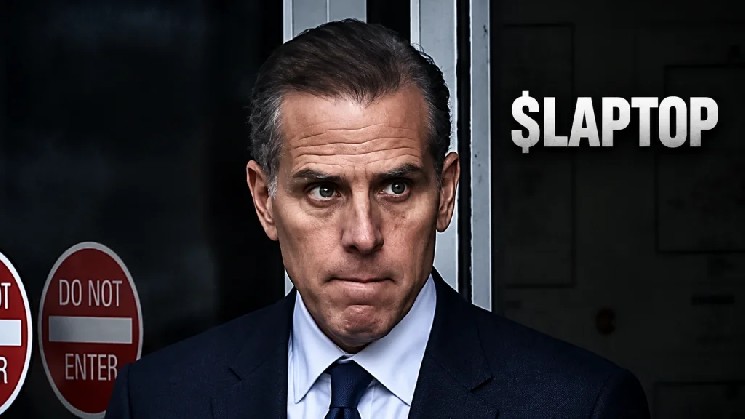
    Hunter Biden, son of former U.S. President Joe Biden, has entered the cryptocurrency market, reviving the laptop controversy that dominated U.S. political discourse ahead of the 2020 presidential election. On September 9, 2026, Biden launched a memecoin named $LAPTOP on the Base blockchain.

    Token Price Surges Then Crashes Within Minutes

    The token experienced an extremely rapid price surge in its first few minutes, briefly exceeding $200. However, the rally proved short-lived, and the price crashed severely soon after.

    X Account Suspended Amid Controversy

    Following the price collapse, the project’s X account was suspended. The platform has not publicly provided a clear reason for the suspension.

    Hunter Biden Appeals Directly to Elon Musk

    Addressing the suspension five days after the launch, Hunter Biden made a direct appeal to Elon Musk via X. In his post, Biden referenced warnings from Musk and Anthropic CEO Dario Amodei regarding the potential threat artificial intelligence could pose to humanity by 2030. Biden jokingly asked if his $LAPTOP account could be reinstated, stating, “Is there any chance we can lift the ban on the laptop token?”

    The request, which tagged Musk directly, sparked debate on social media regarding whether Musk would support the $LAPTOKEN project. However, there is currently no verified evidence that Musk has supported, purchased, or taken any action to influence the token’s price. Additionally, there is no confirmed information indicating that Musk has responded to Biden’s request. At this stage, the connection between Musk and $LAPTOP appears limited to Biden’s public appeal to restore the suspended account.

    This is not investment advice.

  • Zora Co-Founder Dee Goens Steps Up as CEO After 98% Revenue Plunge

    Zora Co-Founder Dee Goens Steps Up as CEO After 98% Revenue Plunge

    Zora Co-Founder Dee Goens Takes CEO Role Amid Sharp Revenue Decline

    Zora co-founder Dee Goens announced Wednesday that he has assumed the chief executive position at the onchain social network, succeeding Jacob Horne. The leadership change arrives during a turbulent period for the platform, as its creator-coin business has contracted dramatically since peaking in 2025.

    Understanding Zora’s Token Ecosystem

    Zora’s terminology often creates confusion. The $ZORA token serves as the platform’s native asset, distinct from Zora Coins—the protocol activity metrics tracked by DefiLlama—and Creator Coins and Post Coins, which users trade to speculate on creators and their content. The $ZORA token functions primarily for reward distribution and liquidity provision, but it confers no governance rights or ownership stakes to holders.

    This distinction is critical. Zora’s recovery depends on reigniting trading volume for Creator and Post Coins while establishing a compelling incentive for $ZORA holders to support the platform’s growth. As CEO, Goens must demonstrate that token-based attention can sustain long-term trading activity, generate meaningful revenue for creators, and strengthen the connection between Zora’s business fundamentals and its native token.

    Revenue Collapse: From $5.6 Million Quarter to Near Zero

    The financial data underscores the severity of the downturn. According to DefiLlama, Zora Coins protocol revenue reached $5.64 million in Q3 2025. That figure plummeted to $3.06 million in Q4 2025, $279,810 in Q1 2026, and $106,540 in Q2 2026—a 98.1% decline from the Q3 2025 peak. The current Q3 2026 figure stands at $46,810, though the quarter remains incomplete.

    Recent onchain activity reflects the same weakness. DefiLlama reports $14,971 in fees, $6,165 in protocol revenue, and $551,284 in DEX volume over the last 30 days. Cumulative fees total $10.43 million, with overall DEX volume reaching approximately $399.47 million.

    Why Momentum Stalled

    Zora’s initial model tied tokens to both creators and their output: Creator Coins represented individuals, while Post Coins represented specific posts. A 0x case study notes that Creator Coins were linked to $ZORA, whereas Post Coins were tied to the creator’s own coin.

    Distribution mechanics drove the 2025 boom. When Coinbase integrated Zora into the Base App feed, daily token creation surged from roughly 6,000 at the start of July to nearly 50,000 by month’s end, per 0x data. The platform’s Swap API subsequently facilitated $59 million in volume across 352,000 trades using Zora coins.

    That momentum reversed in 2026. As reported by Cryptopolitan in February, Base App discontinued its Creator Rewards program and Farcaster-powered social feed, pivoting toward trading—despite having allocated over $450,000 in rewards to more than 17,000 creators.

    Betting on Pairing Infrastructure and Multichain Expansion

    Goens is now steering Zora toward a broader trading infrastructure. “Pairing and social trading will create new waves of adoption for crypto,” he wrote on X, adding that “Zora is here to help grow the pie.”

    The product has begun moving in that direction. Custom Pairs now allow creators to choose the asset their coin pairs with—options include ETH, USDC, Robinhood stock tokens, or Solana tokens across Base, Robinhood Chain, and Solana. These pairs carry a 1% trading fee, with 0.70% allocated to the creator. Trend Coins charge a minimal 0.01% fee. An August update added support for Robinhood Chain and native Solana deposits, plus gas sponsorship for cross-chain swaps across the three networks.

    The Proof Ahead for Goens

    Token alignment remains a central challenge. While Goens has mentioned buybacks or rewards as potential mechanisms to align $ZORA holders with protocol success, he has not disclosed the amount, funding source, timing, or mechanism for such initiatives. This matters because $ZORA holders currently hold no legal claim to protocol revenue or treasury assets.

    The deeper test is longevity. Galaxy Research has observed that new token markets tend to be highly concentrated and capture attention only briefly, producing liquidity bursts rather than sustained activity. Zora will need more than another viral cycle. Goens’ ultimate challenge is whether quarterly revenue can grow through ongoing multichain trading rather than a one-time distribution spike.

  • Hunter Biden Defends Laptop Ahead of Wednesday Launch, Calls Trump a ‘grift’

    Hunter Biden Defends Laptop Ahead of Wednesday Launch, Calls Trump a ‘grift’

    A new cryptocurrency token called LAPTOP has sparked immediate controversy following its announcement, drawing sharp criticism from traders and prompting several high-profile industry figures to distance themselves from the project.

    Creator Warns Buyers Not to Expect Value Creation

    The individual behind the token issued a blunt warning to potential buyers via X, stating explicitly that no effort would be made to increase the asset’s value.

    “You should not expect me or anyone else to make this token more valuable for you. LAPTOP isn’t just about owning something, it’s about saying something.”

    The post arrived amid a hostile reaction from crypto traders over Monday and Tuesday.

    Exchanges and Influencers Pull Back

    Kraken, one of the largest cryptocurrency exchanges, deleted a promotional post about LAPTOP after traders criticized the exchange for amplifying the project.

    Andrew Callaghan, the video journalist behind Channel 5, also distanced himself from the token after learning his audience had been included in a planned token distribution without his consent.

    Base Blockchain Denies Partnership

    Executives at Base, the Coinbase-built layer-2 blockchain where LAPTOP is set to launch, stressed that the network had no formal partnership with the token.

    Base founder Jesse Pollak confirmed the project had approached his team, but said Base made a “conscious decision” not to assist with the token’s design or promotion.

    Token Draws on Infamous Laptop History

    The LAPTOKEN project references the laptop that became a focal point of political controversy. Data said to have come from the device included emails about overseas business dealings as well as deeply personal photos, messages, and videos involving drug use and private life. The laptop spawned years of political attacks and thousands of online memes.

    The token’s creator is now attempting to convert that notoriety into a cryptocurrency asset.

    “They turned laptop into a weapon. I turned it into a token.”

  • Bankr Enables Agent-Powered Stock Liquidity

    Bankr Enables Agent-Powered Stock Liquidity

    Bankr Launches Natural-Language Liquidity for Tokenized Stocks on Aerodrome

    Bankr, a financial infrastructure platform for AI agents, has launched a natural-language liquidity product for tokenized stocks on Aerodrome, a decentralized exchange built on Base.

    Users can now buy supported Coinbase Tokenized Stocks and add them to liquidity pools through a single typed command. The product is designed to make liquidity provision more accessible to individual users, a role previously handled mainly by professional market-making firms using specialized infrastructure.

    Automated liquidity management for tokenized stocks

    Bankr enables users to create and manage concentrated liquidity positions without manually setting price ranges. Its agent monitors those positions and rebalances them as market prices change.

    The agent can operate overnight, during weekends, and while traditional stock markets are closed. Users retain control of their positions and define the parameters within which the agent can operate.

    Coinbase Tokenized Stocks are on-chain certificates backed by shares held with regulated custodians. They are available only in eligible jurisdictions outside the United States.

    Image: Magnific

    Source: cryptonews.net