Tag: Bank of Japan

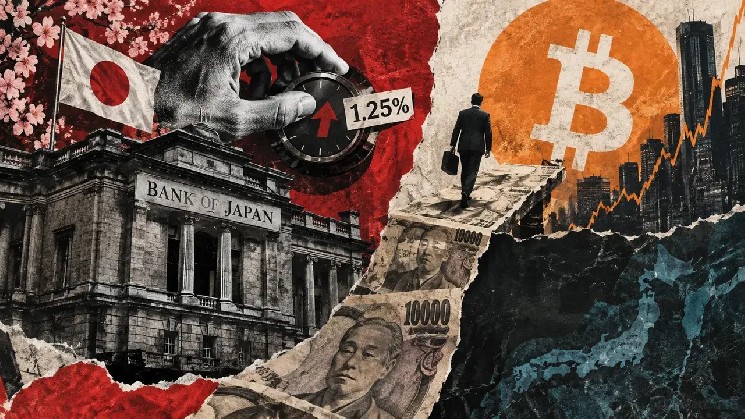
  • Bitcoin Rallies After BOJ’s 1.25% Rate Hike, but Real Yen-Carry Test Looms Next Week

    Bitcoin Rallies After BOJ’s 1.25% Rate Hike, but Real Yen-Carry Test Looms Next Week

    Key Highlights

    • The Bank of Japan raised its policy rate by 25 basis points to approximately 1.25% on September 18, with the new target taking effect September 24.
    • Bitcoin traded orderly following the announcement, rising from $76,961 to over $81,000 intraday, while the yen weakened 1.2% against the dollar—contrary to a classic carry-unwind pattern.
    • The BOJ signaled financial conditions will remain accommodative and tied further hikes to economic and inflation outlook rather than a fixed timetable, leaving longer-term risk open.

    BOJ Delivers Rate Hike as Markets Monitor Yen-Carry Dynamics

    The Bank of Japan voted 7-2 on September 18 to lift its target for the uncollateralized overnight call rate from about 1% to about 1.25%, marking a continuation of its gradual normalization cycle. The new target and related facility rates take effect September 24, meaning the policy path shifted before the official operating rates changed. This separation allows market positions to adjust ahead of implementation, and the BOJ’s next policy signal may prove as consequential as the September 24 effective date because the central bank explicitly tied further increases to its economic and inflation outlook rather than a predetermined schedule.

    Bitcoin Reaction Remains Orderly Amid Yen Weakness

    At the BOJ’s 02:54 UTC release time, Coinbase one-minute data recorded Bitcoin’s closing price at $76,961. By 03:30 UTC, the one-minute close stood at $77,383, with the cryptocurrency continuing to climb throughout the session to an intraday high of $81,000. The currency move simultaneously ran counter to the simplest carry-unwind pattern. Reuters reported that during BOJ Governor Kazuo Ueda’s press conference, the dollar climbed to a two-week high of 157.84 yen, leaving the Japanese currency 1.2% weaker on the day. A visible synchronized unwind would more typically pair rapid yen appreciation with falling risk assets.

    Yen Funding One Channel Among Several for Crypto

    The available evidence leaves the amount of Bitcoin exposure financed in yen unquantified. Coinbase Institutional’s review of the 2024 carry episode identified several simultaneous catalysts, including weak U.S. economic data and pressure on technology stocks. Yen funding represents one transmission channel among several that can shape crypto market moves. The initial reaction points to limited immediate unwind pressure in observed markets, though longer-term risk remains open as the new rate takes effect and the BOJ considers its next steps.

    Why This Matters

    The BOJ’s decision arrives at a critical juncture for global liquidity and risk-asset positioning. Yen-funded carry trades have historically amplified volatility across asset classes when Japanese rates rise or the yen appreciates sharply. The central bank’s explicit conditioning of future hikes on realized economic and inflation outcomes—rather than a mechanical calendar—introduces a layer of policy uncertainty that markets must price incrementally. For cryptocurrency markets, the orderly Bitcoin response suggests current positioning is less vulnerable to an immediate, disorderly unwind than some analysts feared. However, the diagnostic warning signs remain clear: sharp yen appreciation concurrent with declining crypto and equity prices, or a fresh BOJ signal indicating tighter policy sooner than consensus expects, could rapidly alter the risk calculus. The September 24 implementation date serves as the next tangible milestone, but the evolving outlook guidance from Governor Ueda and the BOJ board will likely drive the narrative in the weeks ahead.

    Frequently Asked Questions

    Did the BOJ rate hike trigger a Bitcoin sell-off?

    No. Bitcoin rose from $76,961 at the time of the announcement to an intraday high of $81,000, indicating an orderly market response rather than a forced unwind of yen-funded positions.

    Why did the yen weaken instead of strengthen after the rate increase?

    The dollar climbed to a two-week high of 157.84 yen during Governor Ueda’s press conference, leaving the yen 1.2% weaker on the day. This suggests markets interpreted the BOJ’s forward guidance as sufficiently dovish—emphasizing accommodative conditions and data-dependent future hikes—to offset the immediate rate increase.

    What are the key signals to watch for potential carry-unwind risk ahead?

    Analysts highlight two primary warning signs: a sharp appreciation of the yen accompanied by simultaneous declines in crypto and equity markets, or a new BOJ communication indicating that policy tightening will resume sooner than markets currently anticipate.

  • Bitcoin Bottom Signal vs. Fed Rate Expectations: Which Drives Market Direction? Two Analysts Weigh In

    Bitcoin Bottom Signal vs. Fed Rate Expectations: Which Drives Market Direction? Two Analysts Weigh In

    Key Highlights

    • On-chain analyst Willy Woo identifies a Fisher Transform golden cross on Bitcoin’s monthly chart, marking only the fourth such bottom signal in the asset’s history.
    • Crypto analyst Murphy contends that interest rate hikes by the Federal Reserve and Bank of Japan are not inherently bearish for Bitcoin, emphasizing pace of tightening and market structure over rate decisions alone.
    • Historical comparison shows Bitcoin rallied during the 2015–2017 and 2023 rate hike cycles, while the 2022 decline coincided with aggressive 75-basis-point increases; current conditions mirror early 2023 more than 2022.

    Willy Woo’s Fisher Transform Analysis Signals Potential Bitcoin Bottom

    As Bitcoin consolidates between $76,000 and $79,000, prominent on-chain analyst Willy Woo has turned attention to the asset’s monthly chart, where the Fisher Transform indicator has formed a golden cross. First published in 2002, the Fisher Transform is designed to identify turning points in price movements. According to Woo, this latest crossover represents only the fourth bottom signal in Bitcoin’s entire history. Crucially, the previous three occurrences did not result in false breakouts, lending historical weight to the current formation.

    Why the Golden Cross Isn’t an Immediate Buy Signal

    Despite the indicator’s track record, Woo cautions against interpreting the golden cross as a sudden trend reversal or a direct buy signal. He notes that Bitcoin’s price may continue moving sideways for a period before resuming its upward trajectory. Woo also points out that during bull markets, the Fisher Transform has occasionally crossed bearish only to turn bullish again without signaling the end of the primary trend. Therefore, while the current signal points to a possible bottom, it does not, by itself, definitively confirm a trend reversal.

    Murphy Challenges Rate Hike Bearish Narrative with Historical Evidence

    Separately, crypto analyst Murphy argued that interest rate hikes by the U.S. and Japanese central banks alone do not indicate Bitcoin will re-enter a bear market. Murphy asserts that the pace of monetary tightening, market structure, and investor positioning will be more decisive than the rate hike decisions themselves in determining Bitcoin’s direction.

    To support this view, Murphy compared three distinct tightening cycles. In 2022, the Federal Reserve implemented a cumulative 425 basis points of increases, including four consecutive 75-basis-point hikes from June to November. During that period, Bitcoin declined from approximately $41,000 to $15,800. In contrast, during 2023, the Fed raised rates four times by 25 basis points each, and Bitcoin rose from roughly $16,500 to $42,000. Murphy also highlighted the December 2015 to December 2017 cycle, when the Fed hiked five times by 25 basis points each, and Bitcoin surged from about $454 to $16,515.

    Market Structure Resembles Early 2023 More Than 2022 Peak

    Murphy further observed that the current structure of the Bitcoin market more closely resembles conditions at the beginning of 2023 than those during the initial 2022 rate hike period. At that time, inflation was falling, the size of each rate hike decreased from 75 to 25 basis points, and the market priced in the end of the tightening cycle. According to the analyst, if future rate hikes remain limited to around 25 basis points and the market does not anticipate a new, prolonged tightening cycle, interest rate policy alone may not be sufficient to trigger a fresh bear market in Bitcoin. The pace and scale of future Federal Reserve rate hikes will be critical for Bitcoin’s trajectory.

    Why This Matters

    The convergence of technical and macroeconomic analyses offers a nuanced view for market participants. Woo’s Fisher Transform signal provides a rare, historically validated technical marker suggesting a cyclical bottom may be in place, yet his emphasis on the indicator’s limitations—specifically its inability to time entries or guarantee immediate reversals—underscores the need for patience. Meanwhile, Murphy’s macroeconomic framework challenges the simplistic narrative that higher rates automatically depress risk assets like Bitcoin. By demonstrating that the asset has rallied during previous tightening cycles when hikes were measured and expected, the analysis shifts focus to the trajectory of policy rather than its mere existence. With inflation moderating and central banks signaling smaller incremental moves, the current environment bears stronger resemblance to the constructive 2023 backdrop than the disruptive 2022 shock. For investors, the key takeaway is that Bitcoin’s next major directional move will likely hinge on whether the Fed maintains a gradual, telegraphed path or surprises with accelerated tightening.

    Frequently Asked Questions

    What is the Fisher Transform golden cross, and why is Willy Woo highlighting it now?
    The Fisher Transform is a technical indicator published in 2002 designed to identify price turning points. A golden cross occurs when its faster line crosses above its slower line. Willy Woo highlights that this has happened only four times in Bitcoin’s history on the monthly chart, with the prior three instances marking valid bottoms without false breakouts.
    Does the Fisher Transform golden cross mean Bitcoin will rally immediately?
    No. Woo explicitly states the signal is not a sudden trend reversal or a direct buy signal. He notes Bitcoin may trade sideways for a while before continuing its uptrend, and that the indicator has previously flipped bearish then bullish again during bull markets without ending the primary trend.
    Are Federal Reserve interest rate hikes bearish for Bitcoin?
    Not necessarily. Analyst Murphy shows that Bitcoin fell during 2022’s aggressive 75-basis-point hikes but rose during the 2015–2017 and 2023 cycles when hikes were smaller (25 basis points) and well-telegraphed. The pace, scale, and market expectations around rate hikes matter more than the hikes themselves.
  • U.S. Looks to Influence Japan’s Monetary Policy—but Bitcoin Is Beyond Its Reach

    U.S. Looks to Influence Japan’s Monetary Policy—but Bitcoin Is Beyond Its Reach

    If Japan raises interest rates and the yen strengthens sharply, years of cheap yen-funded bullish bets on stocks, bonds and cryptocurrencies could unwind. Foreign investors who bought Japanese shares because of the weak yen may sell, while Japanese savers who moved money overseas as a hedge could repatriate those funds.

    As these positions are closed, risk assets could come under selling pressure. Bitcoin suffered collateral damage in early August 2024, when a Bank of Japan rate increase pushed the yen higher and triggered a broad wave of risk aversion.

    Bitcoin’s long-term bullish outlook remains intact, but the cryptocurrency still trades as a high-risk asset when traditional markets face sudden interest-rate and currency shocks. Investors should remain alert.

    For analysis of today’s activity in altcoins and derivatives, see Crypto Markets Today. For a comprehensive list of events this week, see CoinDesk’s “Crypto Week Ahead.”

    What’s Trending

    North Korean hackers move tens of millions on Hyperliquid as Trump pushes to bring crypto platform onshore

    Blockchain data reviewed by CoinDesk appears to show that wallets reportedly linked to North Korea’s Lazarus Group sold more than $30 million in bitcoin on the platform during the past three weeks alone.

    CME’s share of $XRP futures jumps as token rallies 40% in one week

    A growing share of $XRP futures trading is shifting toward CME as traders reduce leveraged positions across cryptocurrency exchanges.

    Global bond yields reach multi-decade highs as Middle East turmoil revives inflation fears

    Government bond yields rose across major markets, with borrowing costs in Japan and the U.K. reaching multi-decade highs and U.S. Treasury yields also surging.

    Oil prices rise and stocks fall as Middle East violence intensifies uncertainty

    Oil prices climbed 2% while global shares fell Tuesday. Brent crude gained 2% to $92.35 per barrel, and U.S. benchmark crude rose 2.5% to $87.84 per barrel.

    Source: cryptonews.net