Tag: Baku City Circuit

  • How to Stream the 2026 Azerbaijan Grand Prix on F1 TV Premium

    How to Stream the 2026 Azerbaijan Grand Prix on F1 TV Premium

    Key Highlights

    • Kimi Antonelli leads the 2026 Formula 1 Drivers’ Championship by 81 points heading into the Azerbaijan Grand Prix at the Baku City Circuit.
    • Apple becomes Formula 1’s new Official U.S. Broadcaster, with F1 TV included free within Apple TV subscriptions and the F1 TV broadcast team fronting English-language coverage.
    • F1 TV Premium offers 4K Ultra HD/HDR streaming on up to six devices with a 26-feed Multiview feature, plus access to F2, F3, F1 Academy, and Porsche Supercup sessions.

    Azerbaijan Grand Prix Sets Stage for Championship Showdown in Baku

    The 2026 Formula 1 season arrives at the Baku City Circuit this weekend for the Azerbaijan Grand Prix, with championship leader Kimi Antonelli looking to extend his commanding advantage on the streets of Baku. The Mercedes driver enters the round with an 81-point lead at the top of the drivers’ standings following his victory at the Spanish Grand Prix in Madrid, positioning him as the clear favorite to add another triumph to his growing tally.

    Lando Norris, the reigning World Champion, arrives in Azerbaijan seeking redemption after a cruel twist of fate in Spain. The McLaren driver missed out on a potential race win when his pit stop coincided with the conclusion of a Virtual Safety Car phase, costing him critical track position. Norris will be keen to bounce back on a circuit that has historically produced unpredictable racing and dramatic momentum shifts.

    F1 TV Expands Access with Apple Partnership in United States

    Formula 1’s streaming platform is undergoing a significant transformation in the United States. Apple has been named Formula 1’s new Official U.S. Broadcaster, with F1 TV now included for free within Apple TV subscriptions. This strategic partnership streamlines access for American fans while enhancing the overall viewing experience. The established F1 TV broadcast team will primarily front Apple TV’s English-language coverage, bringing their expertise and insight to a substantially wider U.S. audience.

    For viewers seeking the premium experience, F1 TV Premium delivers races in 4K Ultra HD/HDR across up to six simultaneous devices. A personalized Multiview feature—available on select devices—offers 26 different feeds to choose from, allowing fans to curate their own race perspective. The platform also provides comprehensive coverage of every Formula 1 Grand Prix, Sprint, Qualifying, and practice session, alongside live streams of F2, F3, F1 Academy, and Porsche Supercup events.

    Enhanced Content Library and Global Payment Options

    Beyond live race coverage, F1 TV continues to expand its on-demand library with in-depth programming. Tech Talk Retro examines iconic car designs from Formula 1’s history, while F1 Icons chronicles the careers of legendary drivers from past eras. The service has also broadened its payment infrastructure, now accepting American Express among other methods to facilitate easier global access for subscribers.

    F1 TV Pro and Premium remain available in selected locations only. Fans can check regional broadcaster details and session times for the Azerbaijan Grand Prix through official Formula 1 channels.

    Why This Matters

    The Azerbaijan Grand Prix represents a critical inflection point in the 2026 championship. With an 81-point cushion, Antonelli holds a near-insurmountable lead with more than half the season remaining, though Baku’s history of safety cars and high-attrition races means no lead is truly secure. Simultaneously, Formula 1’s U.S. media rights shift to Apple signals the sport’s accelerating push into mainstream American streaming ecosystems, potentially reshaping how millions of new fans discover and consume F1 content. The integration of F1 TV into Apple’s subscription bundle removes a significant friction point for casual viewers, while the Premium tier’s 26-feed Multiview caters to the hardcore enthusiast demographic that drives sustained engagement.

    Frequently Asked Questions

    How can I watch the Azerbaijan Grand Prix in the United States?

    In the U.S., the Azerbaijan Grand Prix will be available on Apple TV, which now includes F1 TV free with an Apple TV subscription. The F1 TV broadcast team will front the English-language coverage on Apple’s platform.

    What is the difference between F1 TV Pro and F1 TV Premium?

    F1 TV Pro provides live coverage of every session with exclusive features like onboard cameras for all 22 cars and Pre-Race/Post-Race shows. F1 TV Premium adds 4K Ultra HD/HDR streaming on up to six devices, a 26-feed Multiview feature on select devices, and access to F2, F3, F1 Academy, and Porsche Supercup sessions.

    Is F1 TV available worldwide?

    F1 TV Pro and Premium are available in selected locations only. Fans should check the official Formula 1 website for details of broadcasters in their specific area.
  • Isack Hadjar to make racing return with Red Bull at Azerbaijan Grand Prix

    Isack Hadjar to make racing return with Red Bull at Azerbaijan Grand Prix

    Key Highlights

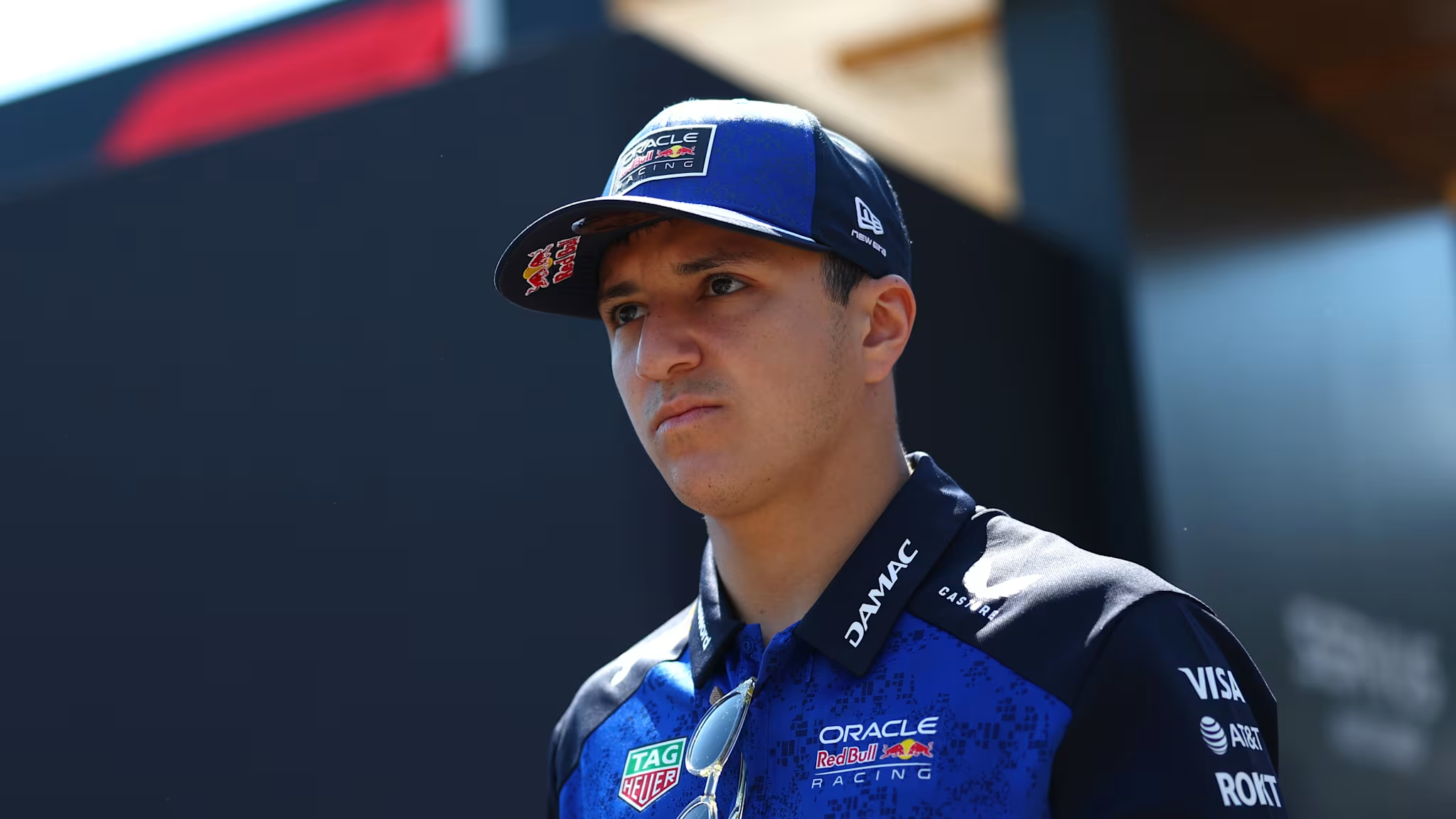
    • Isack Hadjar returns to Red Bull Racing for the Azerbaijan Grand Prix after recovering from a wrist injury sustained during summer training.
    • Liam Lawson completes his three-race substitute stint and returns to Visa Cash App Racing Bulls, while Yuki Tsunoda resumes reserve driver duties.
    • The Baku weekend schedule is condensed: Free Practice on Thursday, Qualifying on Friday, and the Grand Prix on Saturday to avoid a clash with Azerbaijan’s Remembrance Day on September 27.

    Hadjar Cleared for Baku Return After Summer Injury Layoff

    Isack Hadjar is set to reclaim his seat at Oracle Red Bull Racing for the Azerbaijan Grand Prix, marking the end of a nearly two-month absence forced by a wrist injury sustained during off-track training over the summer break. The French-Algerian rookie missed three consecutive rounds — Zandvoort, Monza, and the inaugural Madring event — while undergoing rehabilitation. Red Bull confirmed on Tuesday that Hadjar has been declared fully fit and will participate in Thursday’s opening free practice session at the Baku City Circuit.

    Lawson’s Interim Stint Concludes with Praise from Red Bull Leadership

    Liam Lawson, who stepped into the second Red Bull seat alongside Max Verstappen for the three missed races, will now return to Visa Cash App Racing Bulls. The New Zealander’s performances drew explicit commendation from the team’s hierarchy. In a statement issued Tuesday, Red Bull emphasized Lawson’s professionalism under difficult circumstances:

    “Oracle Red Bull Racing is delighted to welcome Isack back this weekend,” read a statement issued by Red Bull on Tuesday.

    “Having made a successful recovery from his wrist injury, Isack will return to action at the Baku City Circuit on Thursday.”

    “The team would like to sincerely thank Liam for his professionalism, dedication and hard work over the past three races.”

    “Stepping in under challenging circumstances, he delivered some impressive performances and made a valuable contribution to the team.”

    “We wish him all the best as he returns to Visa Cash App Racing Bulls.”

    Lawson’s temporary promotion came at a critical juncture in the Constructors’ Championship battle, and his ability to extract competitive results from the RB20 on short notice strengthened Red Bull’s depth chart heading into the season’s final stretch.

    Tsunoda Resumes Reserve Role as Driver Rotation Resets

    The driver shuffle also sees Yuki Tsunoda revert to reserve driver duties for Red Bull Racing. The Japanese driver had been elevated to a more visible support role during Lawson’s stint but now returns to his standard simulator and development program. The rotation underscores Red Bull’s fluid driver pool strategy across its two Formula 1 entries, with Racing Bulls serving as both a development platform and a tactical reserve for the senior team.

    Compressed Baku Schedule Adds Tactical Complexity

    The Azerbaijan Grand Prix weekend operates on an altered timetable to accommodate Azerbaijan’s Remembrance Day on September 27. Rather than the traditional Friday-to-Sunday format, track action begins Thursday with Free Practice, followed by Qualifying on Friday and the Grand Prix itself on Saturday. This compression reduces preparation time for Hadjar’s reintegration and places a premium on immediate pace during the sole practice session. Engineers must finalize setup directions with minimal running, while Hadjar reacclimates to the RB20’s handling characteristics on a street circuit notorious for punishing errors.

    Why This Matters

    Hadjar’s return signals Red Bull’s confidence in their 2024 rookie investment amid a tightly contested Constructors’ fight. The team’s willingness to rotate Lawson back to Racing Bulls — rather than extend his audition — suggests satisfaction with Hadjar’s pre-injury trajectory and a desire to maintain continuity in their long-term driver development pipeline. For Lawson, the three-race audition provided valuable exposure to championship-pressure weekends, likely strengthening his case for a 2025 seat. The condensed Baku schedule, meanwhile, tests every team’s operational agility, with single-practice formats historically producing unpredictable grids and strategic variance.

    Frequently Asked Questions

    Why did Isack Hadjar miss the last three races?

    Hadjar sustained a wrist injury while training during the summer break, forcing him to sit out the Dutch Grand Prix at Zandvoort, the Italian Grand Prix at Monza, and the inaugural Madring event while he underwent rehabilitation.

    What happens to Liam Lawson now?

    Lawson returns to Visa Cash App Racing Bulls after completing his three-race substitute stint with the senior Red Bull team. Red Bull publicly thanked him for his “professionalism, dedication and hard work” and noted he “delivered some impressive performances.”

    Why is the Azerbaijan Grand Prix schedule different this year?

    The weekend has been moved forward by one day — Free Practice on Thursday, Qualifying on Friday, and the race on Saturday — to avoid a clash with Azerbaijan’s Remembrance Day on September 27.

  • Formula 1 Approves Shorter Races for 2027 to Align with Revised Power Unit Regulations

    Formula 1 Approves Shorter Races for 2027 to Align with Revised Power Unit Regulations

    Key Highlights

    • The Formula 1 Commission has approved a 15 km reduction in grand prix race distance for 2027, dropping the standard from 305 km to 290 km pending FIA World Motor Sport Council ratification.
    • Power unit regulations shift toward combustion: the internal combustion engine (ICE) output rises to 420 kW while MGU-K deployment falls to 300 kW (350 kW in overtake mode), supported by a 5% fuel flow increase.
    • Race stoppage rules are overhauled: the three-hour maximum window for red-flagged events is replaced by a hard stop time based on daylight, and race directors gain authority to extend free practice sessions after prolonged interruptions.

    F1 Commission Greenlights 2027 Race Distance Reduction

    The Formula 1 Commission convened in London on Monday and rubber-stamped a package of regulatory changes for the 2027 season, headlined by a decision to shorten every grand prix by 15 kilometres. The standard race distance will fall from 305 km to 290 km, a move that translates to roughly three fewer laps at most circuits on the calendar. The measure still requires formal approval from the FIA World Motor Sport Council (WMSC) before it enters the sporting regulations.

    Power Unit Rebalance Drives Chassis and Fuel Strategy Changes

    The distance cut is a direct consequence of the 2027 power unit framework agreed earlier. To re-balance the formula and curb the level of “superclipping” and energy harvesting that characterised recent seasons, the Commission confirmed that the internal combustion engine will be upscaled to a 420 kW peak output. Simultaneously, the maximum power drawn from the MGU-K is reduced to 300 kW during standard running, with the overtake mode retaining a 350 kW ceiling. Delivering the extra combustion output demands a 5% increase in fuel flow.

    Rather than mandate larger fuel cells to accommodate the higher flow rate—which would entail costly chassis redesigns—the FIA and Formula One Management (FOM) opted to trim race distances. The shorter races minimise the risk of drivers running dry in the closing laps while keeping the current fuel tank specification intact. It remains an open question whether the 290 km format will persist into 2028, when the regulations evolve again: ICE output is slated to climb to 450 kW, fuel flow will rise by 13% overall, and the combustion-to-electric energy split shifts to 60/40, a configuration that will necessitate a larger fuel tank.

    Race Stoppage Protocol Overhauled for Daylight Constraints

    Beyond powertrain matters, the Commission forwarded a significant rewrite of the race suspension clock to the WMSC. The existing two-hour race-time limit remains, but the three-hour absolute window that currently governs red-flag stoppages will be eliminated. In its place, a hard stop time tied to daylight conditions will be enforced for any delayed or rain-affected grand prix. The FIA communique explained the rationale directly: “these changes were introduced to ensure that the spectators have the best possible chance to enjoy a full race if disruptions occur.”

    Race directors will also receive expanded authority to extend free practice sessions when extended red-flag periods eat into track time. The rule change was motivated by the Spanish Grand Prix FP3 session, which lost approximately 30 minutes after separate incidents involving Lewis Hamilton and Ollie Bearman. Hamilton’s impact at Turn 22 required roughly 25 minutes of barrier repairs, and Bearman’s late-session crash truncated the remaining running by a further five minutes.

    Gearbox Development Unlocked for 2027 Season

    In a move welcomed by manufacturers, gearbox homologation has been rescinded for 2027. The decision allows suppliers to continue developing their transmissions throughout next season rather than freezing specifications. The Commission’s document also alluded to additional minor technical regulation tweaks for 2025, alongside undisclosed updates to the sporting and financial regulations for the current championship year.

    Why This Matters

    The 2027 rule package represents the most substantial regulatory reset since the ground-effect era began in 2022. By dialing up combustion output and dialing down electrical deployment, the FIA aims to restore a more traditional power delivery profile while containing costs through the race-distance reduction rather than chassis redesigns. The shift to a hard stop time for red-flagged races addresses long-standing criticism that the three-hour window created scheduling uncertainty for broadcasters and promoters, particularly at venues with limited daylight or tight curfews. Free practice extensions give teams a safeguard against lost preparation time, a practical response to the increasing frequency of session-stopping incidents. Finally, lifting gearbox homologation acknowledges that transmission development remains a meaningful performance differentiator and prevents a premature technology freeze ahead of the 2028 power unit evolution.

    Frequently Asked Questions

    How much shorter will 2027 Formula 1 races be?
    Each grand prix will be reduced by 15 km, from the current 305 km standard to 290 km. At most circuits this equates to approximately three fewer laps.
    Why is the race distance being cut instead of increasing fuel tank size?
    The 2027 power unit rules raise ICE output to 420 kW and increase fuel flow by 5%. Enlarging fuel tanks would require costly chassis modifications; shortening races achieves the same fuel-margin safety net without structural changes.
    What changes are being made to red-flag and race stoppage rules?
    The three-hour maximum window for a red-flagged race is replaced by a hard stop time based on daylight. Race directors also gain the power to extend free practice sessions after prolonged interruptions, a direct response to the truncated FP3 session at the 2024 Spanish Grand Prix.
  • Carlos Sainz Backs Bold Approach for Williams Junior Will Green’s Racing Future

    Carlos Sainz Backs Bold Approach for Williams Junior Will Green’s Racing Future

    Key Highlights

    • Carlos Sainz advises 13-year-old Williams Academy driver Will Green to prioritize finding the limit over consistency in his transition from karting to single-seaters.
    • The Spanish Formula 1 driver emphasizes that making mistakes while pushing hard is essential for learning and confidence-building at the junior level.
    • Green, the 2026 Karting European Championship junior champion, conducted the interview published on the Williams Racing YouTube channel.

    Sainz Mentors Williams’ Newest Academy Talent

    Carlos Sainz has offered candid guidance to Will Green, the 13-year-old karting prodigy who joined the Williams Racing Academy in December 2024, urging the British youngster to embrace risk-taking over conservative consistency as he prepares for the leap to single-seater competition. The conversation, filmed for the Williams Racing YouTube channel, featured the unique dynamic of Green interviewing the 32-year-old Spanish Grand Prix winner, providing a rare glimpse into how established Formula 1 stars view the developmental pathway.

    Embrace Mistakes to Multiply Talent

    Sainz’s central message focused on the psychological approach required during the formative junior years. “Don’t be afraid to make mistakes. It’s better to push too hard and make mistakes than try and be too conservative,” Sainz said in the video on the Williams YouTube channel. “You are at the age where it’s important to learn as much as possible. So, don’t be scared.” He elaborated that the window for aggressive experimentation is narrow and critical. “Don’t be afraid to make mistakes, risk too much and go for overtakes or last-lap moves that maybe are too risky. I would say that age is the time to do it because that’s when you will learn the most.”

    The Ferrari driver distinguished between productive errors and avoidable blunders. “Always try to be as close to the limit as possible. Obviously, don’t do anything stupid. If you can avoid stupid mistakes, avoid stupid mistakes. But go and take risks because when they pay off, you feel a lot of confidence, and that’s where your talent multiplies. You’re not only talented but also confident.” This philosophy underscores a broader paddock consensus that early-career confidence, forged at the edge of adhesion, is a prerequisite for elite performance.

    A Natural Transition from Karting to Cars

    Reflecting on his own graduation from karts, Sainz offered reassurance regarding the technical adjustment. “I felt that going from karting to cars was quite natural to me. It didn’t feel weird,” he added. “You will jump in a car one day. They will teach you how to drive with the gears, with everything. The first two laps will be strange but then your natural instinct of just pushing flat out whatever they give you will kick in and you will find a way.” The remarks serve to demystify the step up for Green, who currently holds the 2026 Karting European Championship junior title.

    Why This Matters

    The exchange highlights the increasing structure of Formula 1 junior programs, where teams like Williams invest in drivers as young as 13 and facilitate direct mentorship with current race winners. Sainz’s advice aligns with the “find the limit first” doctrine employed by many driver coaches: early consistency often masks a lack of ultimate pace potential. For Green, the 2026 European junior champion, the immediate challenge will be applying this mindset during his first tests in machinery such as the Formula 4 car, where the cost of errors rises sharply compared to karting. Williams’ decision to publish the dialogue publicly also signals a transparency strategy, showcasing their academy culture to sponsors, fans, and future recruits.

    Frequently Asked Questions

    Who is Will Green and what has he achieved?
    Will Green is a 13-year-old British driver announced as a Williams Racing Academy member in December 2024. He recently won the 2026 Karting European Championship junior title.
    What specific advice did Carlos Sainz give about making mistakes?
    Sainz told Green it is better to push too hard and make mistakes than to be too conservative, stating that taking risks at this age is when a driver learns the most and builds the confidence that multiplies talent.
    Where can the full interview be watched?
    The interview conducted by Green with Sainz was published on the official Williams Racing YouTube channel.
  • 2025 F1 Academy champion Doriane Pin sets timeline for Formula 1 race seat

    2025 F1 Academy champion Doriane Pin sets timeline for Formula 1 race seat

    Key Highlights

    • Mercedes Formula 1 development driver Doriane Pin has set a five-year target to secure a race seat on the F1 grid.
    • The 2025 F1 Academy champion became the first woman to drive a Mercedes F1 car at Silverstone in April 2026, testing the 2021 W12 challenger.
    • Pin advocates for greater diversity and inclusion in motorsport, emphasizing the need for more opportunities for women in Formula 1 and beyond.

    Pin Sets Ambitious Five-Year Formula 1 Timeline

    Mercedes Formula 1 development driver Doriane Pin has publicly declared her intention to earn a race seat on the Formula 1 grid within the next five years. The French driver, who currently serves as a development driver for the Brackley-based team, outlined her long-term career aspirations during a recent Mercedes In Convo With Kids interview. When asked where she envisions herself in half a decade, Pin responded directly: “In Formula 1. “That would be cool. It will open some doors to all the girls that want to be a Formula 1 driver.”

    Historic Silverstone Test and Multi-Series Programme

    Pin’s trajectory accelerated significantly after she clinched the F1 Academy championship in 2025, a triumph that secured her a development driver contract with Mercedes. In April 2026, the 22-year-old made history by becoming the first woman to drive a Mercedes Formula 1 car at Silverstone, piloting the W12 — the team’s challenger from the 2021 season. Beyond her Formula 1 commitments, Pin maintains a demanding multi-discipline schedule. She serves as a development driver for Peugeot in the FIA World Endurance Championship and for Citroën in Formula E, while also competing in the Le Mans Prototype 2 Pro-Am class of the European Le Mans Series for the Duqueine Team.

    Championing Diversity in a Male-Dominated Sport

    Pin’s ambition extends beyond personal achievement; she is a vocal advocate for systemic change within the motorsport industry. Asked what she would change about the world, she centered her answer on representation: “Diversity, in general,” she said about one thing she would change about the world. “So in sports and outside of sports, I think we need more diversity. “So more opportunities for everyone. Especially with my experience in a male-dominated sport like motorsport. So it would be good if we had a lot of women also in Formula 1.” Her perspective is informed by direct experience navigating the sport’s hierarchical structure, positioning her as a prominent voice for the next generation of female talent.

    Why This Matters

    Pin’s stated timeline and current trajectory place her among the most credible female prospects for a Formula 1 race seat in recent history. Her path mirrors and advances the progress made by predecessors such as Susie Wolff, who drove in official free practice sessions for Williams in 2014 — becoming the first woman to participate in a Grand Prix weekend in 22 years — and Jessica Hawkins, who completed a 26-lap test in the Aston Martin AMR21 at the Hungaroring in September 2023. With the F1 Academy now firmly established as a feeder series under Formula 1’s management, Pin’s development across single-seaters, endurance racing, and electric competition provides a uniquely broad technical foundation. Should she achieve her five-year goal, it would represent a watershed moment for gender diversity at the pinnacle of motorsport.

    Frequently Asked Questions

    Who is Doriane Pin?

    Doriane Pin is a 22-year-old French racing driver who won the 2025 F1 Academy championship. She is currently a Formula 1 development driver for Mercedes, a development driver for Peugeot in the World Endurance Championship and Citroën in Formula E, and competes in the LMP2 Pro-Am class of the European Le Mans Series for Duqueine Team.

    What historic milestone did Pin achieve at Silverstone in April 2026?

    Pin became the first woman to drive a Mercedes Formula 1 car at Silverstone, testing the team’s 2021 W12 challenger as part of her development driver duties.

    Which other female drivers have recently tested Formula 1 machinery?

    Susie Wolff drove in official free practice sessions for Williams in 2014, and Jessica Hawkins completed a 26-lap test in the Aston Martin AMR21 at the Hungaroring in September 2023.

  • Formula 1 2026 Azerbaijan Grand Prix: Start Time and How to Watch

    Formula 1 2026 Azerbaijan Grand Prix: Start Time and How to Watch

    Key Highlights

    • Formula 1 heads to the Baku City Circuit for the 2026 Azerbaijan Grand Prix, with the race scheduled for Saturday, September 26 at 15:00 local time.
    • Kimi Antonelli holds a commanding 81-point lead in the drivers’ championship after his Madrid victory, while Lando Norris seeks redemption after missing a potential win from pole position.
    • Formula 2 continues its 2026 campaign in Baku for Round 12 with championship leader Nikola Tsolov in action across a packed support-race schedule beginning Thursday, September 24.

    Formula 1 Arrives in Baku for Critical Championship Weekend

    The Formula 1 circus touches down in Azerbaijan this week for the ninth running of the Azerbaijan Grand Prix at the Baku City Circuit, marking the venue’s 10th Formula 1 outing since its debut as the European Grand Prix in 2016. The street circuit, renowned for its dramatic blend of high-speed straights and tight, twisty sections winding through the city’s historic old town and medieval walls, sets the stage for a pivotal weekend in the 2026 championship battle.

    Championship Dynamics: Antonelli Extends Lead, Norris Hunts Redemption

    Kimi Antonelli arrives in Baku with a formidable 81-point advantage at the top of the drivers’ standings following his victory at the previous round in Madrid. That race delivered a significant twist: polesitter Lando Norris, driving for McLaren, failed to convert his grid position into a win, handing Antonelli a crucial psychological and numerical edge. The McLaren driver will be desperate to bounce back on a circuit that has historically produced unpredictable outcomes, while Antonelli aims to continue his commanding run of form and tighten his grip on the title.

    Baku’s Unique Challenge and Historical Winners

    The Baku City Circuit’s distinctive layout—looping around the Caspian Sea waterfront and through the narrow streets of the old town—has consistently tested driver precision and car reliability. Over the years, only two drivers have managed multiple victories at this venue: Sergio Perez and Max Verstappen, both of whom have stood on the top step of the podium twice. Their success underscores the circuit’s demand for a blend of outright speed, tire management, and race craft, qualities that will be essential again this weekend.

    Session Schedule and Global Broadcast Details

    The weekend kicks off unusually early with Free Practice 1 on Thursday, September 24 at 12:30 local time, followed by Free Practice 2 at 16:00. Friday, September 25 sees Free Practice 3 at 12:30 and Qualifying at 16:00, setting the grid for the Grand Prix itself on Saturday, September 26 at 15:00 local time. Comprehensive global start times for all sessions are available via the official Formula 1 race hub.

    Fans can watch every session live on F1 TV Pro (available in selected territories), which offers ad-free coverage, onboard cameras from all 22 cars, and pre- and post-race shows in six languages. The service streams via Apple TV, Chromecast (Gen 2+), Android TV, Google TV, Amazon Fire TV, and Roku. For an enhanced experience, F1 TV Premium provides 4K Ultra HD/HDR streaming on up to six devices simultaneously, plus a personalized Multiview feature with 26 selectable feeds on compatible devices. The platform also includes live coverage of F2, F3, F1 ACADEMY, and Porsche Supercup sessions. Live timing remains accessible on F1.com and the official F1 app throughout the weekend.

    Weather Outlook and Formula 2 Support Action

    Current forecasts indicate mild and dry conditions for the Azerbaijan Grand Prix weekend, though the circuit’s proximity to the Caspian Sea often brings gusty winds that have caught out drivers in previous years. Teams will need to monitor aerodynamic balance closely, particularly during qualifying and the race.

    While Formula 3 concluded its season in Spain, the 2026 Formula 2 championship moves to Baku for Round 12. Championship leader Nikola Tsolov heads the field into a packed schedule: Qualifying, Practice, and Qualifying 2 all take place on Thursday, September 24. The Sprint Race runs Friday, September 25 at 08:15 local time, followed by Feature Race 1 at 14:15. Feature Race 2 is set for Saturday, September 26 at 11:00, providing a full day of junior single-seater action ahead of the Formula 1 Grand Prix.

    Why This Matters

    The Azerbaijan Grand Prix represents a critical juncture in the 2026 Formula 1 season. With Kimi Antonelli holding an 81-point championship lead, the pressure mounts on rivals—particularly Lando Norris and McLaren—to close the gap before the calendar enters its latter stages. Baku’s history of safety cars, red flags, and strategic variability offers a prime opportunity for a momentum shift. Additionally, the circuit’s status as a street venue with limited run-off areas amplifies the importance of qualifying performance and race-day execution. For Formula 2, Baku hosts a triple-header weekend that could decisively shape the title fight, with Nikola Tsolov aiming to extend his advantage under the unique pressure of two feature races in two days. The event also marks the continued evolution of F1’s broadcast strategy, with F1 TV Premium’s 4K Multiview offering a glimpse into the future of personalized motorsport consumption.

    Frequently Asked Questions

    When does the 2026 Azerbaijan Grand Prix race start?
    The Grand Prix starts on Saturday, September 26 at 15:00 local time at the Baku City Circuit. Global start times vary by time zone and are listed on the official Formula 1 race hub.
    How can I watch the Azerbaijan Grand Prix live?
    Live coverage is available on F1 TV Pro (ad-free, with onboards and multi-language commentary) and F1 TV Premium (4K UHD/HDR, Multiview, up to six devices). Both services stream via major smart TV platforms. Live timing is also free on F1.com and the F1 app.
    Who are the most successful drivers at the Baku City Circuit?
    Sergio Perez and Max Verstappen are the only drivers to have won multiple times in Baku, each with two victories. The circuit has produced a variety of winners since its 2016 debut as the European Grand Prix.
  • Why the 2026 F1 Azerbaijan Grand Prix Is Scheduled for a Saturday

    Why the 2026 F1 Azerbaijan Grand Prix Is Scheduled for a Saturday

    The 2026 Formula 1 season enters its final stretch with 14 of the scheduled 23 rounds complete following last weekend’s Spanish Grand Prix. Kimi Antonelli claimed victory in Madrid on Sunday, closing out the European leg of the calendar before the series heads to Azerbaijan and a run of Asian and American flyaway races.

    Why the 2026 Azerbaijan Grand Prix moves to Saturday

    The 2026 Azerbaijan Grand Prix will run on Saturday, 26 September — one week later than its 2025 slot — despite an original Sunday, 27 September date on the provisional calendar. A schedule revision announced in June 2025 shifted the event forward following a request from the Azerbaijan promoter and relevant government stakeholders, according to an official Formula 1 statement at the time.

    The change accommodates Azerbaijan Remembrance Day, observed annually on 27 September. The national day of mourning honours military personnel and civilians who died during the Second Nagorno-Karabakh War, known domestically as The Patriotic War. The conflict erupted on 27 September 2020 in the disputed Nagorno-Karabakh region and lasted 44 days, ending in an Azerbaijani victory and triggering anti-government protests in Armenia. Official figures cite 2,783 Azerbaijani soldiers killed.

    With Remembrance Day falling on Sunday, 27 September 2026, the entire Grand Prix weekend moves forward by 24 hours:

    • Media day: Wednesday
    • Free Practice 1 & 2: Thursday
    • Free Practice 3 & Qualifying: Friday
    • Grand Prix (51 laps): Saturday

    How common are Saturday Formula 1 races?

    While Sunday has long been the standard race day, Formula 1 has contested grands prix on every day of the week. The very first World Championship race — the 1950 British Grand Prix at Silverstone — took place on a Saturday, and the British round remained a Saturday fixture until 1975.

    The Indianapolis 500, which counted toward the F1 championship from 1950 to 1960, traditionally ran on 30 May (moving to Monday when 30 May fell on a Sunday). After 1985, however, Saturday races vanished from the calendar until Las Vegas returned in 2023. Since its revival, the Las Vegas Grand Prix has been held on Saturday each year.

    More recently, the 2024 Bahrain and Saudi Arabian Grands Prix also ran on Saturdays to avoid a clash with the start of Ramadan.

    George Russell, Mercedes
    Photo by: Sam Bagnall / Sutton Images via Getty Images
  • F2 Adds Extra Feature Race to Baku Schedule: Is This a Clue for F1’s Future?

    F2 Adds Extra Feature Race to Baku Schedule: Is This a Clue for F1’s Future?

    Formula 2 Announces Expanded ‘Supersized’ Baku Weekend Amid F1 Calendar Uncertainty

    The Formula 2 championship has confirmed a significantly expanded format for its upcoming round in Baku, adding an extra feature race and qualifying session just 10 days before the Azerbaijan Grand Prix weekend begins. The late decision arrives as the conclusion of the Formula 1 season faces potential disruption due to geopolitical tensions in the Middle East.

    Double-Header Format Confirmed for Azerbaijan

    In a statement released Monday, F2 organizers detailed a unique “supersized” race weekend structure. Unlike the standard format, the Baku event will now feature two qualifying sessions, one sprint race, and two feature races, alongside a single free practice session.

    “As Formula 2 is the only support event at the Azerbaijan Formula 1 Grand Prix, together with the promoters, we have opted for a supersized F2 race weekend, with one free practice, two qualifying sessions, one sprint race and two feature races,” F2 CEO Bruno Michel confirmed.

    “This is the only weekend where the timetable allows the additional sessions, which will increase the level of entertainment even further for the attending crowd and all our fans. The Baku City Circuit always provides us with amazing racing, so we’re very pleased to make the 12th Round of our season pretty unique.”

    Strategic Move Linked to Potential Calendar Changes

    While organizers did not explicitly state the rationale behind the expansion, the timing strongly suggests a contingency plan. The final two rounds of the 2024 season in Qatar and Abu Dhabi remain uncertain due to the escalating geopolitical situation in the region, raising the possibility of cancellations or venue changes that would cost drivers valuable championship points.

    The FIA and Formula 1 are expected to finalize decisions on the remainder of the calendar before the end of the month. Recent discussions have included the potential cancellation of the Qatar and Abu Dhabi rounds, with a relocated season finale at Imola in late November emerging as a possible alternative. A relocated Bahrain Grand Prix at Sepang, Malaysia, has already been added for early October.

    “The final two rounds of the season in Qatar and Abu Dhabi will resume with the usual weekend format made of one free practice followed by one qualifying, a sprint race and a feature race,” F2 said in a statement.

    That standard format remains the current plan for the season finale, but the situation remains fluid. The Baku expansion effectively front-loads competition opportunities, ensuring the championship can award a full complement of points even if the Middle Eastern rounds are disrupted.

  • 8 Best Debut F1 Grand Prix Races: Title Fights, Crashes and Stunning Overtakes

    8 Best Debut F1 Grand Prix Races: Title Fights, Crashes and Stunning Overtakes

    Formula 1 heads to Madrid this weekend for the debut of the brand-new Madring circuit, set to join the calendar officially in 2026. With imposing walls, extreme banking, and searing Spanish temperatures on the horizon, the stage is set for a potentially chaotic inaugural Grand Prix. While the paddock waits for the first laps at Madring, here is a look back at how other venues fared when they hosted their first Formula 1 World Championship race.

    Las Vegas 2023 – Glitz, Glamour, and Plenty of Drama

    Although Las Vegas previously hosted the Caesars Palace Grand Prix, the Las Vegas Strip Circuit made its modern championship debut in 2023 with a spectacular night race framed by iconic landmarks. Ferrari locked out the front row in qualifying, but a power-unit penalty for Carlos Sainz handed pole position to Charles Leclerc alongside Max Verstappen.

    The pair delivered wheel-to-wheel action through the opening lap, with Leclerc emerging ahead after Verstappen was penalised for forcing his rival wide. Sergio Perez joined the front-row battle, while multiple Safety Car periods shuffled strategy options. George Russell and Verstappen made contact, Lando Norris crashed out, and Fernando Alonso spun as drivers struggled for grip in the cool night air.

    Verstappen ultimately claimed victory with a decisive pass on Leclerc, who held second despite a brief pass from Perez. The winner then collected his trophy in front of the famous Bellagio fountains, capping a debut that lived up to the hype.

    Miami 2022 – Verstappen Wins in the Sunshine State

    Miami joined the schedule in 2022, the first season of the new ground-effect car generation. The picturesque layout winding around the Hard Rock Stadium complex in Miami Gardens proved an instant hit. Verstappen, the title favourite, won the inaugural race but was made to work exceptionally hard by Leclerc.

    Starting third, the Dutchman passed Sainz and Leclerc to take the lead and looked comfortable until a collision between Pierre Gasly and Norris tore the wheel off the McLaren and brought out the Safety Car. The pit-stop window split the field: some took fresh tyres, others stayed out. On the restart, Verstappen could not switch his hard compounds on and faced intense pressure from Leclerc on fresh rubber, plus a charging Perez. He held on for the win and went on to secure his second world title that year.

    Saudi Arabia 2021 – Title Rivals Go Head-to-Head

    The Jeddah Corniche Circuit arrived in 2021 boasting terrifying speeds and a layout that pushed cars and drivers to the limit. Drama struck on Saturday when Verstappen crashed in qualifying, gifting pole to Lewis Hamilton. The Briton led the early stages, but two red-flag stoppages turned the race on its head.

    After the first restart, Verstappen cut back onto the track ahead of Hamilton, who also lost a position to Esteban Ocon. A second multi-car crash halted proceedings again. The next restart saw Ocon lead Hamilton and Verstappen, but the Dutchman swept to the front when the leaders tangled. Three Virtual Safety Car periods followed, and before the chequered flag, Verstappen and Hamilton made contact—Verstappen was ordered to cede the place but did so in a manner that caught Hamilton unaware, causing a rear-wing collision. The pair went side-by-side once more, Verstappen running wide to retain the lead, and the stewards intervened. The bad-tempered affair left the title rivals level on points heading into the finale.

    Portimão 2020 – A New Venue in an Unusual Season

    Portugal returned to the calendar in 2020 as Formula 1 navigated the COVID-19 pandemic, with the Algarve International Circuit earning praise for its rollercoaster layout. Lewis Hamilton, in the midst of a dominant Mercedes campaign, recorded his 92nd career victory here, breaking Michael Schumacher’s long-standing record for most Grand Prix wins.

    The race featured varied strategies that sparked a flurry of early overtakes. Sainz surprisingly led from seventh on the grid after the opening exchanges before Mercedes reasserted control, setting up an intra-team battle between Hamilton and Valtteri Bottas that Hamilton won—one of 11 victories he claimed that season.

    Azerbaijan 2016 – Rosberg Takes the Win on His Title Charge

    The 2016 season will forever be defined by the Mercedes civil war between Hamilton and Nico Rosberg. It was Rosberg who struck first at the inaugural Baku event, then branded the European Grand Prix. He controlled the race relatively untroubled around the unique city circuit—long straights, right-angled corners, and the tight, twisty castle section.

    Behind him, Hamilton fought reliability gremlins. After starting tenth, he climbed to fourth before an ERS failure dropped him back, a points loss he would later cite as pivotal in the championship fight. Fans were treated to an action-packed spectacle stuffed with overtakes, a trademark Baku has maintained ever since.

    Turkey 2005 – Räikkönen Makes Late Bid to Stop Alonso’s Charge

    When Istanbul Park debuted in 2005, a generational shift was underway: Fernando Alonso was building a title challenge as Michael Schumacher’s dominance waned, while Kimi Räikkönen attempted to haul a slower-starting McLaren into contention. Räikkönen started on pole at a circuit that instantly won over drivers and fans alike.

    The Finn converted pole into victory, but the real spice came behind him. Juan Pablo Montoya ran second until a late collision with a backmarker allowed Alonso through for P2 and crucial championship points. Meanwhile, Schumacher and Mark Webber clashed in an incident-packed afternoon. Despite a late winning streak from the McLaren drivers, Alonso sealed his maiden world title.

    Malaysia 1999 – A Comeback Race in Attritional Conditions

    Sepang’s first Grand Prix in 1999 is remembered as Schumacher’s comeback race following a broken leg sustained at Silverstone. It was also a brutal test of machinery: only 11 cars saw the chequered flag.

    Ferrari orchestrated a team-orders maneuver, with a dominant Schumacher slowing to back up the field and aid Eddie Irvine’s title bid, securing a 1-2 finish. The drama continued post-race when both scarlet cars were disqualified for a technical infringement, only to be reinstated on appeal. Malaysia’s debut delivered controversy, attrition, and a championship twist all in one afternoon.

    Hungary 1986 – One of the Great Overtakes

    While Hungary had hosted a race in the 1930s, the Hungaroring’s 1986 debut marked Formula 1’s first venture behind the Iron Curtain. The tight, sweeping layout—often likened to a go-kart track—produced a moment for the ages.

    Nelson Piquet dived around the outside of Ayrton Senna’s Lotus into Turn 1, sliding his Williams sideways through the corner and narrowly avoiding contact. It remains one of the most celebrated overtakes in F1 history. Piquet went on to win from Senna and teammate Nigel Mansell, who finished a lap down in third as 16 cars failed to reach the flag.