Tag: Arbitrum

  • Crypto Market Weekly Winners and Losers: ARB, NEAR, STABLE, PI

    Crypto Market Weekly Winners and Losers: ARB, NEAR, STABLE, PI

    Key Highlights

    • Bitcoin reclaimed the $80,000 level as crypto markets shifted from risk-off to a strong rebound, with altcoins outperforming major assets late in the week.
    • AI platform token Akedo (AKE) led weekly gainers with a 400% surge, while Arbitrum (ARB) and NEAR Protocol posted 60% and 55% gains respectively.
    • Stable (STABLE), Pi Network (PI), and Rain (RAIN) headed the losers list, with STABLE breaking below critical $0.025 support and PI facing potential deeper capitulation below $0.05.

    Market Rebounds as Risk Appetite Returns

    Cryptocurrency markets experienced sharp volatility this week before staging a decisive recovery, with Bitcoin [BTC] reclaiming the psychologically significant $80,000 threshold. Ethereum [ETH] and Solana [SOL] joined the rally as short covering and renewed risk appetite propelled the broader market higher. The weekly trajectory moved from an initial risk-off posture to a strong rebound, with momentum rotating aggressively toward higher-beta altcoins during the latter half of the period. Several tokens posted triple-digit percentage gains, underscoring a pronounced appetite for speculative momentum plays.

    Weekly Winners: AI Tokens and Layer-2s Lead

    Akedo (AKE) Surges 400% in Price Discovery Mode

    AI platform token Akedo [$AKE] emerged as the week’s standout performer, posting a massive 400% weekly gain. The rally extends two prior weeks of increases—77% and 7% respectively—while the Relative Strength Index (RSI) remained extremely overextended throughout. This pattern suggests sustained bullish momentum driven by fear-of-missing-out (FOMO) dynamics keeping investors engaged despite short-term selling pressure. On the daily chart, three consecutive green candles signal fresh buying interest and building investor conviction. The token has entered price discovery territory around the $0.08 level, with the $0.10 psychological barrier now the next key area to watch. However, the extremely overextended RSI warrants caution, as a near-term pullback remains a distinct possibility.

    Arbitrum (ARB) Reclaims Early-Q1 Range Amid Profit-Taking Risk

    Ethereum Layer-2 network Arbitrum [$ARB] secured the second spot with a 60% weekly advance, returning to its early-Q1 price range above the $0.20 resistance—a level not breached since the January cycle. While the RSI is stretched but not fully overbought, the fact that short-term bears are already in profit creates a significant profit-taking risk. Historical precedent underscores this concern: last week, ARB declined 30% after a 125% weekly gain. The $0.20 level now serves as critical support; as long as price holds above it, the bullish trend remains intact, but a rejection could trigger another sharp correction.

    NEAR Protocol (NEAR) Tests Q1 Highs Above $3

    NEAR Protocol [$NEAR] rounded out the top three with a 55% weekly increase, reclaiming multi-month highs and crossing the critical $3 level. Its weekly chart structure mirrors ARB’s, positioning it for a re-test of Q1 levels. However, selling pressure has already emerged on the daily chart, pushing price down more than 6% as short-term holders take profits and late long positions are closed. While the RSI remains stretched rather than overbought, a failure to recover alongside renewed price decline could see NEAR retreat below $3, though a full Q1-style correction appears premature at this stage.

    Speculative Altcoins Post Extreme Gains

    Beyond the major DeFi assets, speculative altcoins dominated the leaderboard. BLORB [BLORB] led with a staggering 5,615% gain, followed by Harmony [ONE] at 536% and Bedrock [BR] at 337%, highlighting the extreme risk appetite concentrated in low-liquidity names.

    Weekly Losers: Support Breaks and Bearish Structures

    Stable (STABLE) Breaks Critical $0.025 Support

    USDT-native Layer-1 blockchain Stable [$STABLE] posted the largest weekly decline at 16%, with bearish momentum showing no signs of exhaustion. The drop has brought price near early-Q1 lows and, crucially, below the $0.025 support level. This breakdown places more investors in loss territory, potentially forcing additional capitulation selling. The RSI continues heading lower without approaching oversold territory, suggesting bears retain sufficient momentum to target the next significant level at $0.02. A weekly close below current levels would confirm the loss of another critical support structure.

    Pi Network (PI) Faces Oversold Bounce or Deeper Capitulation

    Pi Network [PI] declined 11.5% for the week, ranking as the second-largest loser. A potential bullish divergence exists: the RSI has entered extremely oversold territory while price holds above $0.05. However, the correction follows two weeks of failed upside attempts above $0.10, indicating insufficient buying power to overcome that threshold. If the bearish structure prevails, PI could break below $0.05 to form a third lower low, enhancing the downside structure and potentially triggering a deeper capitulation phase—a high-risk scenario for holders.

    Rain (RAIN) Extends Correction Amid Persistent Bearish Momentum

    Crypto payments platform Rain [$RAIN] posted a 2% weekly decline, marking its second consecutive weekly correction after a 29% drop the prior week. The RSI sits in neutral territory, suggesting selling pressure remains unexhausted. Price is flirting with the $0.02 level, which now represents critical short-term support. A bearish break below this threshold would likely initiate a fresh correction phase.

    Memecoins and Niche Tokens Suffer Severe Drawdowns

    The broader losers list featured extreme downside volatility. Hunter Biden’s Laptop [LAPTOP] plummeted 65%, Lisk [LISK] shed 50%, and AI Companions [AIC] declined 46% as momentum cooled rapidly across speculative names.

    Why This Matters

    This week’s price action illustrates a classic crypto market rotation: as Bitcoin stabilizes and reclaims key levels, speculative capital flows aggressively into higher-beta altcoins, producing extreme percentage gains in AI-themed tokens, Layer-2s, and micro-cap names. The divergence between fundamentally backed projects like Arbitrum and NEAR—which are reclaiming multi-month technical structures—and purely speculative assets posting 5,000%+ gains highlights the dual-track nature of current market participation. For traders, the key technical levels identified ($0.20 for ARB, $3 for NEAR, $0.025/$0.02 for STABLE, $0.05 for PI) will dictate near-term directional bias. The prevalence of overextended RSIs across top gainers signals elevated short-term reversal risk, while deeply oversold conditions in losers like PI present potential mean-reversion opportunities—provided support holds. Market participants should monitor whether the altcoin momentum broadens or contracts into a narrower leadership group, as this will signal the sustainability of the current risk-on phase.

    Frequently Asked Questions

    Which tokens were the biggest weekly gainers and losers?

    Top gainers: Akedo (AKE) +400%, Arbitrum (ARB) +60%, NEAR Protocol (NEAR) +55%. Notable speculative winners included BLORB (+5,615%), Harmony/ONE (+536%), and Bedrock/BR (+337%). Top losers: Stable (STABLE) -16%, Pi Network (PI) -11.5%, Rain (RAIN) -2%. Severe declines also hit Hunter Biden’s Laptop/LAPTOP (-65%), Lisk/LISK (-50%), and AI Companions/AIC (-46%).

    What are the critical technical levels to watch next week?

    For gainers: AKE faces resistance at $0.10; ARB must hold $0.20 support to maintain bullish structure; NEAR needs to defend $3. For losers: STABLE risks further decline toward $0.02 after breaking $0.025; PI could see deeper capitulation below $0.05; RAIN faces a critical test at the $0.02 level.

    What drove the market’s shift from risk-off to rebound?

    The recovery was fueled by short covering and renewed risk appetite, with Bitcoin reclaiming $80,000 acting as the primary catalyst. Momentum subsequently rotated into higher-beta altcoins, particularly AI-themed tokens and Layer-2 scaling solutions, while major assets like Ethereum and Solana also rallied in sympathy.

  • Bitcoin (BTC) Tops $80K Again, Altcoins Surge: Top Gainers and Market Drivers

    Bitcoin (BTC) Tops $80K Again, Altcoins Surge: Top Gainers and Market Drivers

    Key Highlights

    • Bitcoin surged 4.7% in 24 hours to reclaim the $80,600 level on Binance, triggering $198 million in leveraged liquidations—$190 million of which were short positions.
    • Major altcoins outperformed Bitcoin, with Arbitrum (ARB) jumping 29%, Near Protocol (NEAR) rising 26%, Uniswap (UNI) gaining 20%, and Aptos (APT) climbing 18%.
    • The rally coincides with the SEC’s announcement of a “novelty waiver” plan to temporarily permit tokenized stock trading for five years, which analysts say signals growing institutional blockchain adoption.

    Bitcoin Breaks $80K as Short Liquidations Fuel Sharp Rebound

    Bitcoin staged a forceful recovery on Tuesday, climbing back above the psychologically significant $80,000 threshold and reaching $80,600 on Binance. The 4.7% gain over the previous 24 hours caught leveraged traders off guard, resulting in $198 million worth of positions liquidated in a single hour. Data from Bitcoinsistemi.com shows that $190 million of those liquidations were short positions, underscoring the intensity of the squeeze that propelled the leading cryptocurrency higher.

    Altcoins Outpace Bitcoin with Double-Digit Gains

    The bullish momentum spilled broadly across the altcoin market, where several assets posted percentage gains well ahead of Bitcoin’s. Ethereum rose 4% to surpass $2,550, while Solana advanced 7.8% to top $108 and XRP climbed 4.5% above $1.30. The strongest performers, however, were among the so-called “altcoin leaders.” Arbitrum (ARB) surged 29%, Near Protocol (NEAR) added 26%, Uniswap (UNI) gained 20%, and Aptos (APT) rose 18%. Jupiter (JUP), Worldcoin (WLD), and Ether.fi (ETHFI) followed with increases of 15.5%, 15.2%, and 15%, respectively.

    SEC “Novelty Waiver” Sparks Optimism for Tokenized Assets

    Market analysts attribute the broad-based altcoin strength to an improvement in regulatory sentiment following a landmark announcement by the U.S. Securities and Exchange Commission. On Monday, the SEC unveiled a “novelty waiver” plan that will temporarily allow tokenized stock trading for the next five years. Analysts believe the move anticipates a significant rise in the use of supporting blockchain infrastructure should tokenized equities achieve widespread adoption, providing a fundamental tailwind for layer-one and layer-two tokens alike.

    Why This Matters

    The convergence of a sharp short squeeze in Bitcoin and outsized altcoin gains highlights how quickly leverage-driven volatility can cascade across the digital-asset complex. More structurally, the SEC’s “novelty waiver” represents a rare regulatory green light for tokenized securities, potentially unlocking institutional capital flows into blockchain networks that power settlement, custody, and compliance layers. If tokenized stock trading scales as regulators envision, demand for high-throughput, low-cost infrastructure—exemplified by Arbitrum, Near, and Aptos—could accelerate well beyond speculative cycles. Traders and investors should monitor whether the current rally extends into sustained volume or retraces once liquidation-driven buying exhausts itself.

    Frequently Asked Questions

    How much was liquidated during Bitcoin’s move above $80,000?

    $198 million in leveraged positions were liquidated in the last hour, of which $190 million were short positions, according to Bitcoinsistemi.com data.

    Which altcoins posted the largest percentage gains?

    Arbitrum (ARB) led with a 29% increase, followed by Near Protocol (NEAR) at 26%, Uniswap (UNI) at 20%, and Aptos (APT) at 18%.

    What is the SEC’s “novelty waiver” and why does it matter?

    The SEC announced a “novelty waiver” plan that will temporarily permit tokenized stock trading for five years. Analysts view this as a signal that regulatory barriers for blockchain-based financial infrastructure are lowering, which could drive long-term demand for the networks that support tokenized assets.

    This is not investment advice.

  • Layer-2 and DeFi Tokens Lead Broad Crypto Advance as Post-Fed Hike Nerves Fade

    Layer-2 and DeFi Tokens Lead Broad Crypto Advance as Post-Fed Hike Nerves Fade

    Key Highlights

    • DeFi and Layer-2 tokens led a broad crypto market rally Friday, with the DeFi Select Index surging 16% in 24 hours as risk-on sentiment returned following the Fed rate decision.
    • Bitcoin reclaimed $78,000 while Uniswap (UNI) futures open interest neared a record high, signaling strong institutional conviction in major DeFi protocols.
    • Implied volatility dropped to May lows and options skew turned short-term bullish for BTC and ETH, suggesting traders expect near-term market calm after key macro events cleared.

    DeFi and Layer-2 Tokens Spearhead Post-Fed Risk-On Rotation

    Cryptocurrency markets extended their post-Federal Reserve rally into Friday, with a pronounced sector rotation shifting leadership from privacy and haven assets toward decentralized finance (DeFi) and Layer-2 scaling tokens. The DeFi Select Index (DFX) accelerated fastest among major benchmarks, surging 8.3% since midnight UTC and 16% over the trailing 24-hour period, reflecting a broad-based return to risk-on positioning across digital asset markets.

    Bitcoin $BTC rose above $78,000 during the European morning session, adding 2.1% since midnight UTC and 1.9% over the past 24 hours to trade at $78,192.86. Despite the advance, the largest cryptocurrency remains approximately 5% below its September 4 monthly high of $82,284 after two weeks of range-bound price action. The CoinDesk 100 index showed near-universal gains, with all but two constituents trading higher on the day.

    Macroeconomic Backdrop Fuels Risk Appetite

    The rally unfolded against a more conducive macroeconomic backdrop. The 10-year U.S. Treasury yield slipped back below the psychologically significant 5% threshold, while Brent crude eased under $103 per barrel after touching $109 earlier in the week. This combination relieved some of the inflation pressure that had followed the latest rate increase. Traditional risk assets mirrored the optimism, with S&P 500 and Nasdaq 100 futures rising 0.3% and 0.6% respectively, while gold and silver added 1.1% and 2.8%.

    Derivatives Data Reveals Structural Capital Inflows

    Futures Open Interest Expands as Volume Dips

    The crypto futures market is signaling a revival in positional trading rather than speculative churn. Cumulative open interest (OI) expanded nearly 5% to $141.2 billion, contrasting with a 3% decline in daily trading volume to $95 billion. The taker buy-sell volume remains balanced, suggesting capital is entering the market structurally rather than through aggressive momentum chasing.

    Bitcoin Positioning Builds Gradually

    Bitcoin futures open interest ticked up to 680,000 BTC from 670,000 BTC since midnight UTC, a modest increase accompanying the price advance. This combination typically represents a build-up of long, or bullish, positions. However, the increase remains slight, and the OI tally sits well below the peak of 800,000 BTC recorded early this year, indicating overall positioning remains light by historical standards.

    Binance Trader Ratios Show Institutional Conviction

    Binance’s top trader long-short accounts ratio pulled back to 1.52 from Wednesday’s high near 2.0, while the long-short positions ratio remains elevated at 2.36. This divergence means fewer individual large holders, or “whales,” are leaning long, but those who are have significantly increased their bet sizes, pointing to strong institutional conviction rather than retail-driven speculation.

    Uniswap Futures Open Interest Nears Record

    Among altcoins, open interest in futures tied to Uniswap’s $UNI surged to 86.61 million tokens, flirting with an all-time high and up from 76.89 million tokens yesterday. This expansion highlights substantial capital inflows moving in tandem with a 30% explosion in the token’s spot price. The renewed appetite for major DeFi altcoins stems from mounting market optimism surrounding friendly, coordinated crypto regulations from the SEC and CFTC.

    Volume Delta and Volatility Metrics Confirm Bullish Tilt

    The bullish mood is reflected in the 24-hour OI-adjusted cumulative volume delta, which is positive for most major tokens excluding GRAM, SHIB, HBAR, and BNB. A positive reading indicates bulls are being more aggressive by executing market orders rather than passive limit orders. With major events including the Clarity Act vote and the Federal Reserve and Bank of Japan interest-rate meetings now past, Bitcoin’s annualized 30-day implied volatility index (BVIV) dropped to 36%, a level that has acted as a floor since May, pointing to expectations for near-term market calm.

    Options Skew Turns Short-Term Bullish

    In options listed on Deribit, Bitcoin’s one-week put-call skew has turned positive, indicating relative richness of calls over puts. However, one- and two-month skews still show a slight put bias. Ethereum’s one-week skew also shows bullishness. The 24-hour volume rankings present a mixed picture, with both BTC calls and puts featuring among the most actively traded contracts.

    Token Spotlight: UNI Leads DeFi Surge, Layer-2 Tokens Match Strength

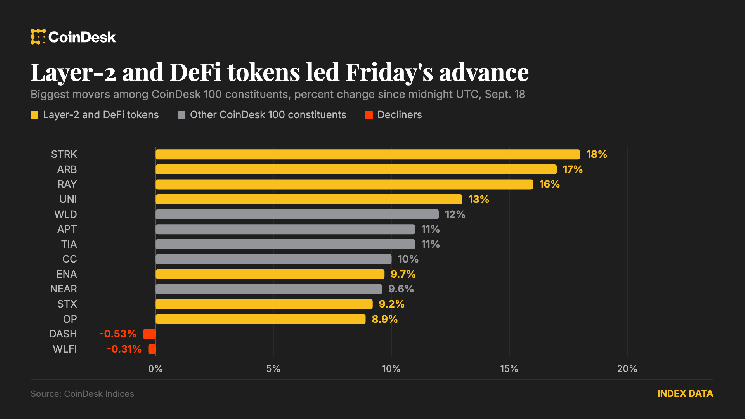
    The DeFi Select Index’s advance rested largely on Uniswap ($UNI), which gained 13% since midnight UTC and 25% over the past 24 hours. Ethena (ENA) added 9.6% and liquid-staking token Lido DAO ($LDO) rose 6.6%. Layer-2 tokens matched DeFi’s strength, led by Starknet ($STRK) at 18% on the day and 21% over 24 hours, with Arbitrum ($ARB) up 17% and 25%, Stacks ($STX) up 9.2%, and Optimism ($OP) up 8.9%. STRK reached its highest level since June 19, while ARB at 20.9 cents hasn’t traded this high since January.

    Solana ($SOL) added 4.5% to $106.14, though the sharper move occurred within its ecosystem where Solana-based DEX token Raydium ($RAY) rose 16% to $1.71 while liquid-staking token Jito ($JTO) lagged at 1.6%. This split points to DEX volume driving the bid rather than a blanket rally for the chain. Thursday’s leader, Zcash ($ZEC), traded at $1,490.10 for a gain of 1.6% on the day against 7.6% over 24 hours, meaning almost all of its advance occurred Thursday. Rival privacy token Dash ($DASH) was one of only two CoinDesk 100 constituents in the red, losing 0.53%, alongside World Liberty Financial ($WLFI), which fell 0.31%. CoinMarketCap’s “Altcoin Season” index rose to 44/100 from Tuesday’s low of 32/100, confirming speculation as the overarching theme Friday.

    Why This Matters

    The sector rotation from privacy coins to DeFi and Layer-2 tokens signals a meaningful shift in market narrative. For months, regulatory uncertainty had pressured DeFi protocols, but the prospect of coordinated SEC and CFTC frameworks has reignited institutional interest in governance tokens like UNI and scaling solutions like ARB, OP, and STRK. The derivatives data reinforces this: rising open interest alongside declining volume suggests conviction-driven positioning rather than speculative flipping. Meanwhile, implied volatility compressing to multi-month lows and short-term options skew turning bullish indicate the options market is pricing in a period of stability after a dense macro calendar. For traders, the Altcoin Season index climbing from 32 to 44 confirms broadening participation beyond Bitcoin, though it remains well below levels seen during full altcoin rotations. The next test will be whether this derivatives-led bid translates into sustained spot accumulation or fades as macro data dependencies return.

    Frequently Asked Questions

    Why are DeFi and Layer-2 tokens outperforming Bitcoin and privacy coins?

    Market optimism around potential coordinated crypto regulations from the SEC and CFTC has renewed institutional appetite for major DeFi protocols like Uniswap and scaling solutions like Arbitrum, Optimism, and Starknet. The DeFi Select Index surged 16% in 24 hours while privacy leaders like Zcash and Dash stalled or declined.

    What does the rise in futures open interest with falling volume indicate?

    The 5% expansion in cumulative open interest to $141.2 billion alongside a 3% drop in daily volume to $95 billion suggests structural capital inflows and positional trading rather than short-term momentum chasing. Balanced taker buy-sell volume further supports this interpretation.

    How should traders interpret the current options skew and volatility readings?

    Bitcoin’s 30-day implied volatility (BVIV) dropping to 36%—a floor since May—signals expectations for near-term calm after key macro events. One-week put-call skew turning positive for both BTC and ETH shows short-term bullish bias, though longer-dated skews retain a slight put bias, indicating hedging for medium-term downside risk remains.

  • Standard Chartered Predicts Arbitrum’s ARB Could Surge 70x to $10, Citing Robinhood Chain Revenue

    Standard Chartered Predicts Arbitrum’s ARB Could Surge 70x to $10, Citing Robinhood Chain Revenue

    Arbitrum token holders currently have no direct claim on the revenue generated by Robinhood Chain, a risk factor highlighted by analyst Kendrick in a recent research note. According to a CoinDesk report earlier this month, Robinhood Chain directs 10% of its net protocol revenue into the Arbitrum ecosystem. That allocation splits 8% to the DAO treasury and 2% to a developer fund, with zero flow directly to $ARB token holders at this stage.

    Robinhood Chain Growth Driven by Memecoin Activity

    While Kendrick’s long-term thesis centers on traditional-finance users adopting tokenized assets, Robinhood Chain’s early traction has arrived from a different demographic. Memecoin launchpads and trading applications have supplied much of the network’s initial activity, even though the chain was architected primarily around tokenized stocks and other traditional asset classes.

    Revenue Metrics Show Rapid Scaling

    The financial data underscores the chain’s quick ramp. In July, Robinhood Chain paid approximately $360,000 in licensing fees, accounting for 35% of Arbitrum DAO income for the month. By September 1, the chain was generating $3.75 million in user fees and transmitting roughly $370,000 to Arbitrum over a 24-hour period.

    Tokenization Thesis and Price Targets

    Kendrick projects that $4 trillion of traditional assets will be tokenized by the end of 2028, with Arbitrum positioned to capture an expanding share of the underlying infrastructure. Based on that trajectory, he forecasts the following price targets for $ARB:

    • Year-end 2024: $0.50
    • 2027: $1.50
    • 2028: $3.50
    • 2029: $6.50
    • 2030: $10.00

    The forecast hinges on Arbitrum’s ability to convert its current memecoin-driven volume into sustainable infrastructure revenue as tokenized traditional assets come online.

  • Weekly Crypto Winners and Losers: VVV, LSK, ARB, ENA

    Weekly Crypto Winners and Losers: VVV, LSK, ARB, ENA

    Crypto Market Shifts to Defensive Posture Amid Rising Yields and Rate-Hike Fears

    This week, the cryptocurrency market adopted a more defensive setup. Rising Treasury yields, climbing oil prices, and growing expectations for Federal Reserve rate hikes pressured risk assets, pushing Bitcoin (BTC) below the $77,000 threshold. However, the sell-off was not uniform across the board. Capital continued to rotate into utility-based narratives, specifically DeFi and privacy tokens, signaling where investors are allocating capital during the current uncertainty.

    Weekly Winners: Privacy AI and DeFi Lead Gains

    Venice Token (VVV): Privacy-Focused AI Platform Hits New All-Time High

    Venice Token (VVV) emerged as the best-performing cryptocurrency this week, surging more than 35% to break into a new all-time high. The critical question now is whether this bullish momentum can sustain into next week.

    Two technical signals suggest continuation is likely. First, VVV’s Relative Strength Index (RSI) on the weekly chart remains well below the overbought threshold. This contrasts sharply with the token’s early-May rally, which drove the RSI into overbought territory and appeared to cap price action near the $20 level.

    Source: TradingView (VVV)

    Consequently, VVV is currently in a stronger technical position than it was in May. The price has successfully broken through the crucial $20 resistance during the past week, suggesting the next leg higher may have significantly more room to run. If VVV holds above $20, a continued breakout could open the path toward the $25–$30 range in the coming week.

    Bitway (BTW): Bitcoin Infrastructure Project at a Technical Crossroads

    Bitway (BTW) secured the second-largest weekly gain, rising 22%. Unlike VVV, BTW has yet to enter the price discovery phase. The asset has climbed for six consecutive weeks, making it technically due for a correction.

    Technically, BTW appears extended at current levels. The token is encountering resistance near $0.60, and the RSI has already entered overbought territory. These factors suggest the rally is unlikely to continue unabated. If this setup holds, BTW is expected to correct shortly before attempting to overcome resistance once again. For the bullish trend to remain intact, buyers must withstand near-term selling pressure.

    Injective (INJ): DeFi Blockchain Tests Key Resistance

    Injective (INJ) claimed the third spot among weekly winners, climbing 10% on Thursday. INJ displays a more robust weekly uptrend compared to VVV and BTW, having steadily climbed since a mid-August correction that saw prices drop to $5.30.

    On the technical front, the RSI indicator sits at a neutral level, leaving room for the rally to extend. Furthermore, INJ rebounded nearly 20% following a late-August bearish correction that dropped the price over 6%. This resilience supports the potential for further gains in the upcoming weeks, with a target range of $6–$7 by the end of September.

    Other Notable Gainers

    Outside the major caps, smaller altcoins posted explosive moves:

    • Lisk (LSK): +877%
    • GreenHood (HOOD): +455%
    • Stonk (STONK): +237%

    Weekly Losers: Major L2s and Synthetic Dollars Under Pressure

    Arbitrum (ARB): Ethereum Layer-2 Faces Profit-Taking

    Arbitrum (ARB) was the week’s biggest loser, plummeting 27%. However, context is critical: this decline follows a 124% weekly increase the prior week, framing the move as a cooldown rather than a structural breakdown. Resistance is forming in the $0.20 zone.

    The key question is whether this sell-off evolves into a deeper correction or remains a minor adjustment. Technical analysis offers clues. Despite the massive 124% rally, ARB’s RSI never entered the overbought area, indicating the long weekly increase never became technically overextended. Simultaneously, the rally pushed price into mid-January resistance near $0.20, suggesting the pullback is a reaction to that level rather than a bearish trend shift.

    Source: TradingView (ARB/USDT)

    If buyers defend key support, ARB could stabilize and stage another assault on the $0.20 resistance.

    Ethena (ENA): Synthetic Dollar Protocol Loses Reversal Momentum

    Ethena (ENA) finished the week down 21%, marking the second-worst performance. Unlike ARB, ENA appears intent on holding the $0.15 level, which it has tested for three consecutive weeks—a sign buyers may be accumulating dips.

    That said, ENA’s RSI has turned lower, signaling cooling buyer enthusiasm. The current setup favors either a prolonged accumulation period or a potential bull trap. The first critical level to watch is $0.10. A break below this level would confirm the recent corrective rally was a trap. Conversely, holding $0.15 with a rising RSI would indicate strengthening buying pressure.

    Dash (DASH): Privacy Payment Coin Rejected at Key Resistance

    Dash (DASH) closed as the third-largest weekly loser, recording a 21% drawdown. Its weekly profile closely mirrors ARB, hinting that the action is a short-lived consolidation rather than a bearish trend reversal.

    Technically, the 21% correction followed a 70% rebound the previous week—the strongest rally since early January. The sell-off was triggered by rejection from the $80 area, a level DASH has failed to retest since the early Q1 cycle. With the RSI remaining overextended and resistance intact, bears may capitalize to lock in profits. However, bulls could regain control at current levels, shaking out weak hands and fueling the next move toward $80.

    Other Notable Decliners

    Broader market volatility punished several lower-cap assets:

    • Safebit (SAFE): -67%
    • Basecat (BASECAT): -66%
    • Cluster Protocol (CP): -54%

    Market Summary

    This week delivered a rollercoaster session characterized by explosive pumps, sharp dips, and nonstop action. As the macro backdrop remains heavy, market participants are advised to stay vigilant, conduct independent research, and manage risk carefully.

    Final Weekly Scorecard

    • Top Gainers: Venice Token (VVV), Bitway (BTW), Injective (INJ)
    • Top Losers: Arbitrum (ARB), Ethena (ENA), Dash (DASH)
  • Bitcoin Holds Near $78,000 as Arbitrum Surges 30% on Robinhood Chain Revenue

    Bitcoin Holds Near $78,000 as Arbitrum Surges 30% on Robinhood Chain Revenue

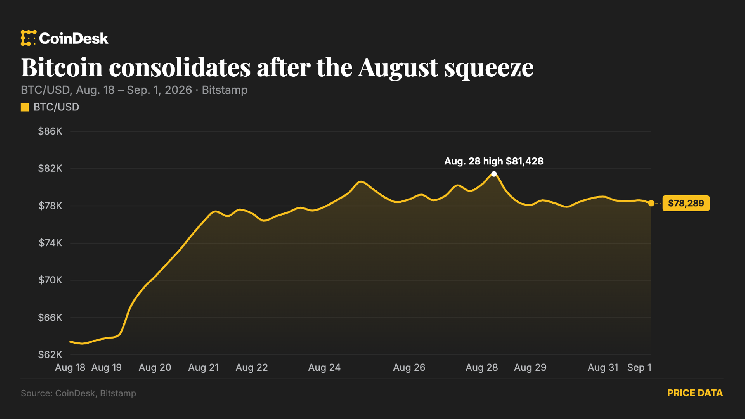
    Bitcoin is trading near $78,000, down 0.4% since midnight UTC and about 0.7% over the past seven days as the market consolidates after a short squeeze lifted the price from below $63,000 to nearly $81,400 last week.

    Bitcoin’s relative strength has remained intact despite the calmer conditions. Nasdaq 100 futures are down 0.5% since midnight, meaning bitcoin is once again outperforming equities.

    Spot bitcoin exchange-traded funds recorded $3.04 billion in net inflows across nine consecutive sessions, their longest streak since April. The run ended Friday with a $202 million outflow before resuming Monday with $217 million in fresh inflows, according to SoSoValue data.

    Altcoins are mixed in the latest session. The Altcoin Season index has fallen to 26 out of 100 from 34 on Friday, its lowest reading in more than 90 days.

    Crypto derivatives positioning remains balanced

    Balanced positioning: The 24-hour taker buy-sell volume ratio in crypto futures markets has remained balanced for a second consecutive day. Open interest has held near $136 billion, while trading volume has declined 7%. The combination suggests traders are adding neither significant long nor short exposure and are waiting for a clearer market signal.

    Arbitrum leads gainers: Arbitrum’s $ARB is the best-performing token among the top 100 cryptocurrencies over the past 24 hours, gaining nearly 30%. The rally is supported by increased futures participation, with open interest rising more than 10%. The data points to a buildup of long positions as $ARB attempts to establish support above chart resistance at 11 cents. Annualized funding rates near 8% suggest the market is not overheated.

    Monero open interest continues to rise: Open interest in privacy-focused Monero futures has climbed to 640,000 tokens, the highest level since February 2024. The signals are mixed. Funding rates have dropped to 15% from more than 50%, suggesting bullish positions are no longer overcrowded. However, the 24-hour open-interest-adjusted cumulative volume delta is negative, indicating bearish leadership. XMR has already pulled back to around $525 from Monday’s high of $548.

    Demand for $TRX shorts: Tron’s $TRX stands out with funding rates at minus 80%, signaling crowded bearish positioning. Short sellers are accepting a high cost to maintain their positions. $TRX is trading near 33 cents after falling for a third consecutive day.

    Light positioning in bitcoin and ether: Open interest in $BTC and $ETH remains subdued, hovering near multi-week lows.

    Volatility cools: Bitcoin’s and ether’s 30-day implied volatility indexes, BVIV and EVIV, have reversed their mid-August spikes, pointing to calmer market conditions.

    Options flow turns bullish: In options listed on Deribit, the $80,000 bitcoin call expiring Sept. 25 was the most-traded position over the past 20 hours. A call represents a bullish bet on the underlying asset. For ether, the $2,500 call attracted the most activity.

    Arbitrum leads the altcoin market

    Arbitrum’s surge is the clearest standout across the altcoin sector. The rally is linked to Robinhood Chain, which operates as a dedicated Arbitrum chain and sends 10% of net protocol revenue to the Arbitrum ecosystem.

    Offchain Labs co-founder Steven Goldfeder said Monday that Robinhood Chain’s 24-hour transaction revenue had exceeded $2 million, up from approximately $1.22 million the previous day. At that pace, Arbitrum’s share would amount to roughly $73 million annually.

    ARK Invest’s Lorenzo Valente calculated that gross revenue on Robinhood Chain rose from $54,676 on Aug. 22 to $1.088 million on Aug. 30, an increase of nearly 20 times. Arbitrum’s share increased from $5,400 to $108,000 over the same period.

    Curve DAO’s CRV$0.3586 rose 14% over 24 hours to approximately 35.13 cents on $119 million in trading volume. The move forms part of the broader decentralized finance rally that has lifted lending and decentralized exchange tokens through the second half of August.

    Uniswap’s $UNI extended its gains, rising 8% since midnight to around $5.80 after advancing 12% over the previous 24 hours. The token is now up 34% over the past seven days on $519 million in volume.

    Among the day’s smaller movers, Aave’s AAVE$126.93 gained 1.9% to $126.54, while Morpho’s MORPHO$2.5549 rose 2%. The moves suggest decentralized finance assets are holding up better than the broader crypto market during Tuesday’s session.