Tag: American Reserve Modernization Act

  • MicroStrategy (MSTR) Stock Rallies Over 16% as Bitcoin Surges

    MicroStrategy (MSTR) Stock Rallies Over 16% as Bitcoin Surges

    Key Highlights

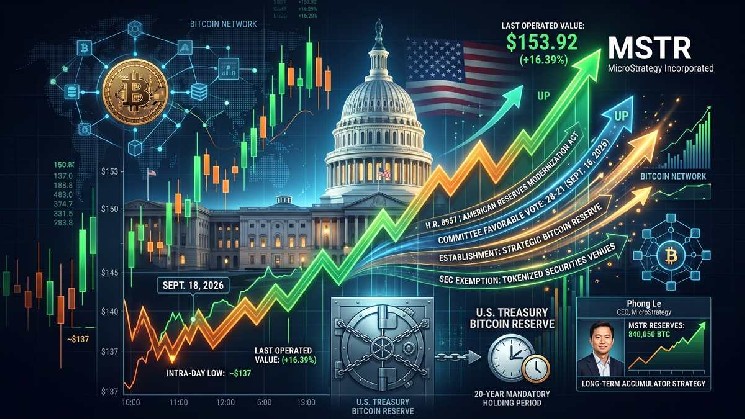
    • Strategy (MSTR) surged 16.39% to close at $153.92 on September 18, 2026, lifting its market capitalization above $59.5 billion amid renewed institutional demand.
    • The House Financial Services Committee advanced the American Reserve Modernization Act (H.R. 8957) by a 28–21 vote on September 16, proposing a U.S. Strategic Bitcoin Reserve with a mandatory 20-year federal custody requirement.
    • Strategy CEO Phong Le confirmed the firm holds 840,050 BTC and reiterated its long-term accumulation strategy, while leaving the door open for minor sales if market conditions or traditional finance integration warrant it.

    MSTR Rallies on Congressional and Regulatory Catalysts

    Strategy’s flagship stock staged a sharp recovery during the September 18, 2026 session, climbing 16.39% to finish at $153.92 after an intraday low near $137. Data from Yahoo Finance showed the company’s market capitalization breaching $59.5 billion during the session, reflecting a resurgence of institutional interest tied directly to legislative and regulatory developments in Washington.

    House Committee Advances Strategic Bitcoin Reserve Legislation

    The bullish momentum coincided with a pivotal vote on September 16, when the U.S. House Financial Services Committee endorsed the American Reserve Modernization Act (H.R. 8957) by a 28-to-21 margin. The legislative text directs the U.S. Department of the Treasury to formally establish a Strategic Bitcoin Reserve. The terms of the bill stipulate that funds qualifying to join the reserve must remain held under federal custody for a mandatory period of no less than 20 years. Lawmakers also introduced technical amendments regarding regular proof-of-reserve reporting and instruments acquired through network hard forks. The full House vote on H.R. 8957 remains unscheduled, and its timing will shape the broader debate over federal custody of digital reserves.

    SEC Grants Temporary Exemption for Tokenized Securities Platforms

    Compounding the legislative tailwind, the U.S. Securities and Exchange Commission granted a temporary regulatory exemption to authorized tokenized securities trading platforms. This measure permits trading certain U.S. assets through regulated automated market makers and permissioned liquidity pools. Market analysts consider that this conditional opening by the SEC could stimulate trading volume for digital-asset-linked equities over the coming months.

    Strategy’s Bitcoin Holdings and Corporate Strategy

    Strategy’s operational exposure remains closely correlated with the cryptocurrency spot market. In a public statement issued Friday, September 18, company CEO Phong Le confirmed that the firm holds 840,050 BTC in its reserve. Le confirmed that the organization’s primary objective remains consolidating its position as a long-term accumulator. However, the executive clarified that management considers the potential sale of small amounts of Bitcoin should market conditions or integration with traditional finance warrant it.

    Technical Analysis Signals Continued Upside Potential

    From a technical perspective on TradingView’s weekly chart, the price of MSTR broke above the descending trendline carried over from its July 2025 highs near $452. The TradingView technical report highlights that the stock managed to position itself above its 20-week exponential moving average (EMA), located at $128.64. The weekly Relative Strength Index (RSI) hovered around 55 points. This technical reading suggests the asset still trades outside the standard overbought threshold of 70 points, potentially leaving room for extended consolidation if trading volume remains steady.

    Why This Matters

    The convergence of legislative progress on a federal Bitcoin reserve and the SEC’s willingness to pilot tokenized securities infrastructure marks a significant inflection point for digital asset integration into the U.S. financial system. H.R. 8957, if enacted, would institutionalize Bitcoin as a strategic reserve asset under long-term federal custody, potentially validating the thesis that underpins Strategy’s corporate strategy. Simultaneously, the SEC’s exemption for permissioned liquidity pools signals a regulatory appetite for controlled innovation in tokenized markets. For Strategy, the 840,050 BTC reserve—worth approximately $50 billion at current prices—serves as both a corporate treasury asset and a de facto proxy for institutional Bitcoin exposure. The market’s reaction suggests investors are pricing in a higher probability of favorable regulatory outcomes, though the full House vote on H.R. 8957 and the SEC’s eventual permanent rulemaking remain critical uncertainties.

    Frequently Asked Questions

    What is the American Reserve Modernization Act (H.R. 8957)?

    H.R. 8957 is a bill advanced by the House Financial Services Committee on September 16, 2026, that directs the U.S. Department of the Treasury to establish a Strategic Bitcoin Reserve. Qualifying assets must remain in federal custody for a minimum of 20 years, and the legislation includes provisions for proof-of-reserve reporting and treatment of assets from network hard forks.

    How much Bitcoin does Strategy currently hold?

    As confirmed by CEO Phong Le on September 18, 2026, Strategy holds 840,050 BTC on its corporate balance sheet, making it one of the largest corporate holders of Bitcoin globally.

    What does the SEC’s temporary exemption for tokenized securities platforms entail?

    The exemption authorizes regulated automated market makers and permissioned liquidity pools to trade certain U.S. assets in tokenized form. It is a conditional, temporary measure that analysts believe could increase trading volume for digital-asset-linked equities like MSTR in the near term.
  • US Bitcoin Reserve Bill Advances, but Odds of 2027 Law Drop to 6%

    US Bitcoin Reserve Bill Advances, but Odds of 2027 Law Drop to 6%

    The U.S. House Financial Services Committee advanced the American Reserve Modernization Act of 2026 (H.R. 8957) on September 16, marking a procedural milestone for the proposed Strategic Bitcoin Reserve. The legislation passed on a 28-21 party-line vote, with Republicans comprising the majority. Despite the committee approval, prediction markets now assign a 6% probability the bill becomes law by 2027, a sharp decline from the 60% odds recorded in December.

    Bill Overview: From Executive Decree to Legislative Mandate

    In March 2025, President Donald Trump signed an executive decree designating Bitcoin (BTC) as a national reserve asset. Converting that directive into binding federal statute requires congressional passage. H.R. 8957, introduced by Rep. Nick Begich (R-AK), codifies the reserve with the following core provisions:

    • A 20-year lockup period for acquired Bitcoin holdings.
    • An accumulation target of 1 million BTC over five years.
    • Budget-neutral acquisition mechanisms to avoid increasing the federal deficit.
    • Creation of a digital asset stockpile for altcoins alongside the Bitcoin reserve.
    • Mandatory third-party audits at regular intervals.

    Committee Vote and Partisan Dynamics

    The Financial Services Committee GOP confirmed the outcome via social media:

    H.R. 8957, the American Reserve Modernization Act, by @RepNickBegich, passed 28-21. pic.twitter.com/JizEPCA1Fp

    — Financial Services GOP (@FinancialCmte) September 16, 2026

    While framed as a bipartisan initiative, the vote split along party lines, signaling potential difficulty in securing the 60-vote Senate threshold required to overcome a filibuster.

    Key Headwinds Threatening Enactment

    Analysts cite three structural obstacles that explain the collapse in enactment probability:

    1. Legislative Precedent: CLARITY Act Rejection

    The recent failure of the CLARITY Act—despite 18 months of negotiation—demonstrates the difficulty of passing comprehensive digital-asset legislation in the current Congress.

    2. Congressional Calendar and Midterm Pressure

    Floor time is shrinking as leadership prioritizes must-pass spending bills and campaign-season messaging ahead of the 2026 midterm elections.

    3. Inter-Agency Oversight Dispute

    The Department of Justice’s Office of Legal Counsel is mediating a jurisdictional conflict among the Treasury, Commerce, and Justice departments over which agency will administer the multi-billion-dollar digital reserve. Resolution is a prerequisite for operational implementation.

    Bitcoin Market Reaction and Technical Outlook

    Bitcoin traded near $75,719 at press time, down from approximately $79,000 a week earlier. Two macro catalysts are weighing on price:

    • The Federal Reserve’s decision to raise interest rates for the first time since 2023, tightening dollar liquidity.
    • U.S. spot Bitcoin ETF flows turning negative by $450 million on September 15, per CoinMarketCap data.

    Short-Term Technical Levels

    • Immediate resistance: $76,000 – $77,000.
    • Key support: $75,719 (current zone).
    • Downside target on support break: $74,000 – $73,500.

    Traders are monitoring the legislative timeline; any further procedural delays could reinforce bearish momentum, while a surprise floor vote in the House could trigger a short-covering rally toward the $77,000 resistance band.

  • Bitcoin Reserve Bill Heads to House Committee for Historic Vote

    Bitcoin Reserve Bill Heads to House Committee for Historic Vote

    House Financial Services Committee Set to Vote on Bitcoin Reserve Bill ARMA

    The House Financial Services Committee is scheduled to hold a pivotal markup session on Wednesday, September 16 at 10:00 a.m. ET to vote on the American Reserve Modernization Act (ARMA) of 2026, designated as H.R. 8957. The bipartisan legislation, introduced in late May by Republican Representative Nick Begich and Democratic co-sponsor Representative Jared Golden, proposes establishing a strategic national Bitcoin reserve alongside a broader digital asset stockpile.

    Key Provisions of the ARMA Legislation

    The bill outlines several core mandates designed to govern the acquisition, storage, and potential use of digital assets by the federal government:

    20-Year Lockup Period for Bitcoin

    A central feature of the legislation is a mandatory 20-year holding period for any Bitcoin acquired for the national reserve. During this timeframe, the government would be prohibited from trading or selling the asset. The sole exception allows for liquidation only if the proceeds are used exclusively to retire outstanding federal debt.

    Redirecting Seized Bitcoin to the Reserve

    The Act mandates that all Bitcoin obtained through criminal seizures or penalties must be transferred directly to the national Bitcoin reserve. This provision effectively ends the current practice of auctioning off forfeited digital assets.

    Creation of a Digital Asset Stockpile

    Reflecting the legislation’s renamed scope, ARMA establishes a “Digital Asset Stockpile” for holding altcoins classified as assets. The government would be authorized to sell or trade these alternative digital assets for Bitcoin, or liquidate them to pay down the national debt.

    Strict Budget Neutrality and Acquisition Strategy

    The proposal enforces budget neutrality, stipulating zero net cost for acquiring Bitcoin. It explicitly bans purchases funded by debt issuance, new taxes, or deficit spending. Instead, the Department of the Treasury and the Department of Commerce are tasked with developing a plan to accumulate 1 million BTC over a five-year period using surplus dollars or a portion of net earnings from Federal Reserve banks.

    Decentralized Storage and Audit Requirements

    To ensure security and transparency, the bill requires a decentralized network of secure physical storage facilities distributed across the country. Third-party contractors would conduct quarterly audits of the reserves.

    Legislative Path Forward

    If the bill clears the committee markup, it will advance to the full House of Representatives for a floor vote. Subsequent passage would send the legislation to the Senate for consideration, followed by the President’s desk for signature into law.

  • US House Schedules Strategic Bitcoin Reserve Bill Markup Vote for Sept. 16

    US House Schedules Strategic Bitcoin Reserve Bill Markup Vote for Sept. 16

    House Financial Services Committee Advances Strategic Bitcoin Reserve Legislation

    The U.S. House Financial Services Committee is preparing to mark up legislation that would establish a strategic bitcoin reserve, signaling growing congressional interest in digital asset policy. The committee’s latest memorandum confirms that H.R. 8957, the American Reserve Modernization Act of 2026, will be among nine bills considered during a markup session scheduled for September 16.

    Legislative Details and Committee Action

    The American Reserve Modernization Act of 2026 represents a significant step toward formalizing bitcoin holdings at the federal level. By including this measure in its upcoming markup agenda, the House Financial Services Committee indicates a willingness to debate and potentially advance the proposal through the legislative process. Markup sessions allow committee members to amend, debate, and vote on legislation before it proceeds to the full House for consideration.

    Broader Digital Asset Policy Context

    This development occurs amid increasing congressional attention to cryptocurrency regulation and the strategic role of digital assets in national financial infrastructure. The inclusion of the Strategic Bitcoin Reserve bill alongside eight other measures suggests the committee is addressing a range of financial services priorities in a single session.

    Next Steps in the Legislative Process

    If the bill passes committee markup, it would move to the House floor for further debate and a potential vote. Subsequent approval would require Senate passage and presidential signature to become law. The September 16 markup represents a critical early test of congressional support for a federally managed bitcoin reserve.