Tag: AI infrastructure

  • Riot Clears $200M Coinbase Loan, Frees $341M in Bitcoin Collateral

    Riot Clears $200M Coinbase Loan, Frees $341M in Bitcoin Collateral

    Key Highlights

    • Riot Platforms fully repaid its $200 million Bitcoin-backed credit facility from Coinbase Credit on September 21, 2025, releasing 5,821 BTC, USDC, and cash held as collateral.
    • The repayment carried no early termination fee and followed an April 2026 amendment that fixed the interest rate at 6.15% annually, replacing the original floating rate.
    • Simultaneously, Riot secured a 20-year, 191-megawatt lease at its Rockdale campus with an unnamed AI developer, projecting approximately $9.1 billion in revenue over the lease term.

    Riot Platforms Eliminates $200 Million Coinbase Credit Facility

    Bitcoin mining firm Riot Platforms has completed repayment of its $200 million credit facility backed by Coinbase Credit, according to a September 25 filing with the U.S. Securities and Exchange Commission. The company settled the remaining principal and accrued interest on September 21, 2025, and notably avoided an early termination fee. The transaction also triggered the release of all pledged collateral, which as of June 30 included 5,821 Bitcoin valued at approximately $340.7 million, alongside USDC stablecoins and cash reserves. That Bitcoin tranche represented roughly 51% of Riot’s total holdings of 11,380 BTC at the time.

    Facility Evolution: From Floating to Fixed Rate

    The financing arrangement originated in April 2025 with an initial $100 million draw, which Riot doubled to $200 million one month later. In April 2026, the parties amended the agreement to replace the floating interest rate structure with a fixed annual rate of 6.15%. This modification provided Riot with predictable debt service costs amid volatile crypto market conditions. The full repayment now marks the conclusion of a roughly 18-month financing relationship that allowed Riot to access liquidity without liquidating core Bitcoin reserves during a period of significant price appreciation.

    Strategic Pivot Toward AI Infrastructure Revenue

    Rockdale Campus Secures Long-Term AI Lease

    Concurrent with the debt retirement, Riot continues to expand its data center operations beyond pure Bitcoin mining. The company announced a 20-year lease covering 191 megawatts of capacity at its Rockdale, Texas campus with an unidentified artificial intelligence developer. The agreement is expected to generate approximately $9.1 billion in revenue over the full lease term, establishing a substantial, predictable income stream that diversifies Riot’s revenue base. This move signals a strategic shift toward high-performance computing (HPC) and AI infrastructure hosting, leveraging the company’s existing power infrastructure and operational expertise.

    Why This Matters

    The dual developments underscore a broader transformation across the Bitcoin mining sector. As block rewards diminish post-halving and mining economics tighten, major operators like Riot are actively deleveraging balance sheets while repurposing energy assets for AI and HPC workloads. The Coinbase Credit repayment demonstrates improved financial health and reduced counterparty risk, freeing up a majority of Riot’s Bitcoin treasury for strategic flexibility. Meanwhile, the Rockdale AI lease—valued at $9.1 billion—exemplifies the “miner-to-HPC” pivot that analysts view as critical for long-term shareholder value. With 191 MW committed, Riot joins peers such as Core Scientific and Hut 8 in monetizing grid interconnection rights and purpose-built facilities for compute-intensive tenants. The unnamed AI counterparty suggests strong demand from hyperscalers or well-funded startups seeking rapid access to powered data center capacity.

    Frequently Asked Questions

    How much Bitcoin did Riot pledge as collateral, and what was its value?

    As of June 30, Riot Platforms had pledged 5,821 Bitcoin as collateral for the Coinbase Credit facility, valued at approximately $340.7 million. This represented roughly 51% of the company’s total holdings of 11,380 BTC at that time. All pledged Bitcoin, along with USDC and cash collateral, was released upon full repayment on September 21, 2025.

    What were the key terms of the Coinbase Credit facility?

    The facility originated in April 2025 with a $100 million draw, which was increased to $200 million in May 2025. In April 2026, the agreement was amended to replace a floating interest rate with a fixed annual rate of 6.15%. Riot repaid the full principal and accrued interest on September 21, 2025, without incurring an early termination fee, per the SEC filing dated September 25.

    What is the significance of the Rockdale AI lease for Riot’s business model?

    The 20-year, 191-megawatt lease at the Rockdale campus with an unnamed AI developer is projected to generate approximately $9.1 billion in revenue over its term. This agreement diversifies Riot’s revenue beyond Bitcoin mining into high-performance computing and AI infrastructure hosting, leveraging its existing power assets and operational capabilities to secure a long-term, contracted income stream.


  • Nvidia Invests $3 Billion in SB Energy Ahead of $50 Billion IPO

    Nvidia Invests $3 Billion in SB Energy Ahead of $50 Billion IPO

    Key Highlights

    • Nvidia is investing an additional $1.5 billion in SB Energy through Class N non-voting shares, raising its total equity commitment to $3 billion ahead of the company’s planned Nasdaq IPO.
    • SB Energy’s PORTS-Pike Technology Campus in Ohio, leased long-term to OpenAI with an exclusive Nvidia chip mandate, is designed for 4.25 gigawatts of AI computing capacity, expandable to 8 gigawatts.
    • Nvidia has disclosed up to $108.5 billion in maximum gross exposure tied to AI infrastructure guarantees, including a $105 billion residual value guarantee linked to the Ohio project that phases in as data centers enter service.

    Nvidia Deepens Financial Ties to AI Infrastructure Ahead of SB Energy IPO

    Nvidia is significantly expanding its stake in the physical infrastructure underpinning the artificial intelligence boom, committing an additional $1.5 billion to SB Energy, the SoftBank-backed energy and data center subsidiary preparing for a U.S. initial public offering. The transaction, executed through a private placement and a prepaid forward contract for newly issued Class N non-voting shares priced at the IPO offering price, doubles Nvidia’s total equity commitment in SB Energy to $3 billion. The move gives the chipmaker substantial financial exposure to one of the largest dedicated AI computing campuses under development in the United States without granting voting control over SB Energy’s governance.

    SB Energy Targets $50 Billion Valuation in Nasdaq Listing

    SB Energy filed its IPO registration in late August 2026 and intends to list on the Nasdaq under the ticker SBE, seeking a valuation of roughly $50 billion. The company aims to raise between $5 billion and $7 billion through the public offering, positioning it as one of the larger listings directly tied to the AI infrastructure buildout cycle. Separately, SB Energy is reportedly pursuing an additional $500 million from Japanese investors earmarked specifically for data center and power infrastructure development, according to Bloomberg. As the energy and data center arm of SoftBank Group, SB Energy sits at the intersection of surging AI compute demand and the massive power requirements needed to support it.

    Ohio Campus Anchors Nvidia’s Strategic Bet

    The rationale for Nvidia’s deepening commitment centers on SB Energy’s flagship project: the PORTS-Pike Technology Campus in Ohio. The facility is engineered to deliver an initial 4.25 gigawatts of AI computing load, with expansion potential to 8 gigawatts, placing it among the largest dedicated AI sites in the country. Crucially, the campus is leased long-term to OpenAI under terms that mandate the exclusive use of Nvidia chips. This arrangement creates a direct commercial feedback loop: every watt of computing capacity deployed at PORTS-Pike translates into demand for Nvidia’s graphics processing units, effectively securing a built-in revenue stream tied to the infrastructure Nvidia is helping finance.

    Billion-Dollar Guarantees Extend Beyond Equity

    Nvidia’s involvement extends well beyond equity ownership. In connection with the Ohio project, the company has pledged residual value guarantees reaching as high as $105 billion. According to Invezz, this guarantee sits within a broader $108.5 billion maximum gross exposure Nvidia disclosed in its latest filing, covering AI infrastructure commitments that also include $3.5 billion tied to certain AI-cloud partners. The OpenAI-linked guarantee does not take full effect immediately; obligations are expected to increase as nine data centers enter service, beginning around fiscal 2029, before declining as OpenAI makes lease payments. The guarantee is also conditional, triggered only under specified circumstances such as tenant default or insolvency, which limits its near-term balance-sheet impact while maintaining substantial long-term exposure.

    Why This Matters

    Nvidia’s expanding role illustrates a structural shift in how the AI economy is being financed. Rather than merely selling chips into demand generated by others, Nvidia is increasingly acting as a capital provider and risk partner for the gigawatt-scale infrastructure required to run advanced AI workloads. By embedding chip-exclusivity clauses into long-term leases and backing projects with residual value guarantees, Nvidia secures demand visibility for its product roadmap while assuming financial risks traditionally borne by real estate and infrastructure investors. For the broader market, the SB Energy IPO will serve as a key barometer of public investor appetite for pure-play AI infrastructure assets, and the company’s financial performance—revenue grew 66.4% year-over-year in the first half of 2026 even as net losses widened—highlights the capital-intensive, front-loaded cost profile of building at this scale.

    Frequently Asked Questions

    How much has Nvidia committed to SB Energy in total, and what structure does the latest investment use?
    Nvidia’s total equity commitment to SB Energy now stands at $3 billion following the latest $1.5 billion tranche. The new shares are Class N non-voting shares acquired via a private placement paired with a prepaid forward contract, both priced at the IPO offering price.
    What is the significance of the PORTS-Pike Technology Campus lease to OpenAI?
    The Ohio campus is leased long-term to OpenAI with a contractual requirement for exclusive use of Nvidia chips. This means the facility’s entire 4.25 GW (expandable to 8 GW) computing capacity is tied directly to Nvidia’s GPU business, creating a guaranteed demand channel for its hardware.
    What are the terms and scale of Nvidia’s residual value guarantee for the Ohio project?
    Nvidia has pledged up to $105 billion in residual value guarantees linked to the PORTS-Pike campus, part of a disclosed $108.5 billion maximum gross exposure across AI infrastructure commitments. The guarantee phases in as nine data centers enter service starting around fiscal 2029 and is triggered only under specified conditions such as tenant default or insolvency.
  • CoreWeave Shares Drop 32% Since Joining the Nasdaq 100

    CoreWeave Shares Drop 32% Since Joining the Nasdaq 100

    Key Highlights

    • CoreWeave shares have fallen approximately one-third since joining the Nasdaq 100 on June 22, 2026, despite the company reporting doubled second-quarter revenue and a $104 billion revenue backlog.
    • Company insiders — including CEO Michael Intrator, co-founder Brannin McBee, and other C-suite executives — have sold more than $600 million in stock since the index inclusion forced passive buying by retirement funds worldwide.
    • Depreciation and interest costs consumed over 75% of every revenue dollar in Q2, while capital expenditure guidance of $35–39 billion dwarfs revenue guidance of $12.4–13.2 billion, resulting in deeply negative free cash flow.

    Index Inclusion Triggers Passive Buying as Insiders Exit

    When the Nasdaq 100 announced its rebalance on June 11, 2026 — effective June 22 — CoreWeave appeared to satisfy every technical and fundamental criterion for membership. The AI infrastructure provider boasted contracted revenue backlog exceeding $104 billion, fresh commitments accumulating since July, and a customer roster that includes Meta, OpenAI, and other leading AI labs. The stock opened at roughly $119 on the effective date, well below its all-time high of $187 reached on June 20, 2025, but the index committee’s de facto endorsement compelled hundreds of Nasdaq 100-linked funds around the world to buy shares on behalf of retirement savers.

    Since that forced passive inflow began, the share price has declined to trade near $80, erasing roughly one-third of the company’s market value in a matter of months. During the same window, securities filings show that the executives and board members closest to the business have been steady sellers. Chief Executive Officer Michael Intrator has liquidated more than $320 million of stock. Co-founder Brannin McBee has sold approximately $220 million. General Counsel and Corporate Secretary Kristen McVeety has sold over $22 million. The company’s Chief Security Officer, Chief Financial Officer, Chief Operating Officer, and Chief Accounting Officer have collectively disposed of a combined $36 million.

    Depreciation and Debt Service Consume the Bulk of Revenue

    The divergence between headline growth and underlying economics centers on the rapid obsolescence of Nvidia GPUs that form the core of CoreWeave’s leased data-center infrastructure. In the second quarter alone, depreciation and amortization of AI equipment exceeded $1.3 billion — a staggering 54% of revenue. Interest expense on a debt pile that has swollen from $7.9 billion at the end of 2024 to more than $35.6 billion today reached $640 million, up from $267 million a year earlier. Together, those two accounting lines consumed more than three-quarters of every dollar the company generated.

    Cash flow dynamics are even more stark. Full-year capital expenditure guidance sits at $35–39 billion, roughly three times the midpoint of revenue guidance of $12.4–13.2 billion. Second-quarter free cash flow came in at negative $5.7 billion. The buildout has been financed almost entirely with borrowed money, and total indebtedness now exceeds $35.6 billion. Demand for GPU compute capacity is not the issue; the challenge is converting that demand into profit faster than the underlying chips depreciate and lenders collect interest.

    Why This Matters

    CoreWeave’s trajectory illustrates a structural tension at the heart of the current AI infrastructure boom: the asset-heavy, debt-fueled model required to amass GPU clusters at scale clashes with the breakneck pace of semiconductor innovation. As Nvidia and its competitors release successive generations of accelerators, the economic useful life of deployed hardware compresses, driving depreciation charges that can overwhelm operating margins even when utilization and contract backlog are strong. For index investors, the episode underscores that inclusion in a major benchmark — often perceived as a quality seal — does not immunize a stock from fundamental deterioration, especially when passive inflows coincide with concentrated insider selling. Market participants will watch whether CoreWeave can restructure its capital intensity, extend hardware refresh cycles, or shift toward higher-margin managed services before debt service and depreciation permanently impair equity value.

    Frequently Asked Questions

    How much have CoreWeave insiders sold since the Nasdaq 100 inclusion?
    Combined sales by CEO Michael Intrator, co-founder Brannin McBee, General Counsel Kristen McVeety, and other named executive officers exceed $600 million since June 22, 2026.
    What is driving the gap between CoreWeave’s revenue growth and its stock decline?
    Depreciation on GPU infrastructure ($1.3 billion in Q2, or 54% of revenue) and rising interest expense ($640 million in Q2) consume over 75% of revenue, while capital expenditure guidance of $35–39 billion far outpaces revenue guidance of $12.4–13.2 billion, producing deeply negative free cash flow.
    What is CoreWeave’s current debt level?
    Total indebtedness has grown from $7.9 billion at the end of 2024 to more than $35.6 billion as of the latest reporting period.
  • US House Passes Bill to Make Data Centers Pay More of Their Grid Costs

    US House Passes Bill to Make Data Centers Pay More of Their Grid Costs

    The U.S. House of Representatives passed the Ratepayer Protection Act (H.R. 9340) on Wednesday by a vote of 417-3, marking the first congressional bill to address the economic impact of rapidly expanding data centers on the nation’s power grid.

    Federal Standard for Large-Load Cost Allocation

    The legislation establishes a federal standard requiring state utility regulators to consider whether “full incremental cost” should be recovered from large-load consumers for generation, transmission, or distribution upgrades necessary to serve them. The bill defines large-load consumers as entities consuming at least 100 megawatts of energy at a single location and mandates that these companies provide financial guarantees before utilities make infrastructure investments.

    While state authorities must adopt the regulation, they retain the right to reject it. Energy policy experts suggest this opt-out provision weakens the framework, though supporters argue it creates a federal benchmark without overriding state ratemaking authority.

    No Cap on Electricity Prices

    The Act does not restrict electricity prices or affect residential bills. Its primary focus is identifying which entities pay for infrastructure required to serve hyperscale data centers and AI compute facilities.

    Rep. Frank Pallone (D-N.J.), the ranking Democrat on the House Energy and Commerce Committee, called the measure “imperfect” and said it addressed only part of the problem, according to Politico. The bill now advances to the Senate for consideration.

    Industry Commitments and Regulatory Pressure

    The legislation follows President Donald Trump’s March 4 Ratepayer Protection Pledge. The Brookings Institution notes that Amazon, Google, Meta, Microsoft, OpenAI, Oracle, and xAI have committed to securing new power and covering delivery-infrastructure upgrades for their data centers. However, translating these voluntary commitments into enforceable protections remains dependent on state regulators and utilities.

    Record Demand Strains Grid Infrastructure

    Pressure on the grid is already measurable. The Energy Information Administration projects electricity sales will reach an all-time high of 4,135 billion kilowatt-hours in 2026, driven partly by data centers and industrial production, while residential prices hit 18.2 cents per kilowatt-hour.

    An ICF analysis published by Brookings suggests residential tariffs could surge 15% to 40% by 2030, with some potentially doubling by 2050. A University of California study estimates data centers may account for 11.8% of total U.S. electricity consumption by 2030.

    The Federal Energy Regulatory Commission has directed six regional grid operators to justify or reform large-load tariffs, including measures to prevent cost shifting and accelerate interconnection.

    Capacity Costs Skyrocket in Key Markets

    As previously reported by Cryptopolitan, PJM capacity costs surged approximately 1,038% compared to 2024 rates. An Ohio brick manufacturer’s monthly capacity fee jumped from $1,600 to $12,000. Data centers now drive roughly 40% of PJM’s unprecedented $16.4 billion capacity auction.

    Shifting Economics of AI Infrastructure

    PwC, using Oxford Economics modeling, estimates global data center investment will reach $2.5 trillion by 2030. The International Energy Agency identifies electricity supply and grid access as central constraints on AI expansion, while Boston Consulting Group says geography, financing, and compute costs increasingly shape AI economics.

    Requiring large-load customers to absorb more infrastructure costs could reduce cost shifting to households and businesses while raising upfront project expenses. Regions with abundant power, faster connections, and lower financing costs may gain a competitive edge in attracting the next wave of AI infrastructure investment.

  • Bitcoin Mining Generates 90% of HIVE’s $1 Million Daily Revenue Amid Ongoing AI Expansion

    Bitcoin Mining Generates 90% of HIVE’s $1 Million Daily Revenue Amid Ongoing AI Expansion

    HIVE Digital Technologies Reports $1 Million Daily Revenue Average, Driven by Bitcoin Mining

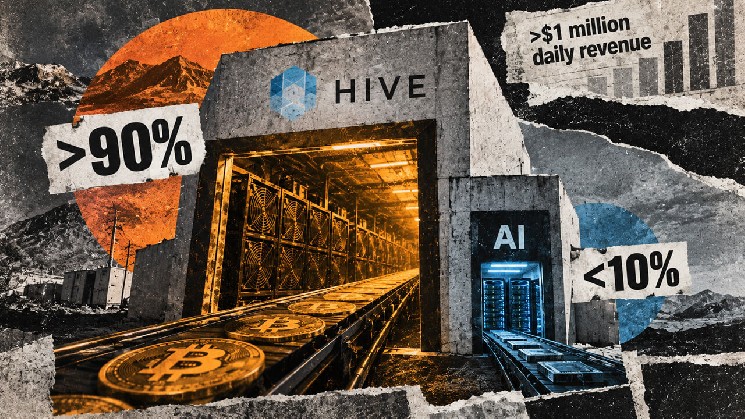
    HIVE Digital Technologies disclosed that its combined Bitcoin mining and GPU cloud operations generated more than $1 million in average daily revenue from August 21 through September 10, offering a concrete measure of how the company’s artificial intelligence pivot is contributing to current results.

    GPU Cloud Contributes Roughly 10% of Daily Revenue

    According to the company’s September 10 update, the GPU cloud segment produced approximately $100,000 per day during the period. That figure represents an operating revenue stream from AI infrastructure, though it accounted for less than roughly 10% of the reported total. Bitcoin mining supplied more than nine-tenths of the daily average.

    An accompanying infographic illustrated the split, showing HIVE averaging over $1 million in daily revenue with approximately 90% derived from Bitcoin mining and 10% from GPU cloud services.

    Mining Output Tied to Network Conditions

    HIVE reported mining an average of about 12 Bitcoin per day during the window, equal to roughly 2% of global network production. The company emphasized that the revenue figures are preliminary, unaudited management estimates, and tied the results to prevailing Bitcoin prices, network difficulty, and operating conditions. The dollar value of mining output can change with Bitcoin’s price and network economics.

    While GPU cloud gives HIVE an operating foothold in AI infrastructure, Bitcoin mining remained the financial engine during the period.

    $600 Million Contract Pipeline Not Yet Recognized Revenue

    HIVE said it had closed more than $600 million in GPU-cloud total contract value year to date, combining signed customer agreements and letters of intent. The company warned that total contract value is not recognized revenue and does not guarantee future revenue.

    That distinction follows August reports of a $350 million AI cloud agreement and the financing and execution demands of a related $185 million GPU buildout. The new disclosure shows the AI business generating revenue, but the much larger commercial pipeline still depends on delivery over time.

    Wind-Down of Legacy Facilities Underway

    HIVE said those operations contributed less than 5% of the company’s global daily revenue in August and that it intends to wind down mining at the facilities. The company is evaluating whether to repurpose the sites for high-performance computing, the data-intensive infrastructure used for services such as AI. It has not said the conversion is complete, and its release cautioned that the wind-down and repurposing may not proceed as planned.

    Two-Speed Transition Continues

    For now, the operating numbers show a two-speed transition. AI cloud has become a revenue-producing business, while Bitcoin mining remains the financial engine carrying the shift. The next test is whether HIVE can turn more of its signed agreements and letters of intent, along with its existing infrastructure, into recognized GPU-cloud revenue without losing the mining cash flow that supports the transition.

  • GoPro Enters Definitive Agreement to Merge With Starman Optical, Inc.

    GoPro Enters Definitive Agreement to Merge With Starman Optical, Inc.

    GoPro to Merge With Starman Optical in $285 Million Recapitalization Deal

    GoPro, Inc. (NASDAQ: GPRO) and privately held optical-photonics company Starman Optical, Inc. have signed a definitive merger agreement that will recapitalize GoPro and expand its presence in AI infrastructure, government, defense and aerospace markets.

    Under the proposed transaction, GoPro shareholders will receive a total cash payment of $285 million, or $1.14 per share, subject to a potential adjustment based on GoPro’s net working capital at closing. Existing shareholders will retain approximately 10% of the outstanding shares of the combined company.

    GoPro’s approximately $92 million in outstanding debt is expected to be repaid in full at closing, leaving the company with a substantially debt-free balance sheet. GoPro will remain publicly listed on Nasdaq.

    GoPro to Add U.S.-Made Optical Transceivers

    GoPro said the merger is intended to maximize the value of its intellectual property and growth potential across consumer, commercial and defense markets. Over the past 24 years, the company has developed imaging technologies, advanced optics and an intellectual property portfolio comprising more than 2500 U.S. patents.

    The company plans to continue supporting its existing consumer products, subscription services and cloud platform while investing in growth and a broader, more diversified product roadmap.

    Starman’s U.S.-made optical transceivers are expected to be added to GoPro’s product portfolio. The move would extend GoPro’s reach into the large and rapidly growing optical-transceiver market supporting AI infrastructure and data centers.

    After the transaction closes, the combined company also intends to apply its intellectual property, optics and imaging capabilities to defense, government, robotics and aerospace markets, building on demand for U.S.-made technologies.

    “Advanced optics and imaging are essential to AI, national security, and the broader economy, yet much of the critical hardware supporting these technologies continues to be manufactured overseas,” said Charles Tebele, Chief Executive Officer of Starman Holding. “The combination of GoPro’s world-class optical expertise and intellectual property with Starman’s advanced transceiver capabilities and U.S. manufacturing platform creates a unique opportunity. Together, we intend to bring production of these critical components back to the United States.”

    “We expect this merger to enable GoPro to grow across consumer, commercial and defense markets as a leading American imaging and optical solutions company, addressing important areas of national security related to cameras, optics and AI infrastructure. We’re excited to combine with the Starman team to capitalize on this opportunity and play an important role in America’s future,” said Nicholas Woodman, Founder and CEO of GoPro.

    Transaction Expected to Close by Year-End 2026

    The merger has been approved by GoPro’s Board of Directors and Starman’s Board of Directors. Closing is expected by the end of 2026, subject to regulatory approvals, approval by GoPro stockholders and other customary closing conditions.

    GoPro plans to provide additional information about the transaction after closing. Houlihan Lokey, Inc. is serving as GoPro’s financial adviser and has provided a fairness opinion. Fenwick & West LLP is serving as GoPro’s legal counsel.

    About GoPro

    GoPro helps people capture and share experiences through immersive imaging products and services.

    GoPro is active on Instagram, YouTube, TikTok, Facebook, X, LinkedIn and its blog, The Current. Members of the press can access official logos and imagery through the company’s press portal. More information is available at GoPro.com.

    GoPro, HERO, MAX, MISSION and their respective logos are trademarks or registered trademarks of GoPro, Inc. in the United States and other countries.

    About Starman Optical

    Starman Optical, Inc. (“Starman”), a Starman Holding company, is a privately held U.S. optical-photonics company focused on developing and manufacturing optical transceivers and related photonics technologies domestically through its Starman New Photonics business.

    Starman Holding is a diversified holding company with interests spanning technology, consumer brands and optical photonics.

    Additional Information for GoPro Stockholders

    This press release may be deemed to be solicitation material in respect of the proposed transaction involving GoPro, Inc. (“GoPro”) and Starman. In connection with the proposed transaction, GoPro intends to file with the Securities and Exchange Commission (the “SEC”) and furnish to stockholders a proxy statement. This press release is not a substitute for the proxy statement or any other document that GoPro may file with the SEC or send to its stockholders in connection with the proposed transaction. INVESTORS AND STOCKHOLDERS OF GOPRO ARE URGED TO READ THE PROXY STATEMENT AND OTHER RELEVANT MATERIALS WHEN THEY BECOME AVAILABLE BEFORE MAKING ANY VOTING DECISION WITH RESPECT TO THE PROPOSED TRANSACTION BECAUSE THEY WILL CONTAIN IMPORTANT INFORMATION ABOUT GOPRO AND THE PROPOSED TRANSACTION.

    The materials to be filed by GoPro will be made available to GoPro’s investors and stockholders at no expense to them. Copies may be obtained free of charge on GoPro’s website at https://investor.gopro.com/. The materials will also be available at no charge on the SEC’s website at www.sec.gov.

    GoPro and its directors, executive officers, other members of its management and employees may be deemed to be participants in the solicitation of proxies from GoPro stockholders in connection with the proposed transaction under SEC rules.

    Investors and stockholders may obtain more detailed information regarding the names, affiliations and interests of GoPro’s executive officers and directors in the solicitation by reading GoPro’s proxy statement for its 2026 annual meeting of stockholders, the Annual Report on Form 10-K for the fiscal year ended December 31, 2025, subsequent Quarterly Reports on Form 10-Q, and the proxy statement and other relevant materials that will be filed with the SEC in connection with the proposed transaction when they become available.

    Information concerning the interests of GoPro’s participants in the solicitation, which may in some cases differ from those of GoPro’s stockholders generally, will be included in the proxy statement relating to the proposed transaction when it becomes available.

    Forward-Looking Statements

    This press release may contain forward-looking statements including, among other things, statements regarding the potential benefits of the proposed transaction; the prospective performance and outlook of GoPro’s business, performance and opportunities; the technologies to be added to GoPro’s portfolio; the ability of the parties to complete the proposed transaction and the expected timing of completion of the proposed transaction; as well as any assumptions underlying any of the foregoing.

    The words “believe,” “may,” “will,” “estimate,” “continue,” “anticipate,” “intend,” “expect,” and similar expressions are intended to identify forward-looking statements. These forward-looking statements are subject to risks, uncertainties, and assumptions. If the risks materialize or assumptions prove incorrect, actual results could differ materially from the results implied by these forward-looking statements.

    Risks include, but are not limited to:

    1. the ability to obtain the requisite approval from stockholders of GoPro;
    2. the risk that the proposed transaction may not be completed in a timely manner or at all;
    3. the possibility that competing offers or acquisition proposals for GoPro will be made;
    4. the possibility that any or all of the various conditions to the consummation of the proposed transaction may not be satisfied or waived, including the failure to receive any required regulatory approvals from any applicable governmental entities;
    5. the occurrence of any event, change or other circumstance that could give rise to the termination of the merger agreement, including in circumstances that would require GoPro to pay a termination fee or other expenses;
    6. the effect of the pendency of the proposed transaction on GoPro’s ability to retain and hire key personnel, its ability to maintain relationships with its customers, suppliers and others with whom it does business, its business generally or its stock price;
    7. risks related to diverting management’s attention from GoPro’s ongoing business operations or the loss of one or more members of the management team;
    8. the risk that stockholder litigation in connection with the proposed transaction may result in significant costs of defense, indemnification and liability;
    9. changes in general economic, competitive, technological and/or industry-specific conditions affecting the businesses and industries in which GoPro and Starman operate;
    10. actions by third parties, including government agencies;
    11. uncertainty regarding the expected financial performance of the combined company following completion of the proposed transaction;
    12. failure to realize the anticipated benefits of the proposed transaction within the expected time frame or at all, including as a result of a delay in completing the proposed transaction or integrating the businesses;
    13. the ability of the combined company to implement its business strategy; and
    14. other risk factors detailed from time to time in GoPro’s reports filed with the SEC, including GoPro’s Annual Reports on Form 10-K, Quarterly Reports on Form 10-Q, Current Reports on Form 8-K and other documents filed with the SEC, including documents that will be filed with the SEC in connection with the proposed transaction.

    The foregoing list of important factors is not exclusive. Any forward-looking statements speak only as of the date of this communication. GoPro does not undertake, and expressly disclaims, any obligation to update any forward-looking statements, whether as a result of new information or developments, future events or otherwise, except as required by law. Readers are cautioned not to place undue reliance on any of these forward-looking statements.

    Source: GoPro, Inc.

  • Zacks Investment Ideas Highlights Dell, Nvidia, Hewlett Packard, Super Micro Computer and Lenovo

    Zacks Investment Ideas Highlights Dell, Nvidia, Hewlett Packard, Super Micro Computer and Lenovo

    Dell Technologies (NYSE: DELL) is scheduled to report its fiscal second-quarter results after the market closes on Tuesday, September 1. Expectations are elevated as demand for artificial intelligence infrastructure continues to drive rapid growth in the company’s server business.

    Dell posted a record first quarter, and another strong performance from its AI-optimized servers could strengthen the bullish outlook for DELL stock. Shares have gained more than 260% year to date but remain about 10% below their 52-week and all-time high of $514.

    Dell’s Fiscal Q2 Earnings Expectations

    The Zacks Consensus Estimate projects fiscal second-quarter earnings of $4.95 per share, more than double the $2.32 reported in the year-ago quarter. Revenue is expected to reach $45.34 billion, up 52% from $29.78 billion a year earlier.

    Wall Street’s current expectations are slightly above Dell’s previous guidance. Management forecast quarterly revenue of $44 billion to $45 billion and adjusted earnings of $4.80 per share, plus or minus $0.10. Dell also projected approximately $15.5 billion in AI server revenue and about 75% growth in Infrastructure Solutions Group revenue.

    The outlook follows a strong first quarter in which Dell generated $16.1 billion in AI-optimized server revenue, a 757% year-over-year increase, while recording $24.4 billion in AI orders. Dell later raised its fiscal 2027 AI server revenue outlook to approximately $60 billion.

    Analyst Estimates Continue to Rise

    Rising earnings estimates are another positive signal ahead of Dell’s quarterly report. Analyst EPS revisions for the second quarter, third quarter, fiscal 2027 and fiscal 2028 have continued to move higher over the past week.

    Over the last 90 days, fiscal 2027 EPS estimates have climbed nearly 11%, from $17.40 to $19.29. Fiscal 2028 EPS estimates have risen almost 10%, from $21.42 to $23.51.

    After reporting adjusted earnings of $10.30 per share last year, Dell is expected to deliver 87% EPS growth in fiscal 2027, followed by projected growth of 22% in fiscal 2028.

    Zacks ESP Signals Potential Earnings Upside

    The Zacks ESP (Expected Surprise Prediction) also points to a potentially strong quarterly performance. The Most Accurate Estimate among Wall Street analysts places Dell’s fiscal second-quarter EPS at $5.26, more than 6% above the Zacks Consensus Estimate of $4.95.

    Dell exceeded first-quarter EPS expectations by nearly 60% and has delivered an average earnings surprise of 18.66% over its last four quarterly reports.

    Dell Expands Its AI Infrastructure Ecosystem

    Dell is one of the most direct hardware beneficiaries of rising AI infrastructure investment through its server business, primarily sold under the PowerEdge (PE) brand. These systems provide the computing hardware used by businesses and data centers for applications, databases, cloud workloads and AI workloads.

    Dell’s partnership with Nvidia continues to expand through the Dell AI Factory, including new PE systems designed around Nvidia’s next-generation Vera Rubin architecture.

    The company is also deepening its relationship with Advanced Micro Devices by offering AI platforms powered by AMD Instinct accelerators.

    Competition remains intense, however. Hewlett Packard Enterprise, Super Micro Computer and Lenovo Group are competing aggressively for AI server and enterprise infrastructure spending. Dell’s ability to preserve strong margins while rapidly increasing AI server shipments will therefore be an important metric to watch.

    Outlook for DELL Stock

    Dell enters its fiscal second-quarter report with substantial momentum, supported by strong AI server demand and steadily rising earnings estimates.

    The trend could leave additional upside for Dell stock, which trades at approximately 24 times forward earnings despite its significant year-to-date rally.

    The primary risk is that expectations have become exceptionally high, with the current consensus already above the upper end of Dell’s initial fiscal second-quarter revenue guidance. Even so, robust AI demand, sharply higher earnings projections and an expanding infrastructure portfolio powered by Nvidia and AMD create a compelling setup ahead of the results.

    Dell currently carries a Zacks Rank #1 (Strong Buy), making DELL one of the more attractive AI infrastructure stocks to consider ahead of Tuesday’s report.

    Zacks Stock Research

    Since 2000, Zacks’ top stock-picking strategies have exceeded the S&P’s average annual gain of 7.7%. The strategies generated average annual gains of 48.4%, 50.2% and 56.7%.

    Investors can access the live picks without cost or obligation through Zacks Investment Research.

    See Stocks Free >>

    Media Contact
    Zacks Investment Research
    800-767-3771 ext. 9339
    support@zacks.com
    https://www.zacks.com

    Past performance is no guarantee of future results. Inherent in any investment is the potential for loss. This material is being provided for informational purposes only and nothing herein constitutes investment, legal, accounting or tax advice, or a recommendation to buy, sell or hold a security. No recommendation or advice is being given as to whether any investment is suitable for a particular investor. It should not be assumed that any investments in securities, companies, sectors or markets identified and described were or will be profitable. All information is current as of the date of herein and is subject to change without notice. Any views or opinions expressed may not reflect those of the firm as a whole. Zacks Investment Research does not engage in investment banking, market making or asset management activities of any securities.

    These returns are from hypothetical portfolios consisting of stocks with Zacks Rank = 1 that were rebalanced monthly with zero transaction costs. These are not the returns of actual portfolios of stocks. The S&P 500 is an unmanaged index. Visit https://www.zacks.com/performance for information about the performance numbers displayed in this press release.

    Readers can also download 7 Best Stocks for the Next 30 Days from Zacks Investment Research.

    This article originally published on Zacks Investment Research (zacks.com).

    Source: finance.yahoo.com

  • Bitcoin Miners Evolve Beyond Crypto Proxies Into High-Performance Computing Hubs

    Bitcoin Miners Evolve Beyond Crypto Proxies Into High-Performance Computing Hubs

    Bitcoin surged 21.5% between the Aug. 17 and Aug. 21 closes, but six of the seven major U.S.-listed Bitcoin miners ended the same trading period lower. MARA Holdings gained 16.1%, making it the closest performer to BTC, while Cipher Digital fell 14.8%, TeraWulf declined 11.2%, Hut 8 dropped 8.1% and IREN lost 6.8%.

    The divergence shows that stocks still widely treated as Bitcoin proxies are increasingly responding to factors beyond the cryptocurrency itself.

    Bitcoin miners diverge as AI businesses expand

    The Nasdaq-100 ETF QQQ fell 2.3% during the same sessions as long-term Treasury yields remained volatile, placing the miners within a weaker technology-equity environment. Their changing corporate structures help explain the split. Several former mining specialists now derive revenue, financing needs or future valuations from long-duration debt, artificial intelligence infrastructure and Bitcoin sales that help finance those projects.

    Construction schedules, equipment procurement and customer concentration have therefore become important parts of valuations that once depended primarily on mining economics and hash prices.

    Company filings show that the major public miners are at different stages of their transition toward artificial intelligence and high-performance computing.

    TeraWulf generated $31.9 million of its $44.8 million in second-quarter revenue from high-performance-computing leases, compared with approximately $12.8 million from digital assets. Hut 8 said its Beacon Point leases cover 949 megawatts of contracted IT capacity and represent $26.6 billion in base-term contract value, subject to future delivery and tenant performance.

    IREN reported $70.5 million in AI cloud revenue and $66.7 million in Bitcoin mining revenue for its June quarter, placing AI above mining in its current revenue mix. In an Aug. 27 release, the company reported operating annual recurring revenue of $1 billion as of Aug. 26 and contracted annual recurring revenue of $4 billion tied to 2026 capacity. That capacity is targeted to become operational by Dec. 31, subject to commissioning, testing and customer acceptance.

    IREN’s quarter also included a $450.4 million impairment, largely related to decommissioned mining hardware as its sites are converted for AI operations.

    Cipher continued to report second-quarter revenue from Bitcoin mining, but it has contracted 700 megawatts of high-performance-computing capacity across three sites and began delivering its first capacity at Black Pearl in August.

    Riot Platforms occupies a more balanced position. The company reported $113.7 million in mining revenue, $23.2 million from data centers and $37.3 million from engineering during a $174.2 million quarter. Its 241 megawatts of contracted AI capacity carry approximately $9.8 billion in company-estimated long-term revenue, giving investors a contract book to value alongside the 11,380 Bitcoin Riot held as of June 30.

    CleanSpark might have served as a mining-only control earlier in the year, but that classification changed before the August breakout. The company signed a 20-year, $6.6 billion agreement. MARA now offers the closest large mining-led comparison, although it is also exploring adjacent energy and computing businesses.

    Bitcoin beta and technology-market exposure

    CryptoSlate analyzed Alpaca/IEX historical equity closes for HUT, WULF, IREN, CIFR, RIOT, MARA, CLSK and QQQ, along with Alpaca’s BTC/USD closes, from Aug. 22, 2024 through Aug. 24, 2026.

    Daily stock returns used exchange trading days. Each Bitcoin return covered the interval between consecutive stock-market dates, meaning Monday observations included the weekend. Ten-year Treasury yields came from the Federal Reserve’s DGS10 series.

    Close-to-close returns from Aug. 17 through Aug. 21 captured the initial separation by comparing Bitcoin’s rally with QQQ as a broad technology-equity reference for the same sessions.

    The longer analysis used rolling 90-trading-day correlations and univariate Bitcoin betas. One comparison ended Aug. 22, 2025, while the current comparison ended Aug. 24, 2026.

    A Bitcoin beta of 1.10 means that a 1% daily move in Bitcoin was associated with an average 1.10% move in the miners during that period. Correlation measures how consistently the stocks’ directions and magnitudes moved alongside Bitcoin.

    Bitcoin beta declined from the comparable 2025 period for six companies, while IREN remained near 0.93. Bitcoin correlation fell for six companies and increased for WULF, rising from an already low 0.17 to 0.22.

    In the current period, QQQ correlation exceeded Bitcoin correlation for all seven companies. Their daily returns therefore tracked the Nasdaq proxy more consistently than the cryptocurrency they mine.

    MARA retained the group’s highest Bitcoin correlation and beta, consistent with its greater dependence on mining economics. HUT, WULF and CIFR ranked in the bottom half for current Bitcoin correlation as their data-center contracts gained more importance in investor estimates.

    IREN complicates that pattern. Its Bitcoin beta remained steady even as its QQQ correlation reached 0.60, allowing its operating mining business and substantial AI pipeline to influence the same return series.

    CryptoSlate also conducted a 2026 year-to-date regression using daily Bitcoin returns, QQQ returns and daily changes in the 10-year Treasury yield. The three-factor model explained approximately 28% to 45% of daily variation across the seven miners. The estimated effect of a 10-basis-point increase in Treasury yields ranged from a 0.52% decline for WULF to a 0.79% gain for CIFR.

    Four rate coefficients were negative and three were positive, providing no evidence of a common duration trade across the group. The mixed results also make a simple bond-market analogy difficult. Higher yields can reduce the present value of cash flows expected years in the future and increase project financing costs, but daily equity returns also reflect tenant announcements, construction progress, Bitcoin holdings, power prices and capital raises.

    Contracts explain why the companies carry different exposures, while the data show no consistent interest-rate trade across the sector.

    AI contracts create a second risk map

    TeraWulf provides the clearest example of a company whose income statement has already moved into a new category. High-performance-computing leases supplied approximately 71% of its second-quarter revenue, and its filings describe the repurposing or curtailment of mining equipment as computing capacity expands.

    A Bitcoin rally can support TeraWulf’s remaining mining operations, but the equity valuation now also depends on tenant payments, construction execution and the financing associated with its computing campus.

    Cipher shows how a company’s stock-market identity can change before its reported revenue mix does. Its June quarter still reflected Bitcoin mining, but investors can also model its contracted computing capacity and the company-estimated $793 million in average annual net operating income associated with its base lease terms.

    The gap between current revenue and promised capacity makes delivery schedules, capital costs and counterparty quality central factors for the share price.

    Riot and IREN display both types of exposure more clearly, although their current revenue mixes have diverged. Mining accounts for most of Riot’s current revenue, while AI cloud revenue slightly exceeded Bitcoin mining revenue in IREN’s June quarter.

    Their mining operations remain sensitive to digital-asset prices, while signed AI agreements add projected cash flows from another business line. Each quarterly filing can change the relative importance of Bitcoin production and data-center delivery, making beta a function of business mix rather than a permanent characteristic of the company.

    Contract announcements also contain significant uncertainty. Base-term value represents payments expected over many years, while revenue and net operating income estimates depend on timely delivery. Project-level debt may protect a parent company’s balance sheet, but only within the limits of the relevant structure.

    A multiyear contract value can help identify a company’s strategic direction, but it cannot replace a discounted cash-flow model or completed operating capacity.

    Mining stocks now combine crypto, AI and infrastructure risk

    The Aug. 17 breakout captured a genuine separation, and the longer sample confirms a broader reclassification of the sector. MARA rose alongside Bitcoin, every company retained a positive current Bitcoin beta, and mining cash flow continues to fund or support several AI buildouts.

    Bitcoin is now one factor among several. Its influence is lowest where contracted computing capacity has become the central part of the equity story.

    “Bitcoin miners” now describe these companies’ origin more reliably than their destination. Investors who buy the group through a mining-focused basket may receive varying exposure to Bitcoin production, hyperscaler credit, construction schedules, power-delivery risk, project finance and technology-equity multiples.

    The contracts help explain why the stocks separated, while their remaining Bitcoin betas show that their original identity still travels with them.