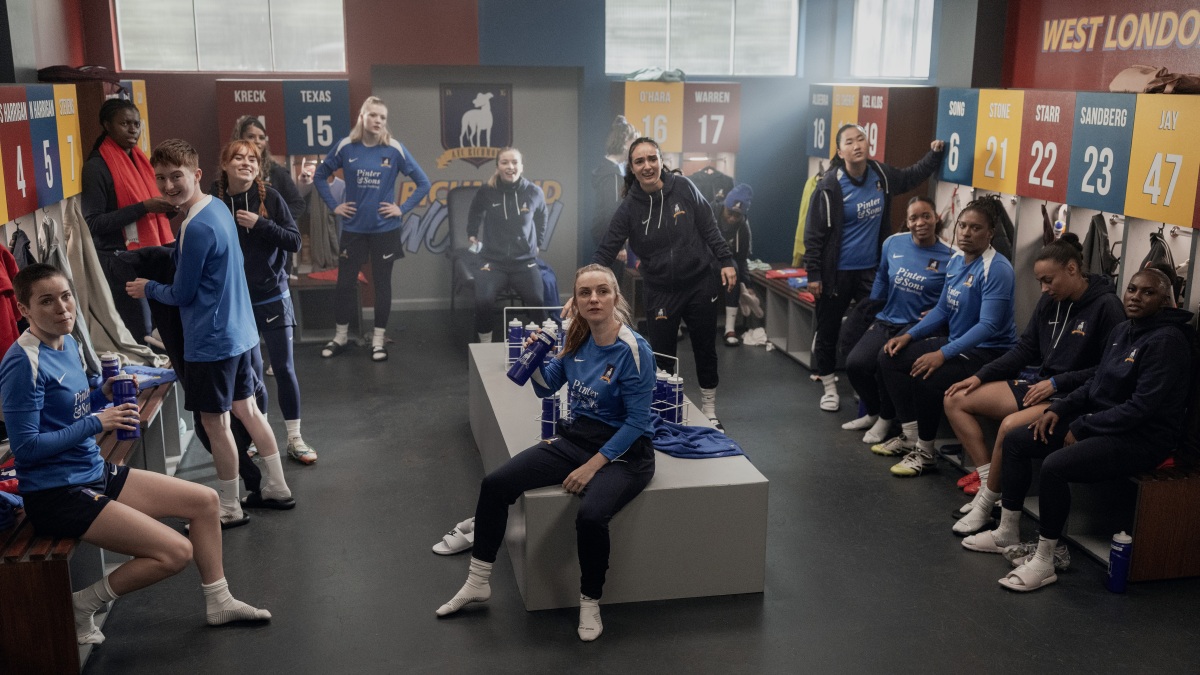
Tag: AFC Richmond women’s team

  • Ted Lasso Finally Starts Doing Right by the Lady Greyhounds

    Ted Lasso Finally Starts Doing Right by the Lady Greyhounds

    Key Highlights

    • Episode 7 “Yes & Baby” shifts focus to the Lady Greyhounds’ personal struggles, addressing a season-long criticism that the women’s team operated as a faceless mob rather than individuals.
    • The episode exposes the financial precarity of second-division women’s football: players juggle childcare crises, rent hikes, car repairs, and side gigs while facing dismissive attitudes like a professor calling Gemma’s career a “football thing.”
    • Coach Alice’s “yes, and” improv philosophy and the locker room’s amendment of the “Believe” sign to “believe and win” signal a more empowered team culture, but with only three episodes left, the show’s ability to fully realize these characters remains uncertain.

    A Long-Awaited Spotlight on the Lady Greyhounds

    In its opening minutes, Ted Lasso Season 4, Episode 7, titled “Yes & Baby,” directly confronts the most persistent flaw of the season: the Lady Greyhounds have functioned more as a collective backdrop than as a crew of distinct individuals. For six episodes, Richmond’s women’s team moved in a pack — attending parties, practicing, and receiving pep talks from Ted (Jason Sudeikis) en masse — with only Coach Alice (Tanya Reynolds) and striker Gemma (Abbie Hern) granted any interiority. That changes immediately in Episode 7, which devotes its first act to the private crises each player navigates off the pitch.

    The Harsh Realities of Women’s Second-Division Football

    The episode lays bare a reality that contrasts sharply with the gilded world of the men’s team across the first three seasons. Lizzie (Faye Marsay) scrambles for childcare after her ex reneges on his promise. Twins Siobhan (Rex Hayes) and Niamh (Aisling Sharkey) face a steep rent increase. Boots (Jude Mack) contends with a broken-down car. Shannon (Shannon Hayes) moonlights as a food delivery courier. Their careers as second-division professionals are demonstrably not “financially life-changing,” and the world around them barely registers their achievements. Gemma’s law professor encapsulates this indifference, dismissing her Richmond career as just a “football thing.” There are no luxurious bachelorette pads or high-level endorsements awaiting these women as the club struggles to establish the team.

    Building a New Team Culture Through “Yes, And”

    While the remainder of the episode re-centers the main ensemble, it carves out significantly more space for the Lady Greyhounds than previous installments. Practice scenes — previously the domain of Ted, Coach Beard (Brendan Hunt), and Alice — now showcase the players’ dynamic. As Alice attempts to say “yes, and” more often, adopting an improv mindset to foster openness, a new, more collaborative rapport emerges between coach and squad. This allows multiple ensemble members to shine, such as Mady (Annelise Heywood) proposing to play blindfolded to “sense” the ball, a gag the episode regrettably does not follow through onscreen.

    The “Believe” Sign Gets an Upgrade

    The Lady Greyhounds’ expanded focus culminates in a final locker room scene where they interrogate the new “Believe” sign. It is a moment that is, like much of Ted Lasso, a bit on the nose, but the critique lands: why should the women’s team inherit the men’s hand-me-downs? What good is blind belief when you cannot pay rent? Alice’s amendment — changing the sign to “believe and win” — speaks to the fire and pragmatic drive of every member of the team. It is a small but potent visual metaphor for a squad demanding tangible results, not just inspiration.

    Balancing Act: Old Characters vs. New Ensemble

    Each of these scenes represents a necessary step toward knowing the Lady Greyhounds as individuals and as a unit. Yet the timing prompts a critical question: is it too little, too late? Seven episodes into a season justified by the existence of this very team, we are only now truly meeting them. The answer lies in the show’s struggle to balance its beloved legacy characters with the entirely new roster created to facilitate its soft relaunch. Episode 7 shows promising signs of finally striking that equilibrium, albeit at the continued expense of the tight 30-minute runtime many have yearned for since Season 2. With only three episodes remaining, the jury is still out on whether Ted Lasso can stick the landing and do full justice to the Lady Greyhounds.

    Why This Matters

    The shift in Episode 7 speaks to a broader conversation about representation in sports media. Ted Lasso built its reputation on nuanced, empathetic portrayals of male vulnerability; extending that same depth to female athletes — specifically those in the lower tiers of professional football where financial instability is the norm — adds crucial texture to the show’s universe. The narrative choice to highlight the “football thing” dismissal underscores the systemic undervaluation of women’s sports, even within an academic setting. Furthermore, the show’s meta-struggle to balance old and new casts mirrors the real-world challenge of franchise reboots: honoring legacy IP while giving new characters the oxygen they need to become iconic in their own right. As the season enters its final stretch, the series’ legacy may hinge on whether it can elevate the Lady Greyhounds from plot devices to fully realized protagonists.

    Frequently Asked Questions

    What is the significance of the episode title “Yes & Baby”?

    The title references the improv principle “yes, and” that Coach Alice adopts to foster a more open, collaborative team culture, while “Baby” likely alludes to the childcare crisis Lizzie faces in the cold open — juxtaposing the philosophy of acceptance with the messy realities of the players’ lives.

    Why does Alice change the “Believe” sign to “believe and win”?

    The change reflects the Lady Greyhounds’ rejection of inherited, passive inspiration. In the locker room, they question why they should settle for the men’s team’s hand-me-down motto when they face concrete pressures like rent and childcare. “Believe and win” signals a demand for tangible results and agency.

    When do new episodes of Ted Lasso Season 4 premiere?

    New episodes premiere Wednesdays on Apple TV+.

  • ‘Ted Lasso’ Exposes Soccer’s Clique Problem—One the USWNT Has Mastered

    ‘Ted Lasso’ Exposes Soccer’s Clique Problem—One the USWNT Has Mastered

    Spoiler alert: This article contains spoilers for this week’s episode of Ted Lasso.

    Across three seasons, Ted Lasso has faced divorce, egos, bullying, relegation, panic attacks, promotion and Jamie Tartt. In the latest episode of season 4, AFC Richmond’s women’s team introduces him to a different challenge: locker-room cliques.

    Cliques are common in soccer. At their worst, they can fracture a team and undermine a coach’s authority.

    As Dr. Sharon Fieldstone, Ted’s fictional psychologist, explains to former Richmond reporter Trent Crimm on his podcast, if coaches “lose the dressing room, they lose the team.”

    “Successful teams are happy teams, and happy teams have coaches that establish a culture of communication and trust,” she says. “The majority of that happens in the dressing room.”

    Why soccer teams form cliques

    Cliques exist at nearly every level of soccer, from youth teams to professional sides and championship-winning squads such as the 2015 and 2019 United States women’s national teams.

    “Even within our squad, the culture has changed,” former U.S. forward Carli Lloyd said on an episode of Hope Solo’s now-defunct podcast recorded in 2022, several months after Lloyd retired as one of the team’s all-time leading scorers. Lloyd and Solo were roommates and close friends during the 2015 World Cup.

    “It was really tough and challenging to play these last several years. To be quite honest, I hated it. It wasn’t fun going in. It was only for love of the game, really, for me. I wanted to win and wanted to help the team, but the culture within the team was the worst I had ever seen it.”

    Lloyd and Solo similarly considered themselves “black sheep” within the group.

    Expecting 26 players to become best friends simply because they wear the same jersey is unrealistic. Every player arrives in a locker room with a different history, set of relationships, loyalties and level of influence.

    A 16-year-old rookie midfielder might sit next to a 35-year-old defender nearing the end of her career. A player competing for her next contract might share a locker room with a national team star earning significantly more through salary and endorsements. International players may arrive without speaking the local language, while former college and youth teammates reconnect. Other players may actively dislike one another after years as rivals.

    A study published in The Sport Psychologist, based on interviews with 18 collegiate athletes across nine teams, found that athletes viewed clique formation as “inevitable.” Age, tenure, proximity and similarity all influenced which players gravitated toward one another.

    How a shared goal can unite a team

    So how can a coach stop cliques from destroying a team? Dr. Fieldstone’s answer to Crimm is simple: give the players a common enemy. When the divisions inside a locker room matter less than an external threat, a team can unite around a goal larger than itself.

    One of the clearest examples comes from the U.S. women’s national teams that won back-to-back World Cup titles in 2015 and 2019. Those squads featured enormous personalities, but the players ultimately found something more powerful than their competing celebrity: they got angry.

    The 2015 World Cup victory was followed by one of the most consequential collective fights in women’s sports. The players turned their attention to U.S. Soccer and what they viewed as systemic inequality in pay, travel, playing conditions and treatment.

    In March 2016, Lloyd, Solo, Alex Morgan, Becky Sauerbrunn and Megan Rapinoe filed an Equal Employment Opportunity Commission complaint alleging wage discrimination against U.S. Soccer.

    Sauerbrunn explained at the time that the entire team had agreed to the complaint. The five players had been elected by their teammates to represent them in collective bargaining, which made them the names attached to the filing.

    Players with different personalities, ideologies and levels of fame suddenly shared one objective: equal pay. The fight was bigger than the cliques.

    That collective effort continued into the next generation. By the 2019 World Cup, Solo was no longer in goal, but many players from the 2015 squad remained. The dispute with U.S. Soccer had escalated, with 28 USWNT players filing a gender-discrimination lawsuit just months before the tournament. They ultimately won.

    The U.S. women’s national team is hardly the only group to discover that getting everyone to pull in the same direction is easier said than done. But when it works, the result can be powerful.

    What England’s Lionesses learned about team unity

    Arsenal and England captain Leah Williamson served as an authenticity consultant for the fourth season of Ted Lasso, answering writers’ questions about women’s football during production. It is unclear which elements of the show she directly advised on, but Williamson has experienced both a club team that overcame reported locker-room rifts when Arsenal won the UEFA Champions League and a national team facing significant outside pressure before the 2025 European Championship.

    Ahead of the 2025 Euros, England goalkeeper Mary Earps abruptly retired from international football, while defender Millie Bright withdrew from selection because of mental and physical burnout. Neither player was necessarily part of coach Sarina Wiegman’s planned starting lineup, despite their successful legacies with the team.

    When major personalities leave a locker room, the team’s internal dynamics change. England nevertheless overcame early tournament struggles to win a second European title. Wiegman’s explanation for the success was: “B****** get s*** done.”

    For the U.S. women, the shared cause was equal pay. For the Lionesses, it was silencing the doubters. For AFC Richmond’s women, it is trivia and a good old-fashioned pub fight against misogynistic hecklers at the Crown & Anchor.

    Because sometimes team unity is not about being friends. It’s about getting s*** done.