Key Highlights
- Veteran trader Peter Brandt projects XRP could reach $5.40 based on long-term monthly chart analysis, implying approximately 251% upside from current levels.
- XRP surged 8.7% to $1.54 in 24-hour trading, reaching a session high of $1.57 before pulling back, with the token trading in an 11% range between $1.41 and $1.57.
- Institutional developments accelerated as South African banking giant Absa launched digital asset custody built on Ripple technology, while the U.S. Senate rejected cloture on the CLARITY Act in a 49-50 vote.
Peter Brandt’s Technical Analysis and $5.40 Price Target
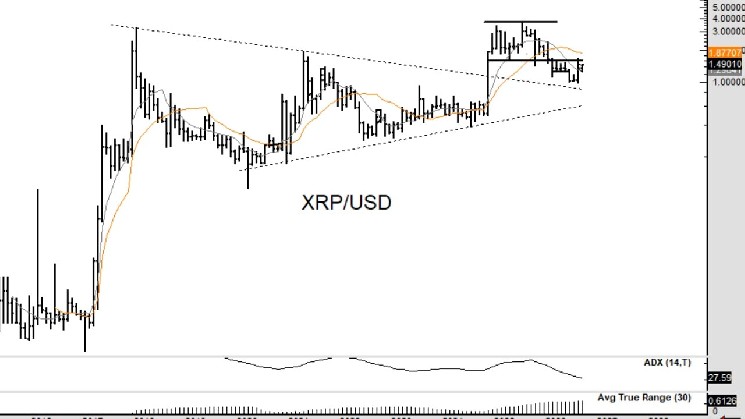
Veteran commodity trader Peter Brandt shared a bullish long-term projection for XRP on September 21, posting a monthly chart on X that he says implies an eventual advance to $5.40. The target would represent a substantial premium over recent trading ranges, requiring approximately 251% appreciation from the $1.54 level where XRP traded at the time of publication.
Brandt, who entered the commodity trading business in 1976 and founded Factor Trading in 1980, emphasized the distinction between a public chart presentation and an executed trade. “This is my long-term chart of $XRP It implies an eventual advance to $5.40.” he wrote. “A claim of a ‘call’ or simple presentation of a chart is $NOT a trade. People who claim ‘trades’ need to provide proof or else the claims are BS. An X post is $NOT proof,” he added. His use of the term “eventual” frames the $5.40 objective as a long-term technical target rather than a near-term prediction, and he explicitly noted that proving an actual trade would require verifiable records showing entry, exit, and result.
XRP Price Action and Market Performance
Bitcoin.com Markets data confirmed XRP trading at $1.54, up 8.7% or $0.12 over the preceding 24 hours. The token established a session low of $1.41 early in the period before climbing steadily through most of the trading day. The advance peaked at $1.57 late in the session, after which XRP eased back to the $1.54 level, leaving it approximately 2% below its 24-hour high and roughly 9% above its low. The session’s full trading range spanned about 11% from low to high, reflecting heightened volatility accompanying the price discovery.
Institutional Infrastructure Expansion and Regulatory Context
The price rally coincided with significant institutional infrastructure developments. South African lender Absa, one of Africa’s largest banking groups, launched Absa Digital Asset Custody on September 21, built on Ripple’s custody technology. The launch occurred 11 months after Ripple and Absa announced their partnership, marking a concrete step in institutional adoption across the African continent.
Asset manager 21Shares outlined a four-pillar investment case for XRP centered on regulatory clarity, institutional access, measurable utility, and fixed supply. The firm noted that while expanding XRP Ledger (XRPL) activity may not directly translate into sustained XRP demand, growing network activity could support demand through transaction fees, account reserves, and bridge transfers. 21Shares cited approximately $4 billion in tokenized assets and roughly $1.6 billion in RLUSD supply, with more than half circulating on the XRPL.
On the regulatory front, the U.S. Senate rejected cloture on the CLARITY Act in a 49-50 vote. Ripple maintained that the failed vote did not alter XRP’s established legal position or disrupt demand across payments, stablecoins, and institutional markets, suggesting the token’s regulatory framework remains intact despite legislative setbacks.
Why This Matters
The convergence of technical analysis from a respected veteran trader, meaningful price appreciation with elevated volume, and tangible institutional infrastructure deployment creates a multi-layered bullish narrative for XRP. Brandt’s $5.40 target, while framed as a long-term technical implication rather than a trading recommendation, draws attention to the monthly chart structure that has historically preceded major trend advances in commodity and digital asset markets. The Absa custody launch demonstrates Ripple’s expanding institutional footprint beyond North America into African financial markets, while 21Shares’ analytical framework highlights the fundamental metrics—institutional access, on-chain utility, and regulatory standing—that professional allocators increasingly prioritize. The Senate’s CLARITY Act outcome, while a legislative disappointment for broader crypto regulatory clarity, appears to have had minimal immediate market impact on XRP specifically, reinforcing Ripple’s assertion that the token’s legal classification is settled. Market participants will likely monitor whether XRP can sustain above the $1.50 psychological level and build a higher base for the next leg toward Brandt’s long-term projection.
Frequently Asked Questions
What is Peter Brandt’s track record in technical analysis?
Peter Brandt has over 45 years of commodity trading experience, founding Factor Trading in 1980 after beginning his career in 1976. He has managed institutional trading operations and authored two books on commodity trading and classical chart patterns, establishing him as a recognized authority in traditional technical analysis applied to digital assets.
Does the Absa Digital Asset Custody launch directly increase XRP demand?
Not necessarily. The custody service is built on Ripple’s technology infrastructure, but 21Shares notes that expanding XRPL activity may not translate directly into sustained XRP demand. However, the firm argues that growing network activity could support demand indirectly through transaction fees, account reserves, and bridge transfer mechanisms on the ledger.
How significant was the Senate CLARITY Act vote for XRP specifically?
According to Ripple, the failed cloture vote on the CLARITY Act did not change XRP’s established legal position or disrupt demand across its core use cases in payments, stablecoins, and institutional markets. The token’s regulatory classification remains intact regardless of the legislative outcome.