Tag: 000

  • Bitcoin Surges Above $80,000 Again as Altcoin Volatility Spikes; Top Gainers and Drivers Identified

    Bitcoin Surges Above $80,000 Again as Altcoin Volatility Spikes; Top Gainers and Drivers Identified

    Key Highlights

    • Bitcoin surged 4.7% in 24 hours to reclaim the $80,600 level on Binance, triggering $198 million in leveraged liquidations—$190 million from short positions alone.
    • Altcoins outperformed Bitcoin with double-digit gains: Arbitrum (+29%), Near Protocol (+26%), Uniswap (+20%), and Aptos (+18%) led the rally.
    • The SEC announced a five-year “novelty waiver” permitting tokenized stock trading, a move analysts say signals regulatory thaw and could accelerate blockchain infrastructure adoption.

    Bitcoin Breaks $80K, Triggering Massive Short Liquidations

    Bitcoin staged a forceful recovery on Tuesday, climbing 4.7% over the past 24 hours to trade above $80,600 on Binance—the first sustained break above the psychologically critical $80,000 threshold in several sessions. The sharp ascent caught leveraged traders off guard, resulting in $198 million worth of liquidated positions within a single hour, according to data aggregated by Bitcoinsistemi.com. Of that total, $190 million originated from short positions, underscoring the one-sided bearish positioning that amplified the upward move.

    Altcoins Outpace Bitcoin in Broad Market Rally

    The rally extended well beyond the flagship cryptocurrency. Ethereum rose 4% to surpass $2,550, while Solana gained 7.8% to breach $108 and XRP advanced 4.5% above $1.30. However, mid-cap altcoins delivered the most explosive returns. Arbitrum (ARB) led with a 29% surge, followed by Near Protocol (NEAR) at 26%, Uniswap (UNI) at 20%, and Aptos (APT) at 18%. Jupiter (JUP), Worldcoin (WLD), and Ether.fi (ETHFI) each posted gains between 15% and 15.5%, signaling broad-based risk appetite returning to the digital asset complex.

    SEC “Novelty Waiver” Fuels Regulatory Optimism

    Market participants attributed the sentiment shift to a landmark announcement from the U.S. Securities and Exchange Commission (SEC) on Monday. The regulator unveiled a “novelty waiver” framework that will temporarily authorize tokenized stock trading for a five-year period. Analysts interpret the move as a pragmatic acknowledgment that tokenized securities require supporting blockchain infrastructure to scale, and that regulatory clarity could unlock institutional participation. The waiver effectively creates a regulated sandbox for equity tokenization, a development long sought by both traditional finance incumbents and crypto-native firms.

    Why This Matters

    The confluence of a technical short-squeeze in Bitcoin and a policy breakthrough from the SEC represents a dual catalyst for the digital asset market. On the technical side, the $190 million in short liquidations suggests excessive bearish leverage had accumulated, creating coiled-spring conditions for a sharp reversal. On the regulatory side, the SEC’s novelty waiver is the first formal U.S. framework enabling tokenized equities at scale—a prerequisite for bringing trillions in traditional assets on-chain. If the waiver transitions into permanent rulemaking, it could legitimize blockchain-based settlement layers and drive sustained demand for Layer 1 and Layer 2 tokens that power such infrastructure. Traders should monitor whether the current rally holds above $80,000, which would confirm a higher-low structure, and watch for further SEC guidance on tokenized asset custody and broker-dealer requirements.

    Frequently Asked Questions

    What triggered Bitcoin’s surge above $80,000?

    A combination of technical short-covering—$190 million in short positions liquidated in one hour—and improved macro sentiment following the SEC’s tokenized stock trading waiver announcement drove the 4.7% rally to $80,600.

    Which altcoins posted the largest gains during the rally?

    Arbitrum (ARB) led with a 29% increase, followed by Near Protocol (NEAR) at 26%, Uniswap (UNI) at 20%, and Aptos (APT) at 18%. Jupiter (JUP), Worldcoin (WLD), and Ether.fi (ETHFI) each rose roughly 15%.

    What is the SEC’s “novelty waiver” and why does it matter?

    The novelty waiver is a five-year temporary authorization allowing tokenized stock trading under a regulated sandbox framework. It matters because it provides the first clear U.S. regulatory pathway for equity tokenization, which analysts expect will increase demand for blockchain settlement infrastructure and associated tokens.

  • Bitmine Chairman Tom Lee Reveals New Bitcoin and Ethereum Price Predictions

    Bitmine Chairman Tom Lee Reveals New Bitcoin and Ethereum Price Predictions

    Bitmine Chairman Tom Lee says Ethereum is undervalued relative to Bitcoin and could climb to $6,000 if Bitcoin breaks above $150,000. He believes Ethereum has substantial upside potential in the months ahead.

    Regulation and institutional demand could support Ethereum

    Lee identified several factors that could drive Ethereum’s value higher through the remainder of the year. The most significant is the potential passage of the CLARITY Act, a comprehensive US regulatory framework for the cryptocurrency market.

    According to Lee, clearer regulations could encourage institutional investors to enter the crypto market. The return of pent-up capital to digital assets could also provide additional support for cryptocurrency prices.

    Other potential catalysts include increased capital inflows from Asia and “compensatory purchases” of crypto assets by global institutions seeking to improve their quarterly performance.

    Ethereum could regain ground against Bitcoin

    Lee said the $ETH/BTC ratio, which measures Ethereum’s performance against Bitcoin, could retest its previous level of 0.08. Even in a more cautious scenario, he believes a recovery to 0.04 would give Ethereum significant upside potential.

    Although Lee acknowledges that Bitcoin retains long-term growth potential, he expects asset tokenization and AI-powered finance to be among the key forces shaping the cryptocurrency market over the next five years.

    Lee’s outlook supports the possibility that the performance gap between Bitcoin and Ethereum could narrow. Market participants are expected to closely monitor how institutional capital flows affect Ethereum in the coming period.

    If Bitcoin reaches $150,000, Ethereum’s move to $6,000 would represent a significant gain from current price levels. However, that scenario depends on Bitcoin surpassing the $150,000 threshold and Ethereum attracting the anticipated capital inflows.

    This is not investment advice.

  • Bitcoin Tops $80K as Crypto Market Flips to Greed—but Is the Rally Misleading?

    Bitcoin Tops $80K as Crypto Market Flips to Greed—but Is the Rally Misleading?

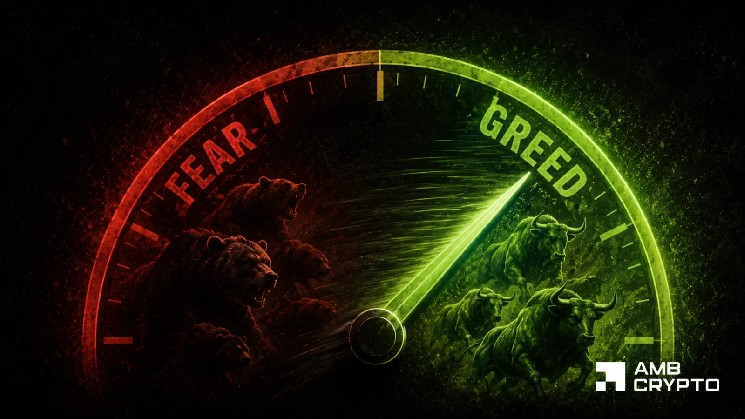
    Crypto market sentiment has shifted sharply in just a few days. After spending months between “Fear” and “Extreme Fear,” the market has now moved into “Greed.”

    At press time, the Crypto Fear and Greed Index stood at 68, placing it in the “Greed” zone. CoinShares’ recent report, ‘From despair to greed in a week: a rally is not a verdict’, highlighted a more favorable environment for Bitcoin’s rally.

    However, the shift does not indicate a fundamental improvement across the entire cryptocurrency industry.

    Source: Alternative

    Why did crypto sentiment change so quickly?

    Jean-Marie Mognetti, CEO of CoinShares, believes conditions surrounding digital assets have become more favorable, particularly for Bitcoin [$BTC]. However, most individual crypto projects have not suddenly become stronger businesses simply because their prices have increased.

    Mognetti put it best when he said:

    This is where the rally becomes more dangerous to interpret.

    Just one month earlier, more than 100 crypto projects had reportedly shut down, entered bankruptcy, or disappeared in 2026. Major industry names were also announcing closures or filing for bankruptcy, creating the impression that the crypto sector was entering another major downturn.

    The situation then changed rapidly. Bitcoin climbed back above $80,000, other digital assets followed, and options traders began placing large bets that Bitcoin could rise above $82,000.

    What is driving the Bitcoin rally?

    Several factors have contributed to the latest crypto market rally. The most prominent was last week’s White House meeting, during which President Trump urged Congress to pass a “fair version” of the CLARITY Act.

    Treasury buybacks, a hawkish tone from the Federal Reserve, and US federal debt surpassing US$40 trillion were additional factors supporting the market’s momentum.

    Despite these developments, the rally has not resolved the fundamental problems that caused more than 100 crypto projects to disappear in 2026. Many failed after running out of funds or experiencing security issues, while cryptocurrency exploits caused more than $1 billion in losses during the first half of 2026.

    These developments suggest that the rally has genuine support from a stronger macroeconomic backdrop. However, rising prices do not automatically validate every asset participating in the rally.

    Mognetti added:

    What deserves scepticism is the assumption that a rising market validates everything rising with it.

    The warning is significant because a similar level of market greed preceded Bitcoin’s correction of more than 30% in October 2025.

    This time, the total crypto market capitalization has risen by more than 22% in a week. However, the weekly relative strength index is extremely overbought, so caution remains warranted. Longer-term data, meanwhile, continues to indicate that the rally may have further room to run.

    Crypto sentiment has not reached peak greed

    Institutional demand remains a key difference in the current market cycle. Spot Bitcoin ETFs recorded more than $1 billion in inflows last week alongside a 21% $BTC rally. October’s inflows, however, exceeded $3 billion, suggesting there may still be scope for stronger institutional demand.

    The Coinbase Premium Index previously reached 0.18, reflecting strong accumulation by US investors. That signal is currently absent. As a result, despite short-term overbought conditions, sentiment around 75 may not yet represent peak greed or guarantee an imminent correction.

    These changes followed Bitcoin’s move back above $80,000. Nevertheless, some concerning market data suggest that the rally could continue while also highlighting the risks of interpreting rising prices as evidence of broad-based strength across the crypto industry.

  • Bitcoin Drops After Warsh Speech as Rate-Hike Odds Reach 57% — Can BTC Reclaim $80K?

    Bitcoin Drops After Warsh Speech as Rate-Hike Odds Reach 57% — Can BTC Reclaim $80K?

    Bitcoin price fell 3% to $77,000 after Federal Reserve Chair Kevin Warsh delivered a hawkish speech at the Jackson Hole event, signalling that the central bank may not be finished fighting inflation despite recent macroeconomic data.

    We must be confident that underlying inflation is moving to our objective, clearly and at sufficient speed. Otherwise, we have work to do.

    Discussing the latest summer inflation data, Warsh added:

    While this summer’s PCE and CPI readings were better than expected, they do not tell me that underlying trends have meaningfully improved.

    Why did Bitcoin fall below $80,000?

    U.S. equities and cryptocurrency markets interpreted Warsh’s comments as hawkish. The tech-heavy Nasdaq fell 0.52%, while the S&P 500 declined 0.25%. Crypto markets followed, with Bitcoin leading the downturn with a 3% drop.

    Source: $BTC/USDT, TradingView

    Bitcoin had rallied 30% in the second half of August, supported by the Treasury’s planned $1 trillion intervention to curb rising bond yields. The upswing also helped BTC reclaim its crucial 200-day moving average.

    However, the rally has stalled below $80,000, delaying Bitcoin’s attempt to reclaim the 50-week moving average at $81,800 and officially mark the end of the BTC bear-market cycle.

    Can Bitcoin rally despite September Fed rate hike fears?

    Inflation directly influences Federal Reserve interest-rate policy and risk sentiment across financial markets. Following Warsh’s speech, interest-rate traders raised the probability of a September Fed rate hike to 57%, a 20% increase from the previous week. The repricing reinforced renewed fears of another rate hike.

    Source: CME FedWatch

    Bitcoin options traders, including sophisticated professionals and institutional investors, also moved to increase downside protection.

    This was reflected in the BTC 25 Delta Skew, which rose from -10% to nearly 5%, representing a 15% increase and signalling renewed demand for downside hedging.

    During Bitcoin’s explosive rally last week, the metric fell below 0% for the first time this year. That indicated traders were reducing their downside hedges as many analysts expected the rally, supported by the so-called debasement trade, to continue amid concerns over U.S. fiscal debt and turmoil in the bond market.

    Source: Velo

    The metric’s weekend spike now suggests that Warsh has forced Bitcoin bulls to reassess their strategy.

    Analyst Luke Gromen, however, believes the bond-market crisis will overshadow Federal Reserve rate decisions in the short term.

    It remains a variant perception that both Fed hikes or cuts will cause the long end to rise…even as long bond yields are now up on Warsh’s ‘hawkish’ speech today.

    If fears of a Fed rate hike intensify and weigh on market sentiment, Bitcoin’s price could retrace toward its 200-day moving average at $69,300.

    However, if the debasement-trade narrative continues, the $80,000 level could become support for the next leg of the uptrend.

    Bitcoin price outlook

    Bitcoin fell 3% to $77,000 after Kevin Warsh’s hawkish Jackson Hole speech. The Nasdaq declined 0.52%, while the S&P 500 fell 0.25%. Meanwhile, the probability of a September Fed rate hike increased to 57%.