Category: Coins

Digital assets, cryptocurrencies, blockchain, and currency news.

  • Vymopay Publishes Self-Custody Wallet Comparison for Bitcoin, Ethereum, and Altcoin Traders: Key Checks Before Leaving an Exchange

    Vymopay Publishes Self-Custody Wallet Comparison for Bitcoin, Ethereum, and Altcoin Traders: Key Checks Before Leaving an Exchange

    Self-Custody Wallets Mature: Traders Weigh Architecture Trade-Offs for Bitcoin, Ethereum, and Altcoins

    The self-custody wallet market has evolved beyond a single selling point. Traders holding Bitcoin ($BTC), Ethereum ($ETH), Solana ($SOL), XRP, stablecoins such as USDT and USDC, and other digital assets now face a nuanced decision: which wallet architecture best aligns with their security, privacy, compliance, and usability needs.

    For years, the argument for self-custody boiled down to four words: “not your keys, not your coins.” That debate is largely settled. The pressing question in 2026 is not whether to self-custody, but which wallet and why.

    The Gap Between Preference and Practice

    Global data reveals a striking disconnect. While 59% of crypto wallet users say they prefer non-custodial solutions, Ledger estimates that only 30 million of 400 million crypto users worldwide actually practice self-custody—and just 10 million do so securely.

    The primary cause is friction. Yet the infrastructure built to close that gap is expanding rapidly:

    • Non-custodial swap volumes surged more than 340% year-over-year through early 2026.
    • Hardware wallet sales reached $560 million in 2025.
    • The non-custodial wallet market is projected to grow from $4.8 billion to $18.3 billion by 2033.

    This growth underscores why the differences between today’s self-custody options matter for active traders and long-term holders alike.

    Five Wallets, Five Distinct Approaches

    Vymopay: Telegram-Native Self-Custody With Integrated AML Screening

    Vymopay is a Telegram-native non-custodial wallet that requires no separate application download. It addresses a problem most self-custody options ignore: what happens to a trader’s wallet identity at the moment funds are withdrawn from a centralized exchange (CEX).

    Its Shield Address feature generates an intermediate receiving address. Funds sent to that address are automatically screened for AML risk and then forwarded to the user’s actual wallet without disclosing the final destination to the sender or originating exchange. This design reduces the risk of directly linking on-chain activity to a CEX-verified identity while keeping compliance controls intact.

    Key features include:

    • Shield Address: Private forwarding with automatic AML screening; the user’s actual wallet address remains undisclosed.
    • Exchange: Market and limit orders executed from the same interface with instant fill notifications.
    • Crypto loans: Stablecoin liquidity against crypto collateral without immediate sale of the underlying asset.
    • Staking: Stake and unstake supported assets directly from the bot, with rewards tracked in one place.
    • Up to 500 dedicated deposit addresses per asset: Per-customer or per-transaction attribution without manual reconciliation.
    • Freeze Alert: Continuous wallet monitoring with real-time alerts and recurring AML reports.

    Trade-offs: Vymopay has a shorter track record than MetaMask or Ledger, its distribution depends on Telegram, and its blockchain coverage is narrower than Trust Wallet’s.

    MetaMask: The Default for Ethereum and EVM Networks

    MetaMask remains the primary entry point for activity on Ethereum and other EVM-compatible chains, boasting over 30 million monthly active users and deep integration across decentralized finance (DeFi) protocols. Private keys are stored locally in the browser extension or mobile app, and no account registration is required.

    Limitation: MetaMask is structurally EVM-focused, provides no built-in AML screening, and does not address the wallet-linkage issue that arises when withdrawing assets from a CEX. The destination address remains recorded by the exchange.

    Trust Wallet: Broadest Blockchain Support for Mobile Users

    Trust Wallet covers the widest range of blockchains among mobile-native options, supporting more than 100 networks including Bitcoin, Ethereum, Solana, and a vast array of altcoins. It reports approximately 220 million users and offers built-in access to decentralized exchanges. Its fast setup makes it a common first wallet for traders leaving centralized exchanges.

    Trade-off: Like MetaMask, Trust Wallet lacks built-in compliance tooling or a mechanism to separate on-chain activity from an exchange-verified identity during withdrawal.

    Ledger: Offline Cold Storage for High-Value Holdings

    Ledger hardware wallets keep private keys entirely offline, making them a standard recommendation for long-term storage of significant Bitcoin, Ethereum, and other cryptocurrency holdings. Ledger Live supports most major networks and enables features such as staking through the same interface.

    Cost: Ergonomic friction. Signing a transaction requires physical device access, which can accumulate quickly for active traders managing multiple positions. The device can also be lost, damaged, or confiscated—risks distinct from those of software wallets.

    Exodus: Accessible Multi-Chain Desktop and Mobile Experience

    Exodus delivers a multi-chain desktop and mobile wallet with built-in exchange and staking features. No account registration is required, and its design prioritizes accessibility over technical depth. Private keys are stored on the user’s device rather than dedicated hardware, placing Exodus below Ledger on the cold-storage security spectrum.

    Limitations: Exodus does not include dedicated compliance tooling, and its developer ecosystem is narrower than MetaMask’s for DeFi integrations.

    Checklist: What Bitcoin and Ethereum Traders Should Verify Before Leaving an Exchange

    No single self-custody wallet dominates every category. The right choice depends on how a trader balances security, privacy, blockchain coverage, compliance requirements, and ease of use. Before withdrawing Bitcoin, Ethereum, stablecoins, or altcoins from a centralized exchange, consider:

    • How and where private keys are stored.
    • Which blockchain networks and crypto assets are supported.
    • Whether the wallet provides AML or transaction-risk screening.
    • Whether the withdrawal address becomes permanently connected to a CEX-verified identity.
    • How recovery phrases and account recovery are managed.
    • Whether the wallet is intended for active trading or long-term storage.
    • The platform’s security history, audits, and operational track record.
    • Whether staking, exchange, and lending features introduce additional smart-contract or counterparty risks.

    Matching Wallet to Use Case

    • Cold-storage security → Ledger
    • Broad blockchain support and mobile accessibility → Trust Wallet
    • Ethereum-native and EVM-based DeFi integration → MetaMask
    • Multi-chain desktop experience with an accessible interface → Exodus
    • Business-grade address management, private forwarding, and integrated AML tooling → Vymopay (with the caveat that a newer platform has less historical evidence of performance under prolonged market and security pressure)

    About Vymopay

    Vymopay is a non-custodial digital asset platform built inside Telegram. It is designed for individuals, traders, businesses, and payment providers that need to manage, exchange, protect, and grow digital assets—including widely traded cryptocurrencies such as Bitcoin and Ethereum—without switching between multiple applications. Users retain control of their keys and funds at all times. AML compliance tools are integrated directly into the platform rather than added as a separate external process.

    Follow Vymopay on Telegram and Twitter for exclusive news, analytics, and on-chain data.
  • Multiple Actors Behind Crypto Clarity Act Derailment

    Multiple Actors Behind Crypto Clarity Act Derailment

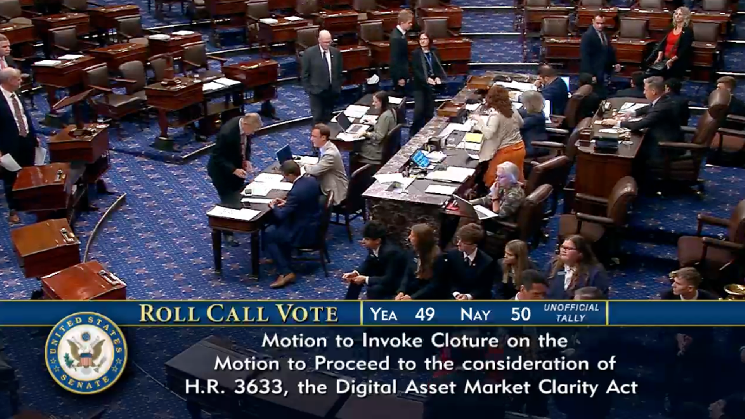
    Senate Democrats accused Republican leadership of abruptly terminating bipartisan negotiations on cryptocurrency legislation Tuesday, forcing a vote despite a potential deal to address ethics concerns surrounding presidential crypto holdings.

    Democrats Demand Ethics Guardrails for Presidential Crypto Holdings

    The legislation, which includes provisions targeting illicit finance, stalled over Democratic demands for stronger ethics requirements. Senator Mark Warner, a Democrat who contributed to the bill’s illicit-finance sections, argued that the legislation was incomplete without guardrails preventing conflicts of interest at the highest levels of government.

    “The president should not be able to use the power and influence of his office to benefit his own crypto holdings while his administration makes decisions that could directly affect their value,” said Senator Mark Warner, one of the Democrats who worked on the illicit-finance portions of the bill and said he really wanted to vote yes on it. “At a minimum, any serious crypto legislation must include meaningful ethics requirements that prevent the president and other senior government officials from profiting off the policies they oversee.”

    Negotiations Collapse Before Tuesday Vote

    According to Democratic lawmakers, negotiators from both parties were close to resolving outstanding issues, including the ethics provisions, as recently as Tuesday afternoon. However, Democrats said Republican leaders shut down talks and proceeded with the vote, which was not procedurally required to happen at that time.

    “Just as Democrats and Republicans were making progress to address ethics concerns, Republican leadership ended talks and forced a vote,” said Democrat Senator Ruben Gallego in a statement after the Tuesday vote. “They were never serious about bipartisan negotiations.”

    Senate Minority Leader Chuck Schumer echoed that account, telling reporters that a bipartisan agreement had been within reach.

    “As you may have heard, there was a bipartisan deal on the table as recently as this afternoon to resolve all outstanding items including ethics,” Schumer said. “Republican leadership walked into the room, broke up the bipartisan discussion and said, ‘No, we’re done’ and killed it.”

    The breakdown underscores the deep partisan divide over how to regulate digital assets while addressing growing concerns about potential conflicts of interest involving public officials and cryptocurrency policy.

  • CoinEx Exits After 9 Years as Crypto Trading Consolidates at Major Exchanges

    CoinEx Exits After 9 Years as Crypto Trading Consolidates at Major Exchanges

    CoinEx Shuts Down After Nine Years Citing Revenue Decline and Rising Compliance Costs

    Centralized crypto exchange CoinEx announced on September 15 that it will wind down operations in stages after nine years, citing shrinking revenue and escalating compliance costs that have made the business unviable. The shutdown marks another exit of a mid-tier platform from an increasingly concentrated market.

    Phased Shutdown Timeline

    CoinEx has laid out a structured closure plan:

    • Immediate: New user registrations have been halted.
    • Immediate: Futures markets moved to reduce-only mode.
    • Immediate: Margin trading, loans, Earn, and staking products are being phased out.
    • September 29: Spot trading ends.
    • December 22: Withdrawals close permanently.

    The exchange has urged customers to withdraw assets early to avoid congestion as the December deadline approaches, stating that customer assets remain fully backed.

    Founder Explains Decision

    Founder Haipo Yang stated that CoinEx failed to reach the top tier of industry exchanges, leaving the company burdened with security and compliance obligations that became increasingly difficult to justify against declining revenue.

    “Revenues can decline, responsibility does not,” Yang said in a statement. “Carrying unlimited risk for limited revenue is no longer a rational choice.”

    CoinEx also pointed to a prolonged contraction in crypto trading volume and liquidity, alongside rising regulatory requirements across major jurisdictions. In 2023, the exchange settled a case with New York Attorney General Letitia James, agreeing to withdraw from the U.S. market after being accused of operating without registering as a securities and commodities broker-dealer. The settlement required CoinEx to refund more than $1.1 million to 4,691 New York investors and pay over $600,000 in penalties.

    Wave of Mid-Tier Exchange Exits

    CoinEx is not alone. Its shutdown follows similar moves by other long-running platforms:

    • BitMEX, once a dominant derivatives venue, will terminate exchange services on September 23 after more than 11 years. Owner HDR Global Trading cited a strategic review of the company and broader crypto industry.
    • AscendEX ceased normal operations on July 1, citing the EU’s Markets in Crypto-Assets framework (MiCA) alongside financial and operational pressures. A planned recapitalization failed, and the company has been preparing for a possible formal insolvency process.

    While circumstances differ, these exits are removing established venues from a market where trading activity is recovering but concentrating among the largest operators.

    Trading Volume Rebounds but Concentration Deepens

    According to CoinMarketCap data tracking eleven major centralized exchanges, combined spot and derivatives volume reached $4.23 trillion in August, a 12.3% increase from July as crypto prices recovered.

    However, the rebound did little to loosen the grip of the top platforms. Binance, OKX, MEXC, Bybit, and Gate.io accounted for approximately 88% of all trading volume across the cohort. Binance alone captured a record 43.3% market share for a third consecutive month.

    August Volume Breakdown (Top 5 Exchanges)

    • Binance: ~$1.83 trillion
    • OKX: ~$681.3 billion
    • MEXC: ~$469.5 billion
    • Bybit: ~$410.3 billion
    • Gate.io: ~$314.7 billion

    CoinEx was not among the eleven exchanges in CoinMarketCap’s sample, so the figures do not directly measure its market share loss. They do, however, illustrate the environment Yang is leaving: trading revenue is recovering while a small group of platforms captures the overwhelming majority of activity.

    Structural Pressure on Smaller Exchanges

    This concentration creates a difficult equation for exchanges operating further down the rankings. Compliance staffing, licensing, transaction monitoring, custody systems, and cybersecurity remain substantial fixed obligations even when an exchange has a fraction of the volume available to Binance or OKX.

    Significant On-Chain Assets Remain

    Data from Nansen showed approximately $253.6 million across CoinEx-labeled wallets following the shutdown announcement:

    • Bitcoin (BTC): ~$134.4 million (over half the total)
    • USDT and ETH: Combined >$50 million
    • Deployed through Aave: ~$27.6 million

    The balances do not necessarily represent customer liabilities because labeled exchange wallets can include operational funds and other assets. Their size still shows how much capital remains within CoinEx’s on-chain footprint as users move funds elsewhere.

    Liquidity Redistribution Begins September 29

    Once CoinEx switches off spot markets on September 29, its remaining traders, market makers, and token projects will need alternative venues. This will push another pool of crypto liquidity into a market where five exchanges already control nearly 88% of the trading volume measured by CoinMarketCap.

  • HOOD Stock Slides 6% as Market Sell-Off Tests Robinhood Rally

    HOOD Stock Slides 6% as Market Sell-Off Tests Robinhood Rally

    Robinhood Markets (NASDAQ: HOOD) shares tumbled more than 6% on Tuesday as a broad-based selloff swept across U.S. equities, interrupting a recent rally that had lifted the stock above the $120 level.

    HOOD Underperforms Broader Market Decline

    The stock opened near $111.72 and slid to an intraday low of $105.86 before paring some losses. At the time of writing, HOOD traded around $107.02, down 6.39% on the session. The decline accelerated after an earlier 3.27% drop to $110.60.

    Source: TradingView

    Sector-Wide Weakness Weighs on Mega-Caps

    The selloff was not isolated to Robinhood. Market heatmaps showed losses across technology, financials, retail, and consumer sectors. Major names including Apple (AAPL), Alphabet (GOOGL), Microsoft (MSFT), and Amazon (AMZN) all declined in tandem.

    Source: TradingView

    However, HOOD’s 6.39% drop significantly exceeded the losses seen in most large-cap peers, suggesting that while the broader risk-off move played a significant role, stock-specific factors — likely profit-taking after the recent breach above $120 — amplified the decline.

    Technical Levels to Watch for HOOD Recovery

    From a technical perspective, the stock has surrendered much of its early September upward momentum. The Relative Strength Index (RSI) fell to 49.65, indicating balanced buying and selling pressure after a period of bullish momentum.

    Key levels for the near term:

    • Immediate resistance: The $110–$114 zone. A sustained move back above this area would signal returning buyer interest.
    • Critical support: The $105 level. A break below this floor could open the door to a test of $100.
    • Bullish scenario: If $105 holds, the stock retains room for a rebound once broader market sentiment stabilizes.

    Bottom Line

    HOOD stock fell 6.39% to $107.02 as losses spread across the U.S. market. The $105 area provides immediate support, while the $110–$114 range could cap any near-term recovery attempt.

  • Wall Street Bets on Fed Rate Hike: What It Means for Bitcoin, Bonds, and Trump

    Wall Street Bets on Fed Rate Hike: What It Means for Bitcoin, Bonds, and Trump

    Federal Reserve Poised for First Rate Hike Since 2023 Amid Inflation Pressure

    Wall Street is bracing for the Federal Reserve to raise interest rates on Wednesday, a move that would mark the first increase since 2023. The Federal Open Market Committee concludes its two-day meeting this week, and CME’s FedWatch tool places the probability of a 25-basis-point hike at 94.5%, up from under 50% just a month ago. Such a move would lift the federal funds rate to a range of 3.75%–4% from the current 3.50%–3.75%.

    Wall Street Consensus Shifts Rapidly Toward Tightening

    The shift from unlikely to near-universal expectation happened quickly. A Wall Street Journal survey published this week found nearly every major bank now anticipates a hike on Wednesday. Most institutions—including Barclays, Citigroup, JPMorgan, Morgan Stanley, and UBS—forecast 50 basis points of total tightening by year-end. Bank of America, Deutsche Bank, and RBC are more hawkish, calling for 75 basis points of tightening in 2026. Goldman Sachs sits at the dovish end of the hiking camp, penciling in only this week’s quarter-point increase. Jefferies and Oxford Economics remain outliers, forecasting a rate cut in December and in 2027, respectively.

    Higher rates increase borrowing costs, dampen spending, and pressure assets that thrive on cheap capital, such as equities and Bitcoin. They also boost yields on safe government bonds, drawing capital away from riskier investments. However, market anxiety stems less from the hike itself than from uncertainty about the trajectory of future moves. Markets are repricing now, ahead of the Fed’s communication, to account for that ambiguity.

    Inflation and Labor Data Drive the Decision

    The case for tightening rests on persistent inflation. Headline CPI ran at 3.4% annually in August, with core inflation at 2.5%—both comfortably above the Fed’s 2% target. Oil prices, elevated by the ongoing conflict with Iran, have added a layer of price pressure that neither tariffs nor rate cuts can easily offset.

    The Fed held rates steady at 3.50%–3.75% in July, but that decision passed by a narrow 9–3 vote, with three policymakers already advocating for a hike at the time. That internal split, combined with a stronger-than-expected August jobs report, tilted the committee toward tightening heading into this week’s meeting.

    Political Tension Mounts as Trump Pressures Fed Chair

    The impending hike places Fed Chair Kevin Warsh in a difficult position. President Donald Trump handpicked Warsh for the role in January and, at his swearing-in ceremony in May, urged him to be “totally independent” while making clear he expected lower rates. That expectation has not materialized—at least not in the way Trump likely meant by “totally independent.”

    In the past two weeks, Trump, Vice President JD Vance, and Treasury Secretary Scott Bessent have all publicly pushed for rate cuts. Trump went as far as threatening to halt trade with countries running surpluses with the U.S. if rates do not come down. Warsh has stated the president has had no influence on Fed decisions.

    The rate decision lands two months before the November midterms, where polls already show voters frustrated with high prices and borrowing costs. The tightening cycle arrives in part because of the tariff and Iran-conflict policies Trump himself has championed.

    Bond Markets Price In Higher-for-Longer Rates

    Bond markets have not waited for Wednesday’s announcement. The 10-year Treasury yield touched 5.04% this week, its highest level since July 2007, as traders priced in both the hike and a prolonged period of elevated rates. The two-year yield, more sensitive to Fed policy, hit its highest level since July 2024. Higher yields make Treasurys more attractive relative to risk assets and tend to strengthen the dollar—a headwind for assets like cryptocurrency that benefit from abundant liquidity.

    Bitcoin and Altcoins Enter Decision Week Under Pressure

    Crypto markets approach the Fed decision already weakened. On Tuesday, Bitcoin traded around $75,700, down roughly 3.2% on the day after the Clarity Act—crypto’s long-awaited market structure legislation—failed a Senate cloture vote. Bitcoin remains well below its September peak near $82,000.

    Technical analysts highlight $73,200 as a critical level: a daily close below it could open the door to $71,000 and even $66,900, negating the bullish structure that recently triggered a golden cross pattern.

    Bitcoin price data. Image: TradingView

    Not all analysts view a hike as purely bearish. Some argue a quarter-point move aimed primarily at anchoring long-term Treasury yields—rather than genuinely tightening financial conditions—could leave crypto’s medium-term outlook largely intact. In this view, the market’s reaction hinges on whether the decision and Warsh’s tone during the press conference surprise relative to what is already priced in.

    Higher-beta altcoins are expected to experience sharper percentage swings than Bitcoin in either direction, given thinner liquidity and heavier leverage.

    Key Events to Watch Wednesday

    The Fed’s policy statement and updated dot plot are due at 2:00 p.m. ET Wednesday, followed by Warsh’s press conference at 2:30 p.m. ET. Traders will scrutinize whether officials still pencil in just one more hike this year or something closer to the two additional moves Bank of America, Deutsche Bank, and RBC now project.

  • Bitcoin Stability Remains Unshaken Despite Regulatory

    Bitcoin Stability Remains Unshaken Despite Regulatory

    Bitcoin Demonstrates Resilience Amid SEC and CFTC Regulatory Developments

    Bitcoin continues to showcase remarkable stability despite ongoing regulatory uncertainty in the cryptocurrency sector. According to crypto commentator @BitGo, the Securities and Exchange Commission (SEC) and Commodity Futures Trading Commission (CFTC) are moving to establish a regulatory framework “due to a lack of progress on Clarity.” The commentary emphasizes that Bitcoin itself does not require this regulatory clarity, as it has “consistently processed blocks on schedule since its inception.” This operational consistency suggests Bitcoin’s fundamental protocol rules remain firmly established regardless of external regulatory shifts.

    Market Overview: Mixed Signals with Bitcoin Stability

    The broader cryptocurrency market currently presents mixed signals, with Bitcoin maintaining a steady presence against the evolving regulatory backdrop. As the SEC and CFTC prepare to intervene, market participants are closely monitoring potential impacts on trading dynamics. Bitcoin’s robust performance through various challenges—including congressional hearings and legislative attempts—reinforces its foundational strength. The uninterrupted processing of blocks further highlights the network’s resilience.

    Key Takeaways

    • Bitcoin processes blocks consistently, demonstrating operational reliability.
    • SEC and CFTC involvement could reshape regulatory oversight of digital assets.
    • Bitcoin’s foundational protocol rules are well-established and unaffected by potential regulatory changes.
    • Current volatility in the broader crypto market contrasts sharply with Bitcoin’s stability.
    • Traders are observing how regulatory actions may influence Bitcoin’s market dynamics.

    Trading Data and Market Sentiment

    Recent Bitcoin trading volume has been relatively thin, yet price stability remains a focal point for many investors. With the SEC and CFTC stepping in, traders might anticipate fluctuations as new regulations are introduced. Observers note that while Bitcoin’s immediate trading data may appear subdued, its long-term prospects remain strong due to its established track record since 2009.

    Bitcoin operates as a decentralized digital currency enabling peer-to-peer transactions without intermediaries. The SEC and CFTC maintain jurisdiction over cryptocurrencies to ensure compliance with securities laws and protect investors, playing a crucial role in shaping the evolving regulatory landscape.

    What to Watch: Regulatory Evolution and Market Impact

    Market participants should monitor how the SEC and CFTC’s regulatory framework evolves and its potential impacts on Bitcoin’s trading dynamics. If new regulations are introduced, they could influence market sentiment and trading volumes. However, Bitcoin’s historical performance suggests it can weather regulatory changes, making it a focal point for long-term investment strategies.

    The information provided is for educational purposes and should not be considered financial advice.

  • Bitpanda CEO to Step Down as Crypto Broker Delays Frankfurt IPO

    Bitpanda CEO to Step Down as Crypto Broker Delays Frankfurt IPO

    Bitpanda is preparing for another leadership transition less than a year after Lukas Enzersdorfer-Konrad assumed the role of sole CEO. The Austrian crypto broker announced the change as it delays a potential initial public offering (IPO) originally targeted for 2026.

    Co-Founder Christian Trummer Appointed Co-CEO

    Effective immediately, co-founder and Chief Scientist Christian Trummer will serve as Co-CEO alongside Enzersdorfer-Konrad. According to the company, Trummer will add executive focus to Bitpanda’s multi-asset offering and infrastructure business for financial institutions during the transition period. The board has opened a succession process that covers both internal and external candidates.

    Enzersdorfer-Konrad to Join Erste Group in 2026

    Enzersdorfer-Konrad intends to step down in the first quarter of 2027. He will join Austrian lender Erste Group early next year in a new group-wide asset-management and digital-investing role, Bloomberg reported.

    Short Tenure at the Helm

    Enzersdorfer-Konrad joined Bitpanda in 2018 and was promoted to Deputy CEO in July 2022. He became Co-CEO in August 2025 and assumed the sole CEO position in November when co-founder Eric Demuth moved to the board as Executive Chairman.

    IPO Plans on Hold Amid Market Conditions

    The leadership change follows a shift in Bitpanda’s listing timetable. Reports in January indicated the company was preparing for a Frankfurt IPO in the first half of 2026 at a potential valuation of €4 billion to €5 billion. Goldman Sachs, Citigroup, and Deutsche Bank were reportedly selected to arrange the offering, though no final decision had been made.

    The listing remains on the agenda but has been halted due to adverse market conditions. Enzersdorfer-Konrad told Bloomberg: “We are ready but we need to consider what the right market timing is and what’s best for the company.”

    Revenue Rises While EBITDA Falls Sharply

    Bitpanda reported €371 million in adjusted revenue for 2025, representing a 16% increase year-over-year. However, adjusted EBITDA fell 75% to €13 million as the company increased spending on product development, regulatory expansion, and international growth.

    Regulatory Fine for MiCAR Breaches

    In August, Austria’s Financial Market Authority (FMA) fined Bitpanda GmbH €70,000 for MiCAR disclosure and marketing breaches. The decision concerned a late crypto-asset white paper and marketing issued before the required disclosure. The regulator noted the violation did not involve custody, withdrawals, or restrictions on Bitpanda’s licence.

    Succession Timeline Unclear

    Bitpanda has not disclosed when it expects to name a permanent CEO, whether Trummer is being considered for the permanent role, or what position he would hold after Enzersdorfer-Konrad’s successor is appointed.

  • Maple Finance Clarifies ‘Trustless’ Concept in DeFi

    Maple Finance Clarifies ‘Trustless’ Concept in DeFi

    Maple Finance Clarifies ‘Trustless’ Concept in DeFi

    Maple Finance recently addressed a fundamental concept in the cryptocurrency ecosystem through a social media post. The decentralized finance platform explained that ‘trustless’ interactions do not imply a lack of trust in counterparties; rather, they eliminate the necessity of trust for transactions to occur.

    Why This Distinction Matters for DeFi

    This clarification arrives as the broader crypto market shows mixed signals across various assets. Maple’s explanation targets a critical knowledge gap: many users misunderstand ‘trustless’ as meaning ‘untrustworthy’ when it actually describes systems where verified onchain data enables direct interactions without intermediaries.

    By emphasizing this distinction, Maple positions itself as a thought leader in decentralized finance at a time when clarity is essential for fostering user confidence. The concept underpins DeFi functionality, allowing participants to engage directly based on cryptographic verification rather than institutional reputation.

    Current Market Context

    Specific trading volume and price data for Maple Finance remain unavailable, suggesting potentially low trading activity or ongoing platform adjustments. However, the educational focus on trustless transactions could drive increased engagement from users seeking secure, direct financial interactions as the DeFi landscape matures.

    Maple Finance’s Role in the DeFi Ecosystem

    Specializing in decentralized lending and borrowing solutions, Maple operates in an environment where trustless interactions are essential for facilitating transactions directly between users. This core offering becomes increasingly relevant as the industry navigates trust issues that have historically hindered mainstream adoption.

    Looking Ahead: Implications for User Adoption

    Traders and platform users should monitor how Maple’s interpretation of ‘trustless’ might reshape engagement patterns across DeFi. As the industry prioritizes transparency, understanding these foundational concepts could accelerate broader adoption of trustless systems. The potential impact on user experience is substantial—eliminating intermediary layers appeals strongly to users seeking autonomy and security in financial interactions.

    This article is for informational purposes only and does not constitute financial advice.

  • Kazakhstan Plans National Crypto Analytics Center to Track Digital Asset Flows

    Kazakhstan Plans National Crypto Analytics Center to Track Digital Asset Flows

    Kazakhstan to Launch National Cryptocurrency Analytics Center on SupTech Platform

    Kazakhstan has announced plans to establish a National Cryptocurrency Analytics Center designed to monitor digital asset transactions across fiat payments, crypto transfers, wallets, and customer data. The initiative was disclosed by National Bank of Kazakhstan Chairman Timur Suleimenov during a government meeting on September 15, according to Qazinform News Agency.

    Center Built on Central Bank’s SupTech Supervisory Platform

    The new analytics center will be constructed on the National Bank’s existing SupTech supervisory platform. This system will analyze both fiat and cryptocurrency components of transactions, alongside client information, wallet details, and individual transfer data. Suleimenov stated that banks, law enforcement agencies, and licensed digital asset providers will gain access to verification tools offered through the center.

    The National Bank has been developing its SupTech platform as a centralized system for supervising digital asset markets and payment organizations. According to an August update on the central bank’s 2025–2029 digitalization and data management strategy, the platform covers the full supervisory cycle—from maintaining registries and profiles of regulated entities to analyzing reports, conducting blockchain analytics, and automating supervisory actions. The National Bank aims to migrate the complete supervisory cycle to the system by the second half of 2026.

    Integration with Anti-Fraud Center Enhances Monitoring

    The National Cryptocurrency Analytics Center will be integrated with the National Bank’s Anti-Fraud Center, placing digital asset monitoring alongside an existing system used by financial institutions and government bodies to identify suspicious financial activity. Launched in August 2024, the Anti-Fraud Center operates with law enforcement agencies and financial market participants to detect and block fraudulent transactions in real time.

    Participation has grown rapidly. By July 2025, more than 200 organizations—including banks, microfinance companies, telecom operators, and government agencies—had connected to the platform. As of January 1, 2026, the system had registered 80,871 incidents involving transactions with signs of fraud and roughly 19,810 incidents linked to drug trafficking, illegal gambling, and financial pyramid schemes. Authorities had blocked 2.8 billion tenge through the system, while more than 500 million tenge had been returned to fraud victims.

    Recent development work has expanded links between the Anti-Fraud Center, the Prosecutor General’s Office, the Interior Ministry, and telecom operators. The National Bank is also developing artificial intelligence tools for behavioral analysis and early detection of suspicious customer activity, including a pilot project on session-based analysis to examine user behavior inside financial applications.

    Regulated Crypto Services Expand Alongside Oversight

    The monitoring project follows a series of measures bringing more cryptocurrency activity under regulated financial infrastructure. In November 2025, Bybit Kazakhstan launched the country’s first regulated peer-to-peer (P2P) platform under an Astana Financial Services Authority (AFSA) license. The platform requires users to complete identity checks, with fiat payments routed through corporate bank accounts of licensed financial institutions rather than personal accounts.

    Kazakhstan has also experimented with stablecoins inside regulated financial services. In September 2025, AFSA began a pilot allowing eligible firms to pay regulatory fees using U.S. dollar-pegged stablecoins through approved agents. Simultaneously, the National Bank is pursuing state investment in digital assets. Kazakhstan plans to use cryptocurrencies confiscated in criminal cases as one source for a national crypto reserve. The National Investment Corporation, the central bank’s investment arm, earmarked $350 million from foreign currency and gold reserves for crypto-related investments, targeting exposure through hedge funds rather than direct purchases.

    Mining and Payment Pilots Support State Reserve

    Kazakhstan continues developing its reserve through the domestic mining industry. Under rules approved this year, licensed Bitcoin miners can receive additional electricity capacity when they contribute a portion of their mined cryptocurrency to the state reserve, linking energy access to participation in the government-backed program. The country remains one of the world’s largest Bitcoin mining jurisdictions, ranked fifth globally by the Cambridge Digital Mining Industry Report in April 2025.

    Regulated cryptocurrency payments are also being tested. In July, Alatau City Bank partnered with Binance Kazakhstan to introduce Crypto Pay, enabling customers to make purchases using cryptocurrency via QR codes and point-of-sale terminals connected to the bank’s acquiring network.

    Enforcement Continues Alongside Innovation

    Kazakhstan’s enforcement policy continues in parallel with these programs. Authorities previously blocked more than 1,100 unauthorized cryptocurrency exchange platforms in 2025 and liquidated 36 illegal platforms with a combined turnover of 60 billion tenge in 2024, seizing 4.8 million USDT. Officials noted that platforms lacking proper anti-money laundering and Know Your Customer controls were being used for fraud, drug trafficking, and other illicit activities.

    The National Bank’s Anti-Fraud Center continues expanding its capabilities, incorporating predictive analytics, session-based monitoring, and integration with government and telecom databases. The new National Cryptocurrency Analytics Center will extend transaction analysis specifically to fiat and cryptocurrency flows, client information, and digital asset wallets, providing a unified view for regulators and market participants.

  • Crypto Market Plunges as Fed Rate Hike Odds Surpass 92%

    Crypto Market Plunges as Fed Rate Hike Odds Surpass 92%

    The cryptocurrency market shed more than 2% of its total value on Sept. 15, dragging Bitcoin below the $76,000 threshold as traders braced for a widely expected Federal Reserve rate hike and a pivotal Senate procedural vote on the CLARITY Act.

    Broad-based sell-off hits digital assets

    Data showed the aggregate crypto market capitalization falling to approximately $2.6 trillion as investors reduced risk exposure ahead of two major U.S. catalysts. Bitcoin declined over 3% after failing to sustain earlier gains, and losses extended across major altcoins. U.S.-listed companies with direct crypto exposure — including Strategy, Coinbase, Circle, and Robinhood — also came under selling pressure.

    Fed rate hike odds surge above 92%

    The decline accelerated as markets priced in the Federal Open Market Committee meeting scheduled for Sept. 15–16. Federal funds futures implied a probability above 92% for a 25-basis-point increase, effectively making a hike the baseline expectation rather than a tail risk.

    A quarter-point move would lift the Fed’s target range from 3.50%–3.75% to 3.75%–4.00%. The decision is due Sept. 16, followed by remarks from Fed Chair Kevin Warsh that could signal whether officials view the increase as a one-off response to inflation or the start of a prolonged tightening cycle.

    Earlier on Sept. 15, crypto.news reported the implied probability of a quarter-point hike had climbed to 86.5% from 69.4% the previous Friday, surpassing 92% as the meeting approached — a rapid recalibration of rate expectations.

    Inflation concerns drive tighter policy bets

    Expectations for restrictive policy have grown alongside renewed anxiety over U.S. inflation. Goldman Sachs and JPMorgan both forecast a 25-basis-point increase at the September meeting, according to reports cited in earlier coverage. Morgan Stanley anticipates a quarter-point hike in September and another in December, linking its outlook to persistent inflation, higher oil prices, and robust demand tied to artificial intelligence investment, Reuters reported.

    Higher borrowing costs typically dampen appetite for non-yielding assets. After a rate increase, investors can earn more from Treasury securities, raising the hurdle for holding volatile assets such as Bitcoin. Elevated policy rates also increase the cost of leveraged positions, potentially prompting crypto traders using borrowed funds to deleverage. A stronger U.S. dollar can add further pressure on dollar-denominated assets.

    The market’s reaction will hinge partly on the accompanying guidance. While a quarter-point hike is largely priced in, any signal of additional increases could force a reassessment of the liquidity and borrowing-cost trajectory.

    Notably, Bitcoin now enters a tightening cycle with a significantly larger institutional investor base than during the Fed’s previous rate-hike cycle. Spot exchange-traded funds, corporate Bitcoin holdings, and other regulated products have tethered crypto more closely to traditional portfolio decisions.

    Trump pledges to respect Fed independence

    National Economic Council Director Kevin Hassett said President Donald Trump would support Warsh’s right to make an independent policy decision, even though the White House does not favor another rate increase.

    “President Trump 100% respects the independence of Kevin Warsh,” Hassett said, according to comments reported by Yahoo Finance.

    Hassett added that the administration would back Warsh regardless of the outcome. His remarks clarified Trump’s position on the Fed’s authority but did not signal White House approval of higher rates. Both Trump and Hassett have opposed raising borrowing costs. During a Fox News interview, Hassett said he would be cautious about increasing rates near the U.S. midterm elections because an independent central bank should avoid becoming part of the political cycle.

    The distinction matters for U.S. investors because the Fed sets monetary policy without White House direction. Political commentary can influence expectations, but the FOMC votes based on its assessment of inflation, employment, and financial conditions. Recent inflation readings have kept pressure on policymakers, with Wall Street firms warning that the personal consumption expenditures price index — the Fed’s preferred gauge — could run hotter than expected, giving officials more reason to keep rates elevated after September.

    CLARITY Act procedural vote adds legislative uncertainty

    Alongside the Fed decision, the Senate is preparing a cloture vote on whether to advance the Digital Asset Market Clarity Act. The procedural motion requires 60 senators to support opening debate on the measure.

    A successful cloture vote would not enact the bill. It would allow the Senate to begin considering the legislation, followed by an amendment process, another procedural vote, and potential negotiations with the House. Republicans hold 53 Senate seats, making the bill dependent on support from several Democrats. Negotiations grew more uncertain after Democrats presented a counteroffer that met Republican resistance shortly before the scheduled vote.

    A recent analysis noted the revised text had expanded from roughly 616 pages to 635 pages. The proposal includes language on the division of authority between the Securities and Exchange Commission and the Commodity Futures Trading Commission, along with provisions affecting the treatment of individual digital assets.

    For American crypto holders, the bill could determine which federal regulator oversees different market segments and how tokens are classified under U.S. law. Failure to advance the measure would leave the current regulatory framework in place while lawmakers decide whether to revise or reintroduce the proposal.

    Crypto-linked stocks fell ahead of the vote as investors trimmed exposure to both legislative uncertainty and the prospect of higher U.S. interest rates.

    Market entered week on defensive footing

    A weekly market recap published Sept. 12 placed Bitcoin near $80,000 and reported $463 million in weekly outflows from U.S. spot Bitcoin ETFs. Continued withdrawals from those funds would indicate that regulated investment products remain a source of selling pressure during this policy-heavy week.